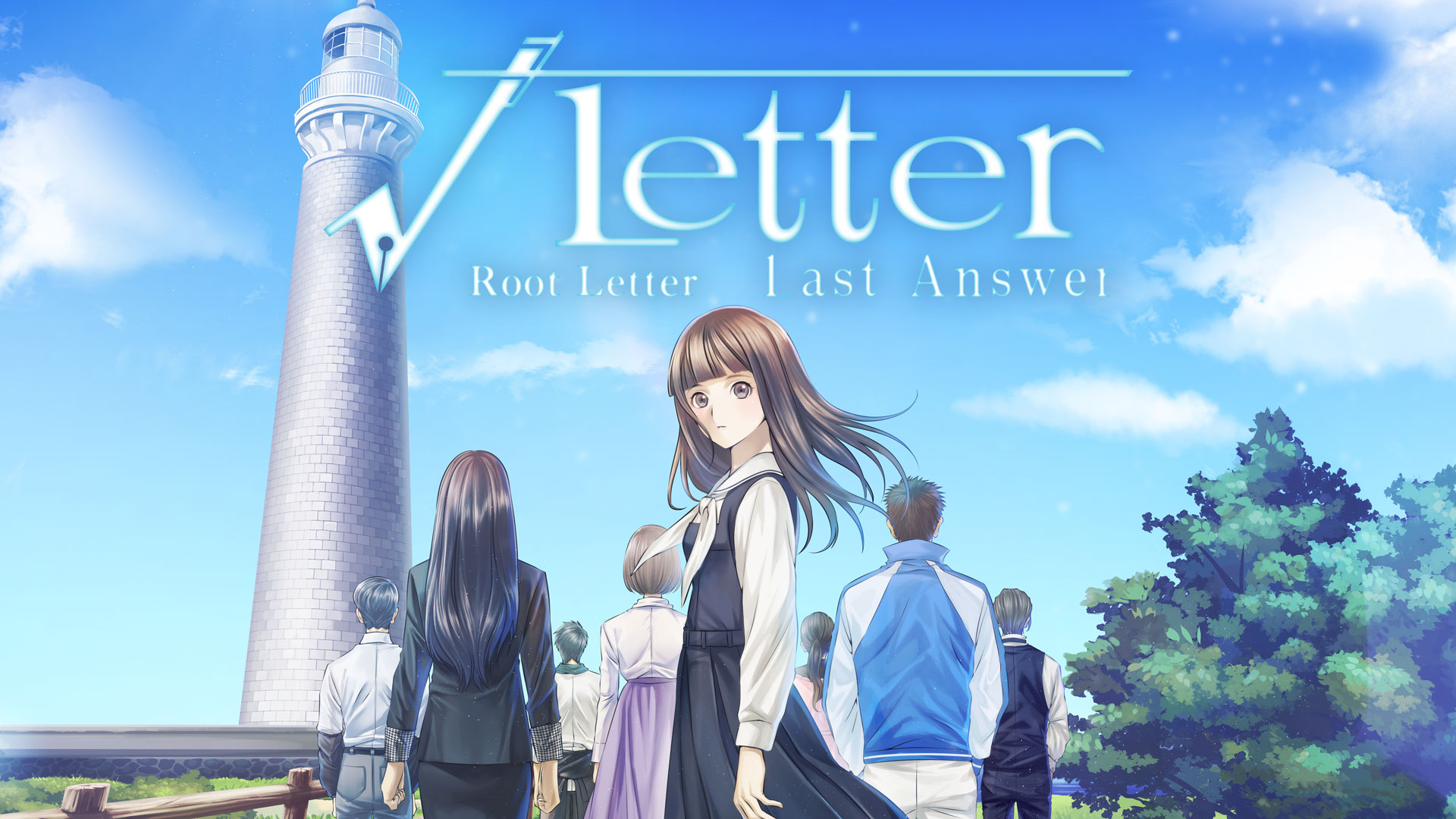
Root Letter

Root Letter is a mystery-themed visual novel that should take most people about six or seven hours to play. I’ve read a number of positive reviews of the game, so I went ahead and downloaded a copy onto my Nintendo Switch when it went on sale at the end of the year.

You play as Takayuki, a thirty-something white collar worker who’s left his job at a design firm and has a bit of free time before he’s scheduled to start a new job. When he goes home to visit his parents, he finds a set of letters from Aya Fumino, his pen pal from his senior year of high school. He’d exchanged nine letters with her, but he discovers a tenth at the bottom of the stack that he doesn’t remember reading. In this letter, Aya tells Takayuki that she can no longer continue their correspondence. She apologizes, saying that she has killed someone.

Takayuki decides to try to find her in Matsue, a city on the Sea of Japan about halfway between Osaka and Hiroshima. When he arrives at the address on the letters, however, he finds an empty lot. A passing neighbor tells him that the house burned down fifteen years ago, so he checks the records at the city library. He learns that, while a girl named Aya Fumino used to live in that house, she died twenty-five years ago, long before she could have written to him.

Why did the house burn down? Who was pretending to be Aya Fumino? And who did she kill?

With a week of free time and an intriguing mystery on his hands, Takayuki sets about tracking down the seven friends his pen pal mentioned in her letters. None of them want to talk to him, however, and everyone claims not to know anyone named Aya Fumino, even when presented with her photo. Your goal, as Takayuki, is to find and interrogate these seven adults in an attempt to figure out who “Aya Fumino” was and what happened during her senior year of high school.

There are five possible endings to Root Letter, but its gameplay is almost completely linear. You use a drop-down menu to move between various locations in Matsue as you follow various hints and clues, and the “Think” command on your menu will (almost) always tell you where the game wants you to go next. The interrogation scenes feature a few Ace Attorney style elements that involve presenting the right piece of evidence at the right moment, but this is also extremely linear. There’s no reward for exploration or creativity; but, thankfully, there’s no punishment for failure. Root Letter is much more of an interactive novel than a game, and it’s not interested in derailing your progress through the story.

The ending you see is determined by your choice of how Takayuki responded to the letter from Aya Fumino that’s presented at the beginning of each of the game’s chapters. You’re given two sets of choices per letter, and your options tend to fall into discrete categories at don’t make much sense unless you already know which ending you’re trying to unlock. Like the shitty casual gamer I am, I chose a “normal” (to me) range of mixed responses and got the worst ending, in which the whole mess about Aya Fumino was a government conspiracy to cover up an alien invasion.

My advice would be to avoid my rookie mistake by consulting a guide to the endings before you begin. Don’t worry about spoiling yourself, because Root Letter’s story is so convoluted that none of the endings will make sense if you haven’t played the game.

It’s my understanding that the “default” ending, meaning the ending you’ll see if you always choose the first response option, is a bittersweet story about missed connections, growing up, and letting the past go as you move on with your life. Another ending, the “Cursed Letter” ending, is about the power of teenage imagination to create both urban legends and personal identity; while another, the “Princess of Himegamori Forest” ending, is a horror-themed exploration of local Shintō folklore.

One of the main benefits of playing the Last Answer edition of the game (as opposed to the original 2016 release) is that it contains an optional “drama mode.” The drama version of the game uses photos of real actors and locations; and, based on what I’ve seen, the photography is quite polished and surprisingly faithful. Having played the game through once with anime illustrations, I’m looking forward to playing it again in drama mode at some point in the future.

While Root Letter pushes the player forward with the strong forward momentum of its mystery story, it also invites you to take time to appreciate the sights of Matsue. As Takayuki, you’ll get to stay at a traditional hot springs inn, stroll through the forested grounds of Matsushiro Castle, visit art museums, and eat at trendy cafés. Root Letter leans especially hard into its celebration of the local cuisine, and I’m excited about the prospect of being able to enjoy photographic depictions of Matsue’s food culture.

Unfortunately, some elements of the game haven’t aged well, probably because they were never attractive to begin with. To give an example, one character admits to a violent attempted rape, and the other characters just sort of shake their heads and move on. If this assault only comes up briefly and is never mentioned again, why include it in the story at all? Likewise, “Aya Fumino’s” fake suicide is teased fairly early in the game but isn’t given any dramatic weight. Rather, it’s played purely for shock value, with the implicit understanding that this sort of thing is just what moody high school girls do.

Some of the most uncomfortable parts of the game involve a character nicknamed “Fatty.” This character’s entire arc is about how he’s overweight, and about how overweight people are weak and gross and unlovable. In order to psychologically break this character during his investigation, Takayuki taunts him with chocolate-covered potato chips, which he can’t resist because, at the deepest core of his being, he is and will always be a big fat fatty. The whole thing is super gross, especially in combination with the casual gay panic thrown into this chapter. I feel that this is one of the many instances in which a more judicious localization could have made some slight changes, not to erase this type of bigotry and meanness, but to mitigate it somewhat.

The player’s enjoyment of Root Letter is largely based on its story, so it’s a shame that the translation is so lackluster. It’s perfectly serviceable, and it’s far from unreadable, but it has numerous quality control issues that would be tedious to list. My main complaint is that the translation received very little localization, which is frustrating in terms of both story and gameplay.

Regarding gameplay, the lack of a localization has rendered it somewhat difficult to talk to or interrogate people, as there are numerous instances in which none of the dialog choices make the slightest bit of sense. The game isn’t that complicated, so you can brute-force your way through the poorly translated bits by trial and error, but it goes without saying that you shouldn’t have to.

It’s tricky to discuss the situations in which localization would have been preferable to a direct translation without resorting to an infodump, but I can give one example that’s fairly self-explanatory. One of the friends Aya Fumino mentions in her letters is nicknamed “Bitch.” In Japanese, the loanword bicchi doesn’t necessarily mean “mean girl,” as it does in English. Rather, it’s the 2015 version of gyaru or kogal, and it refers to a teenage girl who dyes her hair and uses tanning lotion and dresses in trendy clothes and pays a lot of attention to the entertainment industry. The English equivalent of this term changes from decade to decade; but, given that Takayuki probably went to high school around 1998-2001 or thereabouts, “valley girl” or “Barbie girl” might work. The character nicknamed “Bitch” is actually quite friendly, so listening to the other characters talk about how much they used to admire their friend “Bitch” is bizarre.

Root Letter has some definite rough patches, but I want to emphasize that I enjoyed this game. I spent a week playing it, reading for about an hour every day, and I had a lot of fun with its ridiculous characters, charmingly convoluted plot, and unapologetic embrace of virtual tourism. I’m happy that I finally got a chance to play Root Letter, but I’m also happy that I was able to get the game on sale, because I’m not sure it’s worth more than $20.

The Liar Princess and the Blind Prince

The Liar Princess and the Blind Prince is a 2D puzzle platform game about two small children making their way through a creepy murder forest. Unlike similar games (such as Limbo, which jumps immediately to mind), The Liar Princess might best be described as an interactive storybook. The game’s emphasis is not so much on puzzles or platforming, but rather on using the conventions of gaming to help deepen the player’s connection with the characters as they travel through the story together.

This game was created by Nippon Ichi Software, which has developed a reputation for cute horror games with titles like Yomawari: Night Alone and A Rose in the Twilight. Still, I think The Liar Princess isn’t so much horror as it is dark fantasy, or fantasy with a few creepy elements and a touch of dark humor. There’s nothing explicitly violent or disturbing in the story or imagery, and the game itself is quite easy. I probably wouldn’t give this game to a young child, but playing it was a relaxing experience for me as an adult horror fan.

The plot and the gameplay go hand-in-hand, much like the eponymous princess and prince. The story has strong fairy tale elements, with a wolf asking a witch to turn her into a human so that she can save a prince. The prince’s misfortune is the wolf’s own doing, as she accidentally blinded him with her claws. The player’s goal is therefore to help the “princess” escort the prince to the forest witch to be cured before he discovers that she’s the wolf who blinded him. In her beast form, the wolf is powerful and impervious to attack, but she can only hold hands with the prince to guide him forward when she’s in her human form. The wolf can change forms at will, so the main challenge lies in positioning the prince in exactly the right way so that he can walk forward while remaining safe from harm.

The Liar Princess has five levels with four stages each, with a short prologue and a longer “final boss” level. (I’m using scare quotes because this final level is more of an obstacle course than an actual boss fight.) It’s relatively easy to figure out most of the puzzles through trial and error, and the death of either character usually only results in a small setback that generally involves the welcome reset of a specific puzzle. The game also gives the player the option to skip a stage after ten minutes if there’s a puzzle that’s just not clicking. Most of the actual fun of the gameplay involves searching each stage and taking calculated risks to find secret collectibles, which unlock pages of concept art and segments of the forest witch’s backstory. More than anything, The Liar Princess reminds me of the Metroidvania-lite feel of Super Princess Peach in that there’s no real sense of danger and failure is never punished.

The sort of people who complain about games being “too easy,” including no small number of professional reviewers, didn’t hesitate to make that complaint about The Liar Princess when it came out in English translation back in early 2019. The undemanding level of difficulty isn’t a deal-breaker for me personally, but I have to admit that the game isn’t without annoyances. There are a few number puzzles in the third level that are bizarrely tricky, for example, and sometimes it can be hard to tell whether you’re taking the incorrect approach to a puzzle or whether there’s been a glitch in the hitbox for a certain switch that isn’t triggering for some reason.

That being said, the main appeal of this game is visual, with its expressive characters and stylish backgrounds. (In fact, I might even go so far to say that The Liar Princess is perfect for people who love the visual design of Hollow Knight but don’t have the patience to deal with the gameplay.) The character designs are especially interesting and creative, from the weakest enemy in the first stage to the flower-eating “mole” creatures at the end of the game. Although the basic shape outlines are cute and simple, there’s always a fun twist somewhere – when the first mole creature opens its mouth, for instance, you are in for a treat. The game plays with its visual style to make all manner of (relatively gentle) jokes about how the prince doesn’t know that the characters he encounters are all people-eating monsters, and these jokes collectively raise questions about “blindness” and “monstrosity” that are subtle but engaging (and not in the least bit ableist).

My favorite part of the game is the wolf herself, who makes horrible decisions but is basically decent. Despite the fact that she is clearly lying in a way that hurts other people and herself, you can’t help but sympathize with her as her good intentions lead her increasingly astray. The development of the friendship between her and the prince is extremely cute, as is the way both characters smile when they’re holding hands. I’m also a fan of the unapologetically evil witch, and it’s worth seeking out the game’s collectibles in order to learn more about her story.

The Liar Princess and the Blind Prince isn’t a perfect game, and many people will probably think it’s too easy and too short. Playing it from start to finish took me about five hours, including the time I spent going back to earlier stages in order to pick up collectibles I missed and rewatch the cutscenes I unlocked. Despite a few frustrations with the gameplay mechanics, I loved The Liar Princess. I’m somewhat surprised that this game is considered to be a niche title, because it’s refreshingly accessible and a lot of fun. Although the most obvious comparison would seem to be something like Limbo, The Liar Princess actually feels much more like Journey – it’s a visually immersive and relatively chill game about loneliness and companionship that’s easy to dip into for fifteen minutes at a time when you want to relax and unwind.

A Short Hike

A Short Hike was released for Nintendo Switch about three weeks ago, and my only regret is that I waited so long to download it.

You play as an anthropomorphic bird named Claire who’s spending the weekend on holiday visiting her Aunt May in Hawk Peak Provincial Park, and your goal is to climb to the top of the mountain so that you can get reception on your phone. Since you’re a bird, you can jump down and glide whenever and wherever you feel the need. You can also fly for short periods of time, and you can collect Golden Feather upgrades to extend your flying time. There’s no combat, no danger, and no puzzles to solve. Although you’re free to go anywhere you like, the main climbing trail is clearly marked. If you get lost, you can just jump down and glide to an earlier point on the trail. It’s all very relaxing, and the soundtrack is adaptive, meaning that the music changes depending on the altitude and weather.

Because the game is so overtly referential, I don’t think it’s lazy to call it a cross between Animal Crossing and Night in the Woods. Some of the (completely optional) mechanics, such as fishing and digging up X marks on the ground, are pure Animal Crossing, as are the character designs. The dialogue never gets grim or dark, but it’s a little weirder and less performatively wholesome than Animal Crossing. The writing is unobtrusive but clever, and Claire has a lot in common with Mae from Night in the Woods.

Meanwhile, the exploration elements are very Legend of Zelda, and the game looks a lot like Phantom Hourglass and Spirit Tracks, from the cell shading to the head-to-body proportions to the 3D modeling of the landscape. There’s an option to increase the frame rate and make the graphics less pixelated, but the Nintendo DS style visual atmosphere is lovely even if you don’t harbor any particular nostalgia for that era of gaming.

If you go straight up and down the mountain, the game takes maybe half an hour to play, but you can easily spend another half hour going off on side trails and having conversations with the various people you meet during your climb. I imagine that you could spend even more time with the game if you wanted to find every Golden Feather and record every species of fish in your journal, but the game’s menu screen isn’t set up in a way that makes you feel compelled to do so.

I’ve read a few reviews that criticized A Short Hike for being too, well, short, but I don’t think that’s a problem. I am no stranger to the task of collecting all 900 forest sprite poos or evolving all 900+ species of battle monsters or getting all of my fantasy fighters to Level 99, but I also love being surprised and delighted by short, self-contained, and immensely satisfying small-studio games.

I’m not sure how I feel about Nintendo asking $20 for this game, which is a bit expensive for its category, but honestly that seems like a reasonable price to pay for the experience of a solid hour of uninterrupted joy.

Hollow Knight

I’m a big fan of the aesthetic of Hollow Knight, and I got the collector’s edition from Fangamer when the game came out on the Nintendo Switch. I absolutely loved the first hour or two of gameplay. The world is gorgeous, the gameplay is a lot of fun, and the writing is lovely.

When I got to the first boss, however, I died. And then I died again, and then I died again. And then I died again. It’s not that this boss is particularly difficult; it’s just that it has a ton of health while you have relatively little. The fight is therefore an endurance test in which you can’t make any mistakes. This is particularly unpleasant because, once the boss starts breaking out new attacks and movement patterns, you’ve already been in the fight for a relatively long time and have probably already lost some health.

When I took to the internet to figure out what was going on, I found a lot of posts saying that Hollow Knight is a brutally punishing game, and that sometimes people can take hours to make it through a boss fight.

I then tried to search for “Hollow Knight easy mode,” and that was a mistake. Oh my, the “real gamer” discourse these children engage in.

I remember really loving Super Metroid as a kid. It was much too difficult for me and my small brain and tiny hands, so I used a Game Genie as something like a set of training wheels until I got good enough to play it on my own. I ended up spending more than a hundred hours playing the game instead of just one or two, and this hurt no one. I had a game, and I played it, and it was fun. I liked exploring the world and discovering its secrets while listening to the soundtrack; and, if this isn’t “how the developers intended the game to be played,” it didn’t matter, because my parents paid money for the game and I owned it.

This is more or less the same thing I’m interested in when it comes to Hollow Knight – exploring the world and discovering its secrets while listening to the soundtrack. Because of one boss fight at the beginning of the game, however, there’s no way I can do this. I now own a very pretty $70 game that I could only play for a little more than two hours, and it’s frustrating.

I wonder, would it really hurt the developers to include an easy mode?