Firebird

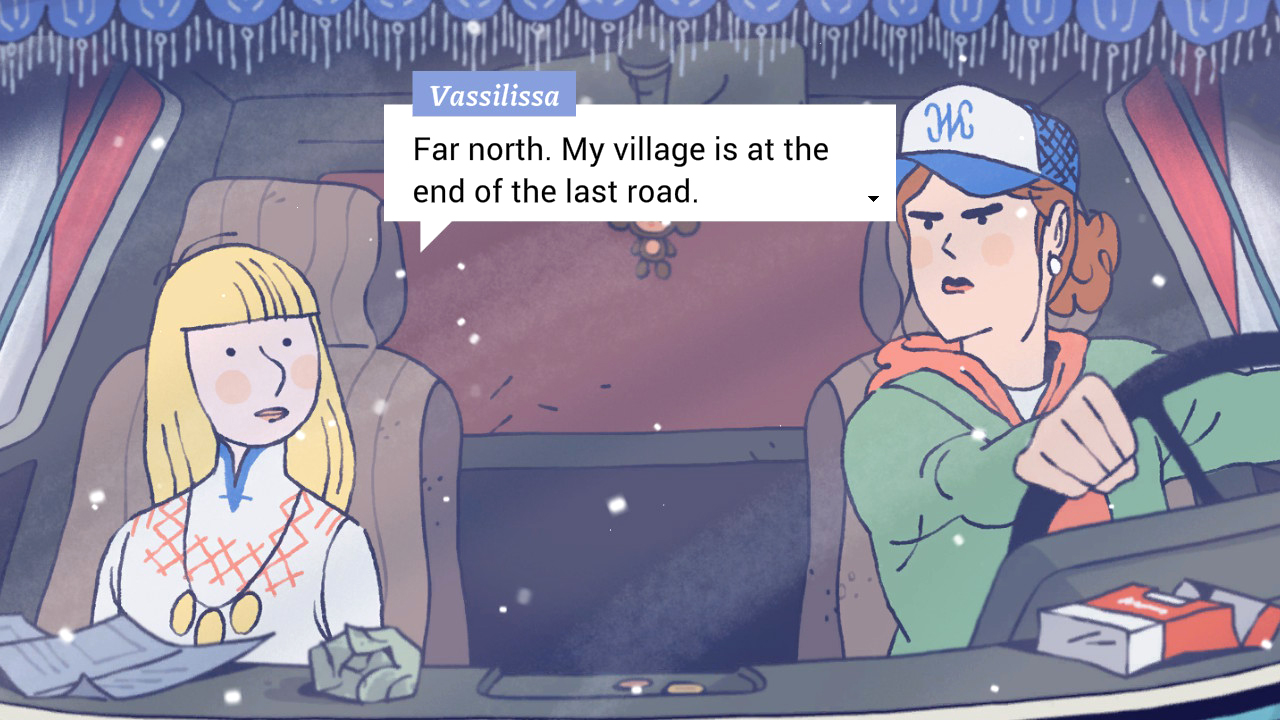
Firebird is a choice-based visual novel that takes about an hour and a half to play. The story is set in the northern borderlands of contemporary Russia, where a Hungarian migrant named Mariska makes her living as a freight trucker.

Since she’s in the country illegally, Mariska had to take out the loan for her truck, the Firebird, from a local mob boss. When she’s caught after trying to flee the boss’s territory without paying the interest on her loan, Mariska crosses paths with a strange girl in traditional clothing named Vassilissa, who promises great riches if Mariska will deliver food to her village in the far north.   

Your job as the player is to navigate between points on the map as Mariska and Vassilissa head steadily northward. There’s no backtracking, so you’ll have to choose between multiple routes while ensuring that the Firebird doesn’t run out of gas. The game is entirely text-based, and the elements of resource management are fairly chill.

More than anything, the gameplay is about roleplaying as you explore the dialogue options. It’s possible to die, but doing so will simply restart the game at a crucial choice. As the player, you’re mostly just along for the ride. And what an incredible ride it is.

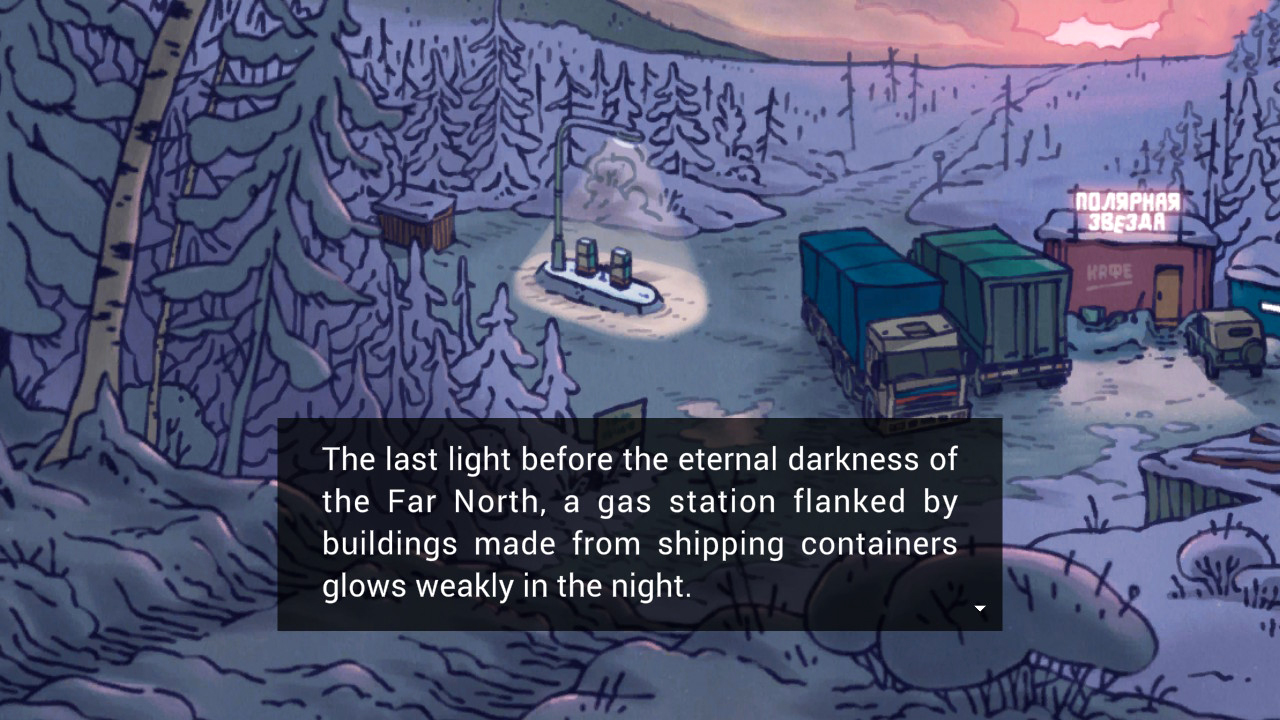
At each point on the map along her route, Mariska is able to leave her truck and search for gasoline or money (which can occasionally be used to buy gas). The road is littered with the ruins of old villages and Soviet outposts, but a few of the waystations are still populated. The humans Mariska and Vassilissa meet are friendly, but the wolves and bears are another story entirely. To make matters worse, the mob boss has sent his henchman Ivan to pursue Mariska in his truck, the Gray Wolf.  

As you might have guessed from the character names, which are drawn from Slavic folklore, there are supernatural forces at play. Over the course of her journey, Mariska encounters various legendary characters, from the crafty witch Baba Yaga to the warrior princess Maria Morevna. The gradual shift from gritty realism into the realm of a fairy tale is a lot of fun, especially when the seemingly absurd advice offered by characters along the way begins to make perfect sense. Thankfully, Mariska is nothing if not pragmatic, and her no-nonsense attitude is exactly what she needs to get the job done.   

Firebird’s developers, Ludogram, are based in France, but they’ve devoted love and care to bringing the Russian setting to life. The luminous ligne claire artwork of Quentin Vijoux invites the player onto the northern tundra while conveying a strong sense of lingering twilight and freezing cold. Despite Firebird’s celebration of Slavic folklore, the game’s narrative makes no attempt to hide its criticism of the Russian state, especially the collusion between government and organized crime. There’s also a haunting scene with Soviet ghosts that I found genuinely chilling.

Although it’s possible to see an entirely different variation of the game’s story during a second playthrough by having Mariska drive through a different set of points on the map, the destination is always the same. No matter what path you choose, Firebird connects to universal themes as it acknowledges the cycles of nature – between winter and summer, and hardship and plenty, and faith and hard work. The bad times won’t last forever, Firebird suggests, and Mariska will keep on trucking.

Castaway

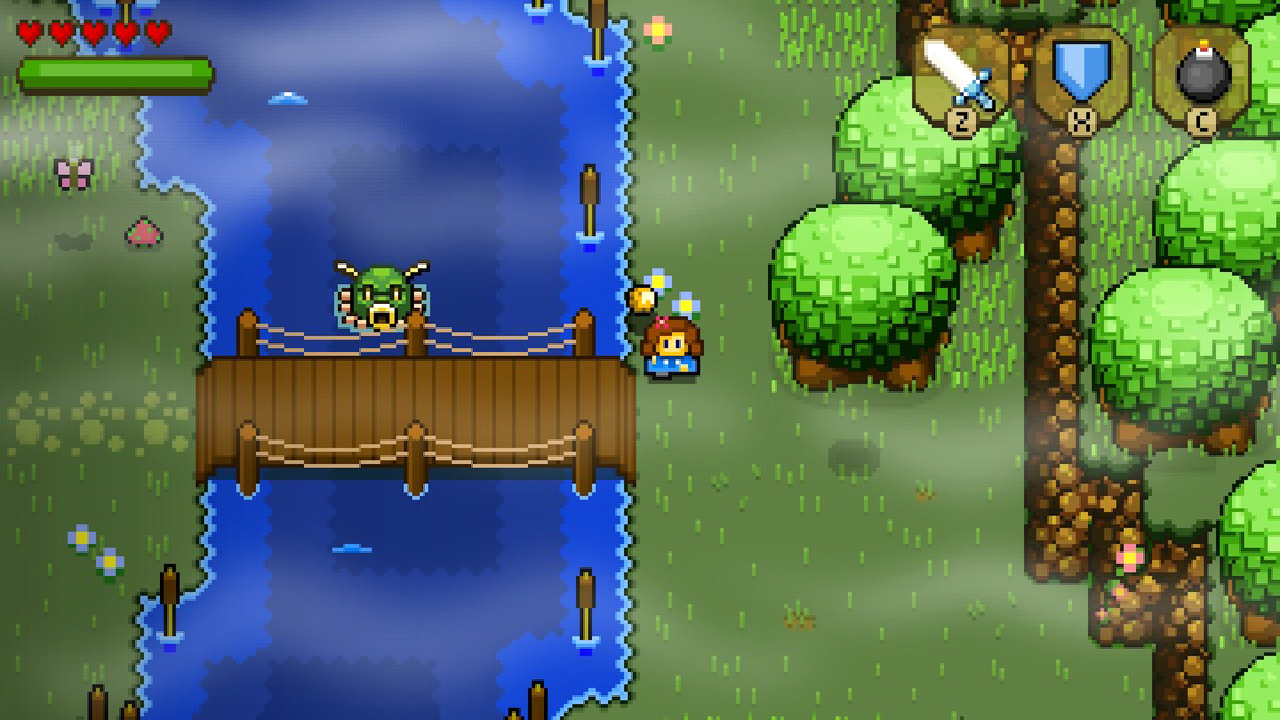
Castaway is a tribute to Link’s Awakening whose story campaign takes about 35 minutes to play. This campaign functions as a tutorial to the game’s Death Tower, in which you have one life to climb fifty simple and static floors with very few health drops and no permanent upgrades. The Death Tower is not for me, but the story campaign was a pocket of pure and unadulterated joy.

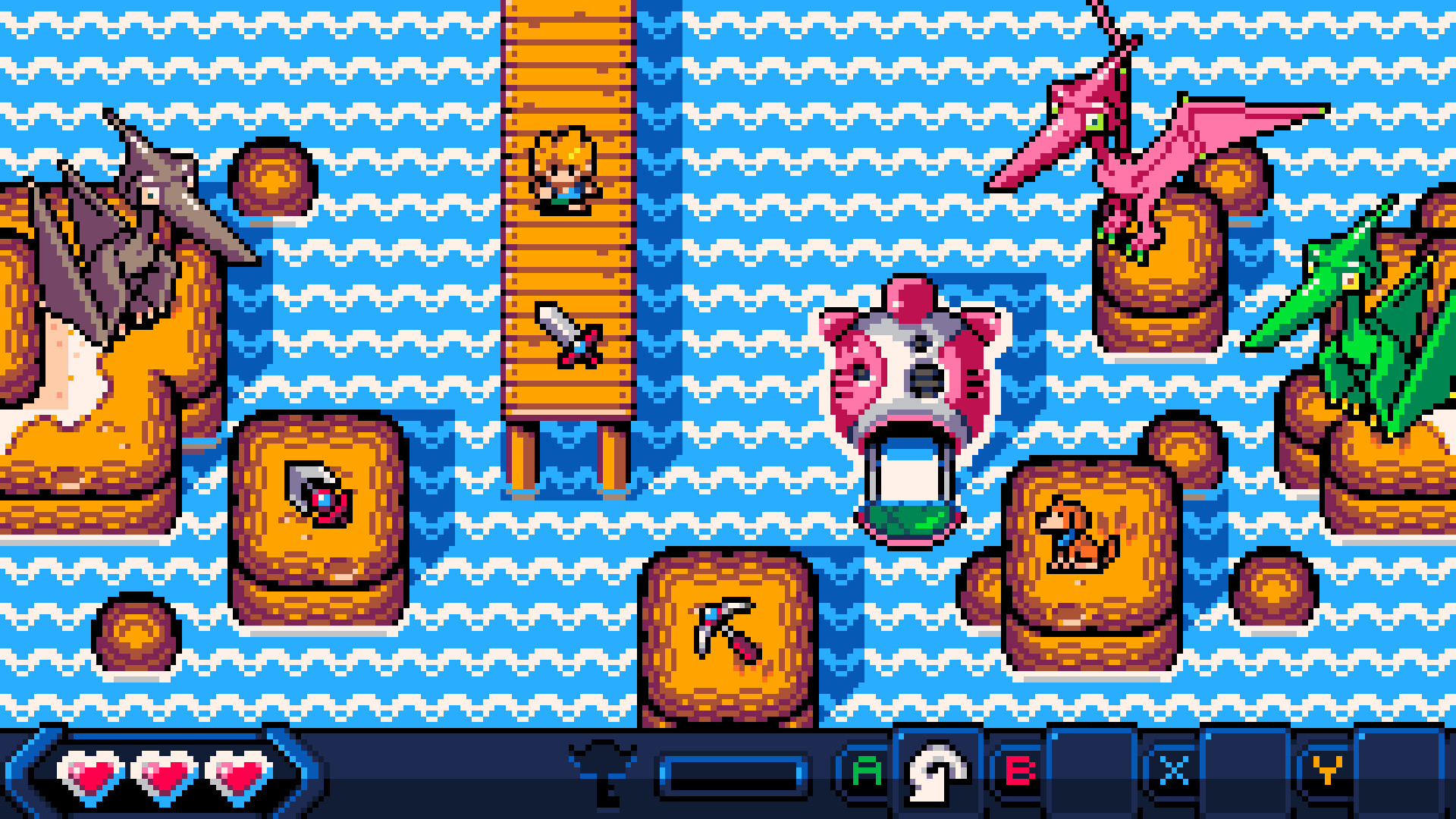
You play as a young boy whose escape pod lands on a deserted island after his spaceship blows up. After the crash, pterodactyls steal the boy’s survival tools and his dog, so it’s up to him to unsheathe his trusty sword and explore the island to get everything back.

The island is very small, as are each of the three dungeons. There’s no one to talk to, and there are only four types of enemies. The only aspects of the environment you can interact with are two types of rocks, so all of the puzzles involve sokoban-style block pushing. The two tools you find in the first two dungeons are a pickaxe that allows you to break rocks and a hookshot that allows you to latch onto rocks to cross gaps. If you use your tools to backtrack, you can collect three additional hearts to bolster your health.

The overworld map and dungeons are all tight and precise. More than a true imitation of a Zelda game, Castaway’s story campaign seems to be a stage for speedrunning, and there’s a special Speedrun Mode that allows you to see the clock onscreen. I tend not to care about such things, but the Speedrun Mode was a nice excuse to give the game a second playthrough with a bit more challenge.

The music and sound effects of Castaway are forgettable, but the graphics manage to achieve the trick of using modern technology to reproduce what you thought Game Boy Color games looked like when you were younger. The pixel art of the opening and closing animations is gorgeous, and the interstitial illustrations are lovely as well.

Whether this tiny game is worth $8 is debatable, especially if you’re not interested in speedruns or gauntlet survival challenges. I love Link’s Awakening beyond all reason, so I was happy to put down the money to support indie developers while spending an hour in nostalgia heaven. Still, it would have been nice if Castaway had more substance.

If you’re interested in the concept of Castaway but don’t want to spend money on something that feels like it should be a free demo of a larger game, please consider the alternative of Ocean’s Heart, a beautiful and robust Zeldalike game that’s honestly better than most actual Zelda games. If you’re interested, you can check out my review of Ocean’s Heart (here).

Animal Well

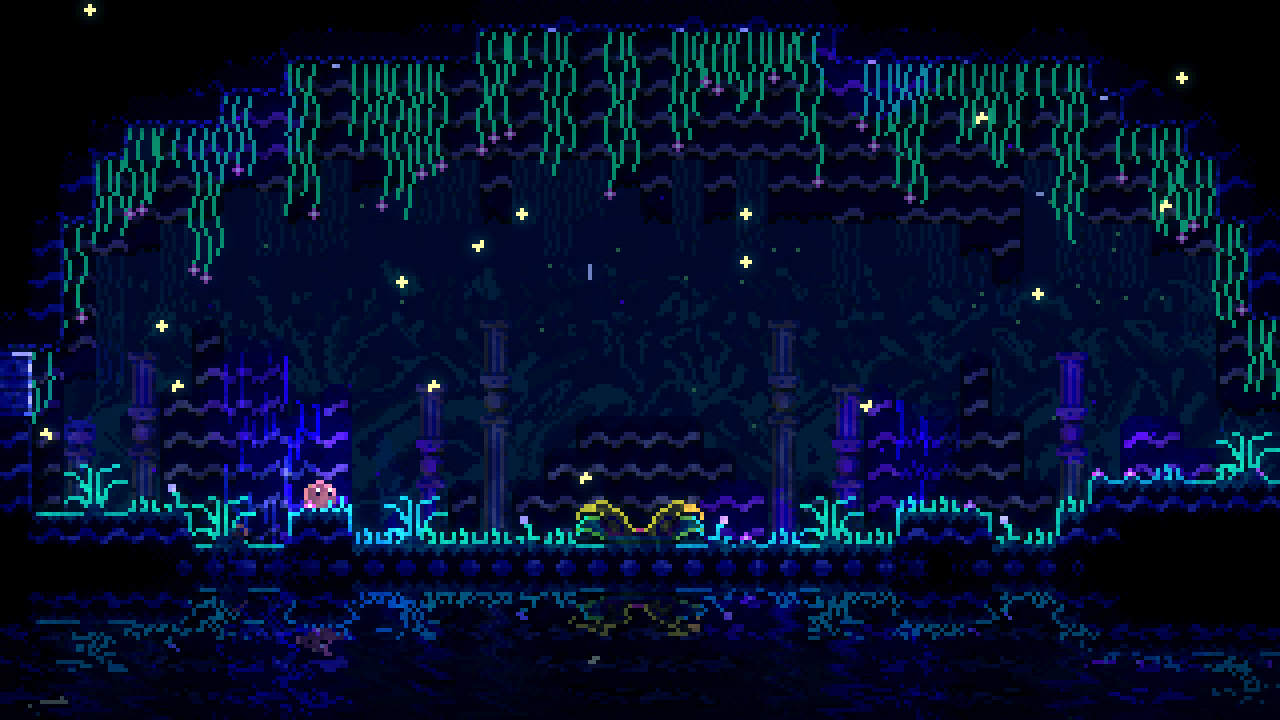
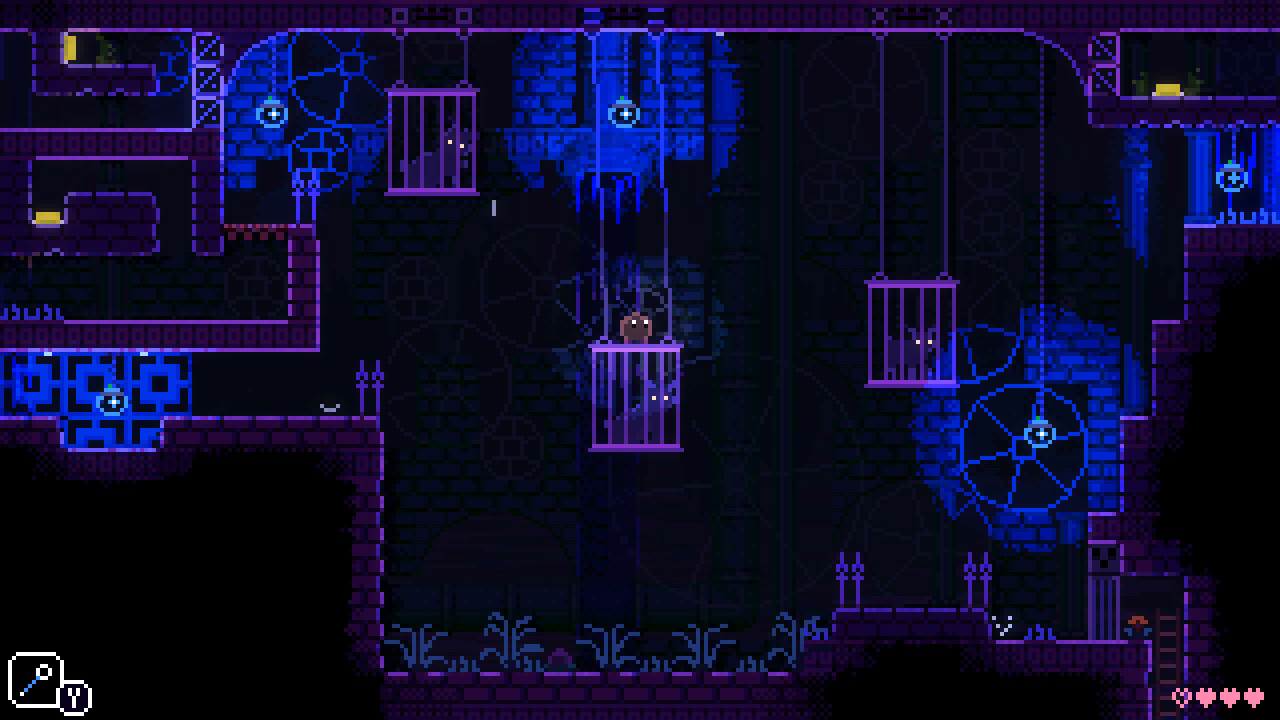
Animal Well is a no-combat puzzle platformer with an open-world Metroidvania structure. You play as a small seed navigating a mossy system of underground tunnels. The game has no dialogue or diegetic text, nor does it need any. Your job is simply to explore.

Because this is a video game, however, the player needs objectives. Early on in the game, the little seed arrives in what appears to be a central hub with statues of four animals. Each animal’s flame is sealed in a themed quadrant of the map. Although your map is mostly blank at the beginning, the location of each flame is marked, giving you four goals to work toward. Navigation is anything but simple, however, and figuring out where you’re supposed to go is just as much of a puzzle as any of the one-room set pieces.

Since Animal Well gives you so many paths to choose from, the beginning can be confusing. In many ways, this game reminds me of Hollow Knight and Hyper Light Drifter, which are similarly cagey about where the critical path might lie. Thankfully, there’s no wrong way to play Animal Well, so you’ll be fine if you simply choose a direction and start walking. Once you make your way into a level proper, the path forward becomes much easier to follow.  

As you might guess from the title, the vast underground well that serves as the setting of the game is filled with animals that theme the puzzles. In the dog level, for example, you’ll need to find a frisbee that you can throw to distract the dogs that chase after you. In the seahorse level, fish blow bubbles into the air that you can use to reach higher platforms. In the chameleon level, you’ll need to adjust the path of wall-climbing hedgehogs so that they hit otherwise inaccessible switches.

Animal Well offers the player a beautiful and evocative environment to get lost in, and it’s nice to see such a well-designed game that focuses on exploration instead of combat. Most of the platforming puzzles are relatively easy but still very clever, which I appreciate. The pixel art is gorgeous and atmospheric, and each area manages to express its theme while still maintaining a unified aesthetic that ties the various ecosystems together. There’s not much music, but the sound design is fantastic.   

If I have one complaint about Animal Well, it’s that the map is riddled with secret passageways that are completely unmarked. In addition, you can only make it so far into each level without the aid of a tool from another level. In theory, this means that there are eight levels instead of four. In practice, it can be frustrating not to know whether you can’t proceed because you need a tool from a different level or whether you simply missed a hidden path. Unless you happen to be either very good (or very patient) with this sort of thing, I’d strongly recommend playing Animal Well with a walkthrough.

It’s impossible to say how long Animal Well takes to play. According to reviews, it has the potential to be a five-hour game, but I get the feeling that the majority of players aren’t going to have such a smooth experience. If I had to guess, I’d say that most first-time players should expect to spend at least six or seven hours getting to the end. After that, there’s potentially another ten hours of exploration enabled by the tools you find at the end of the final area.

Is the cleverness and charm of Animal Well worth the aggravation of getting lost and not knowing what you’re supposed to do? That depends on the player, of course, and it’s worth saying that this isn’t a casual game. Still, although I wish Animal Well were less opaque, I appreciate that it’s not actually difficult. Exploration is always rewarded, and I never stopped being surprised and amazed by each new bit of the game I managed to find. Every single screen in Animal Well is a work of art.

After finishing Animal Well, I read the TV Tropes page to see if there’s an actual story to the game. Perhaps you can unlock a different ending if you can manage to find all the collectables? From what I can tell, there’s no real story no matter what you do, but there are collectables underneath collectables underneath collectables. There’s also an ARG. None of that is any of my business, but it’s cool I guess. I always appreciate when the people who created a game were living their best lives, and I’m happy to have an excuse to spend more time poking around the beautiful mossy tunnels of Animal Well

Games like Echoes of Wisdom

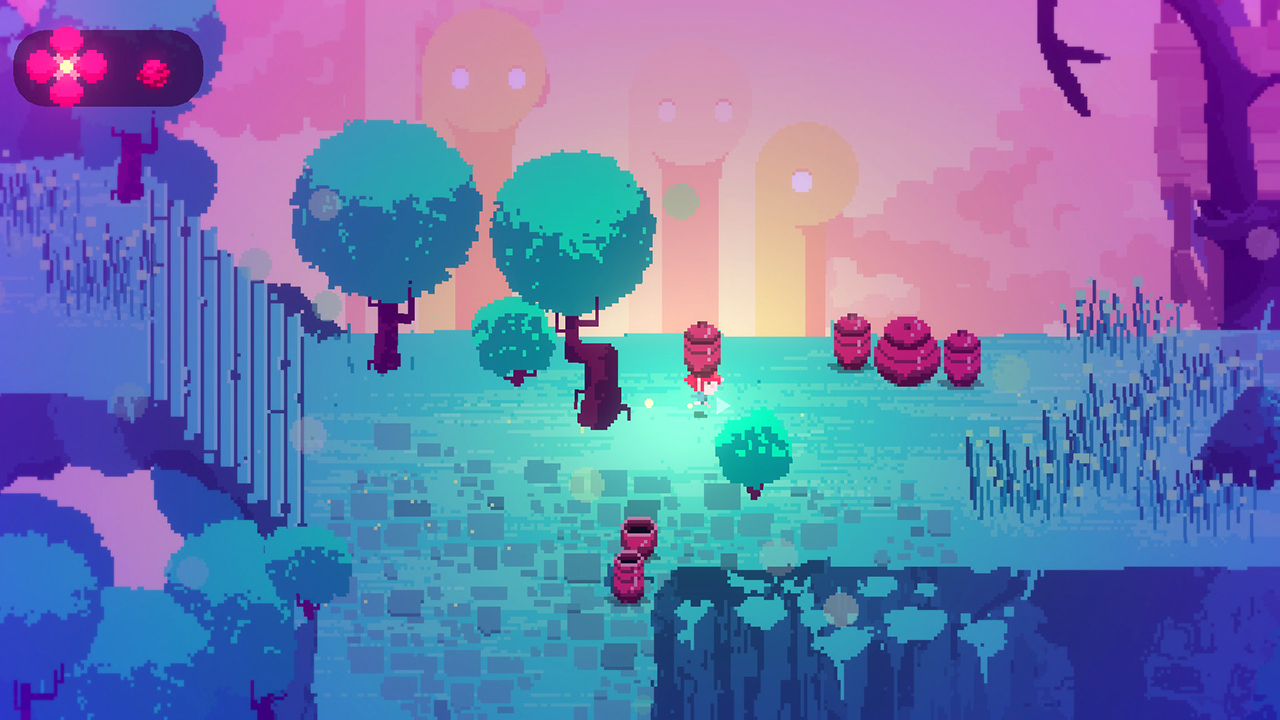
Are you excited about Echoes of Wisdom and can’t wait to play it? Thankfully, there’s a wealth of excellent Zelda-style games with female and nonbinary protagonists made by small studios that you can jump into right now on Nintendo Switch. These are eight of my favorites…

Do you wish Zelda got to fight with a sword?
Check out: Ocean’s Heart

Are you nostalgic for the gameplay and dungeons of A Link to the Past?
Check out: Blossom Tales: The Sleeping King

Are you hungry for more rock-tossing action?
Check out: Lila’s Sky Ark

Are you looking for cute graphics and a nonbinary protagonist?
Check out: Frogsong

Would you like a simple and easy game to share with kids?
Check out: Arietta of Spirits

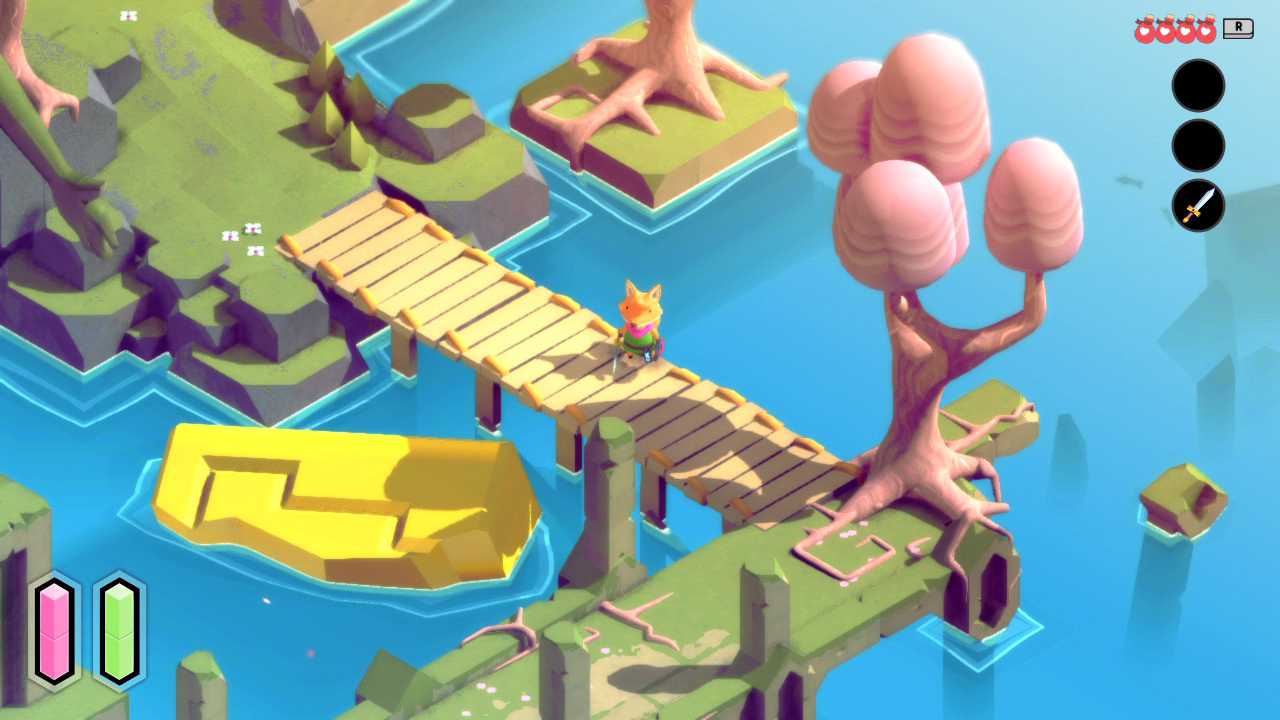
Would you like a challenging game with accessibility options?
Check out: Tunic

Do you prefer the game to be super difficult and have deep lore?
Check out: Hyper Light Drifter

Do you want your female character to wield both a sword and magic, and will you be satisfied with nothing less than complex and multilayered combat in an exploration-rich dark fantasy world that hides a tragic story about the suffering implicit in the rise and fall of empires? 
Check out, unironically: Dark Souls

Giraffe and Annika

Giraffe and Annika is an extremely chill 3D adventure story game with anime-style character designs and panel-by-panel manga cutscenes. The game takes about four hours to finish, and I suppose that whether it’s worth $30 depends on how much you value this type of experience. I played Giraffe and Annika in short stretches during the day to get a bit of emotional sunshine, and it was lovely.

You play as Annika, a ten-year-old catgirl who mysteriously finds herself on a beautiful forested island. There’s a bit of an Alice in Wonderland flavor to the scenario, as Annika doesn’t worry too much about where she is or how she got there, and she begins the story as something of a blank slate. After investigating an empty house belonging to someone named Lisa, Annika goes back outside to find a blue-haired catboy named Giraffe waiting for her. Giraffe tells Annika that she has special powers, and he asks her to visit three dungeons on the island in order to restore starlight to a magical pendant.

The dungeons are themed open-air environments inhabited by roaming ghosts that will drain Annika’s health meter if they get too close. Thankfully, the dungeons are also filled with numerous health-restoring crystals. At the end of each dungeon is a boss battle that takes the form of a simple rhythm game. It’s possible to die from ghost attacks and other environmental hazards in the dungeons; and, in fact, I died a lot. Thankfully, save points and respawn points are so frequent that this isn’t an issue. There is zero stress in this game.

By clearing the dungeons, Annika will unlock exploration abilities such as a floaty space jump and the ability to swim underwater. She’ll also perform small fetch-quest tasks for NPCs who will help her bypass other obstacles. There are various objects that Annika can interact with across the island, but the optional collectibles are just for fun. Objectives are clearly marked, and you’ll never be in danger of getting lost or going off-track from the main quest.

The island is very lush and green and beautiful, and there’s a short day-night cycle that adds a touch of visual flair. I also appreciate the cuteness of the designs of the game’s sizeable cast of NPCs. In order to access the second dungeon, for example, you need to feed carrots to a sea turtle; and, to get the carrots, you have to round up a family of rabbits. The rabbits look like a Studio Ghibli adaptation of Beatrix Potter, and they’re adorable. Meanwhile, the sea turtle is completely photorealistic, which is a good illustration of the game’s gentle sense of humor.

It’s always a pleasure to encounter and interact with new characters, and I really enjoyed the manga-style cutscenes, which play out panel by panel. The character art is comically expressive, and the bright pastel colors are lovely.

It’s difficult to critique Giraffe and Annika, as it’s very sweet and competently constructed. Still, the main 3D playspace of the game can feel a bit textureless, and I also felt that the game wears out its welcome when it starts trying to challenge the player at the very end. I actually appreciate the occasionally amateurish design, as it fills me with a sense of nostalgia for the early 3D adventure games of the PlayStation era. Even though Giraffe and Annika sometimes looks as though it was built with out-of-the-box 3D graphic assets, it’s clear that the creators put a lot of effort into creating unique environments with a distinct sense of character.

Giraffe and Annika probably won’t appeal to someone looking for a deep story or challenging gameplay, but I can imagine that it would be a perfect starter game for its target audience of younger players. As for me, it provided a pleasant and much-needed mood boost during a dismal week in February. Giraffe and Annika is a bright and simple fantasy adventure with cute characters and no unnecessary cooking or crafting elements, and sometimes that’s exactly what you need in your life.

Corpse Party

Corpse Party is a 16-bit RPG Maker horror adventure game from 1996 that was released on multiple platforms before finally finding its way, in a substantially updated form, to the Nintendo Switch. It shows its age, but it’s definitely worth playing if you’re into retro-styled horror adventure games.

Corpse Party is divided into five chapters, each of which stands as a discrete unit accompanied by its own set of save files that can be selected from the main menu. Every chapter has a number of optional bad endings, but you need to achieve the good ending in order to unlock access to the next chapter. If you’re using a walkthrough, each chapter takes roughly an hour to complete.

You play as various members of a group of high school students who stayed late after school one evening to tell ghost stories. They unfortunately trigger a curse that transports them to an abandoned elementary school building that was shut down in the 1970s after a grisly series of abductions and murders. Different students occupy different pocket dimensions of the school, which is almost entirely cut off from reality. To make matters worse, your group of students isn’t the first batch of kids to be spirited away to the school, which is littered with corpses and haunted by vengeful ghosts. Your goal is to help the kids escape the school… if that’s even possible.  

Corpse Party is extremely gory, and not all the kids are going to make it. The game contains intense depictions of mutilation and self-harm accompanied by vivid textual descriptions and occasional environmental illustrations of an uncomfortably graphic nature. The violence occupies an intersection between disturbing, gross, and campy, and I thought it was a lot of fun.

The main challenges of Corpse Party are of the standard “find a key to unlock the door” adventure game variety. The layout of the school changes from scene to scene, but it’s not large enough to get lost in. Aside from avoiding the occasional wandering ghost, there are no reflex challenges, and your characters are very rarely in any immediate danger. If there were jump scares, they didn’t register with me. The 16-bit character sprites are very cute, even when they’re depicting corpses.

As far as horror games go, Corpse Party is relatively chill, but with one caveat:

Corpse Party is completely linear and frustratingly opaque about what you need to do to trigger the next event in any given sequence. Unless you want to walk through endless dark hallways searching every square of the map, you’re going to need a walkthrough to get through the game. The walkthrough people use is (this one), but the walkthrough can sometimes be just as opaque as the game itself.

Personally speaking, I’m not the sharpest tool in the shed, but I managed to get through the first two chapters of Corpse Party without using a walkthrough. These initial two chapters stand on their own as a story, and I felt that they were actually the best part of the game. I think it’s probably safe to say that the opening of Corpse Party is more than enough to satisfy someone with a casual interest and playstyle.

The characters are usually divided into interesting pairs, and most of what you’ll do in the game consists of walking around inside the ruins of the school building while having conversations. The kids are very good about following horror movie rules – they don’t split up or do anything stupid – but they’re at the complete mercy of the ghosts of the original murder victims, who will change the layout of the school or create traps just to mess with them. For the most part, the kids are good and gentle and kind to one another, which makes it all the more upsetting when something bad happens.

The characterization and conversations aren’t that deep, however, so you never get so attached to any character that you don’t want to see them die. My favorite death is when one of the kids gets slammed against a wall so hard that his body explodes into red pulp, which all the rest of the kids have to walk through for the remainder of the game while navigating that particular hallway intersection.

Through disjointed and disconnected teamwork, your characters learn what actually happened to the ghosts haunting the school. For curious lore hunters, there are various bits of text scattered around, from newspaper clippings to messages left by other victims of the curse. These textual passages start off as grim and gradually grow more disturbing, and it’s always a pleasure to find something new to read. There’s also an optional collection quest that encourages you to find and interact with all the corpses in each chapter; and, if you like, you can return to the main menu and read about all the horrible ways these kids died.

It’s probably more accurate to call Corpse Party a “visual novel” as opposed to an “adventure game,” but it’s fun to explore the school while interacting with various objects in the environment. It’s also fun to gain access to new areas, both to learn more about the story and to see more of the game’s pixel art. One of my favorite areas is the outdoor pool in Chapter 4, which is filled with waterlogged corpses and preceded by a hellishly filthy locker room. Good times.

Despite its frustrations, I really enjoyed Corpse Party, and the English translation created by XSeed is fantastic. While reading the game’s Wikipedia page (here), I learned that there’s a manga adaptation (here), and I had so much fun exploring this horrible haunted school that I started reading it. It’s just as ridiculous and over the top as you’d expect from a manga adaptation of a horror game, but each chapter has one or two really great horror scenes enhanced by lovingly detailed and disturbingly gruesome artwork.

Speed Dating for Ghosts

Originally released on Valentine’s Day in 2018, Speed Dating for Ghosts is a short and simple roleplaying visual novel (or rather, visual short story collection) in which you can date your choice of nine ghosts. The version currently available on Steam, on Switch, and on Itchio includes the “Go to Hell” expansion, which includes three more postgame ghosts to date and an epilogue in the form of a beach party in Hell.

You play as yourself. Presumably you are dead, and also a ghost. You have registered for a speed dating event that is, predictably, run by a ghost. At this event, you choose between three rooms, each of which contains three ghosts. You have two short conversations with each of the three ghosts. If a ghost likes you, you can go on a date with them. Thankfully, it’s not difficult to convince the ghosts to warm up to you, and you can go on a date with all of them without having to replay the initial conversations.

These “dates,” such as they are, involve helping each ghost take care of their unfinished business. Instead of romancing the ghosts, what you’re really trying to do is learn their stories. After you complete a date, you’re rewarded with more information about the ghost via a character sheet on the “Graveyard” page of the game’s main menu. Once you date the first nine ghosts, you’re given the option to visit Hell for postgame content.

The gameplay consists of choosing between dialog options and being friendly. The art is simple and stylized but manages to achieve a good balance of creepy and cute. The writing is wonderful.

For me, playing through one speed dating room + going on three dates took about 25 minutes. Technically, you can convince a ghost not to date you, but I don’t know why you’d do this. All of the dialog choices make sense, and I can’t imagine needing to use a walkthrough. The postgame content is a bit trickier, and two of the ghosts in Hell might require some extra effort to date. The third ghost in Hell is a dog, and you can pet him. I love him forever.

Aside from the ghost dog, I’m also a fan of Spooky Peter, the plague doctor ghost who’s been around for centuries and has found a vocation in frightening the living. If you agree to apprentice under him, he inducts you into one of the more arcane mysteries of the afterlife, and I appreciated the worldbuilding of his story. There are also two older ghosts (Vera and Gary) who were involved in murder mysteries, and both of their plot arcs are fantastic. One of these stories was so emotionally satisfying that it made me tear up a little, while the other thoroughly creeped me out.

Speed Dating for Ghosts is a fun collection of short stories tied together by an interesting framing device, and I enjoyed the two hours I spent with it. Based on the dry tone of its humor, I’d say that the game is aimed at a mature audience, but there’s nothing particularly grim or edgy or upsetting about it. The writing and art contain elements of horror, but they’re very mild. I didn’t know what to expect from Speed Dating for Ghosts, and I was surprised by how creative and clever it is. It’s always a pleasure to find a weird little game like this that uses the medium to craft a unique and engaging piece of storytelling.

Trinity Trigger

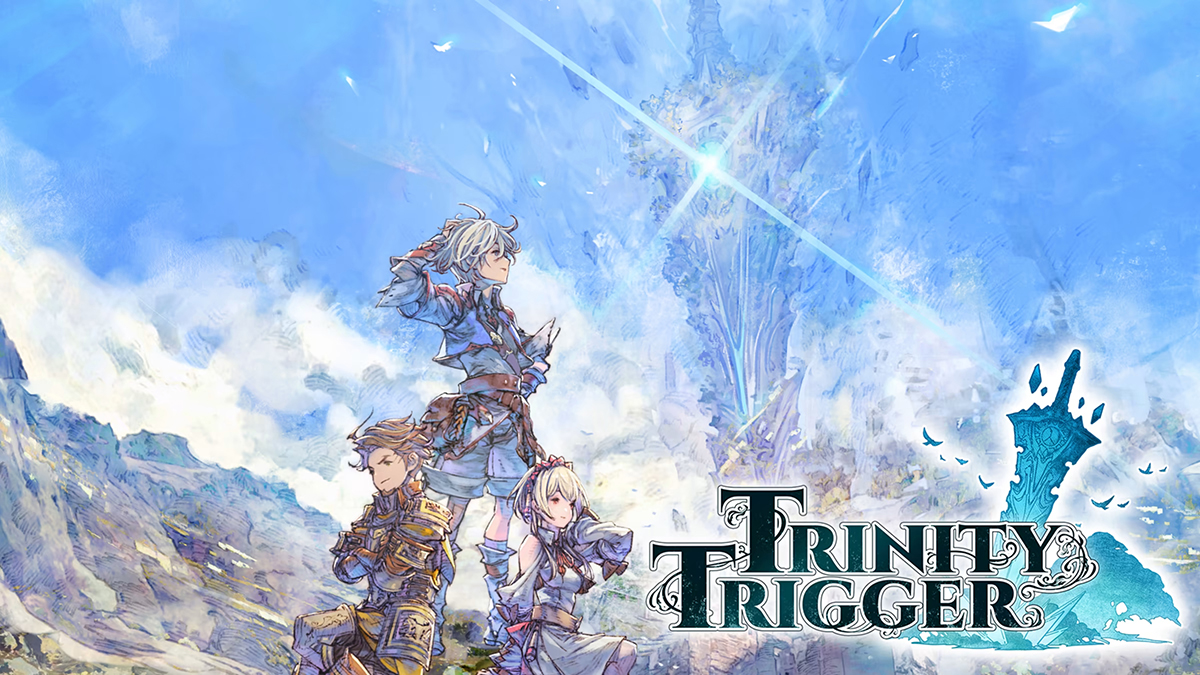
Trinity Trigger, an action JRPG published by Xseed Games in April 2023, is essentially Secret of Mana with a fresh coat of paint. The story is simple. The combat is simple. The dungeons are simple. There’s a rudimentary crafting system, and it’s simple as well. I love this simplicity, which allows you to enjoy the game in the same way that you might enjoy scenery from a train window. Not everything has to be complicated, and Trinity Trigger is a wonderful title for people who play games to relax.

You control three heroes, each of whom can wield a set of weapons chosen via a ring menu, just like Secret of Mana. Some enemies are vulnerable to certain weapons, but these vulnerabilities aren’t a big deal outside of boss fights.

Unlike Secret of Mana, you don’t need to grind for weapon upgrades, which are unlocked automatically at the end of each dungeon. There are a few sidequests that involve backtracking in order to fight a slightly stronger enemy variation, but these aren’t necessary for staying ahead of the gentle difficulty curve. Trinity Trigger is slightly more complicated than I’m giving it credit for, but not by much, and it’s no trouble to figure out the various character optimization systems as you go.

If I were to offer any criticism of the game, I might point out that the AI of the characters you’re not directly controlling isn’t great, but this doesn’t really matter. The voice acting isn’t great either, but you can turn it off. There are a few short anime-style animated cutscenes, and they don’t include English subtitles if you’ve got the voice language set to Japanese. This is an unfortunate oversight, but it’s not as if the cutscenes contain important information about the story, which is largely immaterial.

This story, such as it is, involves a pair of deities enmeshed in an endless war. In order to avoid decimating the world, they’ve agreed to fight through human proxy warriors. The factions of both gods want this cycle to end. Your main viewpoint character, who has been chosen as one god’s proxy warrior, is therefore joined by two warriors from the opposite faction.

Even if they never intend to fight anyone, your party still journeys from one dungeon to the next in order to collect mystical weapons. These dungeons are actually giant weapons once wielded by the gods, and their magic spills out into the environment, causing diverse biomes to exist in close proximity. The snowy mountain biome is right next to the desert biome, for example. The game is fairly linear, so you progress from one biome to the next while wondering what climate is going to be around the next corner.

In many ways, Trinity Trigger reminds me of I Am Setsuna, a game I also enjoyed. The primary purpose of I Am Setsuna was to recapture the simplicity of the combat system of Chrono Trigger, which felt especially satisfying given how complicated and arcane JRPG combat systems had become in the 2010s. In the same way, Trinity Trigger is all about creating a frame for the basic combat loop of Secret of Mana while adding a few small quality-of-life updates.

Along with the simplicity of its combat, a significant part of what made Secret of Mana so lovely was how beautiful and green its world was. As an early Super Nintendo game, Secret of Mana didn’t have great writing, nor were the characters even remotely well-developed. In Secret of Mana, an evil empire wants to cut down a magical tree, and you must save the tree. The evil empire is evil, of course, and they must be stopped. The empire is never presented as a real threat, however. The reason you keep going in Secret of Mana, and the reason you care about the Mana Tree, is because the world is filled with gorgeous variations on the “forest” environment. There are sunlight-drenched peaceful forests and dark labyrinthine forests and lush autumn forests and sparse alpine forests and fantastic mushroom forests and glittering winter forests and forests with pink cherry blossom petals floating on the breeze.

Like Secret of Mana, the writing in Trinity Trigger is passable but not worth remarking on. Instead, the storytelling of the game is broadly conveyed through its environment. What would it mean if the natural environment stopped following natural patterns? What would it look like if lakes and rivers dried up and forests disappeared? What if natural disasters became an everyday occurrence? In Trinity Trigger, an environmental apocalypse is underway, but it’s happening very slowly. Your characters are doing their best to stop it, but that’s not really the point. Rather, what Trinity Trigger wants is for you to enjoy how the wind rustles the leaves and how the sunlight sparkles on the sand.

Basically, in Trinity Trigger, you run around colorful environments and attack colorful enemies with colorful weapons while watching various sets of numbers go up. There’s not much to say about the game save that it’s uncomplicated and fun to play, and I enjoyed the twenty hours I spent with it. I have nothing but respect and appreciation for a solid and well-made 7/10 game that knows what it’s doing and does it well, and I’m always up for saving some trees.

The Witch’s House

The Witch’s House is an RPG Maker gothic horror game from 2012 that was released as a remastered edition for Nintendo Switch in October 2022. The game consists of cute environmental puzzles presented in gorgeous 16-bit pixel graphics, and it’s brutally violent in an over-the-top and almost cartoonish way. It takes about fifty minutes to play if you’re good at video game puzzles, and maybe an hour and twenty minutes if you need to consult a guide like I did.

You play as Viola, a 13yo girl who finds herself alone in the woods outside a mysterious mansion. A black cat greets her and invites her to wait inside until her father comes to pick her up, thereby trapping her within a hungry and malicious labyrinth. Your job is to find a way to escape the house while learning the story of the girl who lives there, a young witch named Ellen.

The game drops you right into the action with very little preamble. Within sixty seconds, you’re inside the house. Within another sixty seconds, you’ve probably already died for the first time. I was shocked and delighted by how graphic this first death was. Viola’s deaths become more horrendous and creative as you get deeper into the house, and the main appeal of the game is seeing all the fun ways this cute anime girl can die.   

With one or two exceptions, surviving the traps isn’t a matter of reflexes. Instead, the game asks you to solve simple puzzles by interacting with the environment. The house is divided into five floors, and each floor is further divided into discrete suites of rooms associated with a specific puzzle sequence. Only the fifth and final floor has enough moving parts to necessitate consulting an online guide; and, for the most part, it’s fairly easy to figure out what you need to do. 

Of course, you can always choose to do something else just to see what will happen. The Witch’s House rewards exploration and experimentation with especially gruesome deaths. My favorite death is when Viola gets eaten by a grand piano. There’s a nice discordant crunch when the lid slams down, and I appreciate how blood oozes from the cracks.

On the game’s opening menu screen, you can choose to play in an “Easy” mode that will allow you to respawn at the start of the room where you died. When you finish the game, you’ll unlock an “Extra” mode that adds more objects and text to the environment while slightly increasing the complexity of the puzzles. Despite the fact that the Extra mode and the Easy mode are mutually exclusive, I enjoyed replaying The Witch’s House with the added difficulty. You can interact with just about everything you see on screen, and the flavor text is terse yet interesting. The house is like a murder playground, and it’s fun to wander around while triggering various awful scenarios.

The game’s story is self-contained and satisfying. There are two extra endings unlocked by meeting special challenge conditions (which aren’t a big deal in Easy mode), and they both add horrifying context to the default ending. Apparently, there’s also a fourth ending where the house simply allows you to leave if you wait in the foyer for an hour of real time. I’m not going to do that, of course, but that’s a neat concept.

For me, The Witch’s House was $15 and two hours well spent. I think some people might complain about how the spooky atmosphere of the game relies a bit too heavily on jumpscares, which is fair… but they’re very good jumpscares. In the end, The Witch’s House presents a perfect short horror story with excellent pacing that continually surprises the player and doesn’t overstay its welcome. The puzzles are clever without being overly difficult, the 16-bit graphics are beautiful, and the translation is excellent.

13 Sentinels: Aegis Rim

13 Sentinels: Aegis Rim is half sci-fi visual novel and half real-time tower defense tactics game with a moderately robust system of mecha customization. It’s an amazing work of nonlinear digital storytelling, but it’s also about 25 hours long and difficult to talk about without spoiling certain elements of the plot. I’m therefore going to spoil a few small bits of the game’s premise, which I hope will make this review easier to follow.

To simplify the story significantly, 13 Sentinels is about teenage mecha pilots from different decades in modern Japan. Although the timeline stretches from 1945 to 2188, the primary setting of the game is an urban high school in the year 1985. Time travel is introduced into the story fairly early on, but it gradually becomes apparent that the various pilots’ movements between decades may not be time travel at all. In addition, a few of the characters are very concerned with “loops,” which seem to be connected to the different “generations” of mecha you control during the tower-defense sequences.

Your job, as the player, is twofold. First, you need to defend the city during a multi-stage final battle against invading alien mecha; and second, you need to follow each of the thirteen characters’ stories in order to figure out how they got to the point at which the final battle begins.

The tactics battles are short and linear, and you can repeat battles to grind for experience or meet certain challenge conditions. You can choose the difficulty level for these battles, which end in victory automatically if the tower does not fall within the time limit. The visual presentation of the battles is somewhat simplistic and occasionally confusing, but they’re easy to cheese through multi-target long-range missiles.

Personally speaking, I’m not big into tower defense tactics, but I found the mecha battles in 13 Sentinels to be extremely addictive. If you, like me, are interested primarily in the narrative aspects of the game, I would say not to worry too much about the mecha battles. They’re easy and fun!

Meanwhile, the visual novel portion of the game plays out in a series of roughly five-minute segments. There are thirteen viewpoint characters, and each character’s story is divided into six to eight episodes. Although some of the episodes have conditions that need to be met before they’re unlocked, you can switch between characters and play through the episodes in whatever order you like. You can also complete a lot of the story without doing the mecha battles, and vice versa.    

The story segments are set up like a 2.5D (Paper Mario style) adventure game in which you navigate between connected screens while talking to NPCs. Most of these story segments are linear, by which I mean that they necessitate specific actions performed in a specific order. Each character’s story has its own style of gameplay-adjacent narration, and certain segments of two of the characters (Juro Kurabe and Yuki Takamiya) might necessitate using a walkthrough. For the most part, though, each story episode is fairly intuitive and self-explanatory, and the player can sit back and enjoy the art and writing and voice acting without having to worry about making decisions.  

Although each individual battle and story episode is relatively short, there are a lot of them in aggregate, and the game will take at least twenty hours to finish. Unfortunately, you have no control over the opening tutorial sequence, which takes about an hour to complete. Because this tutorial takes so long, I think it’s important to let people going into 13 Sentinels know that it doesn’t reflect the content of the vast majority of the game.

I recently listened to a discussion of 13 Sentinels in which two people who’d played the game attempted to explain it to a larger group, and one of them made an embarrassed comment about “anime tropes.” I think it’s worth discussing these tropes (without spoilers), as they appear primarily in the opening tutorial and may turn off many players to an otherwise excellent game.

The first anime trope is fanservice, by which I mean “male gaze anime pedo bullshit.” For whatever reason, this fanservice is frontloaded into the tutorial and then more or less disappears. In other words, it’s a little gross at the beginning, but then it stops being an issue. It’s kind of like the opening of Final Fantasy XII, where you have to get intimately acquainted with the dimples in Penelo’s ass and watch Fran straddle a flying motorcycle in lingerie before the game drops the fanservice pretense and gets down to the business of telling a story in which the characters aren’t sexualized at all.

The second anime trope is basic netto uyoku brainrot. This is concentrated at the beginning of one character’s story but then stops being an issue. There’s not much to say about this, save that it’s fairly common in a lot of anime-adjacent work that came out of Japan in the late 2010s, and that it will probably go over the heads of most people playing the game in English. I’m generally sensitive to this sort of thing, but it’s such a minor part of the overall story that it was easy to roll my eyes and not be bothered by it. Also, that character’s storyline gets much better later in the game.

The third anime trope is “giant mecha that can only be piloted by teenagers in high school.” As someone who generally dislikes this trope, what I would say is that the diegetic explanation is very good, and that the narrative payoff is a lot of fun. The explanation and payoff don’t happen until late in the game, but they’re worth suspending disbelief for.  

In a lot of ways, 13 Sentinels has strong Final Fantasy VIII vibes, and it’s good to remind people (mainly myself) that Final Fantasy VIII was actually a really smart and interesting game. The conceit of all the characters being in high school is admittedly silly, but the “daily life” nonsense at the beginning of the game exists primarily to serve as a contrast for what you learn about the story as it progresses.

I don’t want to say that anyone’s enjoyment of 13 Sentinels will be dependent on their tolerance for anime tropes, but what I would say is that you might need to be patient with the game during the first hour. Like any other JRPG, 13 Sentinels gets so much better once you’re free from the mandatory tutorial.

Given that 13 Sentinels levies a tax of an hour of your life before you’re allowed to start the game in earnest, I want to try to explain why the experience of playing it is worth the price of admission.  

To begin with, 13 Sentinels is a gorgeous game. The character designs are gorgeous. The backgrounds are gorgeous. The lighting effects are gorgeous. The animation is limited, but it’s gorgeous as well. Every tiny detail is just so incredibly gorgeous, and the game constantly reveals new details.

I also appreciate that 13 Sentinels isn’t so much a traditional visual novel as it is a nonviolent adventure game. I love this style of interactive storytelling, and I love to see it done with a proper budget. You don’t just passively watch the characters and look at all the gorgeous art; you get to move through the lushly detailed environments and interact with them using standard JRPG mechanics that help guide you through the story.

While the writing doesn’t draw attention to itself at the level of its prose, it’s a marvel how everything comes together in bits and pieces in a way that makes perfect sense. Some character episodes must be unlocked, so there are a few gates regulating how much the player knows at any given time, but 13 Sentinels showcases nonlinear storytelling at its best.

The game also features a good mix of subgenres. Some characters are normal high school students who gradually get sucked into the larger story, while other characters begin right in the middle of a hardcore sci-fi action movie. Some of the characters have love stories, while others have murder stories. A surprising number of the characters’ stories look deeply into ontological definitions of humanity. Meanwhile, there are some characters you don’t get to play as, an aspect of narrative gameplay that generates its own set of themes and questions.

If you get bored with one character, you can always switch to another. All of the stories are connected, so you might uncover something that causes you to view the formerly boring character in a different light. Some of the characters resonated more strongly with my own interests while others left me a bit cold, but all of the characters have fully realized narrative arcs that somehow manage to keep developing deep into the endgame.

I can’t say too much about the game without spoiling it, but I was constantly dazzled by the storytelling. When I say that the narrative payoff of the anime tropes is worth the initial silliness, I mean it – the ending of 13 Sentinels feels satisfying and well-earned.

Because it’s divided into bite-sized chunks, 13 Sentinels is a great portable handheld game, and it’s perfect for the Nintendo Switch. Its load times are almost nonexistent, so it’s easy to pick up and put down and pick back up again. I gradually played 13 Sentinels over the course of about two months, but I imagine the game’s structure would make it a lot of fun for people who prefer to binge stories.

So, despite the slog of the opening tutorial, I’d definitely recommend 13 Sentinels if you’re interested in a smart and fun sci-story that’s also a smart and fun game.