
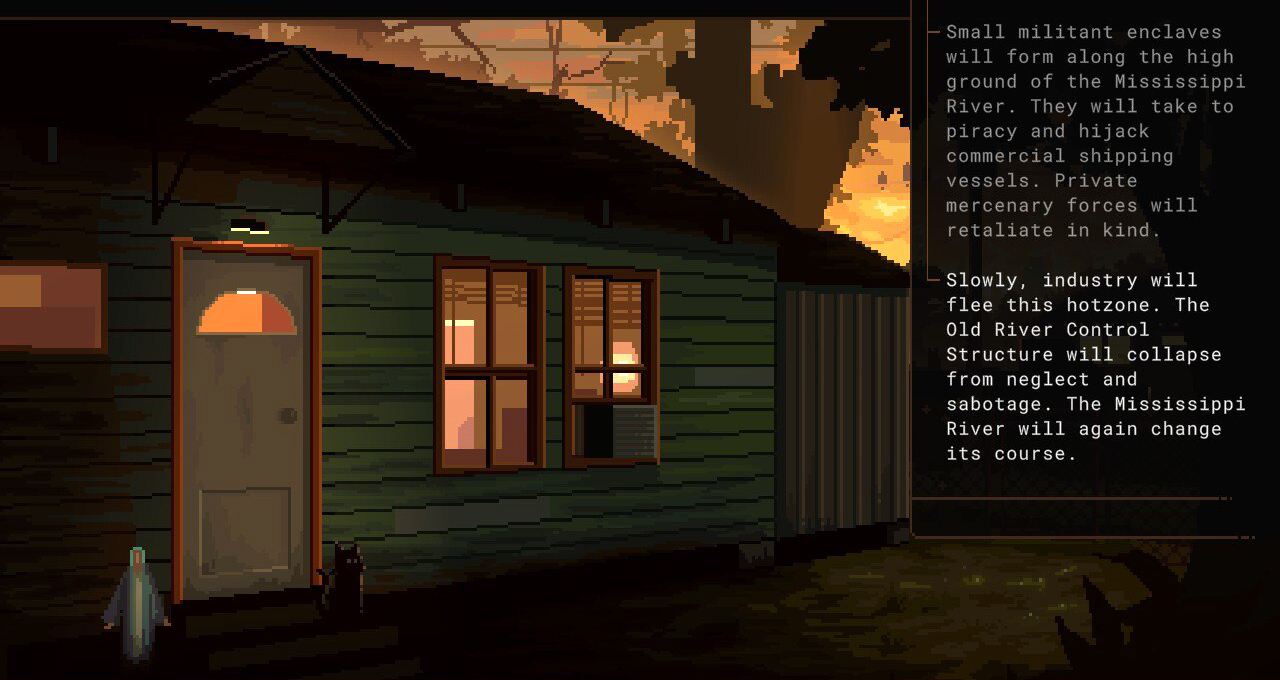
Norco is a cross between a visual novel and a point-and-click adventure game that takes seven hours to play. The game is set in a near-future version of New Orleans and its surrounding bayou. Despite its lowkey cyberpunk elements, the future envisioned by the game isn’t all that different from the present. Norco is gorgeously well-written and intriguingly grounded in the specificity of its setting, and the various small stories it encompasses are filled with fascinating characters and meaningful human drama.
I want to focus on what’s interesting about this game. That being said, Norco can be frustrating, so let me get this out of the way: most of the adventure game elements of Norco are bad. The puzzles (such as they are) are poorly executed and annoying. There’s at least one instance of turn-based combat per act, and it’s not great. Also, the game takes a weird turn toward cosmic horror in the third and final act; and, in order to unlock a slightly more satisfying ending, you have to do a minor random thing in the second act that’s extremely easy to miss.
None of this is a deal breaker. Rather, I think it’s good to set expectations. Specifically, you should expect to use a walkthrough at some point. I actually ended up using three walkthroughs, as I found some of the adventure game sequences to be difficult to piece together. They’re not complicated; they’re just opaque. Thankfully, the more frustrating puzzles are few and far between, and you can play the vast majority of the game just fine on your own.
You begin Norco as a woman named Kay who returns home after her mother dies of cancer and her brother Blake stops replying to texts. Although Blake is nowhere to be found in or around the house, Kay is greeted by the family robot Million, a fugitive from the skirmishes between armed militias that have broken out across the southwest. Million suggests that she and Kay talk to people in the neighborhood to figure out where Blake has run off to.
The search for Blake is interrupted by extended flashback sequences in which you play as Kay’s mother Catherine. While her cancer is in remission, Catherine takes odd jobs on a Fivver-like platform called Superduck in order to pay off loans so her kids can keep the house after she dies. These jobs take Catherine across New Orleans and eventually lead her to an abandoned mall colonized by the teenage disciples of an internet demagogue by the name of Kenner John.
We’re introduced to Catherine as she allows a blandly anonymous tech corporation to make a neural map of her brain. In theory, the experimental procedure is compensated by the generation of an AI personality intended to help Catherine’s family process her death. In reality, Catherine needs the money. Immediately after her brain imaging session, she’s out in the city after dark running errands via the Superduck app.
Oddly enough, Superduck ends up being a real “person,” a branch of an AI personality based on Catherine’s friend Duck. Based on a story Catherine once told Duck, Superduck has figured out that an alien entity resides in the estuary of Lake Pontchartrain, and that it was captured by Kenner John.
Although the cyberpunk elements of Norco’s plot are fun, they’re not the real story. As Catherine, you play as a tired and washed-up adult using a rideshare service to get around town while trying to gather information from other tired adults who are just trying to make a living. It’s through these conversations that the player gets a sense of what New Orleans is like as a city, as well as a sense of how not even wealthy people who seem to be major players have any control over the environment. There are going to be hurricanes, and there are going to be floods, and neither oil companies nor tech companies can do anything about it.
What I appreciate about Norco is how realistic and grounded it is. As someone dealing with cancer, Catherine gets winded climbing stairs during one of the adventure game segments, and she’s okay with telling people that no, actually, she’s not fine and she needs a minute. Kenner John’s cultists are dumb kids (affectionate) who just want to hang out in an abandoned mall and smoke weed while playing video games. Even the MAGA-style militia members who make a brief appearance in the last act are heroic in their own deranged way, and the poor harassed public official who stays late in City Hall dealing with paperwork delivers a monologue about how you can’t save everyone that’s worthy of Shakespeare.
Despite the gritty setting of a city on its last legs and Norco’s complete lack of sentimentality, all of the characters are intensely human and sympathetic. They’re also quite funny, even when they’re at their lowest and most morally dubious. There’s one story about a guy who eats a hotdog from a food cart in a downtown tourist area that made me laugh so hard I cried. Norco tackles challenging themes, but it also manages to be pitch-perfect comedy storytelling. I really can’t overemphasize how brilliant the writing is.
Also, this is worth saying: As someone who grew up in the Deep South, I’m truly and deeply grateful that the script of this game uses an accurate representation of Southern AAVE. My promise to myself about Norco was that I would put the game down and walk away the second anyone said “y’all” or pulled some sort of X-Men Gambit bullshit, but I didn’t need to worry. Everyone talks like a normal person.

The basic gameplay of Norco consists of conversation-based fetch quests. Someone will tell you to talk to someone else, and you have to go find them. You do this by driving (or ordering an off-brand Uber) to take you to a point on a map of New Orleans, and from there you’ll navigate between four or five screens by clicking on various points of interest. Your objective is always clear, but there’s a lot of non-essential content to interact with. And it’s good to talk with everyone! What you’ll get as a reward for being curious is some of the best stand-up comedy you’ll ever read.
The adventure game puzzles are so deeply embedded in the action of the story that they’re difficult to describe without extensive plot summary. What makes the worst of them annoying is that they expect you to leave the game and write something down in real life. One of the more obnoxious of these puzzles involves numerology. I understand that this is a play on the weird Christian-themed numerology cults that have sprung up on YouTube and Facebook – one of my aunts got really into this during the pandemic, true story, and it’s batshit insane – but it’s still a pain to put down the game and go get a piece of paper.
One of the interactive elements of the game that actually works well occupies a large portion of the third act. The Surprise Big Bad antagonist has gotten an offshoot of the Kenner John cult to build a spaceship on the bayou, and Kay needs to go out and find the site by navigating through the swamp in a small boat on a 4-bit pixelated sonar screen. There are all sorts of fun things to find out on the water, and this segment is enhanced by an atmospheric lead-up that includes an interesting lesson in natural history concerning why the topography of the bayou is so treacherous even though it looks like open water.
At the conclusion of the end credits, Norco provides a list of books and documentaries that the developers used as references. I was so drawn into the real-world history presented by Norco that I immediately screencapped this list. I got started on following up with these references by watching a documentary called Mossville: When the Great Trees Fall, and it’s almost painfully apparent that the creators of Norco were pulling inspiration from serious ongoing issues. It’s amazing that they were able to take such heavy material and transform it into something so gorgeously strange and entertaining.
Although Norco isn’t as mechanically robust as Disco Elysium, it’s easily in the same category of excellent writing and unique visual stylization. I somehow got the impression that this game would be all doom and gloom about poverty and injustice, but it’s actually a genuinely funny dark comedy about a cast of characters whom I grew to love despite (and often because of) their flaws and bad behavior.
 Digital Fantasy Diary