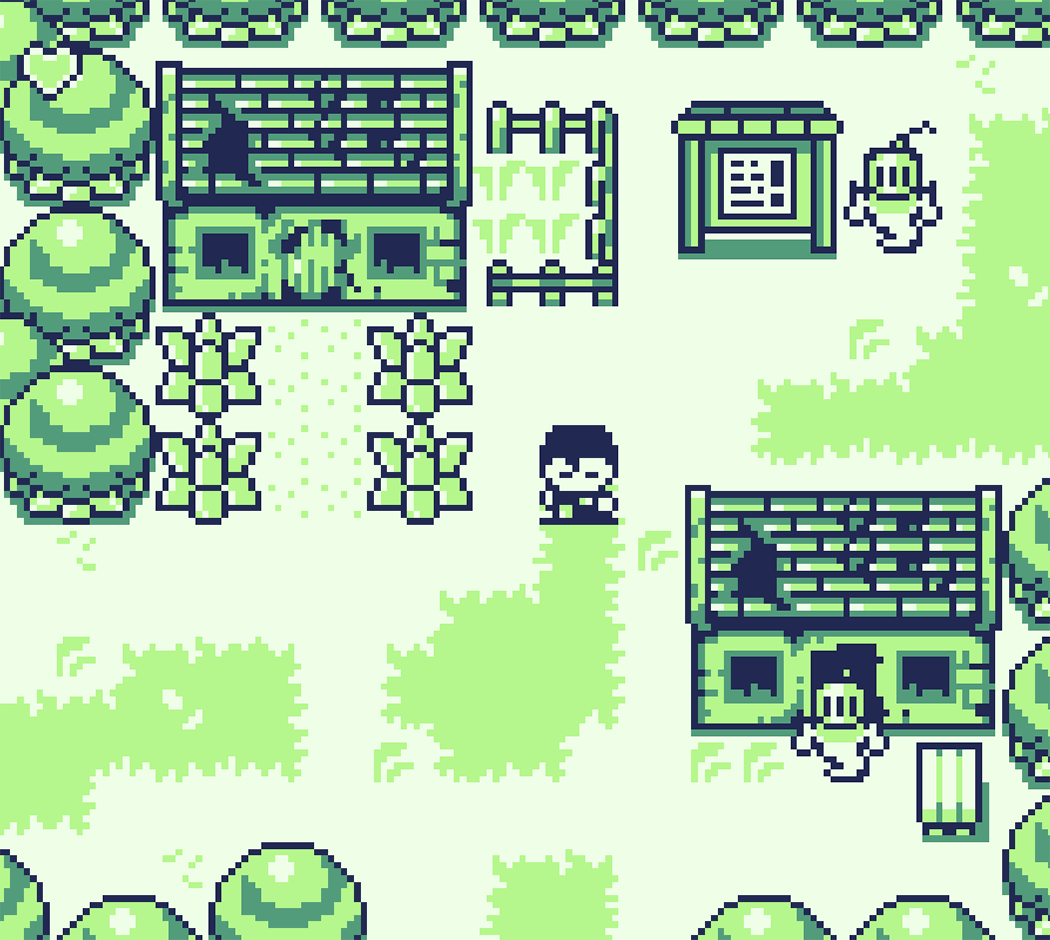
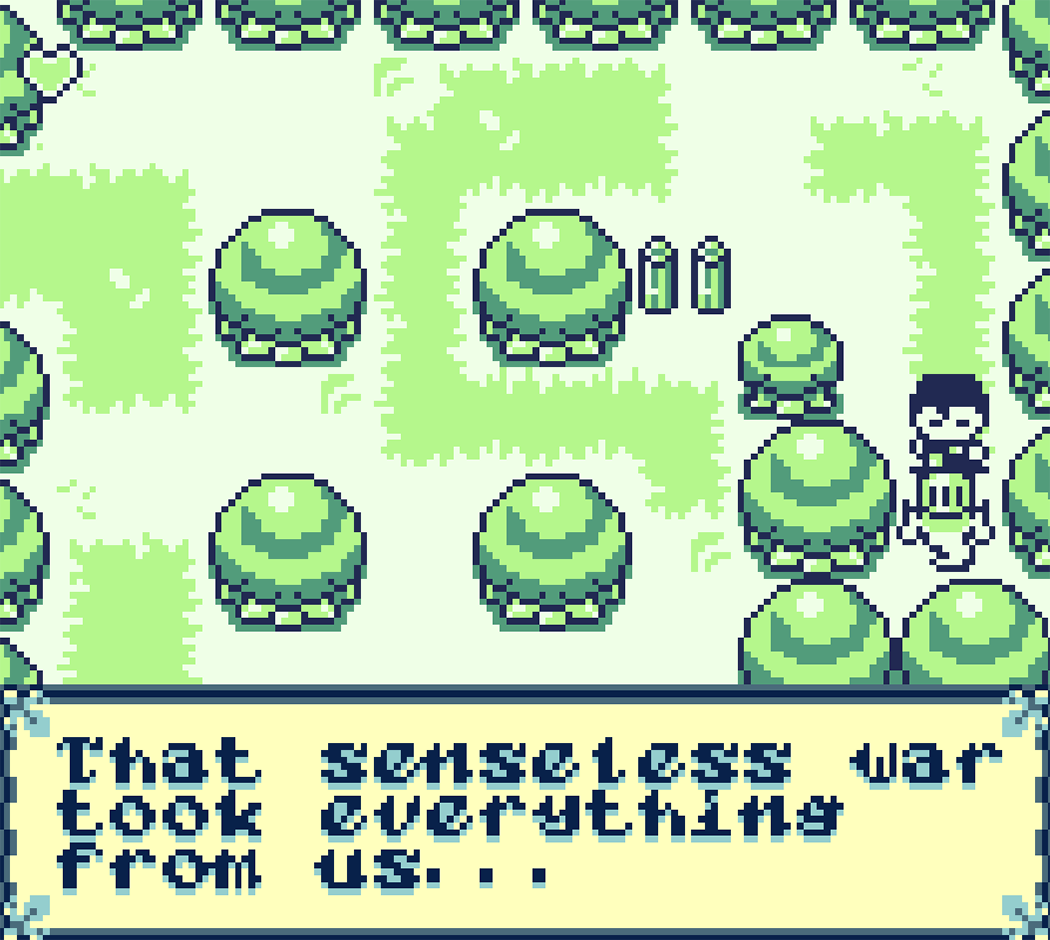
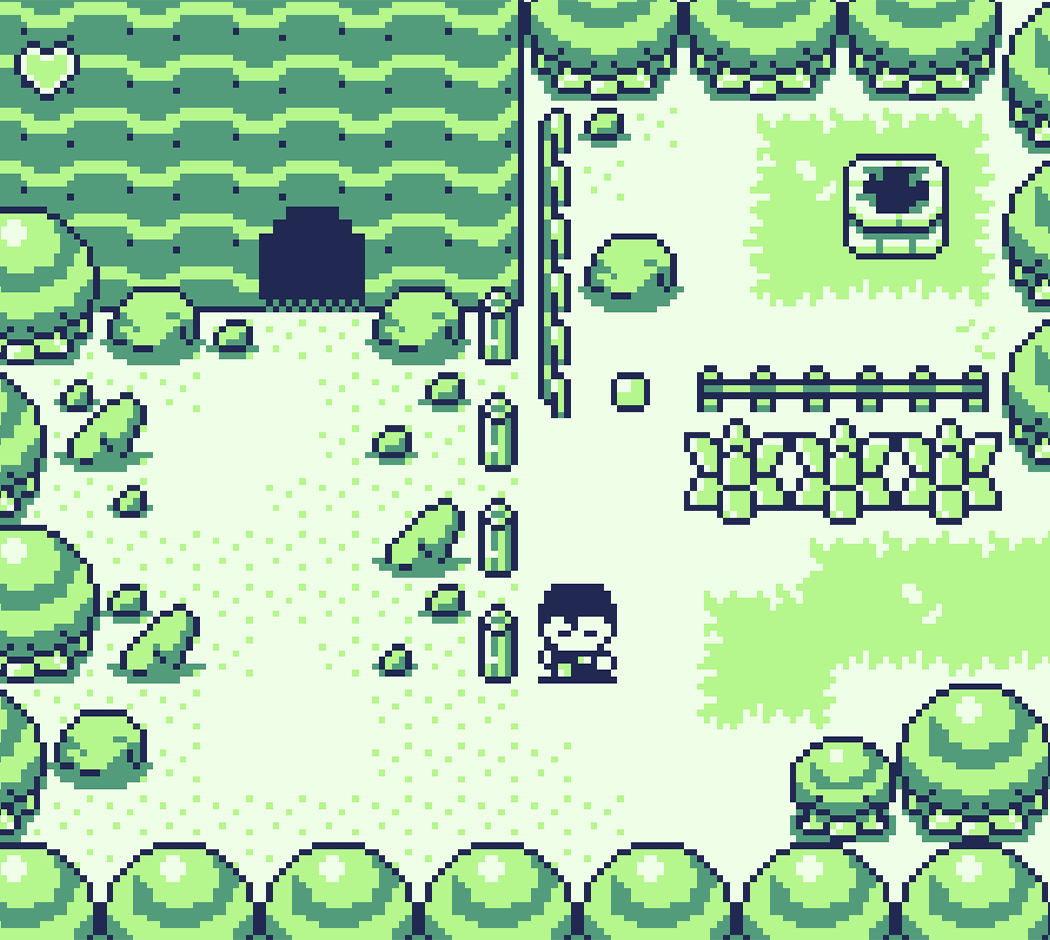
Forest of Fallen Knights is a free-to-play Game Boy narrative adventure game that takes about 30-40 minutes to finish. Though the game is visually modeled after Link’s Awakening, its setting and story are a homage to Dark Souls.
You play as a nameless adventurer who’s found himself alone and unarmed at the bottom of a cave. After the ghost of a knight offers him a sword, the adventurer emerges into a dense forest dotted with ruined houses that were once inhabited by the knights who fled from a devastating war. Though no longer alive, neither can the knights die. Your job, as the still-living adventurer, is to help them make peace with their regrets.
Admittedly, it’s unclear what purpose your good deeds will serve in the long run, given that the knights are eternally unable to pass on. Perhaps the adventurer should take care that their curse doesn’t pass to him as well…
Forest of Fallen Knights consists of about twenty overworld screens, as well as an additional dozen screens inside caves and houses. The gameplay involves walking around, talking to everyone, and taking on simple fetch quests. There’s some (very) basic combat, as well as a small dungeon that requires a moderate level of pattern memorization and dexterity. Save crystals are generously scattered throughout the forest, so you won’t lose much progress if you happen to die. For the most part, the swordplay serves to add texture to what is largely an exploration-based adventure.
The game’s writing is simple but effective. Now that everything they once fought for is gone, the undead knights are attempting to maintain their hold on what was most important to them in life. Any one of their fetch quests might come off as sentimental on its own; but, in aggregate, the player gets a strong sense of how pathetic and regrettable the situation truly is.
There are a few secrets to find in the game, though they aren’t too terribly well-hidden. If the player is moderately observant, perhaps the adventurer might reveal his reason for venturing into the forest, and perhaps he might even find a means to release the fallen knights from their curse. If not, the default ending is more than sufficiently satisfying.
As a fan of both Link’s Awakening and Dark Souls, I feel like Forest of Fallen Knights was made for me specifically, and the time I spent with this game coalesced into a pocket of unadulterated joy. It’s therefore difficult for me to be objective, but I still think it’s fair to say that Forest of Fallen Knights is well-crafted, thoughtfully considered, and at the top of the pile of homebrew Game Boy adventure games.
Many kudos to the developer, NeroGames (who is on Bluesky here). I’m always here for indie artists who use the retro gaming medium to share strange and haunting stories.
Return to Grace (on Steam here) is an atmospheric sci-fi walking sim that takes about an hour and a half to finish.
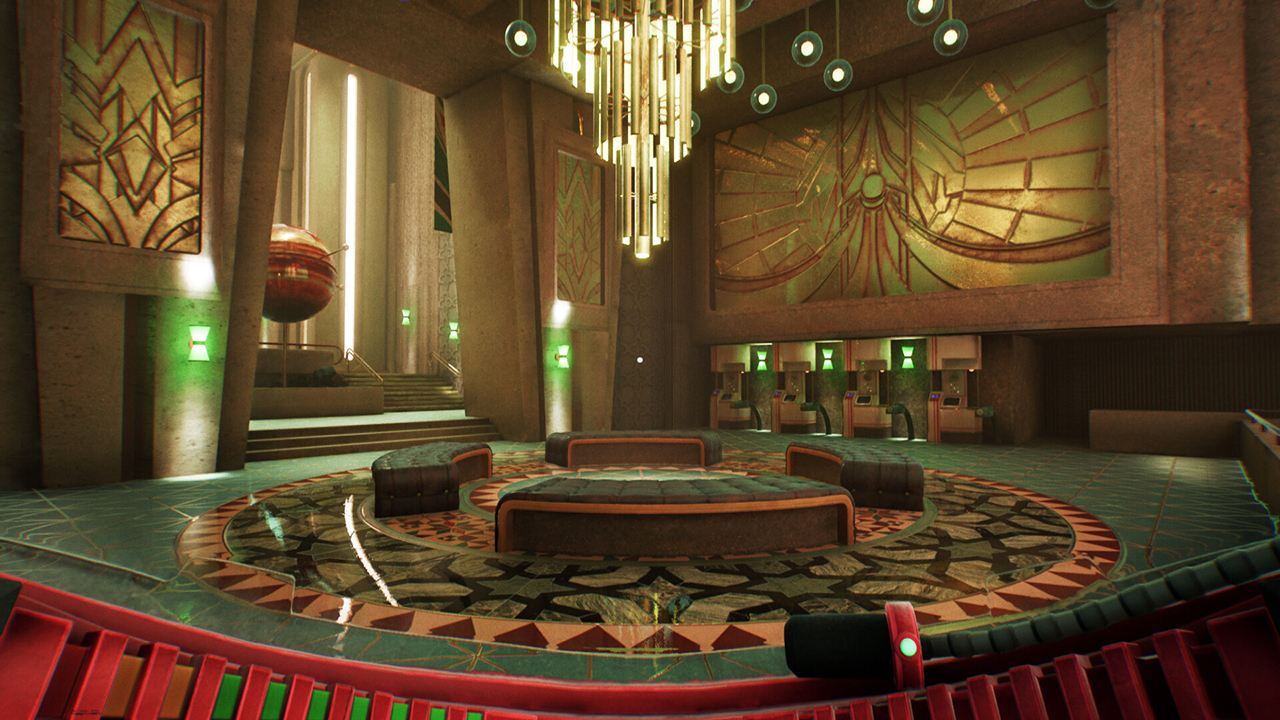
You play as Adie, a space archaeologist who’s searching for a legendary AI named Grace on the Ganymede moon of Jupiter. Inside the immaculately preserved ruins of a structure built to worship Grace, Adie encounters various aspects of Grace’s personality, who communicate through her digital wristband. As she explores the beautifully appointed space station, Adie searches for the answer to a mystery that’s gone unsolved for more than a hundred years: why did Grace suddenly disappear?
The game’s story is well-paced and engaging, and the voice acting is excellent. Return to Grace also showcases one of the most visually striking examples of retro futurism I’ve encountered. The references to everyday 1960s architecture and interior design fit the world and its themes perfectly, as do the more elevated hints of Art Deco.
What I’d like to do in this review is analyze and criticize how the game goes about telling its story, but please understand that this is more about me solidifying some general thoughts about storytelling in video games and less of an actual negative assessment of the game itself.
Essentially, while I have no problem with a game rewarding completionism, I don’t think developers should expect this sort of behavior from the player by default.
More specifically, I feel that some of the more “interactive” elements of Return to Grace don’t work the way they’re supposed to, and this diminishes the effectiveness of the game’s storytelling.
To begin with, the opening twenty minutes of Return to Grace are rough. Adie crashes on Ganymede, wanders through a snowstorm, and navigates a series of anonymous techno-corridors as she attempts to enter Grace’s station. The game doesn’t signpost objectives, and the low visibility and featureless visual landscape make it easy for the player to get lost.
I can understand why this initial difficulty exists on a thematic level. Without AI guidance, the developers suggest, the outer reaches of space are ugly and hostile. Still, while this sort of introduction would work in a movie, it’s perhaps not the best choice for a video game.
It’s not fun to be immediately hit with frustration that delivers no narrative reward, and I feel like the developers aren’t respecting the law of conservation of detail. In a shorter work, each detail matters more, and there’s no narrative reason to have a full 20+ minutes of the player wandering around aimlessly at the very beginning of the story. This section of the game could have been shorter, or at least “easier” in the sense of offering more guidance.
Thankfully, everything changes once Adie enters the station proper. The visual environment is beautiful, and the aspects of Grace’s personalities begin to have amusing and enlightening conversations with Adie and with each other. One of these aspects, “Logic,” suspects that there might have been a good reason for Grace to shut herself down, and she starts to put artificial barriers in the way of Adie’s ascension to the peak of the station.
To summarize, Logic essentially requests that Adie locate and listen to a collection of voice recordings left behind by the station’s last residents. Navigating a gorgeous 3D space to piece together a lore puzzle sounds like it would be great fun; and, for the most part, it is.
Unfortunately, the game puts two artificial points of friction in front of each discovery. First, the player must complete a simple but annoying memory puzzle in order to unlock each residential unit in the station; and second, each recording can only be accessed after completing a short but annoying spatial puzzle on Adie’s wristband. This isn’t necessarily a problem the first few times, but it gets very stale very quickly.
Eventually, an aspect of Grace’s personality called “Control” offers to complete these puzzles for you, thus removing the friction. Control is a weird asshole, to be sure, but it’s difficult to overemphasize how immersion-breaking and repetitive the puzzles are.
While roleplaying as Adie, my thought process was that perhaps Control might be less of an asshole if he had something to do. We all want to feel useful, after all, and “wanting to feel useful” seemed to be a throughline across the various aspects of Grace’s personality. Meanwhile, as the person playing Return to Grace, I was invested in the game’s story and interested in learning more details while exploring, and I didn’t like my flow state being interrupted by meaningless tasks.
It turns out, however, that allowing Control to do even one of these puzzles locks you out of the most satisfying ending, which is the ending in which you get to meet Grace.
In other words, the default ending is a “bad” ending that answers no questions and offers no narrative resolution. In addition, Control kills Adie in a decision that has zero foreshadowing. I don’t even consider this death a spoiler, as it comes out of nowhere and makes very little sense. The default ending isn’t really an “ending,” but rather a punishment dealt to the player for not finding all of the voice records while manually completing all of the puzzles.
This leads me back to the point I started with, which is that I don’t think games should expect completionist behavior from the player. Some players might come to a narrative adventure game like Return to Grace for pointless busy work, sure. It’s not beyond the realm of possibility. Still, I’m guessing that most of us don’t play cinematic story games for the purpose of ticking boxes off a spreadsheet, and that most of us aren’t going to want to play the entire game through a second time after seeing such a pointless and upsetting ending the first time.
What I would like to see in Return to Grace (and other narrative-driven games) is a default ending that respects an organic style of progress through the story and doesn’t assume that the player will have a walkthrough constantly open on a second screen. There’s no need to penalize casual players! Let the default ending be satisfying.
In the case of Return to Grace, Adie’s meeting with Grace really should have been the natural conclusion to the story. For players intrigued by the fictional world, a satisfying “default” ending will trigger curiosity concerning different possibilities. I’m all for different endings dependent on more attention and devotion to the gameplay, but I think these endings should be weirder and more interesting than the natural default ending.
In Return to Grace, the “Control kills Adie” ending would make far more sense if the player’s completionist behavior were perhaps framed as Adie resisting Control by refusing to allow him to help her, for instance. Also, I tend to think this “bad” ending with Control is far more emotionally compelling if the player has already talked with Grace in the “good” ending.
Again, I’m all for developers rewarding completionism, but it shouldn’t be taken for granted. This is especially true in games whose mechanics serve to break the flow of the story, even if this interruption is thematically intentional.
I’m using Return to Grace as an illustration of a general argument not because I dislike it. I actually really enjoyed this game! 90% of Return to Grace is very good, but I thought it might be worthwhile to explore the 10% in which the ludic medium is something of an uncomfortable fit for the message.
Putting my concerns regardings its endings aside, Return to Grace is a thought-provoking narrative adventure filled with uniquely stylized artistic flourishes, and I’d definitely recommend checking it out if you’re a fan of What Remains of Edith Finch and Outer Wilds.
Apartment Complex is a short and free-to-download narrative exploration game set in a mostly abandoned apartment building. The only human occupants of this building are its two landlords. You play as one of the owners, who is middle-aged, jobless, and depressed. In an effort to do something with his life, your character takes it upon himself to check in with the tenants, who are not even remotely human.
The game only takes about twenty minutes to play, and the gameplay consists of walking through the three-story building and talking to the tenants. Just to put this out on front street, Apartment Complex has a message, and that message is that landlords are bad. I don’t disagree, but the game isn’t shy about being didactic. Putting the armchair Marxism aside, the writing is a lot of fun.
Each of the eight tenants (inasmuch as they can be counted) is a Lovecraftian monstrosity that defies Euclidean logic but still needs a place to stay on this particular plane of reality. Perhaps because of his depression, your character isn’t the least bit bothered by the ontology of these beings. Regardless of whether he’s talking to the fungus-infested remains of the former co-landlord, a divorced dad with multiple alligator mouths, or a colossal all-seeing eye of the abyss, this guy takes each of these conversations in stride.
And honestly, this is such a mood. I get it. Sanity-altering cosmic abnormalities are a dime a dozen, but you know what’s really fucked up? The unequal distribution of wealth across class lines. Again, Apartment Complex has a message, but it’s not wrong.
Also, given that the creator is only twenty years old, I admire the accuracy of the game’s portrayal of the jaded middle-aged mindset. Like does it really matter that your neighbor is an eldritch abomination who exists in the shadows of reality? Does it even matter.
Where Apartment Complex shines is the boldness and creativity of its 16-bit pixel art. The floorplan and room layouts of the building are bog-standard, but the way each tenant occupies the space has to be seen to be believed. If you’ve ever wondered just how weird Earthbound-style graphics can get, this game is for you. The character portraits displayed during conversations are incredible.
From its eye-catching color palette to the dry tone of its absurdist humor, Apartment Complex makes me nostalgic for Welcome to Night Vale in the best possible way. This is a chill and fantastically creative game about monster friends and postmodern malaise, and honestly? It’s super relatable.