An Autumn With You

An Autumn With You
https://leafthief.itch.io/autumn

An Autumn With You is a short and nonviolent Game Boy adventure game that you can play for free in your browser window. You are Daynese, who is five and three quarters years old, and you’ve just moved with your parents from the city to your nana’s house in the country.

On the game’s Itchio page, the creator says An Autumn With You was inspired by My Neighbor Totoro, and I can see the influence. The forest around your nana’s house is home to magical creatures called Wichu that are attracted to acts of kindness. As her parents deal with their own issues, Daynese explores the beautiful area around her new house and makes a friend.

The interesting pull from My Neighbor Totoro isn’t the forest creatures, however; it’s the way Daynese creatively engages with her environment in to help her process what’s going on with her parents. Like Mei and Satsuki’s father, Daynese’s mother is a scholar working on a manuscript, and her writing schedule is intense. Meanwhile, Daynese’s father seems to have lost his job, and the family couldn’t afford to stay in the city on an academic salary.

I imagine this situation will be spookily relatable to the many Millennial parents who had to move back in with their own parents during the pandemic, or perhaps during the prolonged economic depression preceding it. Daynese is five (and three quarters) years old, and she just wants to play outside. Meanwhile, her parents aren’t doing well. In between Daynese’s jaunts into the forest, the player watches her parents gradually break down while her grandmother stands outside and waits for the storm to pass.

The main narrative drive of An Autumn With You is figuring out whether Daynese’s parents are going to be okay. It’s a short game that should take about ten to fifteen minutes to play, but I nevertheless managed to become extremely invested the story.

Unfortunately, a few of gameplay elements toward the end of the game are somewhat opaque. To give an example, I had to consult a video playthrough (here) in order to figure out the next-to-last action necessary to finish the game. You know you have to fetch food for Daynese’s forest creature friend, but there are no clues to indicate that the game expects you to go fishing with the fishing rod in the back of the car parked outside the house. If your family just moved from the city, why would there be a fishing rod in their car? I spent a solid ten minutes searching for something to interact with in and around the house before I finally gave up and went online.

If you’ve just read the above paragraph, however, then you already know about the fishing rod, and rest of the game shouldn’t be too tricky. In fact, I’d say that An Autumn With You is a perfect game for its length, not to mention a wonderful use of the medium to tell a story. The art is lovely, and An Autumn With You is filled with small but significant grace notes that add color and depth to its world.
Hoa

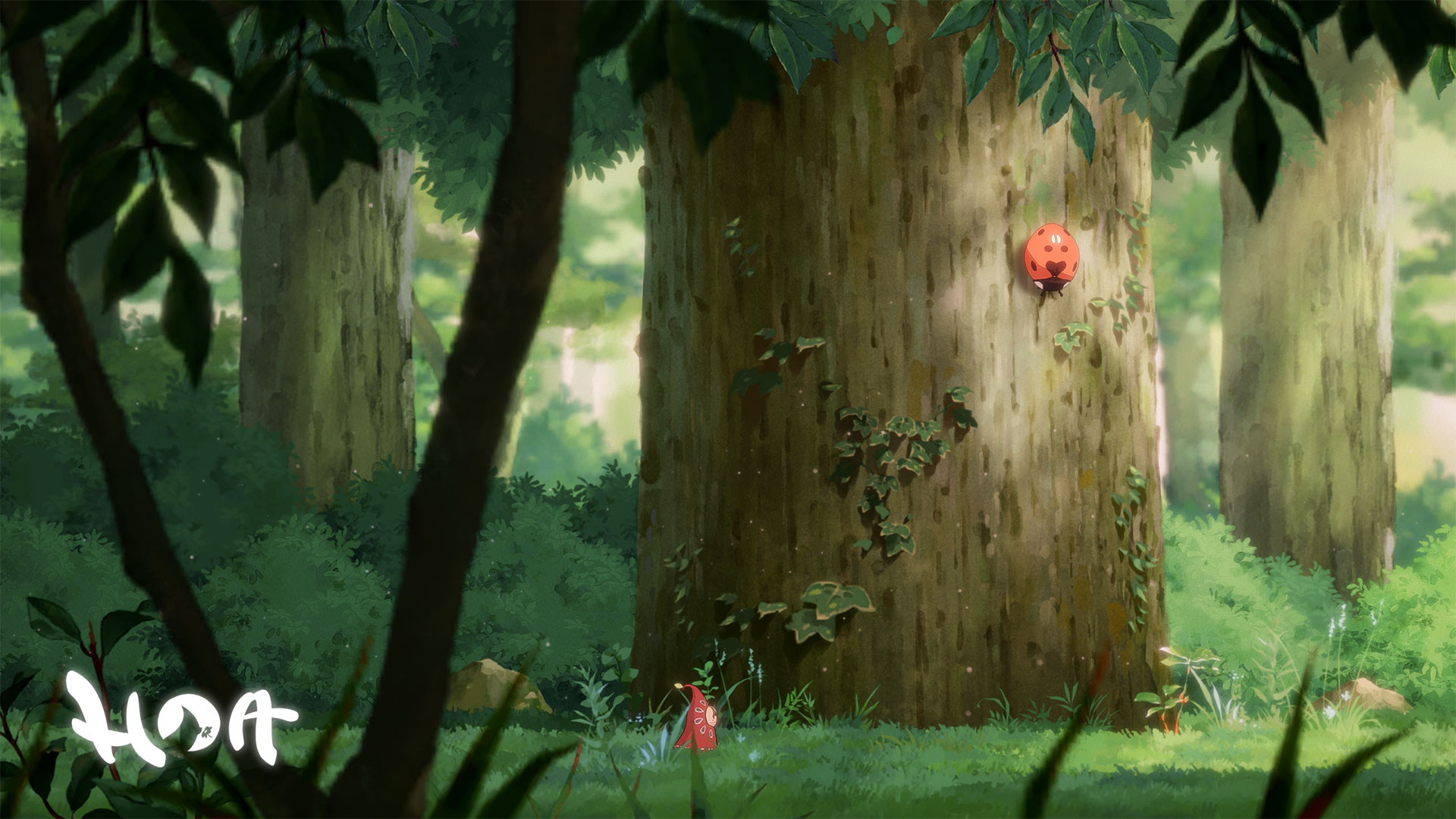
Hoa is a short and nonviolent 2D puzzle platformer set in a gorgeous green world of hand-painted art. If you’ve ever watched a Studio Ghibli movie and wanted to spend more time exploring the backgrounds, Hoa was made for you. The game’s gentle piano music is reminiscent of a Joe Hisaishi score, and Hoa gave me strong My Neighbor Totoro vibes in all the best ways.

You play as a tiny fairy who has returned to the forest after a mysterious trip across a body of water. Your motivation is unclear, but your character seems to want to make her way back to her home. Along the way, you navigate eight levels organized according to simple themed platforming puzzles. Your goal in each level is to wake the level “boss” by restoring light to their sigils, and the boss will give you a new navigation ability once you collect all the golden butterflies scattered throughout the level.

There is no combat or hostility in Hoa, and successful navigation of each level requires the cooperation of its denizens, which include snails, ladybugs, jellyfish, and tiny little robots. As your character walks, flowers bloom and leaves unfurl to help her on her way, and she double jumps in a swirl of sparkling pixie dust. All of this magic is understated and feels like a natural part of the world, and every new level is filled with pleasant surprises.

Unfortunately, there are parts of Hoa that are somewhat unintuitive, especially toward the beginning.

In the first area, your character is taught that she can break horizontal branches if she jumps on them with sufficient force. In the next area, she’s presented with a vertical branch blocking her way. On a higher level, a bug repeatedly rams into another vertical branch, eventually breaking it. It seems the message is clear: If you ram into the vertical branch on your own level enough times, it will eventually break.

This is not what the game is trying to teach you, however. What the game wants you to do is leave the room and walk all the way around the area so you can enter the room from the opposite side, where the branch that the bug knocked down now forms a bridge to another room. Hoa is trying to teach you that all of the rooms in an area are interconnected, and that sometimes you’ll need to approach a puzzle from a different direction. This makes sense, of course, but it’s counterintuitive. When I tried to search for a walkthrough, I found dozens of people asking the same question: How do you break the vertical branch?

In other words, it’s easy to understand what the level design seems to be suggesting, but it’s harder to understand whether that’s the solution the designers intended. I won’t lie – this can be frustrating.    

Once you get deeper into Hoa, you’ll begin to understand how the designers constructed these puzzles, but the game’s combined lack of precision and flexibility still creates unnecessary moments of tension. Although Hoa seems to be aimed at young children, I feel like it demands an unusually high level of patience and forgiveness, as well as an ability to read the abstract intentions of the designers instead of the concrete environment of the game. I would say that Hoa may indeed be a good game to play with a kid, but you probably want to play it all the way through by yourself first.

I should also mention that there’s a gameplay twist in the final level. It’s very good, but it’s also legitimately challenging in a way that the game hasn’t prepared you for. The basic gameplay loop is significantly disrupted, and there’s a certain tricky sequence about halfway through the level that I imagine might cause many players to quit the game without finishing it. Still, even if Hoa doesn’t perfectly execute what it’s trying to do here, it offers the player an interesting concept presented with a surprising degree of style and creativity.

I don’t want to suggest that these moments of frustration break the game. Once I was able to get past the idea that Hoa is supposed to be easy and intuitive, I was able to have a lot of fun with it. After you get a better sense of what the game wants you to do, you can make your way through the later areas with minimal hassles as you enjoy the art and music, both of which are well worth the experience.

My first playthrough of Hoa took about two and a half hours, which includes the time I spent searching for puzzle solutions online. My second playthrough was a smooth one hour, and it was a chill and peaceful experience. I’d say that Hoa is a solid “7/10 game” in the best sense of what that generally means, with the more unpolished elements serving to endow the game with a unique sense of character. All things considered, I’m happy that Hoa is a piece of hand-crafted art that exists in this world.