Review of Hero Cave on Comics Beat

My review of Hero Cave, a dark fantasy comedy, was recently published on Comics Beat (here). This graphic novella is only about fifty pages long, but it’s surprisingly powerful and cathartic. Here’s an excerpt from my review…

It’s easy to look down on NPCs, the “non-player characters” who seem shallow and uninteresting when compared to the protagonists. It’s not so easy to realize that, in certain aspects of your life, you’re not much better than an NPC yourself. In Player vs. Monster: The Making and Breaking of Video Game Monstrosity, Jaroslav Ŝvelch explains how the construction of monsters in Dungeons & Dragons reflects the concerns of the white-collar managerial class. To the dungeon master, even a creature as miraculous as a walking skeleton is little more than a series of numbers to be entered into a spreadsheet. Given how frequently we’re all reduced to data points — by social media algorithms, by insurance companies, and certainly by employers — perhaps it’s worthwhile to extend a bit of sympathy to a low-level skeleton.

You can read the full review on Comics Beat here:
https://www.comicsbeat.com/graphic-novel-review-hero-cave/

As an aside, Hero Cave features a type of nonbinary representation that I love to see. Waifishly thin models with stylishly androgynous faces are all well and good, but it’s frustrating that only attractive and nonthreatening “childlike” body types are commonly understood as being nonbinary. I believe we should have a bit more range in our representation, while also not limiting ourselves to conventional notions of “humanity.”

Why, for example, does a cartoon skeleton need to fit into a binary notion of gender? Also, if a character is an undead eldritch monstrosity, it’s silly to think that their nonbinary gender identity is the most interesting thing about them. Hero Cave demonstrates a refreshing lack of concern for the gender of its skeleton protagonist, but that doesn’t preclude the possibility of queer sexuality serving as an escape from the restrictive confines of hellworld capitalism. I didn’t want to get into this aspect of the book in my review, but it’s brilliant, and it means a lot of me personally.

Apartment Complex

Apartment Complex
https://kinerus.itch.io/apartment-complex

Apartment Complex is a short and free-to-download narrative exploration game set in a mostly abandoned apartment building. The only human occupants of this building are its two landlords. You play as one of the owners, who is middle-aged, jobless, and depressed. In an effort to do something with his life, your character takes it upon himself to check in with the tenants, who are not even remotely human.

The game only takes about twenty minutes to play, and the gameplay consists of walking through the three-story building and talking to the tenants. Just to put this out on front street, Apartment Complex has a message, and that message is that landlords are bad. I don’t disagree, but the game isn’t shy about being didactic. Putting the armchair Marxism aside, the writing is a lot of fun.

Each of the eight tenants (inasmuch as they can be counted) is a Lovecraftian monstrosity that defies Euclidean logic but still needs a place to stay on this particular plane of reality. Perhaps because of his depression, your character isn’t the least bit bothered by the ontology of these beings. Regardless of whether he’s talking to the fungus-infested remains of the former co-landlord, a divorced dad with multiple alligator mouths, or a colossal all-seeing eye of the abyss, this guy takes each of these conversations in stride.

And honestly, this is such a mood. I get it. Sanity-altering cosmic abnormalities are a dime a dozen, but you know what’s really fucked up? The unequal distribution of wealth across class lines. Again, Apartment Complex has a message, but it’s not wrong.

Also, given that the creator is only twenty years old, I admire the accuracy of the game’s portrayal of the jaded middle-aged mindset. Like does it really matter that your neighbor is an eldritch abomination who exists in the shadows of reality? Does it even matter.

Where Apartment Complex shines is the boldness and creativity of its 16-bit pixel art. The floorplan and room layouts of the building are bog-standard, but the way each tenant occupies the space has to be seen to be believed. If you’ve ever wondered just how weird Earthbound-style graphics can get, this game is for you. The character portraits displayed during conversations are incredible.

From its eye-catching color palette to the dry tone of its absurdist humor, Apartment Complex makes me nostalgic for Welcome to Night Vale in the best possible way. This is a chill and fantastically creative game about monster friends and postmodern malaise, and honestly? It’s super relatable.

Evil Gardening with Ganondorf

I always seem to find myself in a Wind Waker mood during summer. One of the many things I love about The Wind Waker is how beautiful and green and breezy it is. It’s a joy to spend time in the world of the game, which is filled with all sorts of strange and interesting creatures.

To me, then, it’s always been amusing that the Deku Tree in the Forest Haven blames this state of affairs on Ganondorf. I believe the implication is supposed to be that Ganondorf is so innately evil that his very presence on the Great Sea causes monsters to appear, but that’s extremely silly. Ganondorf may be up to no good, but he’s just a crabby old man.

If Ganondorf is responsible for the appearance of plant monsters, I prefer to think that this is because one of his many old man hobbies is gardening. Evil gardening!!

This comic was drawn by the darkly brilliant Frankiesbugs, whose cute and creepy illustrations and comics can be found on Tumblr (here), on Instagram (here), on Cara (here), and on Redbubble (here). Frankiesbugs is also responsible for the comic art and environment design featured in an upcoming beat-em-up game called V’s Rage. Like Wind Waker, V’s Rage boasts plenty of cute creatures, beautiful sun-soaked landscapes, and ridiculous middle-aged men. You can check out the game and play a substantial free demo on Steam (here).

One Hell of a Maid

One Hell of a Maid
https://bun-tired.itch.io/one-hell-of-a-maid

One Hell of a Maid is a free, ten-minute RPG Maker horror game about a young man who has been dispatched on his first assignment for an at-home maid service. Unfortunately, the apartment he’s been contracted to clean belongs to a group of cultists. Using a handy set of cleaning tools, you follow the handsome maid as he cleanses the apartment of blood on the floor, eldritch horrors in the bathtub, and coffee stains on the couch.

The apartment has three rooms, and each of them has a (very) mild jumpscare. I love the monster design, and I also love the poor maid’s no-nonsense attitude regarding the horrors he encounters. This was the only job he could get, apparently, so he might as well do it. It’s unclear why he has to wear a frilly maid’s outfit, but it’s probably best not to think about that too hard. 

The ending of the game is very sweet. When the cultists finally come home, they are adorable. The gameplay in One Hell of a Maid is minimal, but the art and writing do a lot of heavy lifting. Just like the maid himself, bless his heart.

One Hell of a Maid is not for everyone, but…

Actually who am I kidding. The appeal of this game is universal. What a fun and tasty snack.

Love in the Time of Gloom Spawn

After years spent investigating the mysterious shrines of East Necula, Dr. Calip has joined the Zonai Survey Team’s efforts to study the Ring Ruins of Kakariko Village. The ancient structures are fascinating, but what has captured Calip’s attention is the chasm in the forest on the hill. While Calip has been gazing into the abyss, however, the leader of the Zonai Survey Team has been gazing at him.

As I grow more impatient with grand narratives of nation-building and heroic destiny, I’ve become more interested in how epic fantasy universes appear to normal people. Hyrule is especially fascinating as a case study, as the privileges enjoyed by Link clearly aren’t applicable to everyone else. This is especially true of the knowledge Link accumulates over his journey, during which the secrets of prior eras are revealed to him alone.

In the present postapocalyptic era of Breath of the Wild, it seems the only person trying to study and understand Hyrule is a scholar named Calip, who lives in an isolated cabin as he attempts to stage an archaeological investigation into the site of one of the ancient Sheikah shrines. As an academic, Calip is a pompous asshole. Regardless of “Dr.” Calip’s self-serving motives, I admire him as a character who investigates the world and tries to understand it instead of simply killing things and accumulating treasure.  

Perhaps because of the popularity of the fandom’s speculation and study of Hyrule, Tears of the Kingdom leans into the ethos of archaeological inquiry with the establishment of a large and diverse set of NPCs forming the Zonai Survey Team. This Sheikah-funded research organization is led by a brick house of a character named Tauro. Tauro has set himself up in Kakariko Village, which has been beset by ruins falling from sky islands and a giant pit opening in the forest on the eastern hill.

Given their interests, it’s only natural that Calip and Tauro would interact. When you read the diaries that Calip has left at his former cabin and at his desk in his office in Kakariko, you learn that Calip is undeniably attracted to Tauro, who apparently went out of his way to invite Calip to work with him. Late in the game, the two men abandon their duties to run off and do research together. I think is a sweet lowkey love story – and even Kotaku agrees, apparently!

The emphasis on archaeological excavation in Tears of the Kingdom is somewhat problematic. In essence, the kingdom of Hyrule had a state-building myth that justified its sovereignty over the surrounding regions, and the result of the archaeological study performed by state-sponsored Zonai Survey Team is the demonstration that these myths were true in the most literal sense. Yes, there are evil outsiders who will kill everyone if they get the chance; and yes, only the royal family and its servants can protect everyone; and yes, the royal family is literally descended from gods/dragons. It’s all kind of gross.

What I therefore appreciate about the implied love story between Calip and Tauro is that they turn their backs on the politics of ancient texts and leave Kakariko so that they can go out into the woods and look at ruins together. For them, curiosity about the world has nothing to do with national mythologies and everything to do with the connection they feel to the people who lived on the land before them – and the connection they have with each other.

Because I am apparently incapable of creating anything that doesn’t have monsters, however, the story I wrote about Calip and Tauro ended up being a horror story as much as it is a love story. It has a happy ending, but it also has a healthy dose of eldritch horrorterrors. Phantom Ganon also makes an appearance, because of course he does.

The story is complete at 4,000 words, and you can read it on AO3 here:
https://archiveofourown.org/works/51328888

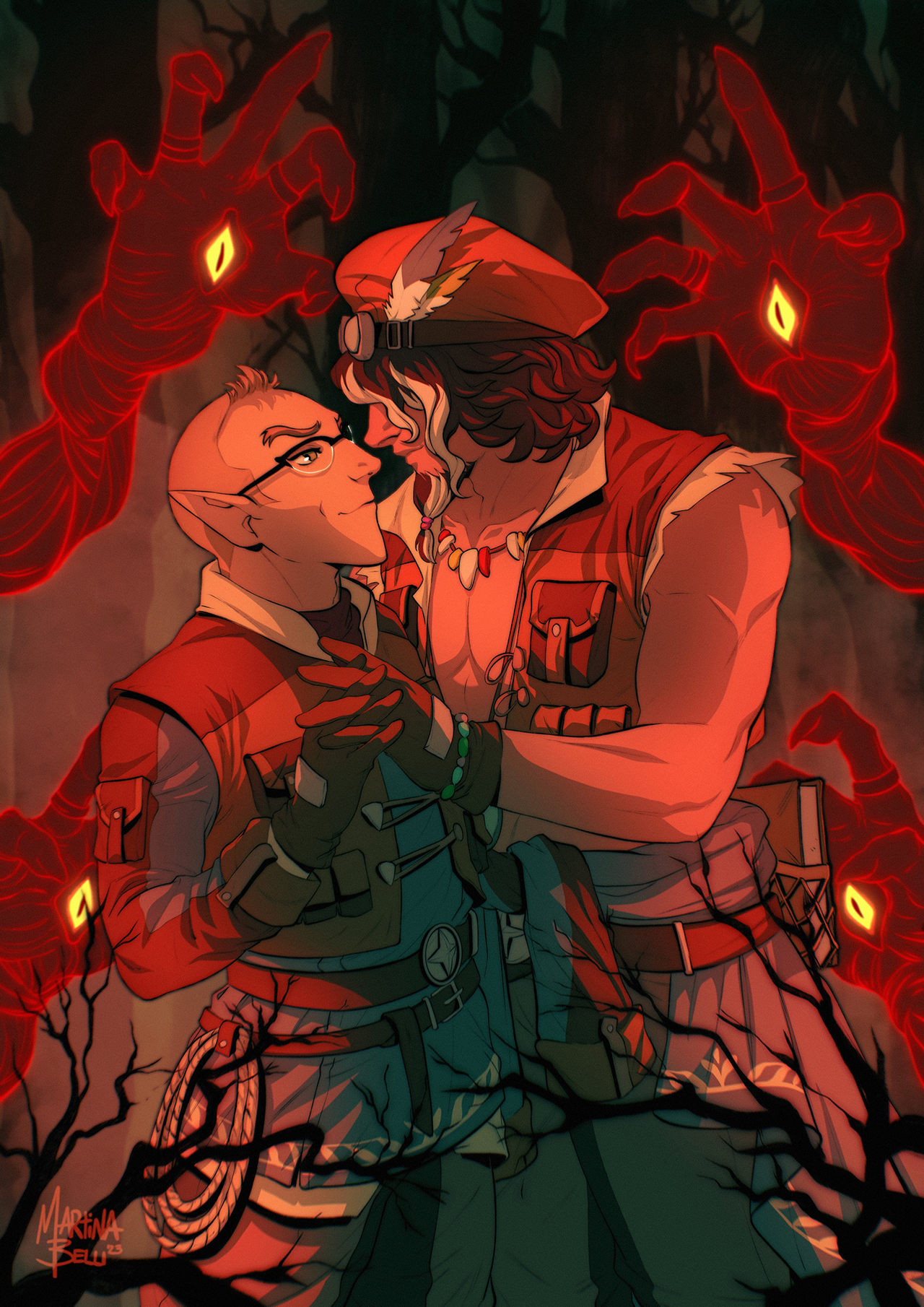
The illustration is by the marvelously talented Martina Belli, whose magical artwork helped me bring these two characters and their story to life. Marty paints dynamic portraits of fantasy characters and dramatic science fiction scenes, and she excels at creating compositions that draw the viewer into the world of her art. It was a lot of fun to work with her, and I highly recommend following her creations on Twitter (here).

The Capra Demon Is for the Gays

While waiting for more news about the Breath of the Wild sequel, I started playing Dark Souls on my Nintendo Switch. I’m not into character customization, so my Chosen Undead is the basic male character. I named him Tulip. I am very bad at this game, and Tulip has been having a rough time of it. Yesterday evening, for example, Tulip fell down some stairs and died.

Tulip is currently spending a lot of time with someone called the Capra Demon. The Capra Demon infamously functions as a gatekeeper who blocks the player’s access to the majority of the game. It’s impossible to beat him without knowing exactly what you’re doing or getting help from real-life friends, and the game makes getting help difficult for reasons that are complicated to explain. Everything about this game is complicated to explain, so I hope you’ll forgive me if I leave it at “it’s just very hard to beat this boss.”

The Capra Demon exudes Pyramid Head energy in that he’s extremely fit, shirtless, and carrying two heavy meat-cleaver swords in such a way that his shoulders are pulled back, his chest is thrust forward, and the muscles of his arms are bulging. I made a stupid pastel-colored sketch of him and put it on Twitter, and I immediately lost five followers. I lost five more overnight.

When I say that I hate Pride Month – and sometimes I do hate Pride Month, kind of a lot – what I mean is that I hate the commodification of queer identity, and I hate how this commodification necessitates the sanitization of queer sexuality. Everyone is happy to see cute Disney animals dancing with hearts and rainbows, but nobody actually wants to see gay people being gay. And the Capra Demon is just about as gay as gay can be, which I think is charming and delightful.

I know the history of Pride Month, and I know why it’s important. Still, I wish people were able to accept difference not because it’s fun or attractive, but because… I don’t know, because it’s the right thing to do? Because we’re not animals? Because we’re capable of moral reasoning and extraordinary flexibility concerning what we’re able to accommodate into our worldview? And I just don’t feel that corporate rainbow merch and police-sponsored city pride parades are really helping people outside the community understand that being gay isn’t like Christmas, meaning that it isn’t a “special” thing that we collectively tolerate because it only happens once a year.

Like, being gay is being thirteen years old and playing Dark Souls because your friends are playing it, and then you get to this one boss, and you don’t know what’s going on but there’s just something about him, and the next thing you know you have your pants down and a wad of tissues in your hands, and then when you go to school the next day, maybe the way you talk about this video game character is a little weird, and your friends would never say that they’re homophobic, because of course they aren’t, but there’s just something about you that they don’t like, so they stop talking to you. You’ll make other friends as you find your community, but now you’ll have to live with the anxiety that there’s an element of who you are that a lot of people are always going to understand as being bad and wrong. Just like the Capra Demon is bad and wrong… but don’t his legs look fantastic in that cute little skirt?

I don’t really have a thing for the Capra Demon myself, to be honest, but as soon as I saw him I knew what was up. The Pride Month version of “this is for the gays” has become whatever sweet and wholesome child character is trending from whatever sweet and wholesome children’s cartoon is popular at the moment, but I don’t think that’s an accurate reflection of the reality of queer identity and sexuality. The Capra Demon is for the gays.

Felis Decapoda

I spent part of my childhood in rural Georgia in an old farmhouse that my mother went into bankruptcy to refurbish and remodel. Along with antique furniture, my mother collected stray cats, and at several points we had more than two dozen roaming around the house and yard.

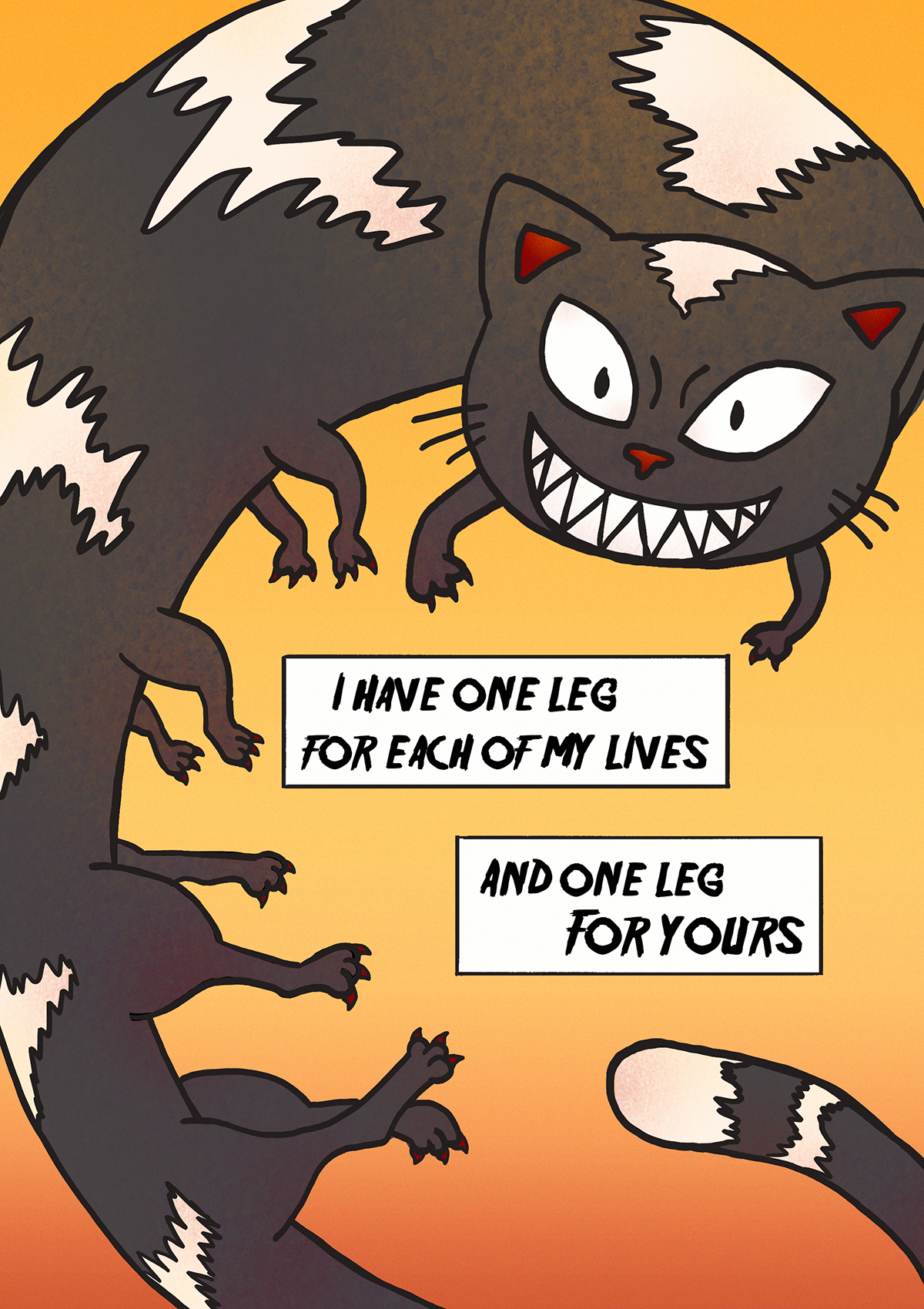
I know that living in an historic farmhouse filled with expensive furniture and cats sounds like a dream come true for many people, and presumably this was the case for my mother. For me, however, it was extremely uncomfortable. I could never sleep properly, and I used to have nightmares about the cats eating each other and merging into giant mega-cats with far too many legs.

I don’t have anything against cats, and I’d like to adopt one of my own one day, but for the time being I’m happy being a dog person.

Haunted Houses

Earlier this week I published my newest zine of horror-themed microfiction. Haunted Houses contains fifteen very short stories about haunted spaces and the terrible people who inhabit them. The cover art is by @QuinkyDinky, and the zine contains interior art by @irizuarts. I’ve got a listing up on Etsy (here), and I’m also promoting the zine on Twitter (here) and Instagram (here).

This zine is quite short, with each story and illustration occupying only one page. This is partially a trick of formatting, but it’s also a result of careful editing. You wouldn’t want to spend too much time in these places, after all.

I have to admit that, even though I’m categorizing this zine and the two other collections of microfiction that preceded it as “horror,” I’m on the fence about what genre my stories actually belong to.

In my mind, the genre of horror isn’t about a specific set of tropes or narrative structures. Rather, horror is characterized by the psychological and visceral sensation of unease it inspires.

I personally prefer to think of most horror, including the stories I write, as “dark fantasy,” or perhaps simply “magical realism.” I’m not easily creeped out by fiction, mainly because the real world is so lowkey awful so much of the time. As I write this, the National Guard is setting up base at a West Philadelphia Target in advance of the presidential election next week, ostensibly as a “defense” against people engaging in civic protest. There are actual tanks in the parking lot of the place I go to stock up on toilet paper, and that’s really scary. But monsters? Not so much.

I’ve always tended to identify with monsters, and not simply because so many villain characters are overtly coded as queer. Monsters are about disrupting the status quo, and I can get behind that. Postwar American horror cinema, including the slasher films of the 1970s and 1980s, is all about interlopers quietly invading small-town America and infecting people. The story behind many of these movies basically boils down to this: Can you even imagine scary things like communism and feminism and civil rights secretly gaining a foothold in our town? (Stephen King goes into fantastic detail about this in his 1981 book Danse Macabre, if you’re curious, and I think the book still reads well and holds up in many ways.)

To me, monsters aren’t scary because I am the monster, which is an uncomfortable set of life experiences to try to talk about in fiction or otherwise. There’s nothing you can specifically put your finger on regarding why people treat you the way they do, but you know there’s something a little off.

Fuck Sigmund Freud and his weird misogyny and homophobia, but I think I’m on the same page with him regarding “the uncanny” as one of the primary components of horror. Freud got a lot of things wrong in his career, but something he gets absolutely right is that it’s difficult to discuss the uncanny in concrete terms.

The uncanny doesn’t just apply to appearance, of course – social interactions and environments can be uncanny as well. If what I’m writing is horror at all, it probably falls into the subcategory of social horror, which focuses on people behaving in a way that’s almost human, but not quite. Many horror stories are cathartic, in that the status quo is threatened but ultimately restored at the end. Even if things have changed, we can feel relief in the knowledge that at least they’re getting back to normal. With social horror, however, our anxiety is never resolved, because we now understand that the status quo itself is horrifying.

It’s difficult for me to talk about the details of my identity and life in a mimetic way. When I’ve tried, it’s been my experience that people either won’t believe me, will think I’m being manipulative in an attempt to elicit undeserved sympathy, or will be put off by the political elements underlying my descriptions of the ways in which I’ve had to move through the world.

The point of the stories in Haunted Houses is not to try to explain why certain aspects of my life have been unsettling, but rather to create a sense of the uncanny in order to communicate the sense of feeling unsettled for reasons you can’t quite explain. Sometimes my stories about haunted houses are about the hidden trauma of being queer in a society that goes out of its way to create monsters; but, in the end, I just really like telling stories about strange people occupying uncomfortable places. I enjoy exploring these themes both as a reader and as a writer, and I’ve found that summoning the courage to open the door and peer into the darkness on the other side is, if not total escapism, still good spooky fun.

And right now, at this specific moment in time, I think we can all relate to the uncanny experience of feeling trapped in a haunted space, because this is our daily life – we live here now.