We Know the Devil

We Know the Devil
https://pillowfight.itch.io/we-know-the-devil

We Know the Devil is a horror-themed visual novel about three teenagers at summer camp. Although the world of the game is close to our own, there are a few differences, one of which is that “the devil” is real. One of the kids’ duties as campers is to reinforce the magical wards protecting a forest, and your job as the player is to help them make it through the night. We Know the Devil has four endings; and, depending on how quickly you read, it takes about thirty to forty minutes to finish a run.

Since you can’t get the true ending on your first playthrough, I might recommend going into the game without consulting a guide, but only if you’re the sort of person who absolutely can’t tolerate any spoilers whatsoever. We Know the Devil functions primarily at an allegorical level, and you’ll get infinitely more out of its story if you understand what’s going on. In this post, I’m not going to spoil what happens, but I think it makes sense to accurately describe the game’s premise.  

We Know the Devil is divided into ten short chapters. For the most part, the game is entirely linear. The only element of gameplay is that the player is required to make seven choices, and these choices only affect the ending. Essentially, the player is put into the shoes of one of the three main characters and given a choice between the other two characters. The ending you get is determined by which of the three kids is left out of the pairings the most frequently. Essentially, you’re choosing who dies at the end (although they don’t actually die).

To get the true ending, you have to balance the pairings evenly. Unfortunately, you can’t do this on your first playthrough, as the game doesn’t give you the key choice that makes a perfect balance possible. The first ending you get will therefore be strange and upsetting, but it’s the unpleasantness of this ending that serves as the cipher for decoding the allegory.

A major weakness of We Know the Devil is that the setting of the game is poorly defined to an extreme degree. Unless you understand the allegory, it’s difficult to piece together what’s going on. This confusion is exacerbated by the inanity of the character dialog, a great deal of which is trite chatter. In fact, some of the writing feels like a parody of an indie comic about depressed edgy teens, and my first playthrough of the game left me cold.

Although the horror elements were intriguing, I didn’t understand the larger narrative. Why were these kids at camp if they didn’t want to be there? If they had cellphones, didn’t they have cars? Why couldn’t they just leave? Why were they refusing to communicate with each other? If “the devil” is real, why were teenagers being forced to patrol the woods at night? Were they conducting some sort of ritual? And for what purpose?

None of these questions is answered, and the first ending I got didn’t make much sense in terms of plot, character development, or narrative themes. I couldn’t figure out why people have lavished so much praise on this game since its initial release in 2015, so I googled “We Know the Devil ending explained.” That’s when the story became much more interesting.

Essentially, each of the three main viewpoint characters represents a different type of queer identity. The ways in which these characters fail to communicate with one another are representations of how young people attempt to keep themselves in the closet, and the way in which “the devil” gets one of them at the end is a representation of how a secret queer identity might manifest in an unhealthy way. The summer camp is supposed to be analogous to a Christian camp for “problem teens,” and the ritual night in the woods is an analogy for how such organizations put campers in difficult situations in order to break them emotionally, after which they can be “fixed.” If you’re interested in learning more, I highly recommend (this fantastic essay), which unpacks what’s going on in We Know the Devil from the perspective of someone close to the culture and experience being portrayed.  

To me, the queer identities of the characters were obvious from the start. Still, a character being gay or trans is completely normal to me here in 2023, and I know very little about Christianity in the United States. All of the allegory therefore went completely over my head. Once I picked up on what everything was supposed to represent, all of the seemingly random symbology started to make sense and fit together nicely.

Admittedly, the allegory is clever. Still, I wish the story stood better on its own, especially for players who don’t come from that particular cultural background. All that aside, I enjoyed the game’s gentle and sketchy visual portrayals of its characters, and the descriptive writing that frames their conversations is quite good and occasionally even beautiful. In addition, the ambient music that underscores the game is gorgeous and used to fantastic effect. On the whole, I’m grateful that I had the opportunity to experience the story told by We Know the Devil, but I wish I’d done myself a favor and read more about its cultural context first.
Later Daters

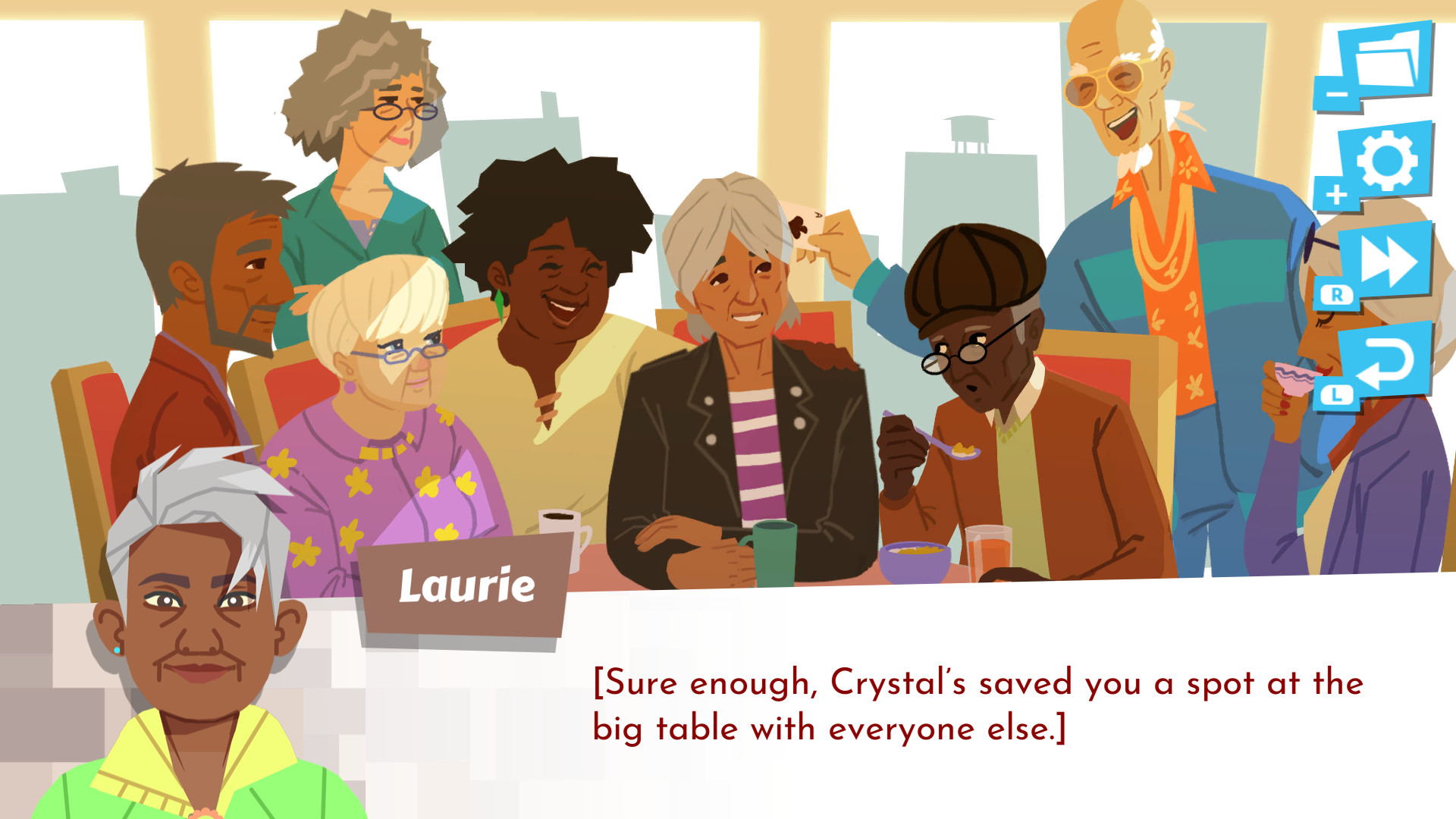
Later Daters is a cute and clever queer dating sim set in a retirement community. It’s divided into seven chapters, each of which takes about ten minutes to read. I enjoyed this game so much that I played it three times. There’s a fair amount of repetition, but also enough potential for variation to keep each replay interesting.

Each of the characters in Later Daters is distinctly attractive in their own way, but perhaps it’s important to say that not a single one of them looks a day past 65 years old. In fact, most of them seem to be in their mid-to-late 50s. I’m not sure if this is a failure of imagination or simply a concession to the player, but everyone is healthy and hearty. All of the characters have good hair and good skin and good teeth and good posture, and they all have the minds and progressive views and sex drives of college students.

Not that I’m complaining, of course! I just want to make it clear that, as in any dating sim, there’s a strong element of fantasy involved.

Your character, who looks maybe 50 years old, is supposed to be 80. (You can choose their gender, but I’m going to stick with “they.”) They’re an artist who lived in a big house out in the country, but their doctor recommended that they move to a retirement community after they developed vertigo and took a fall. The player can choose how positive they feel about this; regardless, everyone in the community is friendly and welcoming.

The retirement community itself is beautiful, with lovely apartments, grass-covered lawns, and a gorgeous greenhouse filled with marijuana plants. The community also has sufficient funding for various clubs and activities, and it’s managed by the residents with no outside interference. It feels like paradise, to be honest.  

The main goal of the game is to choose an NPC to romance, which you can do at your leisure and to whatever degree of steaminess you prefer. The first time I played the game, I was so enchanted by the characters that all I wanted to do was to make friends. I therefore played the game as aro-ace, which ended up being a lot of fun. Unfortunately, I made some questionable decisions regarding a few of the characters, overstepping the boundaries of some while not being attentive enough to others. I therefore played the game again to get to know them better, and along the way I ended up starting a relationship with my cute neighbor.

On my third playthrough, I was like, “Fuck it, we ball,” and I ended up seducing a rock star. The bed scenes were very silly, and there was more than enough humor to create a bridge above any potential cringe. I don’t think most people are going to feel compelled to crank it to Later Daters, but the quality of its dick jokes is extremely high.

Despite the number of excellent (but mercifully non-obtrusive) one-liners, the underlying purpose of the game is to help the player explore scenarios related to aging and death that aren’t often addressed in pop culture or entertainment media.

To give an example, a minor character suddenly dies of a heart attack in the second chapter. Although you can choose not to participate, your character is invited to a group therapy session that has moments of humor but legit made me cry the first time because it was so heartfelt and honest. No one preaches or lectures, but the session does manage to sneak in some real talk about issues such as the importance of creating a will when you get older.

Another example is the person who is (or seems to be?) the sole exception to my earlier statement that “every character is healthy.” A man named Haroun is suffering from Alzheimer’s. This understandably causes trouble for his wife Salema, who doesn’t want to move him to an intensive-care residence.

If you become friends with Salema, you’ll be introduced to her fourteen-year-old grandson Marcel, a sweet kid who tries to help with Haroun but can’t really manage his care on his own. Putting Salema and Haroun’s issues aside, it’s lovely to see how everyone reacts to Marcel with love and kindness. If you’re a queer person who’s ever felt anxiety regarding the judgment of older people, this portrayal of friendliness and acceptance is a godsend.  

Given that Later Daters is so warm-hearted, I didn’t have the courage to do a genocide run, but I’m curious about what that would look like. From the very first dialogue option, you can choose to be extremely negative about moving to a retirement community, and you can also actively choose not to spend time with anyone.

I’m the sort of person who needs a lot of alone time and has never taken well to communal living. If I were to play this game realistically, as myself, I think this would probably be tantamount to a genocide run. Still, I get the feeling that Later Daters might be a safe space to explore these fears and anxieties.

I think it’s especially for people like me that the fourth chapter of the game is a sci-fi themed “and it was all a dream” style mini-story that serves as an icebreaker, allowing you to explore your relationships with the characters without there being any long-term consequences. This chapter is a marvelously clever storytelling device, and it’s a lot of fun.

Even if you’re not especially into older-looking characters, Later Daters is about an hour of good art and excellent writing that can easily be played in one sitting and rewards multiple playthroughs. And again, the dick jokes are great, but you don’t have to date anyone if you’re just interested in the story. If you do happen to be up for romance, Later Daters gives you all the queer options you could hope for while allowing you to set your own pace at every step of the way.

There are several ways to download Later Daters, including paying for each chapter at a time, but I’m happy that I went ahead and got the full game, “Later Daters Part One and Two.”