Everyday Heroines

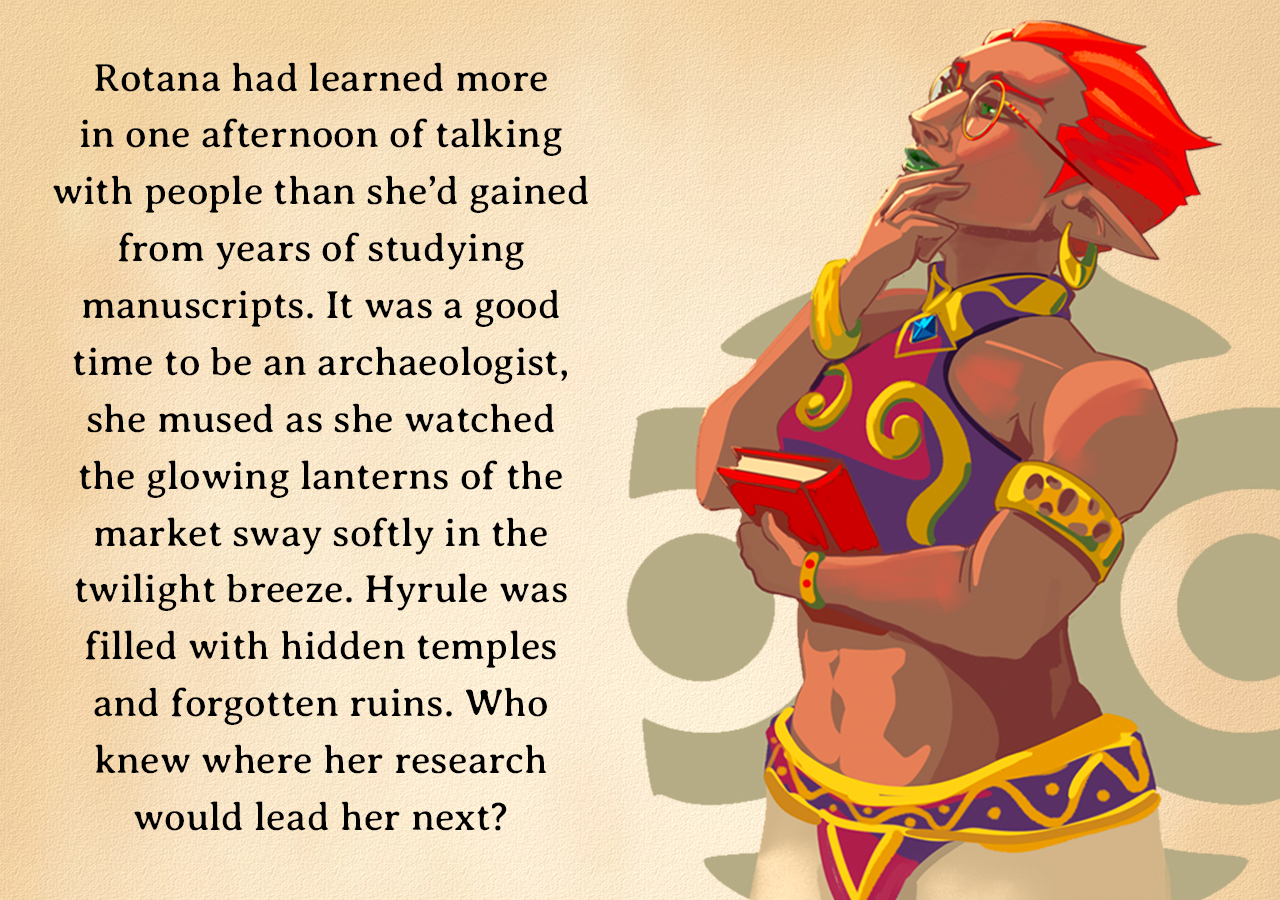
By happy coincidence, the Gibdo attack on Gerudo Town grants the Gerudo archaeologist Rotana a breakthrough in her research on the Seven Heroines. Link’s assistance was invaluable in locating the first mystical orb of the Heroines, but Rotana has resolved to find the others on her own. As she speaks with the residents of Gerudo Town, Rotana becomes acquainted with the virtues espoused by the Heroines and learns that knowledge can be found in surprising places.

I love Rotana as a character, and it’s one of the highlights of Tears of the Kingdom to listen to her lectures. Also, as an academic, it’s a guilty pleasure for me to write about research and fieldwork and the hurdles on the way to publication. Still, what I really wanted to do with this piece was tell a story about everyday life in Hyrule. Because Link is the hero of a video game, everything seems to revolve around him, so it’s interesting to get an outside perspective.

In particular, I wanted to see the characters in Gerudo Town living their best lives and solving their own problems without Link’s help. I hope this story draws the reader into a beautiful setting where the everyday quests of regular people are just as meaningful as Link’s journey to rescue Zelda.

The story is on AO3 here:
https://archiveofourown.org/works/57922744

I’m honored to have contributed this piece to Residents of the Wild, a gorgeous digital fanzine celebrating the NPCs of Breath of the Wild and Tears of the Kingdom. The zine was published on August 3, and you can still order a digital copy during the Zeldathon charity event beginning on August 13.

I consider myself extremely lucky to have my story illustrated by the legendary Linktober veteran Taboonle, who created a radiant portrait of one of Hyrule’s premier scholars. Taboonle draws amazing character art as well as cute comics with a gentle sense of humor, and you can check out his work on Instagram (here) and on Tumblr (here).

Games like Echoes of Wisdom

Are you excited about Echoes of Wisdom and can’t wait to play it? Thankfully, there’s a wealth of excellent Zelda-style games with female and nonbinary protagonists made by small studios that you can jump into right now on Nintendo Switch. These are eight of my favorites…

Do you wish Zelda got to fight with a sword?
Check out: Ocean’s Heart

Are you nostalgic for the gameplay and dungeons of A Link to the Past?
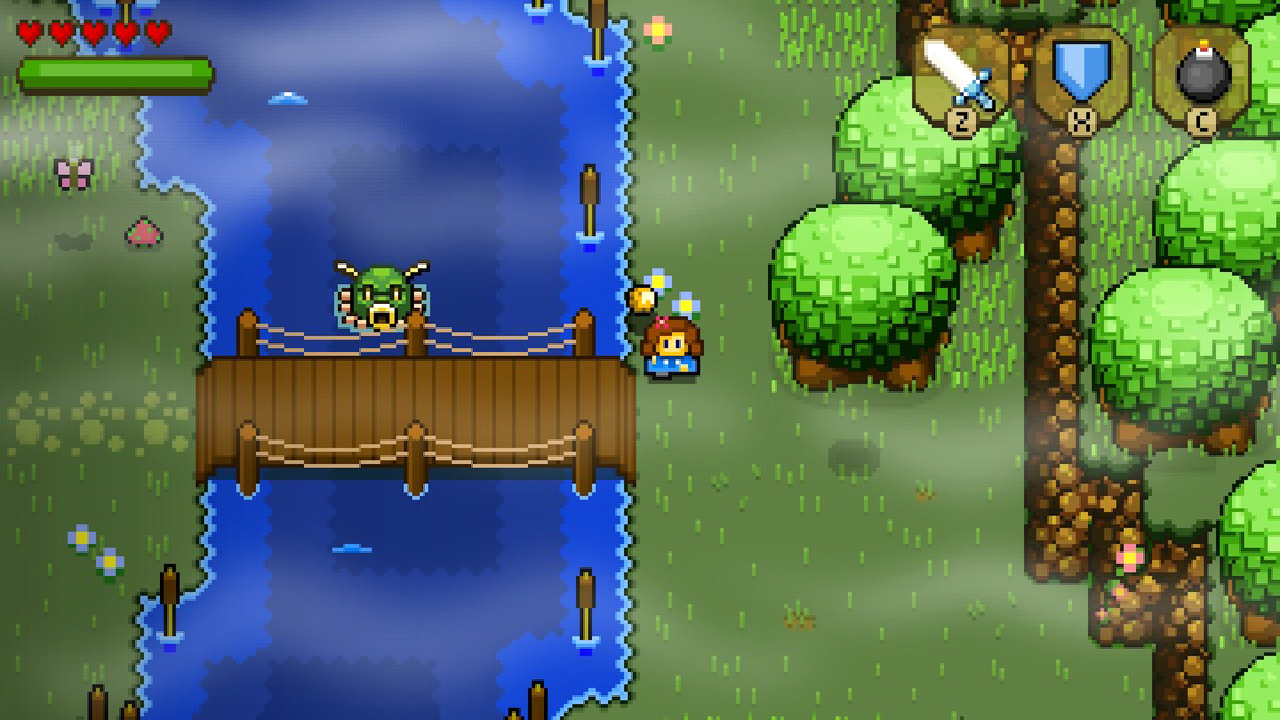
Check out: Blossom Tales: The Sleeping King

Are you hungry for more rock-tossing action?
Check out: Lila’s Sky Ark

Are you looking for cute graphics and a nonbinary protagonist?
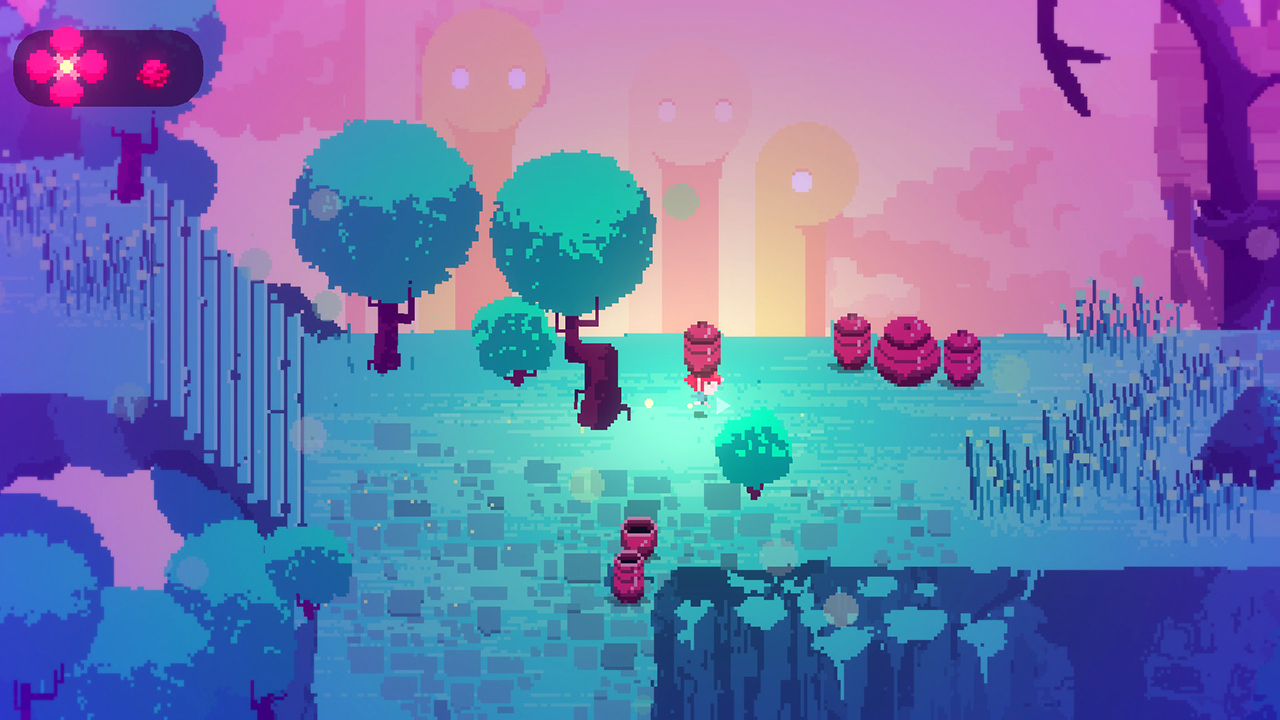
Check out: Frogsong

Would you like a simple and easy game to share with kids?
Check out: Arietta of Spirits

Would you like a challenging game with accessibility options?
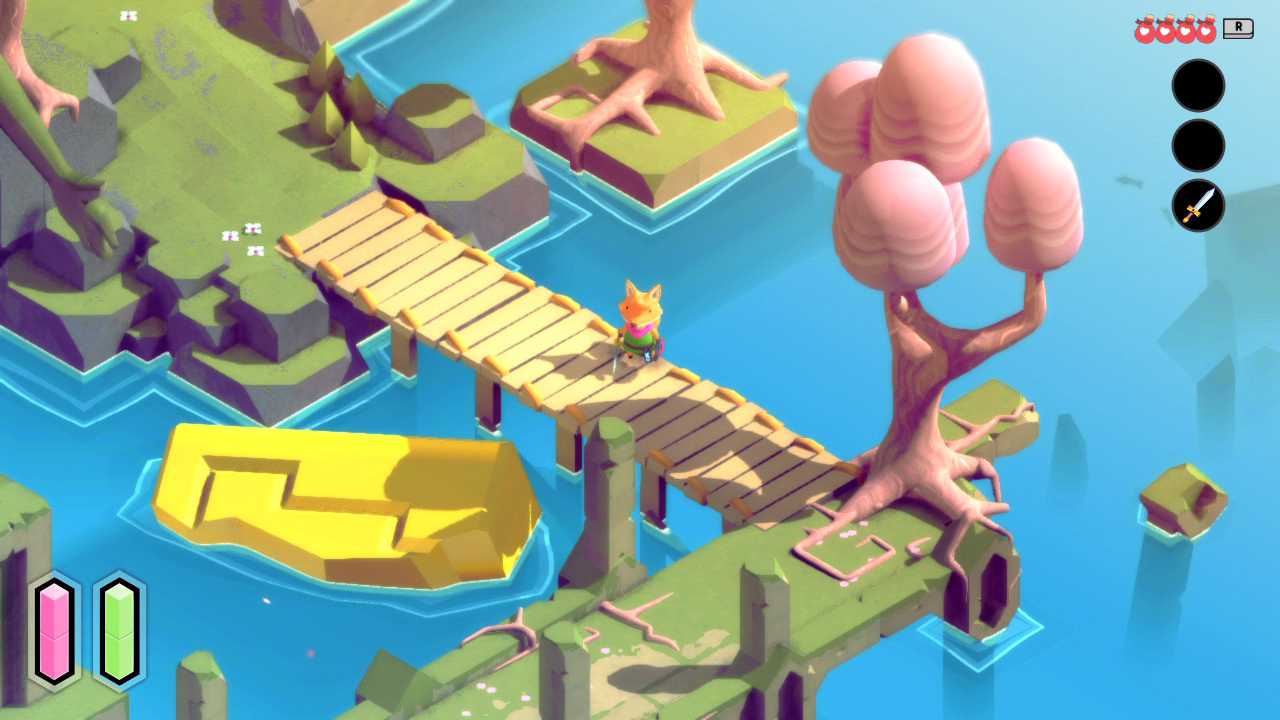
Check out: Tunic

Do you prefer the game to be super difficult and have deep lore?
Check out: Hyper Light Drifter

Do you want your female character to wield both a sword and magic, and will you be satisfied with nothing less than complex and multilayered combat in an exploration-rich dark fantasy world that hides a tragic story about the suffering implicit in the rise and fall of empires? 
Check out, unironically: Dark Souls

When the Moon Didn’t Fall

All the clocks in Clock Town have stopped working, and letters have stopped arriving from the Gerudo in the Great Bay. Both the clock master’s daughter and the swamp witches’ son sense that something is amiss. Slowly they come to understand one another while their world gradually winds itself apart.

When the Moon Didn’t Fall is a short novella that imagines what Zelda and Ganon would look like in the world of Majora’s Mask. According to the Legend of Zelda Encyclopedia, Termina only exists as a dream inside Link’s mind, and it’s interesting to analyze how the events and characters of Majora’s Mask reflect the trauma that Link experienced in Ocarina of Time. I therefore wanted to use Termina as a stage to explore the trauma of Zelda and Ganon, specifically within the context of a dream that’s rapidly fading.

I think it’s fair to admit that I was strongly inspired by Stephen King’s 1990 novella “The Langoliers,” which is a disturbing bit of speculation concerning what happens to the world of the past after the present has already moved on. I tried to capture a similar sense of time (literally) running out, a theme that felt appropriate to the anxiety-inducing atmosphere of Majora’s Mask. Like “The Langoliers,” When the Moon Didn’t Fall has elements of uncanniness and horror, but it’s also about forgiveness, healing, and hope for the future.

I originally wrote this story back in 2018, but it still holds a special place in my heart. I completed a substantial set of edits so that I could include one of the early chapters in my portfolio of writing samples for The Whispers of Hyrule, an upcoming Legend of Zelda fanzine celebrating Hyrule’s forests. I love the swamp forest bordering the open plains of Majora’s Mask, and I enjoyed revisiting the strange green spaces of Termina through this fic.  

You can read the full story on AO3 here:
https://archiveofourown.org/works/14093202/

The story illustration was created by the dangerously talented Thali, whose cool and creepy video game art can be found on Twitter (here), on Instagram (here), and on Tumblr (here).

Evil Gardening with Ganondorf

I always seem to find myself in a Wind Waker mood during summer. One of the many things I love about The Wind Waker is how beautiful and green and breezy it is. It’s a joy to spend time in the world of the game, which is filled with all sorts of strange and interesting creatures.

To me, then, it’s always been amusing that the Deku Tree in the Forest Haven blames this state of affairs on Ganondorf. I believe the implication is supposed to be that Ganondorf is so innately evil that his very presence on the Great Sea causes monsters to appear, but that’s extremely silly. Ganondorf may be up to no good, but he’s just a crabby old man.

If Ganondorf is responsible for the appearance of plant monsters, I prefer to think that this is because one of his many old man hobbies is gardening. Evil gardening!!

This comic was drawn by the darkly brilliant Frankiesbugs, whose cute and creepy illustrations and comics can be found on Tumblr (here), on Instagram (here), on Cara (here), and on Redbubble (here). Frankiesbugs is also responsible for the comic art and environment design featured in an upcoming beat-em-up game called V’s Rage. Like Wind Waker, V’s Rage boasts plenty of cute creatures, beautiful sun-soaked landscapes, and ridiculous middle-aged men. You can check out the game and play a substantial free demo on Steam (here).

A Zelda Game Starring Princess Zelda

When the first trailer for Tears of the Kingdom was posted in June 2019, fans were excited about Princess Zelda’s new cropped haircut. Perhaps this meant she would be a playable character, people speculated, as it meant that no weapons or armor would have to clip through her hair. In November 2020, Zelda was indeed one of the main playable characters in Age of Calamity. Although it’s great fun to use Zelda’s magical light blasts to part seas of swarming enemies, it was also somewhat disappointing that the gameplay of Age of Calamity positioned Zelda as just another fighter, while Zelda was largely absent from the gameplay of Tears of the Kingdom.

No one can deny that Zelda is an important character in the games that bear her name, but it’s a shame to see her sidelined. My frustration with Tears of the Kingdom made me wonder what the gameplay of a title that focused on Princess Zelda might look like…

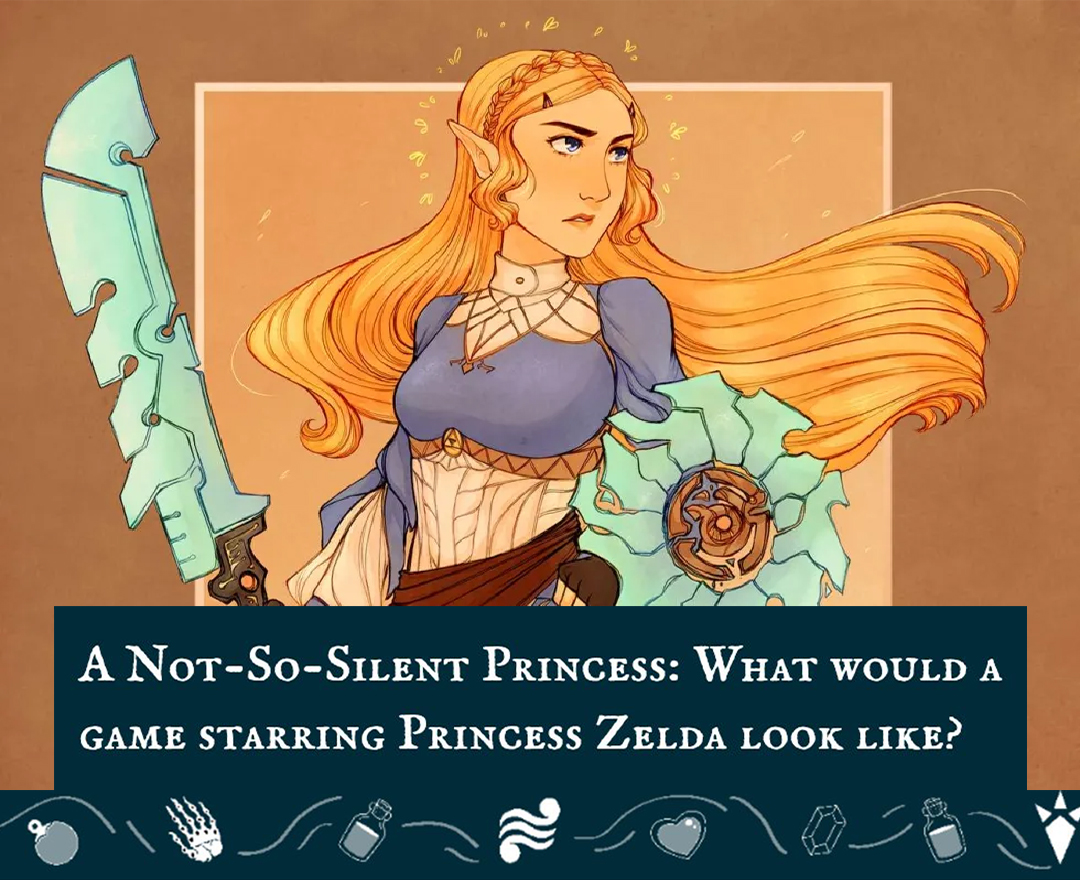
I recently had the opportunity to write a short essay for the Zelda Creators community blog based on this month’s creative prompt, “How would you design a Legend of Zelda game?” I’ve been thinking about what Princess Zelda might look like as a video game protagonist for years, and it was a lot of fun to share my ideas. I included some illustrations that I’ve commissioned over the years that envision Princess Zelda as a playable character, and the art used for the preview graphic is by the wise and powerful Benvey0 on Tumblr.

If you’d like to read the full essay, you can find it here:
https://www.zeldacreators.com/blog/a-not-so-silent-princess

An Elegy of Earth and Sky

An Elegy of Earth and Sky
https://archiveofourown.org/works/55003288

Long ago, in a time now lost to the ages, Hyrule was a formless void roiling with primal darkness. Seeing potential in this untapped energy, three goddesses descended from the source of light to shape Hyrule according to their will. They bestowed three sacred virtues upon their daughter before leaving her in the land they created, where the god of the earth waited to grant her a gift of his own.

I’ve been intrigued by the mythology of the Legend of Zelda games since I first read the fantastically illustrated story of Hyrule’s creation in the game manual for A Link to the Past, and I’ve enjoyed how games like Ocarina of Time and Skyward Sword have expanded on the divine cosmology of the series. I was frustrated by the lack of any foundational mythology in Tears of the Kingdom, so I decided to write my own version of Hyrule’s origin story. The first half is based on Hesiod’s Theogony, while the second half borrows from one of the stories about Izanami and Izanagi in the Kojiki. Hopefully this short story reflects the poetry of its inspirations!

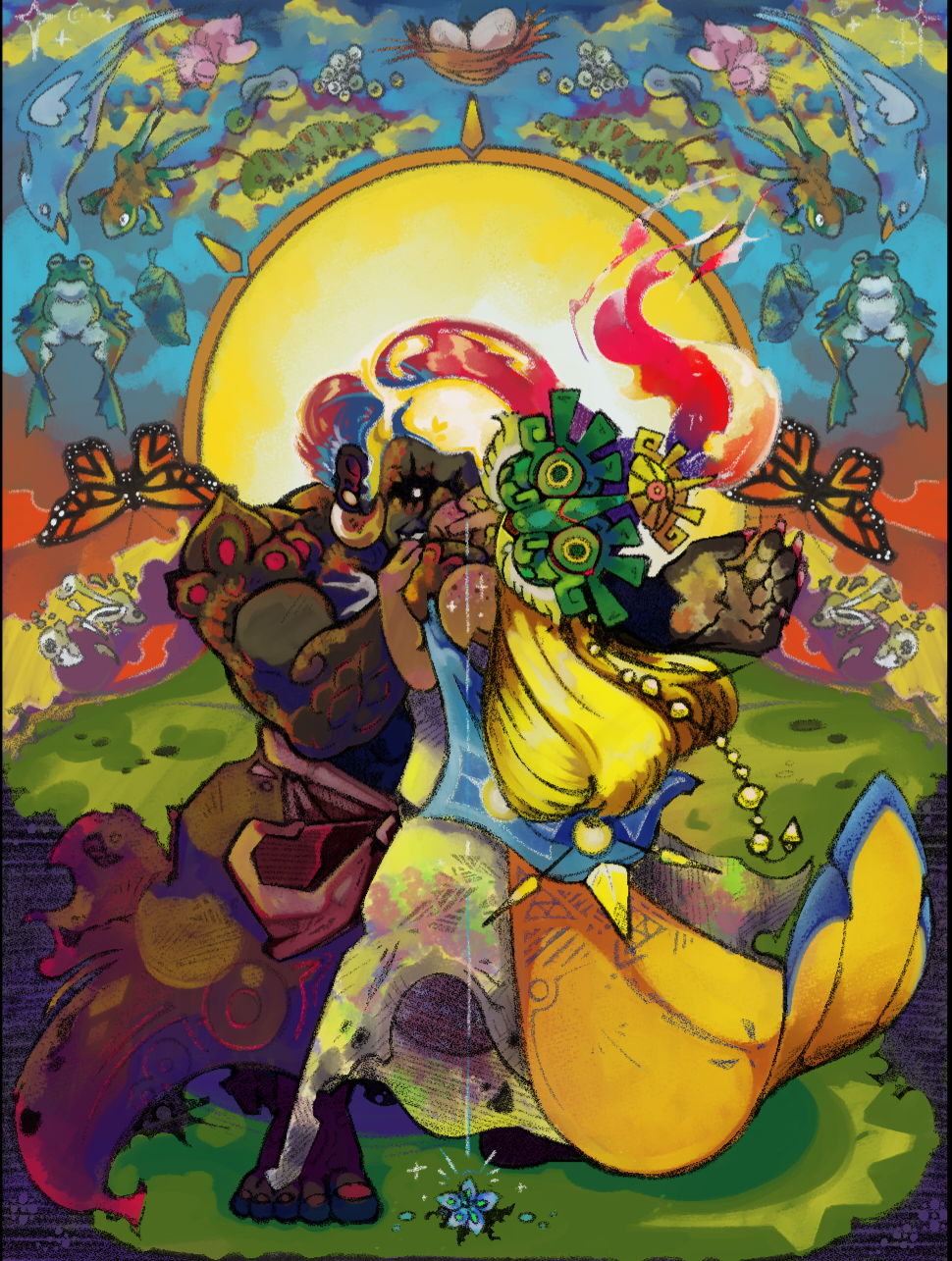
The illustration that accompanies this story was created by Hylias_Disgrace, a purveyor of the strange and divine whose gorgeous character art and intriguing comics can be found on Instagram (here). It was the artist’s decision to use the famous Gustav Klimt painting The Kiss as a way to bring out the parallels between Hyrule’s deities and the myth of Hades and Persephone, and I love how this dynamic illustration celebrates the cycles of the natural world.

A Record of the Calamity

This collection of meta essays explores the worldbuilding and cultural background of Hyrule and its inhabitants during the timeline of Breath of the Wild and Tears of the Kingdom.

Ninja Lore in Breath of the Wild
On the historical precedents of the Sheikah, the origins of the names “Yiga” and “Kohga,” and how the culture of historical ninja is referenced in the story and setting of Breath of the Wild.

Governance in Hyrule
On the nature and questionable necessity of the Hyrulean monarchy in comparison with other systems of governance in Hyrule.

Zelda and the Calamity
On how Zelda’s repressed emotions may have surfaced in a tragic explosion of chaotic power.

Ganondorf as an Agent of Change
On Ganondorf’s role as the villain of a heroic fantasy, the existential challenge he poses to Hyrule, and the necessity of disruption to an otherwise closed system.

Ganondorf’s Design in Tears of the Kingdom
On the Japanese cultural references incorporated into Ganondorf’s visual design.

The Two Kings in Tears of the Kingdom
On the fantasies of Japanese cultural identity represented by Rauru and Ganondorf, and why the power structures associated with the two kings are disavowed by Zelda.

Zelda Horror Zine Preorders Open

I’m excited to share a preview of my story for Blood Moon Rising, a Legend of Zelda horror fanzine.

I wrote about the undead princess of Zelda II, as well as the decision that Impa is forced to make in dooming the princess of the original Legend of Zelda to the same fate. The two NES Zelda games are deeply dystopian, and I enjoyed going full Dark Souls while exploring the decay of their horrifically postapocalyptic settings.

Preorders of the zine are open until March 15, and all proceeds will go to Medical Aid for Palestinians. There’s some truly frightful work in this zine, so please check out their social media if you’re interested!

🩸 https://bloodmoonzine.carrd.co
🩸 https://bloodmoonzine.tumblr.com
🩸 https://twitter.com/BloodMoonZine
🩸 https://bloodmoonrising.bigcartel.com

The Memory of Stone

I wrote “The Memory of Stone” back in 2020, when the announcement of a sequel to Breath of the Wild encouraged many Legend of Zelda fans to speculate that the game would feature Princess Zelda as a playable character. I returned to this story after finishing my second playthrough of Tears of the Kingdom, which reduces Zelda to a voiceless source of crafting materials. It was a disappointment, to say the least.

One might argue that there are other games with female protagonists, so why insist on playing as Zelda? I would counter this argument with another question: why not play as Zelda? The concept of Zelda as a playable character makes perfect sense within the context of the games’ stories. Link’s journey almost always runs parallel to a journey that Zelda undertakes on her own, after all, and being able to explore Hyrule with a different set of skills (and from a different narrative perspective) would be a lot of fun.

“The Memory of Stone” follows Zelda through each of the temples in Ocarina of Time, and it’s a small attempt to imagine what the eponymous “legend of Zelda” might look like through the eyes of Zelda herself.

You can read the story on AO3 here:
https://archiveofourown.org/works/25230271

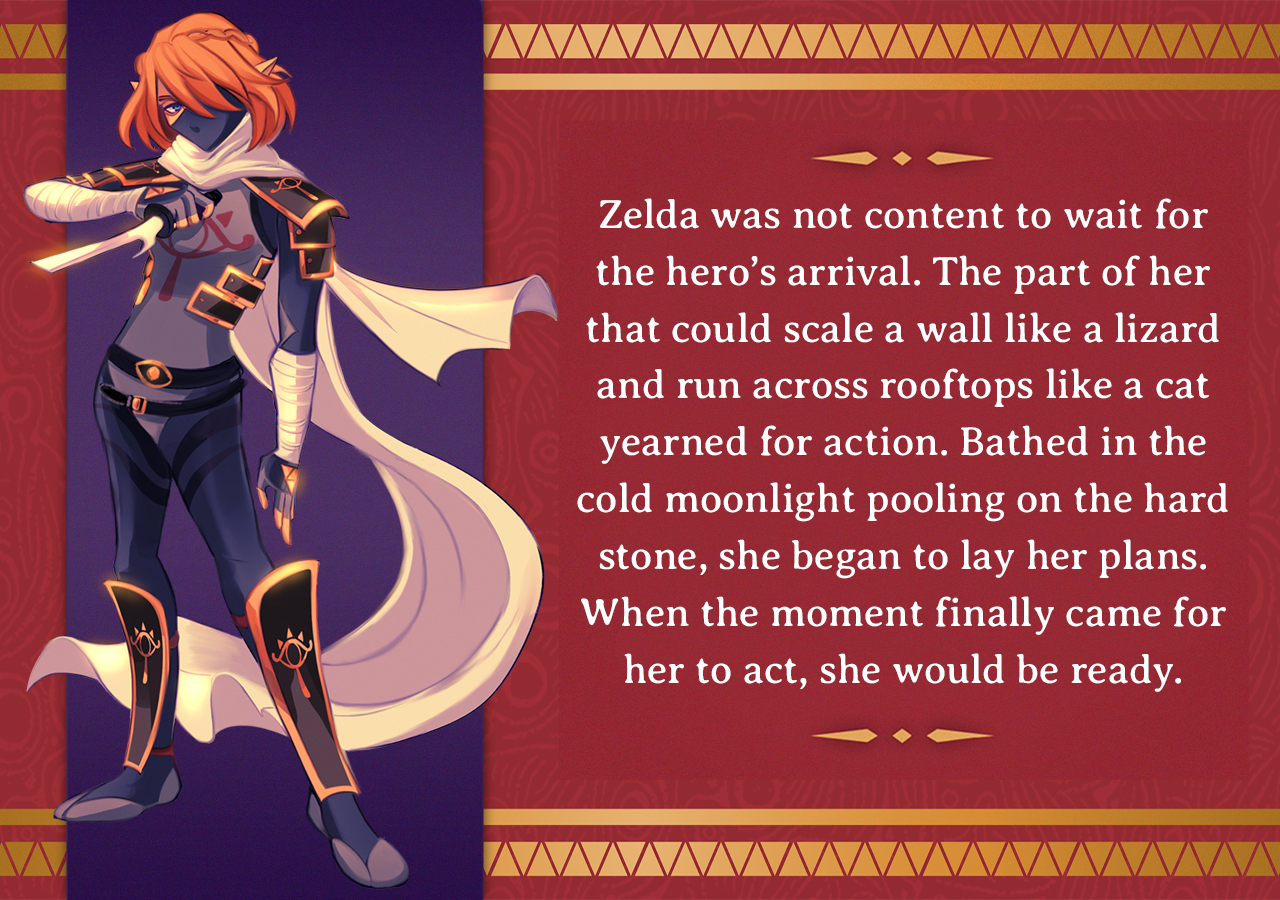
The illustration of Sheik included in the story preview graphic was drawn by the revolutionary Nolvini, a fan of shōjo anime who creates magical character illustrations filled with personality and flare. You can check out her work on Twitter (here), on Instagram (here), and on Tumblr (here), and she also has a shop on Etsy (here).

Love in the Time of Gloom Spawn

After years spent investigating the mysterious shrines of East Necula, Dr. Calip has joined the Zonai Survey Team’s efforts to study the Ring Ruins of Kakariko Village. The ancient structures are fascinating, but what has captured Calip’s attention is the chasm in the forest on the hill. While Calip has been gazing into the abyss, however, the leader of the Zonai Survey Team has been gazing at him.

As I grow more impatient with grand narratives of nation-building and heroic destiny, I’ve become more interested in how epic fantasy universes appear to normal people. Hyrule is especially fascinating as a case study, as the privileges enjoyed by Link clearly aren’t applicable to everyone else. This is especially true of the knowledge Link accumulates over his journey, during which the secrets of prior eras are revealed to him alone.

In the present postapocalyptic era of Breath of the Wild, it seems the only person trying to study and understand Hyrule is a scholar named Calip, who lives in an isolated cabin as he attempts to stage an archaeological investigation into the site of one of the ancient Sheikah shrines. As an academic, Calip is a pompous asshole. Regardless of “Dr.” Calip’s self-serving motives, I admire him as a character who investigates the world and tries to understand it instead of simply killing things and accumulating treasure.  

Perhaps because of the popularity of the fandom’s speculation and study of Hyrule, Tears of the Kingdom leans into the ethos of archaeological inquiry with the establishment of a large and diverse set of NPCs forming the Zonai Survey Team. This Sheikah-funded research organization is led by a brick house of a character named Tauro. Tauro has set himself up in Kakariko Village, which has been beset by ruins falling from sky islands and a giant pit opening in the forest on the eastern hill.

Given their interests, it’s only natural that Calip and Tauro would interact. When you read the diaries that Calip has left at his former cabin and at his desk in his office in Kakariko, you learn that Calip is undeniably attracted to Tauro, who apparently went out of his way to invite Calip to work with him. Late in the game, the two men abandon their duties to run off and do research together. I think is a sweet lowkey love story – and even Kotaku agrees, apparently!

The emphasis on archaeological excavation in Tears of the Kingdom is somewhat problematic. In essence, the kingdom of Hyrule had a state-building myth that justified its sovereignty over the surrounding regions, and the result of the archaeological study performed by state-sponsored Zonai Survey Team is the demonstration that these myths were true in the most literal sense. Yes, there are evil outsiders who will kill everyone if they get the chance; and yes, only the royal family and its servants can protect everyone; and yes, the royal family is literally descended from gods/dragons. It’s all kind of gross.

What I therefore appreciate about the implied love story between Calip and Tauro is that they turn their backs on the politics of ancient texts and leave Kakariko so that they can go out into the woods and look at ruins together. For them, curiosity about the world has nothing to do with national mythologies and everything to do with the connection they feel to the people who lived on the land before them – and the connection they have with each other.

Because I am apparently incapable of creating anything that doesn’t have monsters, however, the story I wrote about Calip and Tauro ended up being a horror story as much as it is a love story. It has a happy ending, but it also has a healthy dose of eldritch horrorterrors. Phantom Ganon also makes an appearance, because of course he does.

The story is complete at 4,000 words, and you can read it on AO3 here:
https://archiveofourown.org/works/51328888

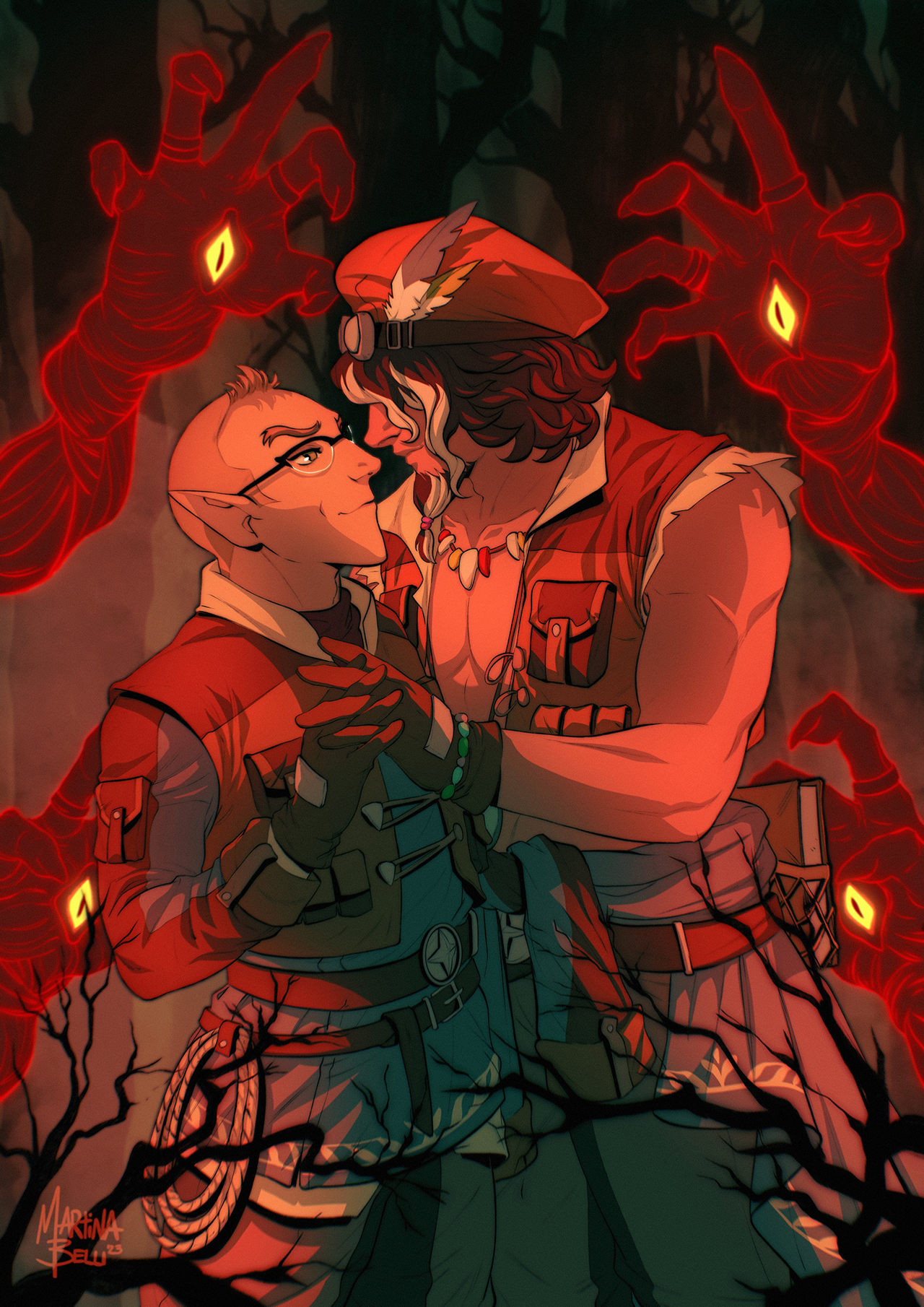
The illustration is by the marvelously talented Martina Belli, whose magical artwork helped me bring these two characters and their story to life. Marty paints dynamic portraits of fantasy characters and dramatic science fiction scenes, and she excels at creating compositions that draw the viewer into the world of her art. It was a lot of fun to work with her, and I highly recommend following her creations on Twitter (here).