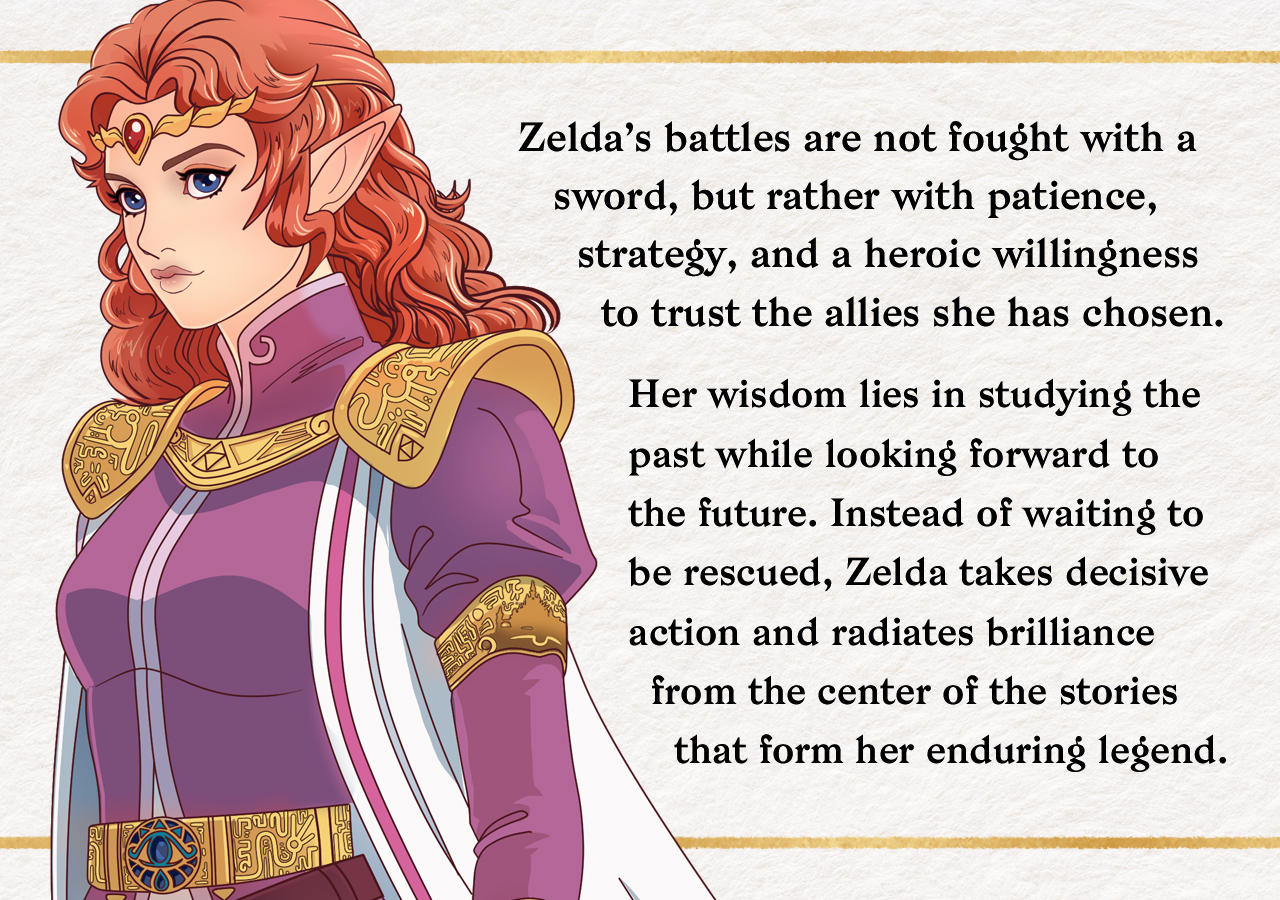
The Wisdom of the Waiting Princess

The Wisdom of the Waiting Princess is an empowering feminist reading of how the trope of the “captive princess” applies to the Zelda of the original 1986 game. While this Zelda is an action hero in her own right, her wisdom manifests in her remarkable ability to lay plans for the future.

You can read the essay on AO3 here:
https://archiveofourown.org/works/67410167

I had the honor of contributing this essay to Silent Princess: A Zelda Zine. The zine’s website is on Carrd (here), and you can check out the art and writing featured in the zine on its Tumblr site (here). Leftover sales of the zine merch are currently open (here), and you can still pick up a digital copy of the zine (here). All profits from zine sales will go to support Doctors Without Borders.

This original design for Princess Zelda was created by Hollarity, who put an incredible amount of love and care into portraying the character as a courageous young woman who is fully capable of going on her own adventures. You can find more of Holly’s gorgeous artwork on her website (here).
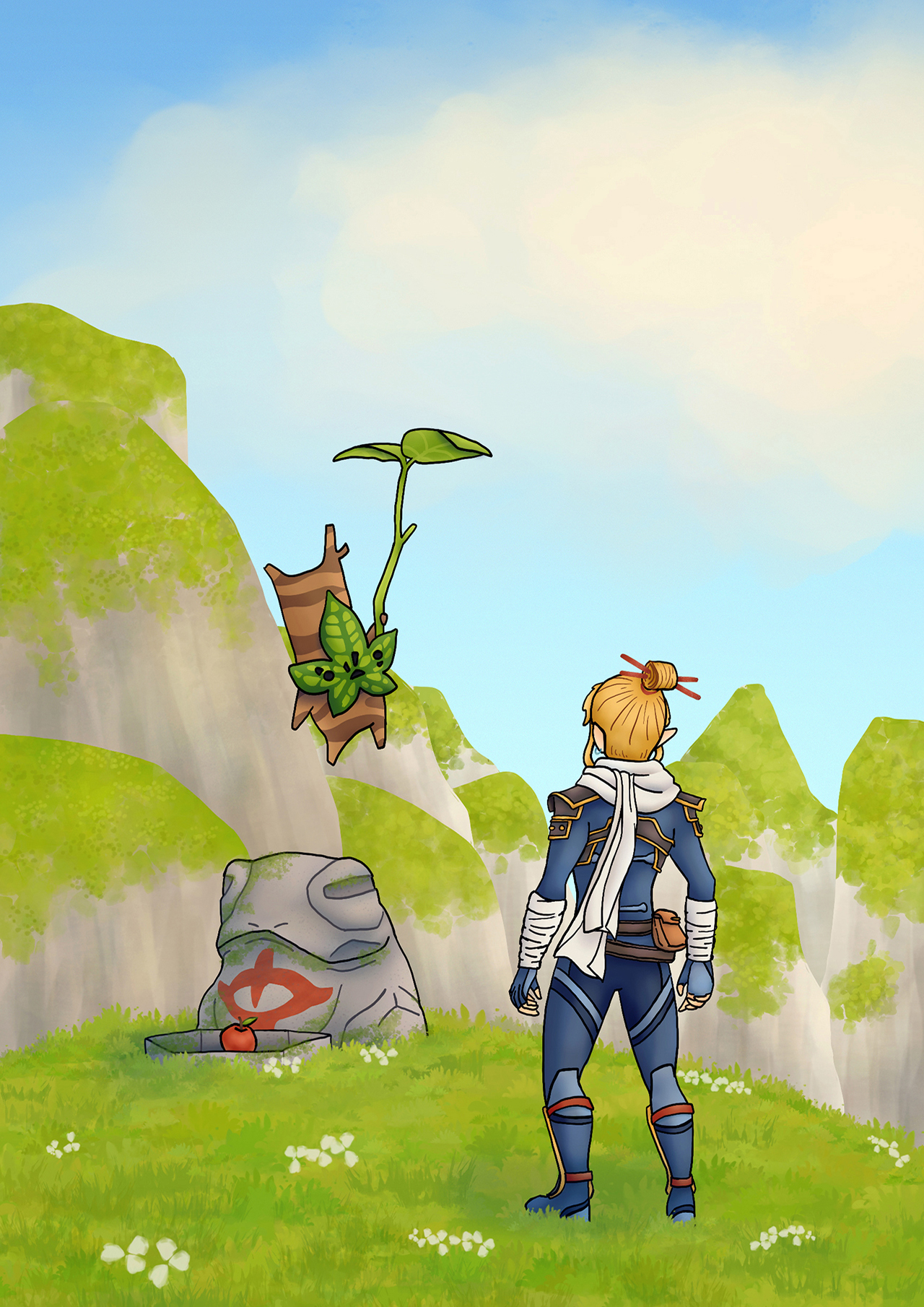
Kakariko Hills

The mountains overlooking Kakariko Village are one of my favorite places in Breath of the Wild.

Most players will visit Kakariko Village early in the game, and it’s possible for a more experienced player to climb the surrounding hills and venture into the mountains. Link can find Koroks by solving little environmental puzzles (in this case, putting an apple in the offering plate in front of the frog statue), and the optional hunt for Koroks encourages the player to explore the hidden corners of the map. There’s no meaningful material reward for finding this Korok, but the scenery is impressive. This experience of discovery is a perfect example of what I love about video games – the joy of the journey.

It’s hard to say I have a favorite game, but I’m a big fan of Breath of the Wild. I live in a neighborhood of Philadelphia that has almost no plants or trees, and the beautiful landscapes in this game provide a much-needed immersion in green space while inspiring me to engage in urban gardening. I love open-world games in general, but Breath of the Wild is the first one I played and the one I keep returning to.

This illustration was my submission to the Videogames Zine published by Coin-Operated Press, a cool zine community based on Scotland that’s open to people from all over the world. You can follow them on Instagram (here), where they post news about events and upcoming calls for submissions.

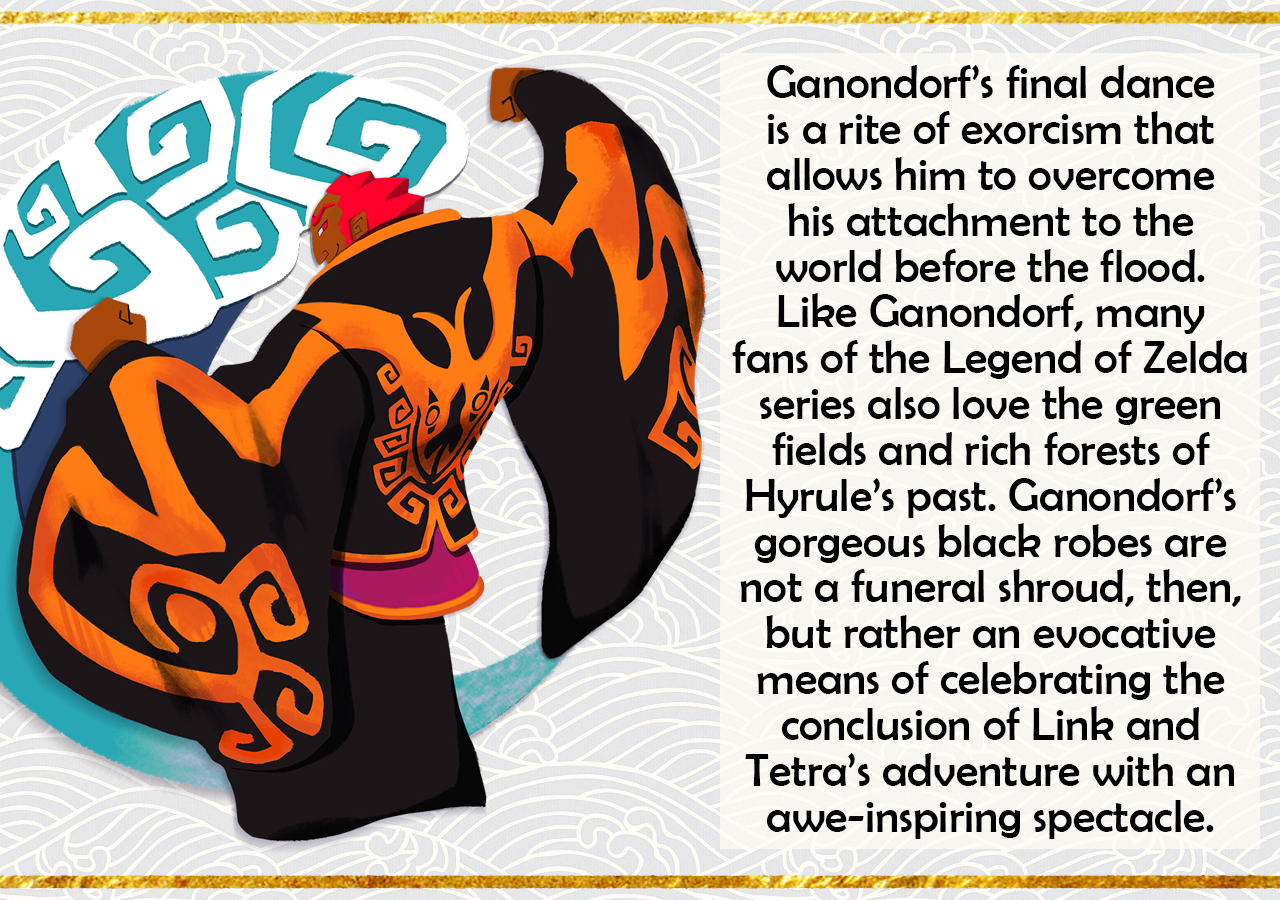
Ganondorf’s Robes in The Wind Waker

I’m excited to share my contribution to Hyrule Fashion Anthology, a fanzine celebrating the complex evolution of fashion history through the characters and setting of the Legend of Zelda series. Here’s a short description…

“A Wind-Grieved Ghost” discusses the influence of medieval Noh theater on the striking costume worn by Ganondorf in The Wind Waker. I provide a brief introduction of Noh drama and summarize how its character archetypes are enhanced by their clothing. I then explain the symbolism of Ganondorf’s gorgeously patterned robes and argue that the sartorial allusions to Noh theater serve to characterize Ganondorf as a frightening yet tragic ghost displaced from the beautiful vanished kingdom of Hyrule.

If you’re interested, you can read the full essay on AO3 here:
https://archiveofourown.org/works/60062635

I consider myself extremely fortunate to have this essay illustrated by the dangerously stylish Astarsor, who shares bold and colorful character portraits on Instagram (here).

Leftover sales for Hyrule Fashion Anthology are open until November 15. This is a beautifully published zine filled with gorgeous artwork and fascinating articles inspired by the golden age of glossy fashion magazines, and it’s a stunning physical object. You can pick up a digital or paper copy along with a dazzling selection of merch via the zine’s storefront (here).

When the Moon Didn’t Fall

All the clocks in Clock Town have stopped working, and letters have stopped arriving from the Gerudo in the Great Bay. Both the clock master’s daughter and the swamp witches’ son sense that something is amiss. Slowly they come to understand one another while their world gradually winds itself apart.

When the Moon Didn’t Fall is a short novella that imagines what Zelda and Ganon would look like in the world of Majora’s Mask. According to the Legend of Zelda Encyclopedia, Termina only exists as a dream inside Link’s mind, and it’s interesting to analyze how the events and characters of Majora’s Mask reflect the trauma that Link experienced in Ocarina of Time. I therefore wanted to use Termina as a stage to explore the trauma of Zelda and Ganon, specifically within the context of a dream that’s rapidly fading.

I think it’s fair to admit that I was strongly inspired by Stephen King’s 1990 novella “The Langoliers,” which is a disturbing bit of speculation concerning what happens to the world of the past after the present has already moved on. I tried to capture a similar sense of time (literally) running out, a theme that felt appropriate to the anxiety-inducing atmosphere of Majora’s Mask. Like “The Langoliers,” When the Moon Didn’t Fall has elements of uncanniness and horror, but it’s also about forgiveness, healing, and hope for the future.

I originally wrote this story back in 2018, but it still holds a special place in my heart. I completed a substantial set of edits so that I could include one of the early chapters in my portfolio of writing samples for The Whispers of Hyrule, an upcoming Legend of Zelda fanzine celebrating Hyrule’s forests. I love the swamp forest bordering the open plains of Majora’s Mask, and I enjoyed revisiting the strange green spaces of Termina through this fic.  

You can read the full story on AO3 here:
https://archiveofourown.org/works/14093202/

The story illustration was created by the dangerously talented Thali, whose cool and creepy video game art can be found on Twitter (here), on Instagram (here), and on Tumblr (here).