Essay about Junji Ito’s Manga “Town of No Roads” on Shelfdust

I recently had an opportunity to write a short essay for the comics website Shelfdust about Junji Ito’s short story “Town of No Roads” (道のない街), a stand-alone manga from 1992 included in the 2002 collection Alley (路地裏), which was published in English translation by Viz Media in 2024.

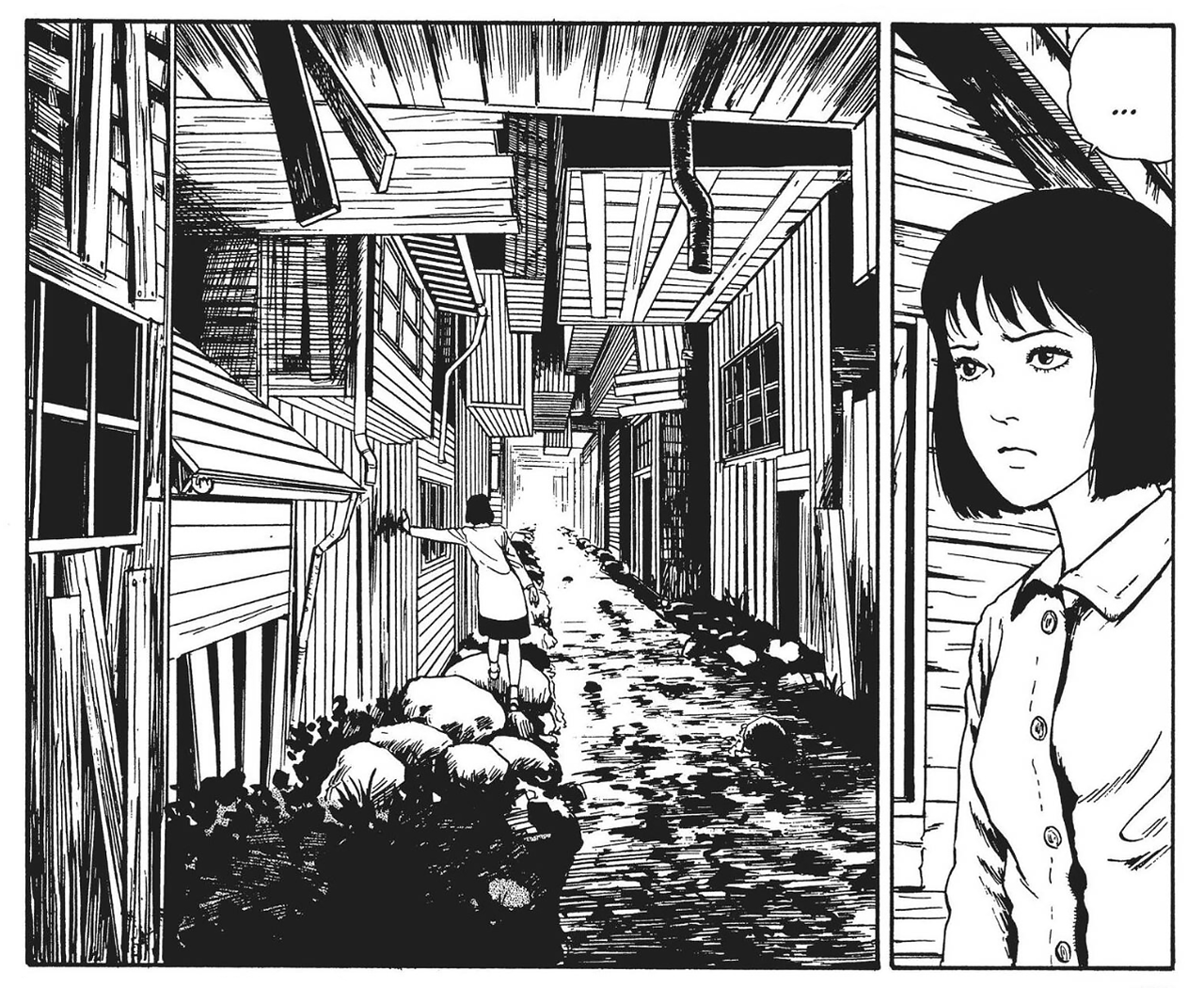
“Town of No Roads” is an oddly structured story that begins with a teenage girl’s experience of having her privacy violated. After she decides to leave home, the manga follows her journey into a weird labyrinthine suburb that’s been rebuilt into one giant wooden house. I’ve always been intrigued by the imagery of “Town of No Roads,” and I thought it might be fun to explore its take on the theme of postwar nostalgia as expressed through its uncanny architecture.

Part of my conclusion is a paragraph that goes…

The pleasure of a labyrinth is that you can enjoy the sensation of getting lost while always knowing that you can simply leave. Perhaps the same can be said of nostalgia as well, and so much the better. The reactionary mode of thought that insists society used to be better when protections for individual rights and dignity were more limited has unpleasant implications, after all. Perhaps it’s best not to linger in this space for too long.

This conclusion makes sense in relation to the story, but what I also mean is that a mode of thought that holds that “things were better before Second Wave Feminism” (which definitely existed in Japan) steps into the territory of horror. I don’t say that part out loud in my essay, but a careful reader will probably understand what’s going on. In all fairness, I’m not entirely sure that Junji Ito intended for a political message to be read into this manga; but, if nothing else, it feels validating to know that he finds certain aspects of the postwar period as creepy as I do.

You can read the full essay on Shelfdust here:
https://shelfdust.com/2026/10/28/how-to-escape-junji-itos-town-of-no-roads/

Review of The Harrowing Game on Comics Beat

I consider myself extremely fortunate to have been an early reader of Antoine Revoy’s newest graphic novel, The Harrowing Game. I love this book, which is strongly inspired by Junji Ito but still very much its own thing. I’m also lucky to have gotten an opportunity to write a review for Comics Beat. Here’s an excerpt…

The Harrowing Game will delight fans of Junji Ito and H.P. Lovecraft, to be sure, and connoisseurs of horror will appreciate Revoy’s intriguing interpretations of familiar tropes. Revoy twists gothic stories into broken reflections of cultural anxieties, and the storytelling is no less dramatic for the subtlety of its social commentary. If nothing else, it’s a pleasure to get lost in the details of Revoy’s spectacular illustrations. Whether you’ll be able to find your way out untouched and undisturbed is another story.

You can read the full review on Comics Beat here:
https://www.comicsbeat.com/graphic-novel-review-the-harrowing-game/

NextDoor

NextDoor
https://broelbrak.itch.io/nextdoor

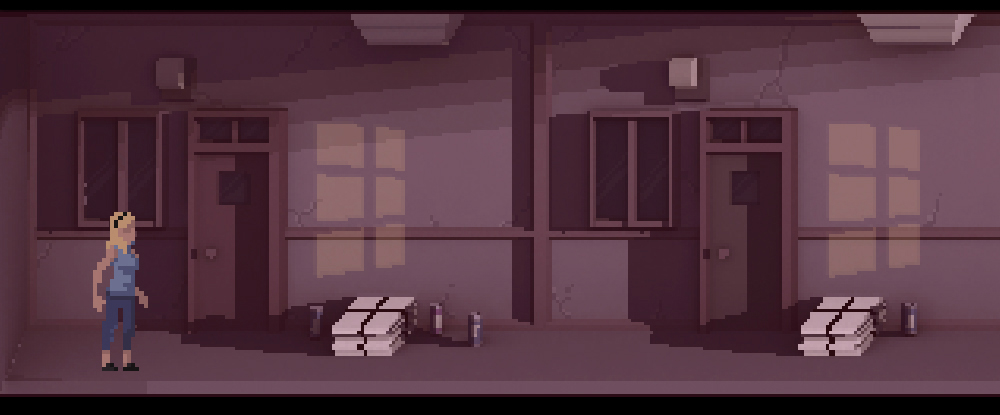
NextDoor is a spooky 2D interactive story game based on one of Junji Itō’s short horror manga. It’s free to download or play in your browser, and it takes about ten to fifteen minutes to read.

You play as a college student living in a rundown apartment building. The student is unable to concentrate because of the loud music blaring in the apartment above hers, so she finally snaps and goes to complain. The upstairs tenant is an asshole who refuses to turn down his stereo because his next-door neighbor has never said a word to him about the noise. If you can convince his neighbor to complain, the manchild gripes, perhaps he might listen to what you have to say.

The problem is that the next-door neighbors are decidedly unfriendly. Another tenant in the building says that there’s actually a group of women in that apartment, but they’re very quiet, and no one has ever spoken with them. Perhaps it’s not the best idea to attract their attention…

Despite its limited scope, the environment design of NextDoor is nicely done and more than sufficiently creepy. Ironically, the music is quite good, and the sound design is better. The character animations are a pleasure to watch, especially when the player gets to see more of the mysterious next-door neighbor.

“The Lady Next Door” is from Junji Itō’s collection Mimi’s Tales of Terror, and it’s a fun play on a category of Japanese urban legends that take the form of “here’s some weird shit I saw in a Shōwa-era (built before the 1990s) apartment building.” Itō transforms the tropes of these non sequitur “weird shit I saw” stories into a cautionary tale, and it’s delightfully cathartic to witness the unnecessarily harsh punishment of the transgressor. Because seriously, fuck that guy.

NextDoor’s adaptation of this manga is interesting in that it configures the college student as the transgressor. By association, you the player are the transgressor as well, and it’s fun to push the college student forward into increasingly bad decisions. She doesn’t die, but she most definitely sees some weird shit.

There’s one (very mild) jumpscare in the game, and it’s a cameo from my favorite Junji Itō manga, Junji Ito’s Cat Diary: Yon & Mu. Yon & Mu is exactly what you would expect from a cute autobio pet manga drawn by Junji Itō, and it’s marvelous. It’s always a pleasure to have an unexpected encounter with one of these adorable hellbeasts.