Essay about Analog Nostalgia on Shelfdust

I’m honored to have published an essay on Shelfdust about the gentle anti-capitalist use of cultural nostalgia in the French graphic novel Onibi: Diary of a Yokai Ghost Hunter, which is an autobiographical account of a summer the artists spent in rural northern Japan. When I used this book as a course text in my “Japanese Ghost Stories” class last fall, I was surprised by the warmth of the students’ response, which I suspect is tied to the trend of “analog nostalgia” that seems to be big on social media at the moment. I’d always thought of nostalgia as a reactionary cultural movement, but I have to admit that Onibi presents a welcome challenge to this assumption.

Here’s an excerpt from the beginning of my essay:

Onibi demonstrates a fascination with retro objects and aesthetics, which are presented as a refuge from hustle and productivity. As concerns regarding pressing issues such as unemployment and climate change grow ever more pressing, so too do anxieties concerning the speed and waste demanded by capitalism. I believe that the recent fascination with retro and analog technologies is partially a response to these anxieties. Given that comics have emerged as an increasingly visible and viable space for public discourse, I’d like to take a look at how Brun and Pichard use analog nostalgia to translate local culture into an argument for a break with contemporary capitalism’s insistence on constant growth. 

You can read the full piece here:
https://shelfdust.com/2025/10/15/analog-nostalgia-and-gentle-degrowth-in-onibi-diary-of-a-yokai-ghost-hunter/


Essay on WWAC about Machiko Kyō’s Manga Cocoon

I’m proud to have worked with the brilliant editorial team at Women Write About Comics on my essay “Nature and War Memory in Machiko Kyō’s Cocoon,” in which I discuss the imagery that propels the story of a heartbreaking graphic novel about the Pacific War.

An animated cinematic adaptation of Cocoon is scheduled to be released in Summer 2025. This is a high-profile project commissioned by NHK and directed by the veteran Studio Ghibli artist Hitomi Tateno, whose animation credits range from Spirited Away to The Wind Rises.

Although the essay (like the manga itself) should be approached with sensitivity to its content, I hope I was able to offer a small contribution to the international awareness of the narrative work of Machiko Kyō, a celebrated and prolific Japanese artist who has created some of the most groundbreaking manga of the past decade.

You can find my essay about Cocoon (here) on Women Write About Comics, an award-winning venue for media journalism covering pop culture from a diversity of perspectives. I’m extremely grateful for the support and excellent feedback of Emily Lauer (on Bluesky here), whose critical insight illuminates the discussions and reviews of genre fiction on WWAC.

Gender and Magic in Final Fantasy VI

Final Fantasy VI is deeply concerned with the relationship between human beings and technology. The game borrows many elements from Western fantasy and science fiction, yet the story and action are centered around two teenage female protagonists, Terra and Celes, who are variations on the “magical girl” and “beautiful fighting girl” archetypes of Japanese popular culture.

Back in 2016, I published an essay about “Gender and Magic in Final Fantasy VI” on the website of the sadly defunct gaming magazine Kill Screen. Since then, I’ve made substantial edits for clarity, and I posted the updated version on AO3.

This meta essay situates Final Fantasy VI within the cultural context of Japan in the 1990s in order to discuss how the game explores its posthuman themes through the bodies of its female characters. I demonstrate how Final Fantasy VI uses gender as a lens for its exploration of the intersections between biology and technology, and I argue that the otherness associated with Terra and Celes serves as a powerful analogy for anxieties surrounding the future of the human species in relation to seemingly magical biotechnologies.

You can read the essay on AO3 here:
https://archiveofourown.org/works/53596483

The cover illustration was created by Palliceart, an artist with a dual specialty in magical girls and beautiful fighting girls. You can find her gorgeous and ethereal artwork on Twitter (here), on Instagram (here), and on Tumblr (here).

Review of Japanese Role-Playing Games

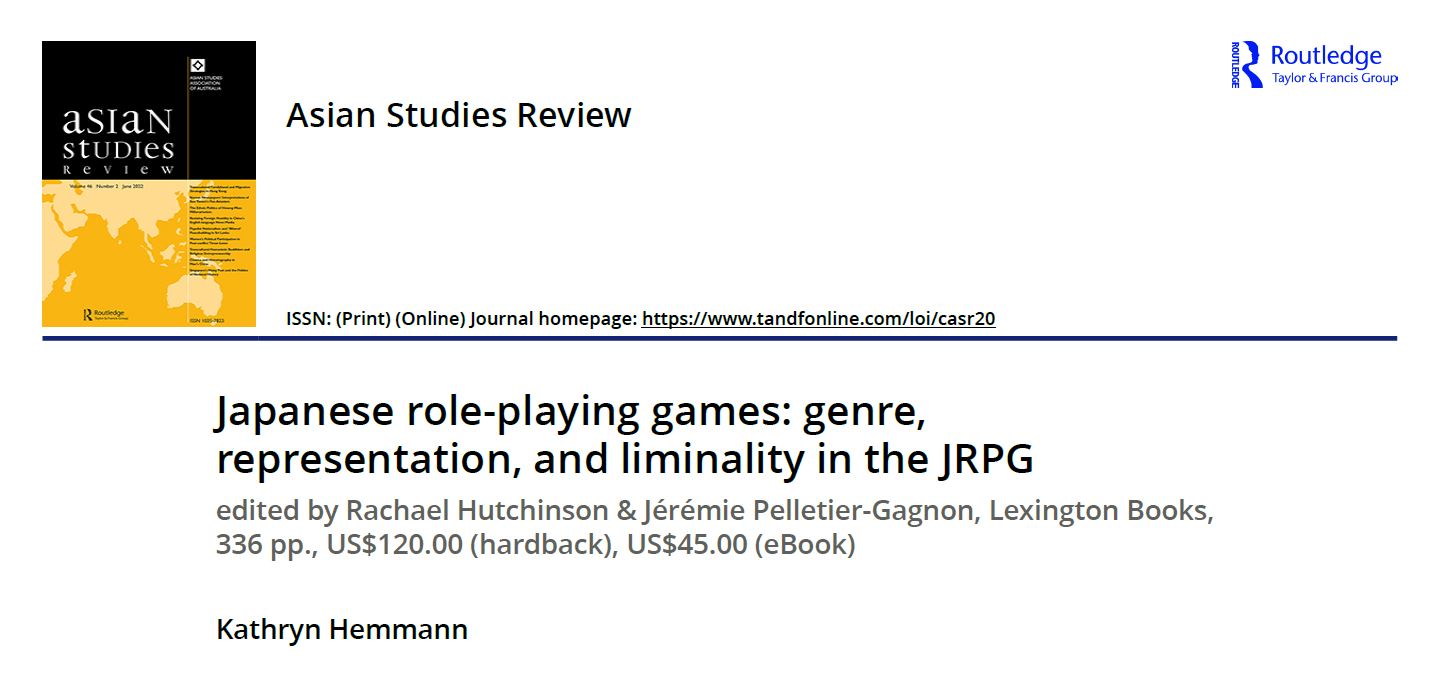
This past summer I was given an opportunity to review an academic essay collection titled Japanese Role-Playing Games: Genre, Representation, and Liminality in the JRPG. The work the two editors did for this collection is incredible, and every single essay is fantastic. Here’s a short excerpt from the book review that I published in the journal Asian Studies Review:

Japanese Role-Playing Games: Genre, Representation, and Liminality in the JRPG is the first English-language collection of essays focusing entirely on a genre of Japanese games known for their complex stories and rich worldbuilding. The fourteen essays in this collection cover the construction of the JRPG genre, the formation of transcultural gaming communities, and the representation of issues such as nationality, gender, and disability.

Japan Studies scholars with varying degrees of familiarity with the specific titles used as case studies will find a wealth of information and resources in these essays, which briefly summarize the games while explaining why they are representative, important, and connected to broader currents in Japanese history and society. Meanwhile, Game Studies scholars will find approachable yet intellectually rigorous discussions of culture and national origin, which have thus far been relatively few and far between in the field outside of the work of a few specialists.

If you’d like to read the full review, you can find it (here). I understand that not everyone has institutional access to academic journals, so I’m also hosting the PDF on my own website (here). In addition, you can find Japanese Role-Playing Games on the publisher’s website (here), and you can follow the journal Asian Studies Review on Twitter (here).