Strange Tales and Modern Legends

My zine Strange Tales and Modern Legends collects three illustrated short stories based on demonic Japanese folklore.

When I was an undergrad, I had the honor of taking a class called “Demonic Women in Japanese Fiction” with a professor I truly admire. This course was a foundational experience, and I ended up writing a lengthy senior thesis with the same title. The project served as an introduction to literary theory and feminist thought; but, more than anything, I really enjoyed stories about women behaving badly.

I taught my own “Demonic Women” class at the University of Pennsylvania for the first time in Spring 2024, and it was a resounding success. Everyone in this class was just as fascinated by the stories as I was, which was a minor miracle. In all fairness – demonic women are a lot of fun.

Though I teach and publish (and blog) about Japanese literature, and though I’ve spent a significant amount of time living in and around Tokyo, I generally don’t write original fiction set in Japan. Still, I love demonic folklore so much that I couldn’t help but be inspired by the literature in my “Demonic Women” class. I therefore put together a short zine that collects two previously published stories and one original piece of flash fiction, and I commissioned a coven of talented artists to create illustrations.

In the zine’s opening story, “The Smile of a Mountain Demon,” a 21st century yamauba entraps a YouTube influencer with Buddhist pretensions by using Airbnb and the language of New Age spirituality. The young man is looking for a scenic “spiritual retreat” to use as a source of content, and the yamauba is looking for a tasty snack. I was inspired by the medieval Adachigahara folktales in which a cunning yamauba entraps a less-than-devout Buddhist priest, as well as Minako Ohba’s beautiful and heartbreaking short story “The Smile of a Mountain Witch.”

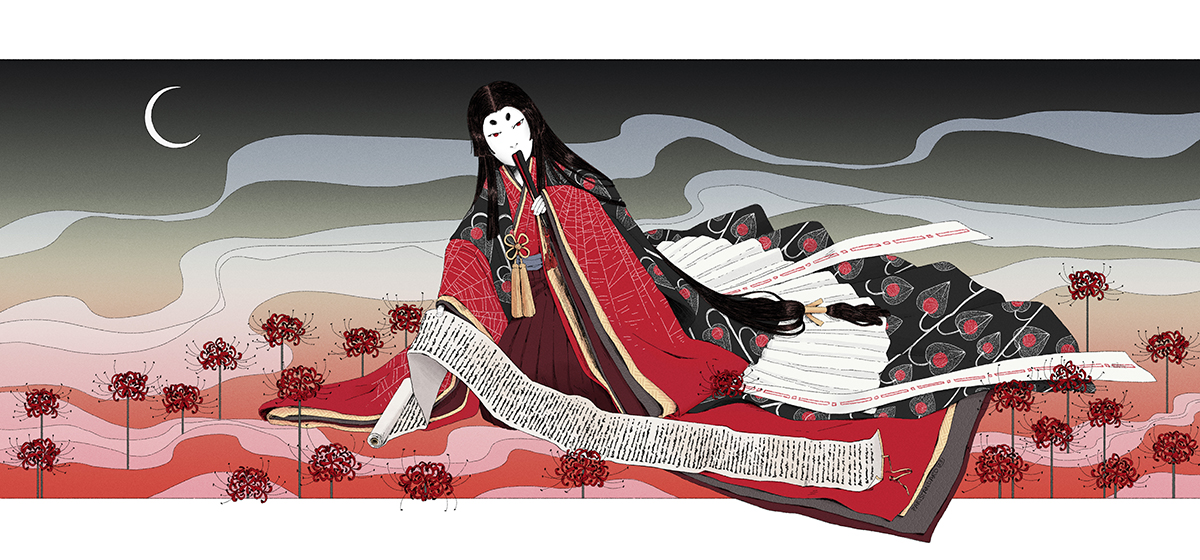
The zine’s main story, “The Kumo Diary,” is set in the Meiji period, the era of Japan’s industrial revolution. As Japan established itself as a nation that could compete with Western powers, its intelligentsia were motivated to create a unified sense of “Japanese culture.” Scholars were therefore tasked with making The Tale of Genji a respectable classic to be held in esteem by a modern nation. While I was studying the history of The Tale of Genji, I couldn’t help but wonder about all the apocryphal chapters that never made it into the canonical version, and I created a few fragments of a medieval text to be discovered by a reader who dwells in the shadows cast by the light of modernity.

The final story, “Hanahaki,” is about a neglected cat who vows revenge on the small child that has monopolized his beloved human’s attention. The title comes from a trope in underground manga and fancomics of the late 2000s and early 2010s. In these stories, someone suffering from unrequited love painfully coughs up (haki) delicate flower petals (hana) in lieu of the words they can’t say. The cat in this story is unable to communicate in human language, but he still finds a way to make his displeasure clear. If nothing else, the child must go.

Strange Tales and Modern Legends explores themes that have fascinated me for years, specifically the intersections of folklore, feminism, and the unruly joy of problematic characters. I hope readers find these stories as delightfully unsettling as I did when I wrote them.

If you’re interested, you can order a paper copy of the zine from Etsy or download a free digital version from Itch.io.

👹 https://digitalterrarium.itch.io/strange-tales
👹 https://www.etsy.com/listing/4299187840/strange-tales-horror-fiction-zine

The art at the top of this post, which is one of the illustrations featured in the zine, was created by Le Soldat Mort, a dark fantasy artist who shares their work on Bluesky (here) and on Instagram (here).

Green Dreams: Tales of Botanical Fantasy

I’m excited to announce that I published a new zine! Green Dreams: Tales of Botanical Fantasy collects six illustrated stories about our relationships with plants and nature.

“Each turn of the seasons brings an end to lives both large and small, but new seeds sprout joyously from the ruins” is the zine’s tagline, and disaster is a major theme of the collection. One of the opening stories is about the gradual effects of climate change; and, in the closing story, environmental catastrophes have become so severe that humans have disappeared completely. The zine also features stories about a medical tragedy narrowly averted, the aftermath of a devastating war, and a porous biological quarantine.

I considered subtitling the zine “Tales of Botanical Dark Fantasy,” but the truth is that none of the stories are actually that “dark.” In fact, I’d say the main theme of the collection is a persistent hope for the future. At this particular moment in history, the state of the world seems very bleak, so it’s good to remember that the environment that surrounds us is much larger – but also much more personal – than whatever horrors are currently unfolding.

Precisely because are so many fires burning in the world, I think it’s important to spend time in thriving green spaces that suggest futures of shifting and changing growth. I believe that a mindful contemplation of our natural environment can also be useful in the uncomfortable but necessary process of decentering normative humanity while challenging the artificial divisions we impose on ourselves and each other.

The incredible cover art by Frankiesbugs captures the mood of these stories perfectly.

Frankie creates bold and imaginative botanical fantasy art, and I asked them to illustrate the pagan archetypes of the flower maiden and the horned god, who together represent the endless natural cycle of death and rebirth. In this zine, I wanted to play with symbols that convey the beauty and mystery of the natural world, and Frankie embraced this theme, tinging the painting with potent Christian motifs and a powerful sense of fertility.

It’s an extremely impressive piece of art, and you to check out more of the artist’s work on Instagram (here), on Bluesky (here), and on Redbubble (here).

In this collection, I did my best to share a sense of fertile “green dreams” for the future. Mostly, though, I just really wanted to write some fun ecofiction about plants and mushrooms.

If you’re interested, you can read a free digital version of the zine on Itch.io or order a print copy from Etsy.

🌿 https://digitalterrarium.itch.io/green-dreams
🌿 https://www.etsy.com/listing/4351990958/green-dreams-fantasy-fiction-zine

Kakariko Hills

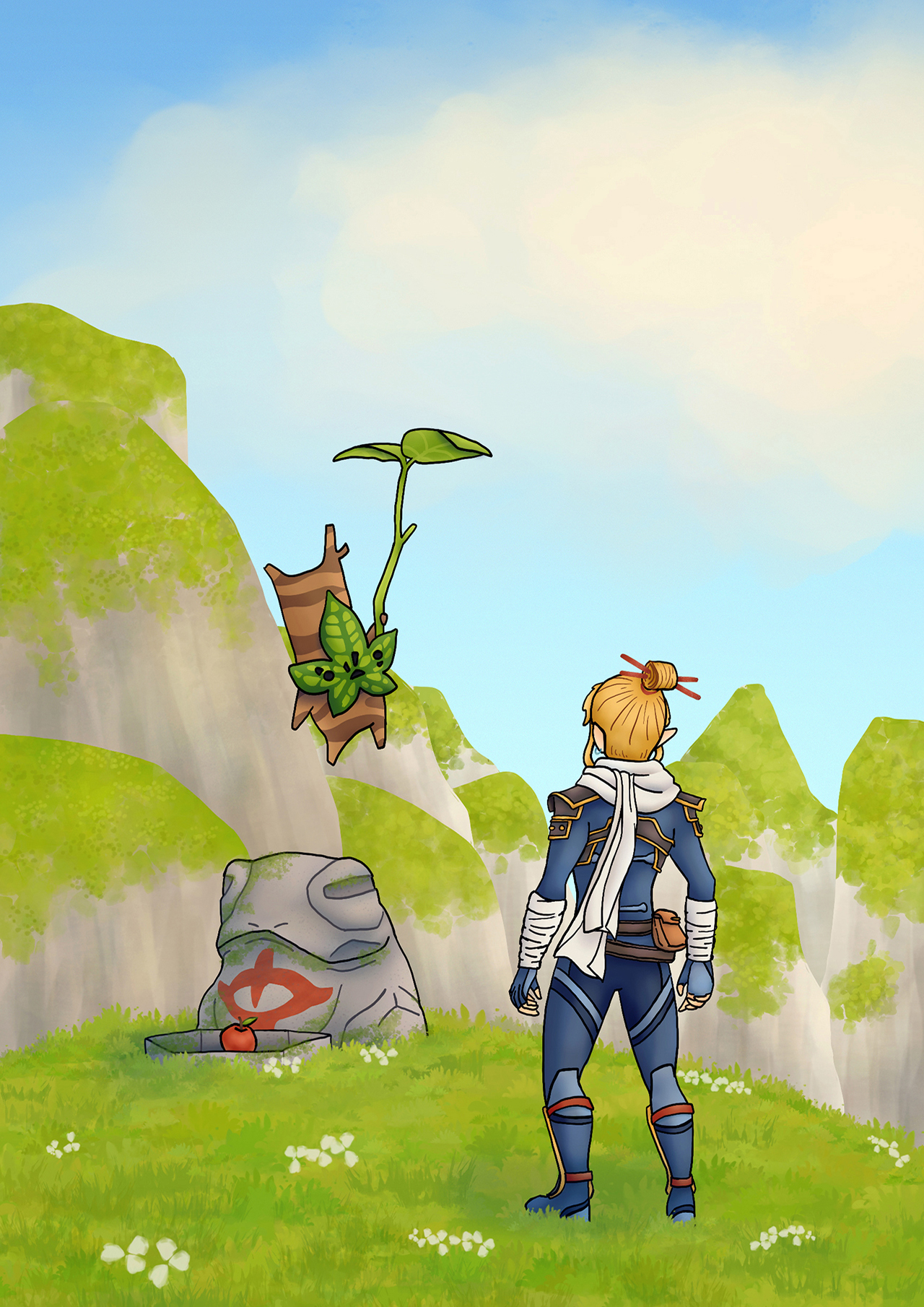
The mountains overlooking Kakariko Village are one of my favorite places in Breath of the Wild.

Most players will visit Kakariko Village early in the game, and it’s possible for a more experienced player to climb the surrounding hills and venture into the mountains. Link can find Koroks by solving little environmental puzzles (in this case, putting an apple in the offering plate in front of the frog statue), and the optional hunt for Koroks encourages the player to explore the hidden corners of the map. There’s no meaningful material reward for finding this Korok, but the scenery is impressive. This experience of discovery is a perfect example of what I love about video games – the joy of the journey.

It’s hard to say I have a favorite game, but I’m a big fan of Breath of the Wild. I live in a neighborhood of Philadelphia that has almost no plants or trees, and the beautiful landscapes in this game provide a much-needed immersion in green space while inspiring me to engage in urban gardening. I love open-world games in general, but Breath of the Wild is the first one I played and the one I keep returning to.

This illustration was my submission to the Videogames Zine published by Coin-Operated Press, a cool zine community based on Scotland that’s open to people from all over the world. You can follow them on Instagram (here), where they post news about events and upcoming calls for submissions.

The Kumo Diary

A professor’s assistant at Tokyo Imperial University uncovers a curious manuscript whose author weaves an elegant tale of the twilight years of the Heian court. As she reads between the gossamer lines of the narrator’s account of a moonlit assignation, the quiet and unassuming scholar reflects on what happens in the shadows cast by civilization and enlightenment.

This story is a play on The Tale of Genji that I contributed to Carpe Noctem: Vampires Through the Ages, an anthology of historical fantasy fiction, illustrations, and comics about vampires in historically specific settings.

I wouldn’t say I’m a “fan” of The Tale of Genji in the same way that I’m a fan of the Legend of Zelda series, but I’ve read multiple translations of the book and enjoyed them all. When you engage with a story so deeply, it’s difficult not to come up with fun theories. I certainly wouldn’t be the first person in Japanese literary history to make this suggestion, but please consider: Why are the characters in The Tale of Genji always described as being so pale, and why are many of them only active between dusk and dawn?

“The Kumo Diary” is set in the Meiji period (1868-1912), Japan’s industrial era of “civilization and enlightenment.” As Japan attempted to establish itself as a nation that could compete with Western powers, its intelligentsia were motivated to create a unified “Japanese culture.” The Tale of Genji occupied an interesting place in this movement. On one hand, it could easily be regarded as the quintessential work of classical Japanese literature. On the other hand, its plot is largely concerned with the love affairs of a rotating cast of beautiful but neurotic women. Japanese scholars were therefore tasked with making The Tale of Genji a respectable classic to be held in esteem by a modern nation.

Scholars had been compiling and revising the chapters of The Tale of Genji for centuries, so it was necessary to create a “definitive” version of the text. While I was studying the history of The Tale of Genji, I couldn’t help but wonder about all the apocryphal chapters that never made it into the canonical text.

It took me ten years, but finally I wrote one of these apocryphal chapters myself. I embedded the so-called “Kumo Diary” into a frame story about a woman who finds the manuscript and decides not to share it with the stodgy male professor who employs her. It’s interesting to imagine there being a secret history of The Tale of Genji, and I really enjoyed writing the ending of my story. After all, who’s to say there aren’t demonic women pulling the strings from the shadows? If they do their work correctly, we’d never know they were there at all.

I’ve posted the story on AO3, and you can read it here:
https://archiveofourown.org/works/50802628

The illustration is by the darkly brilliant Paristandard, whose creepy and creative illustrations can be found (on Twitter), (on Tumblr), and (on Instagram). It was an amazing experience to work with them, and I can’t recommend them enough for character designs, book covers, short comics, and other illustration projects. For this project in particular, the historical specificity of their costume design was uncanny, and I am in awe.

The Girl in the Screen at the End of the World

It’s been more than twenty years since rumors about a cursed videotape began to spread. The stories were true, and Japan is in ruins. Can the people who survived the collapse of civilization escape Sadako’s curse? Or do they seek her out instead?

“The Girl in the Screen at the End of the World” is a series of four short vignettes about the last living humans making their peace with the end of the world as Sadako bids a gentle goodbye to modern civilization. All of the human characters in the story die, but all the animals go on to live their best lives.

The story is complete at 1,800 words, and it’s on AO3 here:
https://archiveofourown.org/works/47735320

I had the immense privilege of working with an artist who goes by Vani on an illustration for this story. I was inspired by his short Animal Crossing comic about grief (here), and I love the way he draws handsomely rendered characters in lush environments brought to life by bold colors. You can find more of his evocative art on Twitter (here), on Instagram (here), and on Tumblr (here).

Plant Space

No one in this house is “productive.” 🌿

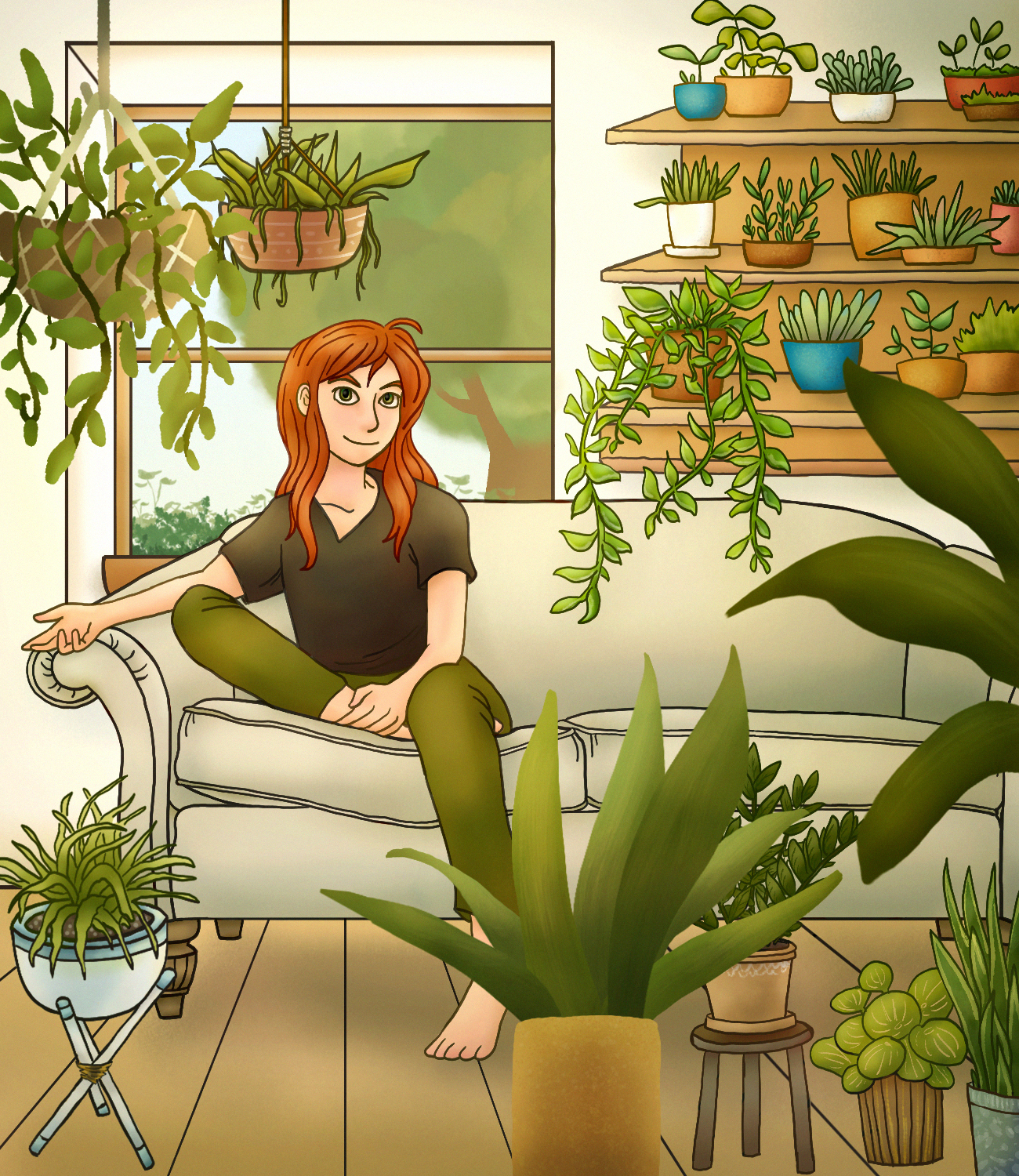
Inspired by my annual reading of Sarah Ahmed, I drew this as a reminder to myself that there’s room for stillness and silence in the ongoing resistance against systems that seek to exploit our energy and labor. It ended up becoming an unintentional self-portrait. I was thinking, “What sort of person would live in a house like this,” and then I realized, “Oh right, I do.”

A lot of my plants have been all across the United States as I moved from apartment to apartment while chasing jobs in a market that depends on people like me, by which I mean young(ish) people who are willing to cut their connections and uproot their entire lives in order to have a small chance at getting their foot in the door of an unnecessarily competitive industry. Academia especially is built on exploited and largely uncompensated labor, and there’s so much survivor bias that not even the people who have experienced and suffered from this precarity acknowledge how harmful it is to everyone involved.

It’s wild how the vast majority of critiques of capitalism are contained within the logic of capitalism. Capitalism is all about doing things and being productive; and, in exactly the same way, most critiques of capitalism are about doing things and being productive. To give a classic example, Marx says that workers need to utilize the “muscle power” and “vital force” that have been harnessed by capitalism and redirect their energy and labor to overthrow the system. I would argue that not doing things and not being productive is an equally valid means of resisting capitalism. Sarah Ahmed, who has just as fraught of a relationship with academia as I do, has argued the same thing: Don’t allow yourself to become a tool in the hands of people who are intent on breaking you.

After being destroyed by a “dream job” that I almost had to kill myself to stay on top of, I made a firm decision to take it easy and chill out for a bit. Part of this decision is deprogramming my instinct to be “productive,” but a lot of it is simply taking the time to be quiet and listen while creating the space to appreciate the sort of time-consuming writing, scholarship, and art that’s been marginalized and pushed aside by the constant demand for new content. Like my plants, I’m going to sit still and soak in the sun.

………also, I needed an “author photo” for my summer project, a zine about Gothic botanical horror. 💀🌱