The Annotated Kitab al-Azif

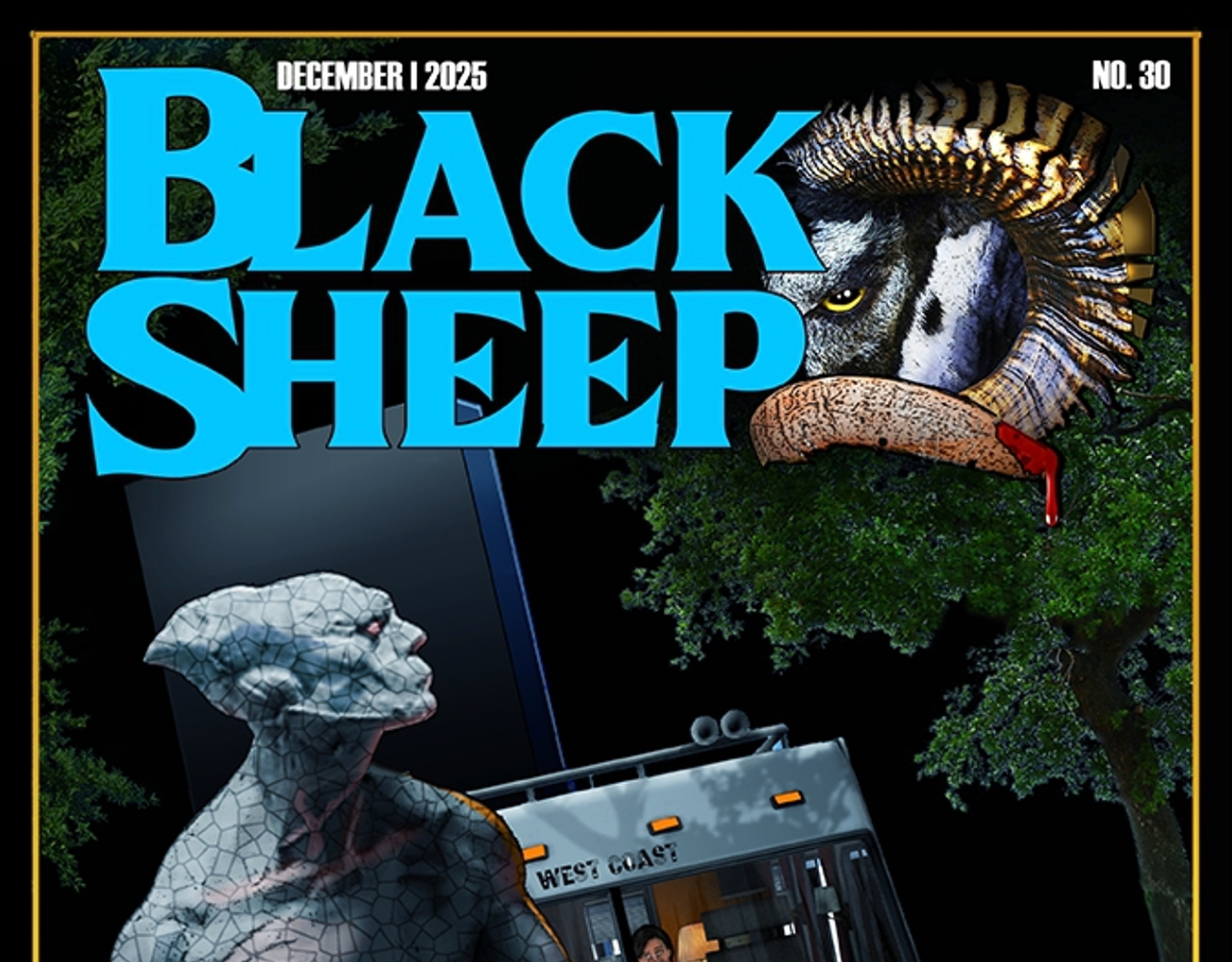
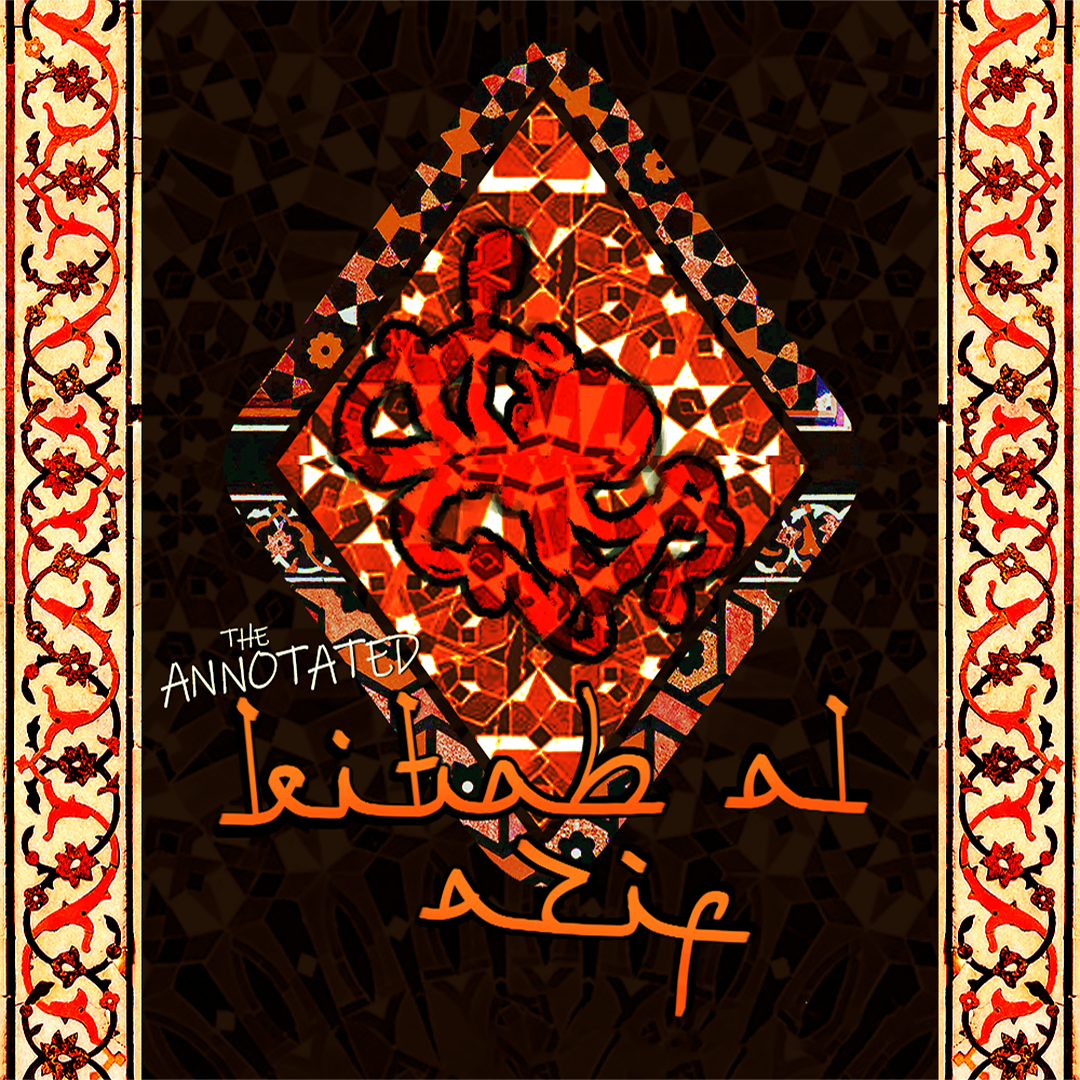
My queer Lovecraftian romance, “The Annotated Kitab al-Azif,” was just published in the latest issue of Black Sheep, a magazine for weird fiction. This story treats the gnostic origins of the Necronomicon with respect while being slightly silly about grad students.

You can order a copy of the issue with my story here:

🐙📖 www.amazon.com/dp/B0G25R82TY

It’s very cool to have the opportunity to publish a Lovecraft pastiche in an honest-to-god pulp magazine, which seems appropriate. At the same time, I definitely feel the friction of using Lovecraft’s own tropes to push back against the ugly Orientalism surrounding the Necronomicon.

The truth is that, while I admire Lovecraft, but I wouldn’t consider myself a fan. Rather, I spent a formative part of my childhood in a small town in the Deep South whose public library was severely limited by budget constraints. The only thing remotely close to fantasy fiction they had on their shelves was Stephen King, the lone second volume of Lord of the Rings, and a handful of ancient paperback collections of H.P. Lovecraft.

I didn’t really have the cultural context to understand Stephen King, and I wouldn’t recommend The Two Towers as the place to start reading Tolkien. Lovecraft grabbed me, though. Even as a kid, I understood the xenophobia expressed in Lovecraft’s stories. Believe me, I understood all too well. Still, I guess I was young enough that this wasn’t a dealbreaker, especially since there was nothing else to read during the summer where I practically lived at this tiny little library.

I had more resources the following year, when I started attending an international school in Atlanta and began to read more widely. But Lovecraft stuck with me, and a small but significant goal of my writing now is to try to capture and explain why that is.

I sincerely believe that people should write whatever they want, but a part of me still questions the value of aligning myself with the work of such a problematic author. The truth remains, though, that these Lovecraft stories only occupy a small closet in the house I’m trying to build with my writing. What I want to do is expand the scope of the small rural library that only had room for Stephen King and HP Lovecraft, as well as to create space for original work that dismantles the toxic feedback loop of preset responses to human difference.

Much love to Black Sheep magazine for giving a home to this story. 

Review of The Harrowing Game on Comics Beat

I consider myself extremely fortunate to have been an early reader of Antoine Revoy’s newest graphic novel, The Harrowing Game. I love this book, which is strongly inspired by Junji Ito but still very much its own thing. I’m also lucky to have gotten an opportunity to write a review for Comics Beat. Here’s an excerpt…

The Harrowing Game will delight fans of Junji Ito and H.P. Lovecraft, to be sure, and connoisseurs of horror will appreciate Revoy’s intriguing interpretations of familiar tropes. Revoy twists gothic stories into broken reflections of cultural anxieties, and the storytelling is no less dramatic for the subtlety of its social commentary. If nothing else, it’s a pleasure to get lost in the details of Revoy’s spectacular illustrations. Whether you’ll be able to find your way out untouched and undisturbed is another story.

You can read the full review on Comics Beat here:
https://www.comicsbeat.com/graphic-novel-review-the-harrowing-game/

The Sleeping Princess

There is a legend in Hyrule that a sleeping princess lies behind the door of a locked room deep under the ruins of the North Castle. When the princess rises, so too will the ancient powers sealed within her dreams. Impa knows the legend is true, and she fears the fate that will befall the kingdom should the first Zelda wake. Yet when a shadow rises on the borders of Hyrule after the birth of a new princess, Impa must make a terrible choice.

I had the honor of contributing a story called “The Sleeping Princess” to Blood Moon Rising: A Zelda Horror Zine. I was interested in exploring the background of Princess Zelda in the original 1986 game, and I thought it might be fun to see her story through the eyes of Impa, who knew about the undead princess who was the first of Zelda’s line. In other words, I’m connecting some of the more disturbing threads between The Legend of Zelda and Zelda II: The Adventure of Link.

“The Sleeping Princess” is a story about maternal love, political sacrifice, and the dark secrets hidden within the labyrinthine dungeons of Hyrule. I was strongly inspired by H.P. Lovecraft’s novel At the Mountains of Madness, which dwells in the geometric terror of monumental architecture built by strange hands, and I did my best to create a sense of ruined grandeur similar to that of Dark Souls and Ico: Castle in the Mist.

For the story’s illustrations, I had the incredible pleasure of working with the devilishly talented Pumpkinsouppe, whose dark arts brought this ruined world to life.

You can find “The Sleeping Princess” on AO3 here:
https://archiveofourown.org/works/62492182

Leftover sales of the zine are open until February 24 on BigCartel (here).

Apartment Complex

Apartment Complex
https://kinerus.itch.io/apartment-complex

Apartment Complex is a short and free-to-download narrative exploration game set in a mostly abandoned apartment building. The only human occupants of this building are its two landlords. You play as one of the owners, who is middle-aged, jobless, and depressed. In an effort to do something with his life, your character takes it upon himself to check in with the tenants, who are not even remotely human.

The game only takes about twenty minutes to play, and the gameplay consists of walking through the three-story building and talking to the tenants. Just to put this out on front street, Apartment Complex has a message, and that message is that landlords are bad. I don’t disagree, but the game isn’t shy about being didactic. Putting the armchair Marxism aside, the writing is a lot of fun.

Each of the eight tenants (inasmuch as they can be counted) is a Lovecraftian monstrosity that defies Euclidean logic but still needs a place to stay on this particular plane of reality. Perhaps because of his depression, your character isn’t the least bit bothered by the ontology of these beings. Regardless of whether he’s talking to the fungus-infested remains of the former co-landlord, a divorced dad with multiple alligator mouths, or a colossal all-seeing eye of the abyss, this guy takes each of these conversations in stride.

And honestly, this is such a mood. I get it. Sanity-altering cosmic abnormalities are a dime a dozen, but you know what’s really fucked up? The unequal distribution of wealth across class lines. Again, Apartment Complex has a message, but it’s not wrong.

Also, given that the creator is only twenty years old, I admire the accuracy of the game’s portrayal of the jaded middle-aged mindset. Like does it really matter that your neighbor is an eldritch abomination who exists in the shadows of reality? Does it even matter.

Where Apartment Complex shines is the boldness and creativity of its 16-bit pixel art. The floorplan and room layouts of the building are bog-standard, but the way each tenant occupies the space has to be seen to be believed. If you’ve ever wondered just how weird Earthbound-style graphics can get, this game is for you. The character portraits displayed during conversations are incredible.

From its eye-catching color palette to the dry tone of its absurdist humor, Apartment Complex makes me nostalgic for Welcome to Night Vale in the best possible way. This is a chill and fantastically creative game about monster friends and postmodern malaise, and honestly? It’s super relatable.

Best Horror Comics on How to Love Comics

I had the immense honor of being able to contribute to a list of “The 45 Best Horror Comics You Should Read” on the website How To Love Comics. Here’s how I pitched the eight titles I recommended…

Betwixt: A Manga Horror Anthology, edited by Fawn Lau and Mayuko Hirao
A diverse collection of big-name creators showcasing manga-style stories that focus on urban legends and folk horror.

Bloodborne: The Healing Thirst, by Ales Kot and Piotr Kowalski
A stand-alone story that captures the oppressive gothic atmosphere of Bloodborne while being accessible to readers with no knowledge of the game.

The Crossroads at Midnight, by Abby Howard
A single-artist collection of queer short stories with distinctive monochromatic art and intensely disturbing imagery. 

The Hills of Estrella Roja, by Ashley Robin Franklin
A lushly illustrated graphic novel about a college student on the hunt for cryptids in the beautiful but eerie Texas desert.

Loving, Ohio, by Matthew Erman and Sam Beck
A suburban gothic horror story about a small town quietly controlled by an all-too-realistic cult. 

Not Drunk Enough, by Tess Stone
A colorful and stylish horror comedy about being trapped in a mad science corporation after dark.

PTSD Radio, by Masaaki Nakayama
A quiet but intensely creepy collection of Japanese urban legends loosely connected by an overarching narrative.

The Shadow over Innsmouth, by Gou Tanabe
A painstakingly faithful Lovecraft adaptation with meticulously drafted art and a well-researched translation. 

You can check out the fully annotated list (here). There are a lot of famous heavy hitters on this list, and it was a pleasure to be able to include a few lesser-known manga and indie graphic novels.

Bloodborne Background Lore

While waiting for the Elden Ring DLC to be released, I decided to try my hand at Bloodborne, a gorgeous and atmospheric gothic action adventure game that somehow manages to withhold even more of its story from the player than Elden Ring. I haven’t seen a concise and accurate summary of Bloodborne’s background lore, so I thought I’d take a shot at creating one.

Before anything, it’s important to establish that Bloodborne is loosely based on H.P. Lovecraft’s Cthulhu mythos, whose premise is as follows:

The earth is billions of years old, and it has supported multiple civilizations that rose and fell without leaving any trace of themselves behind. One of these civilizations was that of the Great Ones, whose fungal bodies allowed them to benefit from long lives and peaceful societies. The Great Ones developed technology that assisted them in communicating across time and thereby making contact with other civilizations on the planet, including humans. Because the Great Ones are so physically and mentally inhuman, however, these connections are flawed. Sometimes human communication with Great Ones invokes fear, and sometimes it invokes madness that results in aberrant behavior. 

In order to facilitate more productive communication, the Great Ones created dream spaces that exist alongside the waking world as separate dimensions. In Homestuck terms, these dimensions are “dream bubbles” that function as self-contained terrariums. In other words, a dream bubble preserves a certain place at a specific moment for the educational benefit of whoever accesses it, kind of like an interactive movie. Time doesn’t flow inside the dream; it repeats. This means that you can trap someone in a dream and use it as a type of prison. In the most famous example, this is what the Great Ones did with Cthulhu, a priest of malevolent cosmic elder gods that would destroy organic life on earth if the planet came to their attention.

Using this mythos as an inspiration, the world of Bloodborne has been shaped by three broad categories of Great Ones.

The first is a group of Great Ones who have tried to communicate with humans. Humans have taken blood from the immortal physical bodies of these creatures. In small doses, the administration of this blood cures illness and prolongs life. In larger doses, the blood induces physical transformation. A coalition of surgeon-scholars called “the Healing Church” has established itself as a religious organization in the city of Yharnam so that they may perform “blood ministration” on the populace, whom they’re using as test subjects in their experiments to bring humans physically and mentally closer to the Great Ones.

The second group of Great Ones eschews this sort of direct contact and communion between Great Ones and humans. Their motives have little to do with the welfare of human beings, but they’ve nevertheless acted in opposition to whatever is going on in Yharnam. One of these Great Ones, called “the Moon Presence,” has created a dream bubble for the ostensible purpose of training hunters to kill the humans maddened and transformed by blood ministration. This is the “Hunter’s Dream” that serves as the central hub of Bloodborne.

The third faction is a loosely federated group of spiderlike Great Ones called Amygdala, who have created their own set of dream bubbles. Some of these dream bubbles are maintained in cooperation with humans seeking eternal life in a timeless space, while some were created seemingly for the purpose of feeding from the human souls trapped inside them. I believe the version of Yharnam that the player-character navigates exists within a dream bubble created by Amygdala. 

Essentially, the world of Bloodborne is a dream inside a connected network of dreams that can be accessed by the player-character as they dream. While the Hunter’s Dream exists as a sanctuary for would-be hunters, the dream that contains Yharnam is something like a training simulation. Your character can only wake from these interconnected dreams (meaning: finish the game) by completing the task they are given as they fall asleep during Bloodborne’s opening cutscene: “Seek Paleblood to transcend the hunt.”

It’s not entirely clear what “Paleblood” refers to, but the game offers two primary interpretations.

The first interpretation is that Paleblood is the blood of the Great Ones that caused the scourge of beasts in Yharnam. Once the player-character understands the full extent of the effects of Paleblood on human physiology and society by witnessing the downfall of Yharnam, they are qualified to become a hunter in the waking world. At the end of Bloodborne, the player-character’s mentor Gherman offers a choice. He can release them from the Hunter’s Dream, or they can best him in combat in order to earn the (highly dubious) honor of replacing him as its warden.

The second interpretation is that the term “Paleblood” refers to the human-adjacent children of the Great Ones, who cannot produce offspring on their own and must rely on human hosts. The conditions for the creation of Paleblood children are unclear, and various factions of the Healing Church have undertaken ghastly experiments on the population of Yharnam in order to pursue this knowledge.

If the player locates and consumes three umbilical cords from unsuccessful Paleblood pregnancies, it’s possible for them to be reborn as a Paleblood squid baby (and future Great One) within the Hunter’s Dream. According to the interpretation suggested by this ending, the Hunter’s Dream was created by the Moon Presence in order to select and nurture potential candidates capable of becoming its child.

The game’s title, Bloodborne, therefore refers to the player-character’s ultimate goal. Either they will be reborn as a fully-fledged Hunter after awakening from the bloody chaos of the Hunter’s Dream, or they will be reborn as a Great One after inheriting the Paleblood of their “parent,” the Moon Presence. 

The story of Bloodborne (such as it is) focuses on the player-character’s journey through the city of Yharnam and its outlying areas as they fight the humans who have been transformed into monsters by the blood of Great Ones. The game’s DLC, called “The Old Hunters,” provides additional background information concerning the origins and establishment of the Healing Church through dream encounters with the key figures in its history.

For an excellent synopsis of the story presented by the DLC, I recommend this article: https://www.eurogamer.net/bloodborne-whats-going-on-in-the-old-hunters

For a deeper dive into Bloodborne‘s story presented in well-organized chapters that arrange the aspects of the plot in chronological order, I’d recommend checking out this fan-created wiki, which can be read like a novel: http://soulslore.wikidot.com/bb-plot

The Mist

The Mist
https://yliader.itch.io/the-mist

The Mist is a Game Boy horror adventure game based on Cthulhu mythos and inspired by the 2019 movie The Lighthouse. Despite only consisting of about twenty side-scrolling screens, it’s an intricate game that takes around 40 to 45 minutes to finish.

You play as an old man sent to maintain an isolated lighthouse for two months. Your job is simple: keep the light at the top of the tower going, maintain the chapel, and don’t try to look for the body of the previous lighthouse keeper.

This potential gameplay loop is quickly interrupted when your character starts having strange dreams involving a sea monster calling him “son” and asking him to return to the ocean. Your character’s dreams become progressively stranger, and what you end up doing is completely neglecting the lighthouse as you poke around the tower to satisfy his curiosity.

About halfway through the game, you begin to navigate dream sequences as well as the waking world, and these dreams are a lot of fun. There are no jumpscares in the dreams, but there are a few (excellent) monster animations that you’re forced to watch become progressively more disturbing. In addition to the in-game cutscenes, there are about two dozen illustrations for longer conversations and reading passages. The pixel art in this game is wonderful, especially given the graphic limitations.

The Mist includes a few puzzle sequences, but these sequences mainly consist of figuring out what you need to do next. Given that your range of motion is limited, these “puzzles” can be solved by process of elimination. There’s one puzzle about thirty minutes into the game that might be a little frustrating, but the creator has embedded a full playthrough video in the game’s page on Itchio if you get stuck.

The creator of The Mist is French, which means two things. First, their English is a little off, but it’s off in a way that makes sense in French and is still completely comprehensible to English speakers. Second, their concept of Christianity is extremely Catholic, and it was amusing to me to imagine a grizzled New Englander consecrating an altar with wine and praying to various saints. It’s always interesting to see how other cultures interpret the Cthulhu mythos, and I unironically loved this.

The Mist loses its footing for a bit in the middle – especially around the puzzle I mentioned earlier – but it’s a neat piece of storytelling that creates an immersive environment at a slow but steady pace. Even if you’re not a Lovecraft fan, The Mist is an interesting and atmospheric game about slowly losing your mind on the fragile shell of land suspended above the massive horrors of the watery depths.

A Monstrous Little Mermaid Story

I’m honored to have an essay in one of my favorite online magazines, Cosmic Double. “A Monstrous Little Mermaid Story” is about how I discovered the joy of queer transformations in HP Lovecraft’s “The Shadow over Innsmouth.”

“A Monstrous Little Mermaid Story” is free to read on the Cosmic Double website here:
https://cosmicdouble.com/2023/01/08/a-monstrous-little-mermaid-story/

I originally created this essay as something of a writer’s statement for a short story called “Don’t Eat the Fish.” The story is about the uncanny space at the intersection of queerness, disability, and economic precarity, but I also think it stands on its own as an unsettling work of body horror. I workshopped this story for years as I slowly developed my skills, and I worked hard to polish the narrative voice and sharpen the genre effectiveness while also being as honest as I could about the nuances of my own personal experience.

I generally try to keep overt identity politics out of my writing, which isn’t a value statement as much as it is a personal preference. It’s not as though my stories aren’t informed by my identity or social environment. Rather, both my identity and my environment constantly shift and change, and my stories generally aren’t about myself to begin with. Still, because this particular story was so strongly informed by my positionality, I spent more than a year submitting it a series of literary magazines dedicated to raising the voices of queer, disabled, and economically precarious writers.

Unfortunately, every single magazine I submitted the story to was like, “Oh damn, that’s truly upsetting, and this story is not Positive Queer Representation™ enough.” Usually, when I have a story rejected, I’m lucky enough to get a personal note from an editor along the lines of, “This isn’t a good fit for us right now, but we all enjoyed this piece and would love to see more work from you in the future.” With this story, the response was inevitably: NO.

I therefore wrote this essay as a way of processing what my story and its literary influences meant to me. I’ve long since accepted that the story itself will never be published, but I’m truly grateful to Cosmic Double for being willing to publish an essay that may not be Positive Queer Representation™ but still attempts to represent what I believe is a very real aspect of nonbinary (and trans!) queer identity. That takes courage, and the essays I’ve been reading on the site led me to believe that the editors are open to an earnest investigation of what it means to feel “monstrous.” If you’re interested in well-crafted essays from unexpected points of view, please check them out!