Fishy is a horror-themed “wholesome” visual novel that takes about twenty minutes to finish. You play as a sweet middle school girl who’s spending the night at an aquarium for a friend’s birthday party. The problem is that she’s deathly afraid of the ocean, and it doesn’t help that there’s mild friendship drama afoot. She gets separated from the group and wanders into a restricted area, where she encounters fish that aquarium guests are never meant to see.
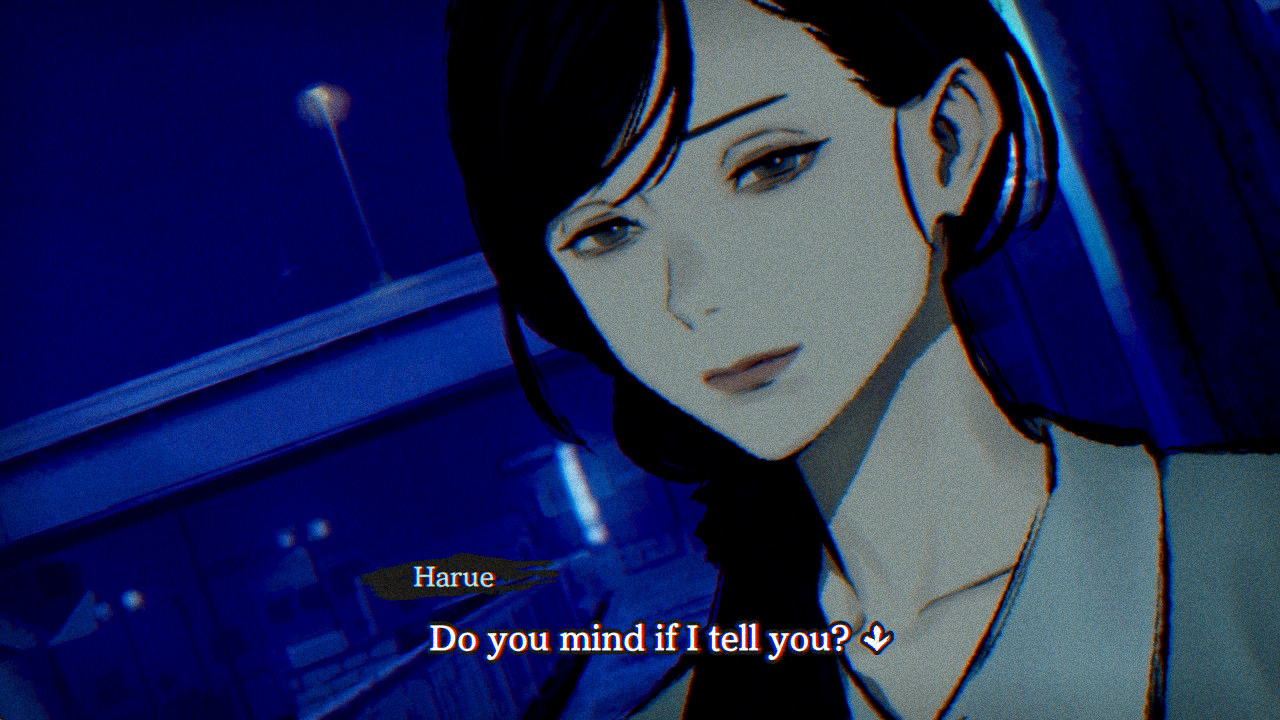
The art of Fishy is fantastic and alternates between genuinely gorgeous and genuinely creepy. Putting the spooky fish aside, the environmental illustrations perfectly capture the magical atmosphere of what it might be like to spend the night in an aquarium. The character designs are lovely as well.
The writing is competent, but the game seems to be aimed at the same audience as its preteen characters. In its determination to be wholesome and teach the player a positive life lesson, the story hesitates to create a sense of tension, dread, or even character development.
Fishy’s message is that having a prosthetic limb is cool, actually. And that’s great! Prosthetic limbs are in fact cool as hell. Still, the twenty minutes that most players will spend with the game isn’t quite enough time to tie all the various thematic threads together. There’s the player-character’s anxiety + her relationship with her friends + her fear of the ocean + the potentially haunted aquarium; and then, on top of that, there’s the positive message about disability positivity. It’s a lot!
The lack of any real darkness or specificity makes the experience of the player-character somewhat confusing, at least to my adult sensibilities. Like, what exactly is the source of the friendship drama? Why is the player-character afraid of the ocean? Is there something going on in her life that makes her prone to attacks of social anxiety? Why does she react to this situation in such an extreme way? Is she having a legitimate psychotic break?
I always appreciate stories that reach for big goals, of course, and the writing is quite compelling. If nothing else, the characters all seem like real people, and I was interested in learning more about them.
Also, I have a bit of a crush on the girl in the friend group who knows all sorts of disturbing facts about the ocean and doesn’t mind bringing them up at (in)appropriate moments. I want a whole game about Weird Fish Girl and whatever her damage is. She’s wonderful, and I love her.
All in all, Fishy is a fun story with a few spooky scenes, and it feels like a good visual novel to share with younger children. The hand-drawn art is appealing, and the story goes to some interesting places in a relatively short amount of time. In any case, it’s free to play, so no complaints there. Even if you’re not into preteen friendship drama, it’s always good to spend quality time with the terrors of the deep.
Originally released on Valentine’s Day in 2018, Speed Dating for Ghosts is a short and simple roleplaying visual novel (or rather, visual short story collection) in which you can date your choice of nine ghosts. The version currently available on Steam, on Switch, and on Itchio includes the “Go to Hell” expansion, which includes three more postgame ghosts to date and an epilogue in the form of a beach party in Hell.
You play as yourself. Presumably you are dead, and also a ghost. You have registered for a speed dating event that is, predictably, run by a ghost. At this event, you choose between three rooms, each of which contains three ghosts. You have two short conversations with each of the three ghosts. If a ghost likes you, you can go on a date with them. Thankfully, it’s not difficult to convince the ghosts to warm up to you, and you can go on a date with all of them without having to replay the initial conversations.
These “dates,” such as they are, involve helping each ghost take care of their unfinished business. Instead of romancing the ghosts, what you’re really trying to do is learn their stories. After you complete a date, you’re rewarded with more information about the ghost via a character sheet on the “Graveyard” page of the game’s main menu. Once you date the first nine ghosts, you’re given the option to visit Hell for postgame content.
The gameplay consists of choosing between dialog options and being friendly. The art is simple and stylized but manages to achieve a good balance of creepy and cute. The writing is wonderful.
For me, playing through one speed dating room + going on three dates took about 25 minutes. Technically, you can convince a ghost not to date you, but I don’t know why you’d do this. All of the dialog choices make sense, and I can’t imagine needing to use a walkthrough. The postgame content is a bit trickier, and two of the ghosts in Hell might require some extra effort to date. The third ghost in Hell is a dog, and you can pet him. I love him forever.
Aside from the ghost dog, I’m also a fan of Spooky Peter, the plague doctor ghost who’s been around for centuries and has found a vocation in frightening the living. If you agree to apprentice under him, he inducts you into one of the more arcane mysteries of the afterlife, and I appreciated the worldbuilding of his story. There are also two older ghosts (Vera and Gary) who were involved in murder mysteries, and both of their plot arcs are fantastic. One of these stories was so emotionally satisfying that it made me tear up a little, while the other thoroughly creeped me out.
Speed Dating for Ghosts is a fun collection of short stories tied together by an interesting framing device, and I enjoyed the two hours I spent with it. Based on the dry tone of its humor, I’d say that the game is aimed at a mature audience, but there’s nothing particularly grim or edgy or upsetting about it. The writing and art contain elements of horror, but they’re very mild. I didn’t know what to expect from Speed Dating for Ghosts, and I was surprised by how creative and clever it is. It’s always a pleasure to find a weird little game like this that uses the medium to craft a unique and engaging piece of storytelling.
We Know the Devil is a horror-themed visual novel about three teenagers at summer camp. Although the world of the game is close to our own, there are a few differences, one of which is that “the devil” is real. One of the kids’ duties as campers is to reinforce the magical wards protecting a forest, and your job as the player is to help them make it through the night. We Know the Devil has four endings; and, depending on how quickly you read, it takes about thirty to forty minutes to finish a run.
Since you can’t get the true ending on your first playthrough, I might recommend going into the game without consulting a guide, but only if you’re the sort of person who absolutely can’t tolerate any spoilers whatsoever. We Know the Devil functions primarily at an allegorical level, and you’ll get infinitely more out of its story if you understand what’s going on. In this post, I’m not going to spoil what happens, but I think it makes sense to accurately describe the game’s premise.
We Know the Devil is divided into ten short chapters. For the most part, the game is entirely linear. The only element of gameplay is that the player is required to make seven choices, and these choices only affect the ending. Essentially, the player is put into the shoes of one of the three main characters and given a choice between the other two characters. The ending you get is determined by which of the three kids is left out of the pairings the most frequently. Essentially, you’re choosing who dies at the end (although they don’t actually die).
To get the true ending, you have to balance the pairings evenly. Unfortunately, you can’t do this on your first playthrough, as the game doesn’t give you the key choice that makes a perfect balance possible. The first ending you get will therefore be strange and upsetting, but it’s the unpleasantness of this ending that serves as the cipher for decoding the allegory.
A major weakness of We Know the Devil is that the setting of the game is poorly defined to an extreme degree. Unless you understand the allegory, it’s difficult to piece together what’s going on. This confusion is exacerbated by the inanity of the character dialog, a great deal of which is trite chatter. In fact, some of the writing feels like a parody of an indie comic about depressed edgy teens, and my first playthrough of the game left me cold.
Although the horror elements were intriguing, I didn’t understand the larger narrative. Why were these kids at camp if they didn’t want to be there? If they had cellphones, didn’t they have cars? Why couldn’t they just leave? Why were they refusing to communicate with each other? If “the devil” is real, why were teenagers being forced to patrol the woods at night? Were they conducting some sort of ritual? And for what purpose?
None of these questions is answered, and the first ending I got didn’t make much sense in terms of plot, character development, or narrative themes. I couldn’t figure out why people have lavished so much praise on this game since its initial release in 2015, so I googled “We Know the Devil ending explained.” That’s when the story became much more interesting.
Essentially, each of the three main viewpoint characters represents a different type of queer identity. The ways in which these characters fail to communicate with one another are representations of how young people attempt to keep themselves in the closet, and the way in which “the devil” gets one of them at the end is a representation of how a secret queer identity might manifest in an unhealthy way. The summer camp is supposed to be analogous to a Christian camp for “problem teens,” and the ritual night in the woods is an analogy for how such organizations put campers in difficult situations in order to break them emotionally, after which they can be “fixed.” If you’re interested in learning more, I highly recommend (this fantastic essay), which unpacks what’s going on in We Know the Devil from the perspective of someone close to the culture and experience being portrayed.
To me, the queer identities of the characters were obvious from the start. Still, a character being gay or trans is completely normal to me here in 2023, and I know very little about Christianity in the United States. All of the allegory therefore went completely over my head. Once I picked up on what everything was supposed to represent, all of the seemingly random symbology started to make sense and fit together nicely.
Admittedly, the allegory is clever. Still, I wish the story stood better on its own, especially for players who don’t come from that particular cultural background. All that aside, I enjoyed the game’s gentle and sketchy visual portrayals of its characters, and the descriptive writing that frames their conversations is quite good and occasionally even beautiful. In addition, the ambient music that underscores the game is gorgeous and used to fantastic effect. On the whole, I’m grateful that I had the opportunity to experience the story told by We Know the Devil, but I wish I’d done myself a favor and read more about its cultural context first.
Paranormasight: The Seven Mysteries of Honjo is a supernatural thriller set in the Honjo neighborhood of Sumida Ward in central Tokyo during the 1980s. This visual novel’s story is told via the intersecting perspectives of three main protagonists through a series of short episodes laid out along a story grid. Although you have some choice regarding the order in which you play the episodes, the story is linear, with minor branching paths leading to premature endings. Paranormasight has strong elements of horror, as well as a few jumpscares, but it’s sensitive about its use of mature themes and graphic visual imagery. Depending on how quickly you read, it should take about ten to twelve hours to unlock all of the endings.
Let me cut to the chase: I really enjoyed Paranormasight and would happily recommend it even to people who aren’t horror fans. The game only has a moderate level of interactivity, so I’m not sure it would appeal to people who dislike visual novels. That being said, Paranormasight is at the height of its genre, and it’s as well-written, well-illustrated, and intriguingly presented as a visual novel can get.
A quick description of the story is going to sound like anime nonsense, but please take my word for it that this is a story written for an adult audience and bear with me for a moment.
During the early modern Edo period, an onmyōji wizard found the secret to a ritual that would bring someone back from the dead. In order to recreate the soul of the deceased, one would need to store sufficient “soul dregs” of murder victims inside a ritual object. The wizard managed to perform the ritual, a process that resulted in nine deaths. The history of these deaths has survived to the present in the form of urban legends about the “seven mysteries of Honjo.”
Late one night, ritual objects in the form of wooden netsuke charms mysteriously appear in the hands of nine people in the Honjo neighborhood. In addition to the physical charms, these “curse bearers” have inherited the resentful memories of the victims of the original ritual, as well as the power to kill others with a curse, which they’re able to trigger when certain conditions are met. If one of the curse bearers manages to kill enough people, they’ll be able to perform the ritual of resurrection – but only if another curse bearer doesn’t kill them first.
Paranormasight opens with a stand-alone prologue in which one of the curse bearers meets a gruesome end. When the prologue is concluded, the story is taken up by three more curse bearers: a grieving mother whose young son died in a kidnapping incident, a high school girl whose best friend committed suicide, and a senior police detective assigned to investigate the mysterious death of a youth truancy officer. All three of these protagonists are sympathetic, as is the companion character accompanying each of them. As the story unfolds, they gradually begin to work together in an attempt to figure out what’s happening so that they can survive the curse while preventing more murders.
I feel like I’ve spent years quietly waiting for Square Enix to start publishing visual novels, and I’m happy it’s finally happening. Visual novels are somewhat infamous for being relatively inexpensive to make, and it’s so cool to see one of these games with big-budget production values. Although the art and music are wonderful, the high quality of Paranormasight mainly comes through in the strength of its writing, its manga-style mise-en-scène, and its excellent translation.
When I talk about the mise-en-scène, I’m referring to the cinematic framing of each scene. While many visual novels will show you a visually flat illustration of a character superimposed on top of a static background, Paranormasight puts a great deal of effort into making conversations feel more dynamic, with the camera following standard “line of sight” rules to show the player the conversation from different angles and perspectives. As a result, Paranormasight feels like reading a manga instead of reading an illustrated novel. This framing isn’t overly dramatic and doesn’t draw attention to itself, but it must have required an incredible amount of planning and effort to pull off with such skill and variety.
The same goes for the writing. The writing doesn’t go out of its way to appear “brilliant,” but the way the various threads of the characters gradually become woven into the larger story is incredible. Although you’ll often have to finish one character’s current storyline before continuing another’s, I was impressed by how the game maintains its forward momentum while still giving the player a fair amount of freedom to move between characters and conversation topics. I also appreciate how none of the characters ever devolves into a stereotype, and how both major and minor characters have a balanced mixture of admirable and problematic personality traits.
On a lark, I downloaded Paranormasight onto my older Nintendo Switch and played the prologue in Japanese. I can therefore say with confidence that the English translation is excellent. The translation team preserves the flavor of the original writing through canny localization choices, especially regarding the game’s more arcane vocabulary. I’ve been annoyed with the translation of Tears of the Kingdom, which is filled with nonsense like “Ultrahand” and “secret stones,” so I admire how the English version of Paranormasight manages to make its more unusual terms seem perfectly natural.
Despite its goofy name and slightly silly supernatural premise, Paranormasight was created for an audience of intelligent adults. The game is very much mass-market entertainment published by a giant corporation, so perhaps it’s not as bold or edgy as it could be, but I actually think this market concession to “broad appeal” is a blessing. Sometimes it’s nice to read a horror thriller that has the confidence not to rely on sexual assault, fantastically grotesque violence, or poorly-disguised bigotry against minorities. As a fun bonus, there are no creepy “male gaze” character designs, just a wide range of character types who are drawn in an appealing anime-influenced style but still look like real people.
Paranormasight was developed in cooperation with the Sumida City Tourism Association, and the game does a fantastic job of giving the player a sense of its setting. This works especially well in tandem with the story’s theme of how many Japanese urban legends are closely connected to a specific place and the history of the people who live there. Although most of the gameplay involves choosing how to advance the conversation, there are also moments when the player is invited to explore an area via a visual panorama while investigating points that catch their attention. It’s fun to explore this weird little neighborhood in Sumida that’s been around since the Edo period, and you never feel as though you’re on the receiving end of a history lecture.
One of the coolest aspects of Paranormasight is its framing device, in which a narrator wearing an Edo-period kimono and a half-face Noh mask directly addresses the player. This narrator invites the player to watch the story through a Shōwa-era color television, one of the bulky cathode-ray screens embedded in its own piece of furniture.
The menu has a great time with this retro aesthetic, distorting the background with tv “noise” and curving the screen at the edges. From the menu, you can access an annotated index with entries for the characters, places, and historical incidents that appear in the story. Each entry is accompanied by an illustration and two or three paragraphs of text. I generally don’t bother with the annotated indices in visual novels, but the one in Paranormasight is especially well-written and edited to provide a satisfying amount of intriguing information without overwhelming the player with walls of text. I also love that the entries for the urban legends are illustrated with period-accurate woodblock prints.
For someone with my particular set of interests, Paranormasight is a 10/10 game. Even if you’re not into urban history or urban legends, I still think the strength of the game’s writing and the cleverness of its design are strong selling points. You can download Paranormasight as a phone app, but it’s perfect for Nintendo Switch’s handheld mode and well worth the $20.
By the way, if you’re intrigued by the concept of “virtual tourism through a visual novel,” I’d also like to recommend the supernatural mystery thriller Root Letter. Its story is set in the small city of Matsue in rural Shimane prefecture, which is also famous for its Edo-period urban legends. Root Letter is very good, but it’s nowhere near as polished as Paranormasight. Square Enix really hit it out of the park with this one.
The House in Fata Morgana describes itself as “a gothic suspense tale set in a cursed mansion,” but I would describe this visual novel as 500k+ words of torture porn. It’s so bad. It is so so bad.
The premise of the game is that you wake up in an abandoned mansion with no memories. A creepy maid guides you through the house while telling you the tragic stories of the people who once lived there. It turns out that the maid was present in all eras of history, and that you were too – albeit not in the form you expect. Along the way there are a lot of silly and juvenile anime tropes, as well as a seriously awful mistreatment of transgender issues. And did I mention torture? There’s a lot of torture.
The remainder of this post includes discussion of torture, including sexual assault, so please take care.
One of the reasons I shy away from away from amateur writing communities is because they tend to have at least one person who will go through a manic phase and then won’t shut up about how they wrote 10k words in one night, and how these words are the most brilliant thing that’s ever been written, and how every single one of these words are perfect and should never be edited.
The House in Fata Morgana wrote 10k words in one night, and it shows. The ideas behind the individual character stories and the overarching plot aren’t bad, but the writing is godawful. There was clearly no editing, and the pacing is a miserable mess. Characters repeat themselves endlessly in a way that goes far beyond “demonstrating the theme of a cycle of abuse.” Each of the sub-stories drags on forever before ending in a bloodbath of screams that go “AaAAAAggHHH” and “NnnGGggGG uuuUrrhhh” and “hehehHEHEHehehe” for literally dozens of minutes of the player clicking through meaningless text.
(I don’t mean to suggest that the translation is bad, by the way. It’s actually very polished. Still, I feel horrible that the translator had to wade through this mess, and I hope they got to take a long vacation afterward.)
The art is pretty but extremely limited, and the character designs fail to convey any sort of personality or mood. The game offers almost no horror art, or even any interesting visual imagery. The giant gothic mansion has maybe ten rooms, and they’re all bog-standard stock photos run through different filters. The player is asked to make a few decisions, but they’re few and far between. These choices are binary, with the wrong decision being crystal clear and resulting in an obviously premature end to the game. In other words, there’s no real gameplay to speak of, nor any real payoff for making your way through the text.
About two-thirds of the way through the game, I got to the point where I was holding down the skip button to speed-read through the text as quickly as possible. I gave up at some point during the penultimate chapter. Towards the end, the story’s pace slows down instead of quickens, making the game feel even more tedious as it offers revelations that might have been surprising if the writing weren’t so mind-numbingly boring.
The House in Fata Morgana could have had the potential to be unique and interesting if its writing had been properly edited. At perhaps 250k words, the player would still have been able to spend a significant amount of time in this creepy mansion with these unfortunate characters, and the writer still would have been able to convey the sense of feeling trapped in a web of words. I’m willing to grant a creator sufficient room to explore the world of their story, but I think it’s safe to say that three entire novels’ worth of extra words will try anyone’s patience.
There’s also the game’s severe mistreatment of transgender issues.
By this point I have enough exposure to Japanese otaku media to understand that the representation of queer identity and sexuality is complicated. For example, is a work of fiction seemingly intended for a straight male audience secretly LGBTQ+ friendly, or is it actually homophobic? And, if it is borderline homophobic, how much energy do you need to expend to reinterpret the plot and characters into something that can be read as queer-positive? Is it worth the trouble?
Even with the benefit of the doubt, however, the second-to-last chapter of The House in Fata Morgana hit me especially hard.
This chapter is about a transgender (and possibly intersex) character quietly coming out as gay and then being tortured by his family. It’s intense, and it lasts for more than an hour of gameplay time. I don’t use the word “problematic” lightly, but the way this torture and misgendering resonates with the rest of the story is deeply upsetting.
Maybe this is all resolved and everyone gets a happy ending, who knows. For me, I’m not sure any ending is worth having to sit through hours of a transgender character being imprisoned and starved and beaten and tortured and being told, in line after line after line of text, that he would be happy if only he weren’t gay.
I feel like this goes beyond “horror” and enters the realm of something else entirely. Either the writer has an intense fetish, or it’s sincere homophobia. I don’t think every piece of media needs to be ideologically pure or written for me specifically, but the way this element of the story casts a different light on the plot of the entire game (for complicated spoiler reasons) is extremely weird and fucked up.
I think most players will eventually run up against the question of “why don’t the characters just get up and leave the house,” and the same frustration applies to The House in Fata Morgana in a meta sense. Namely, you don’t need to be trapped by this poorly-written and poorly-edited and poorly-paced game. You can just quit playing! So that’s what I did.
If you’re wondering whether you should spend $40 to check out The House in Fata Morgana and just play until you get bored, it’s worth keeping in mind that there’s a strong psychosexual element to the story presented by each chapter, with sexual assault and torture being the dominant themes. This is par for the course for gothic horror, but the player’s enjoyment of this game is going to be strongly dependent on how many hundreds of thousands of words of explicit descriptions of non-erotic yet still sexualized torture they’re willing to tolerate. Also, the very first chapter is about incest.
I love horror, and I’m not judging anyone who uses fiction to explore the darker sides of human experience. Still, considering how highly rated The House in Fata Morgana is on Steam, I think it’s important to say that this game definitely isn’t for everyone.




 Digital Fantasy Diary