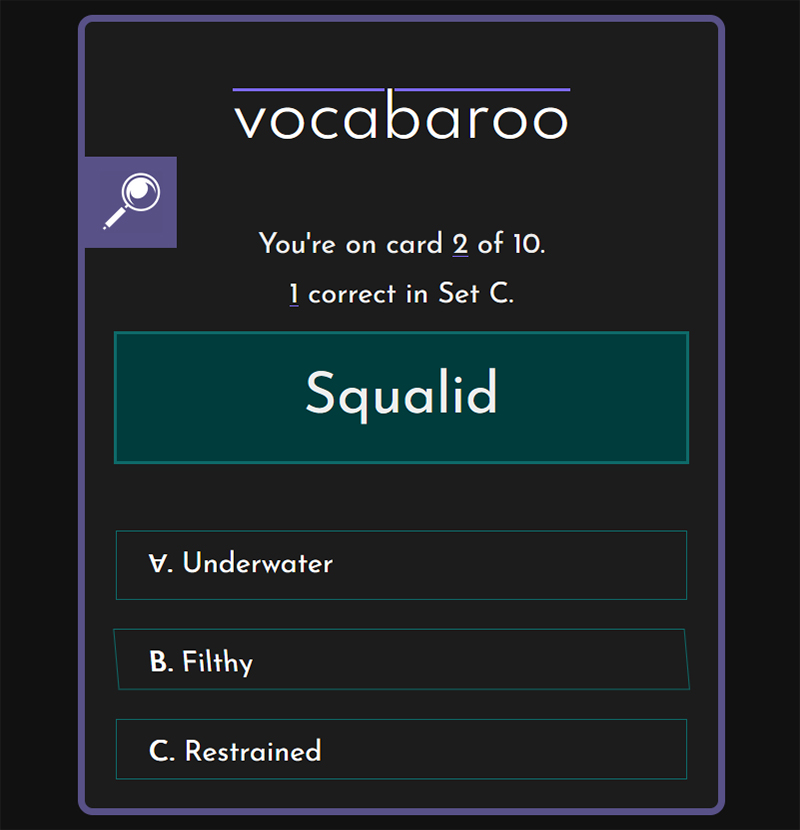
A Man Outside is a short vocabulary quiz game. This twist is that, while you play, a creepy shadow man watches you from outside your bedroom window. You’re tasked with doing three sets of ten vocab cards as spooky ambient sounds play in the background, and you can look out of the window at any time to see if the man has gotten closer. Between quiz sets, you can text a friend to update them on the situation.
I hope it doesn’t spoil this game to say that there are no jumpscares. The vocabulary gets progressively creepier, though, and there are fun distortions in the quiz interface. The vocab game itself is quite good, even without the added attraction of the creepy man. Necrophagy is my new favorite word.
Based on what I’ve seen in YouTube playthroughs, your vocab score doesn’t matter, and the choices you make in the text conversations simply add a bit of extra flavor. In order to get the true ending of the game, you have to play it from start to finish three times. There are three different vocab difficulty levels, so I suppose that adds a bit of replay value. Each run only takes about seven or eight minutes, but I don’t think the second or third ending is anything special. The alternate endings are nice bonuses for vocab flash card enthusiasts who want to try every difficulty level, but the first ending is perfect.
As an aside, as someone with ADHD, I often have to pretend that someone is watching me in order to get past executive dysfunction. I used to “have someone watch me” by going to coffee shops, but that only worked in Tokyo and Washington DC, which are beautiful and walkable and filled with cafés. Philadelphia has many charms, but it’s not that sort of city. Now, if I’m having trouble sending emails or whatever, I have to conjure an amorphous imaginary person who’s sitting in the room with me just out of eyesight like some sort of sleep paralysis demon.
So, for me, playing A Man Outside was kind of comforting. Cozy, even. Honestly, this might actually be a decent way to study vocab.
One Hell of a Maid is a free, ten-minute RPG Maker horror game about a young man who has been dispatched on his first assignment for an at-home maid service. Unfortunately, the apartment he’s been contracted to clean belongs to a group of cultists. Using a handy set of cleaning tools, you follow the handsome maid as he cleanses the apartment of blood on the floor, eldritch horrors in the bathtub, and coffee stains on the couch.
The apartment has three rooms, and each of them has a (very) mild jumpscare. I love the monster design, and I also love the poor maid’s no-nonsense attitude regarding the horrors he encounters. This was the only job he could get, apparently, so he might as well do it. It’s unclear why he has to wear a frilly maid’s outfit, but it’s probably best not to think about that too hard.
The ending of the game is very sweet. When the cultists finally come home, they are adorable. The gameplay in One Hell of a Maid is minimal, but the art and writing do a lot of heavy lifting. Just like the maid himself, bless his heart.
One Hell of a Maid is not for everyone, but…
Actually who am I kidding. The appeal of this game is universal. What a fun and tasty snack.
With the spooky season upon us, Smarto Club decided to take a break from being wholesome and turned spooky with Rental, an eerie game about the risks of renting beach houses.
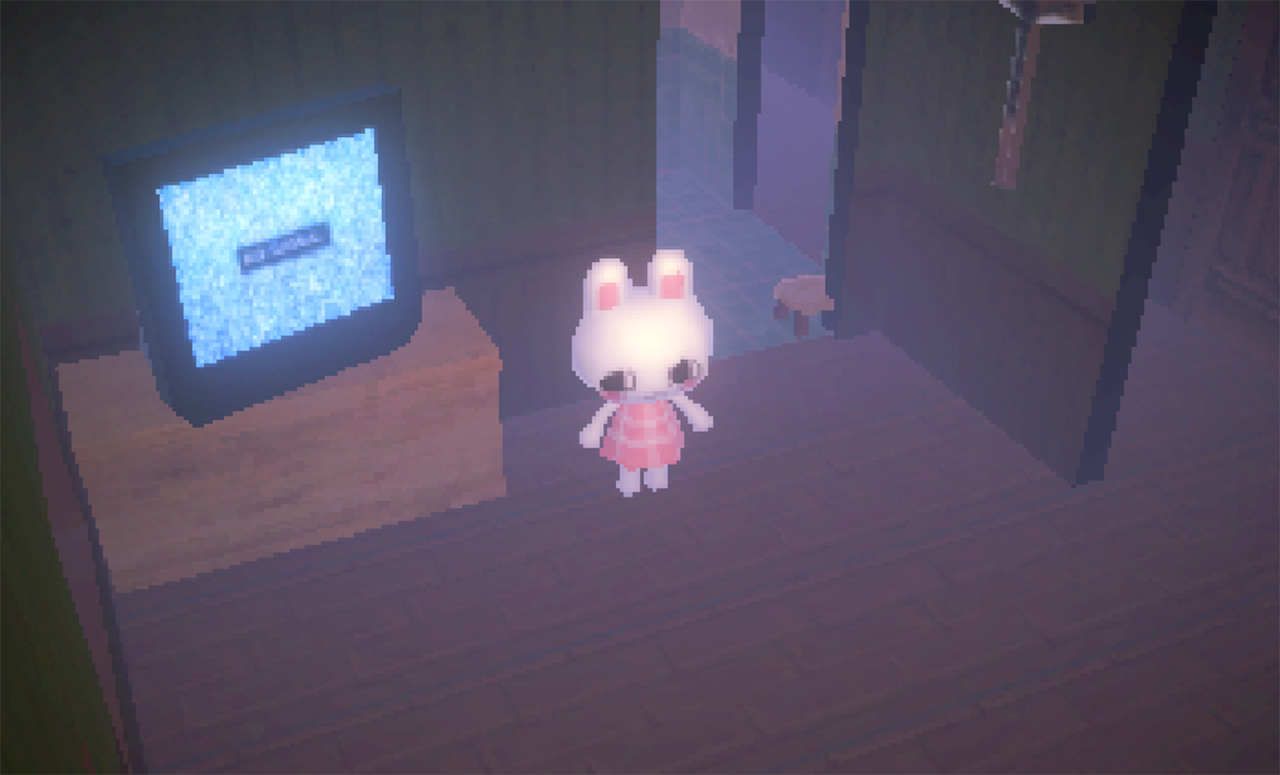
Rental is a 32-bit game about a family of cute bunnies who rent a vacation house in the woods. This isn’t a horror game, necessarily, but it’s strange and lowkey creepy. It takes about fifteen minutes to finish, although it might take slightly longer for people who are out of practice with PlayStation One style 3D spatial navigation.
As the daughter of the bunny family, your job is to walk through the house and collect objects. The twist is that there are House of Leaves shenanigans going on. The first half of the game takes place aboveground, while the second half is more of an adventure. There’s a shadow monster in the house with you, but its appearance seems to be random. I only saw it once, briefly, during my second playthrough, and it wasn’t a big deal. Rental is much more atmospheric than scary, and most of the atmosphere has to do with the ambient music and the oddness of the scenario.
Rental works well as analog horror. The graphics and gameplay and washed-out colors feel super outdated, as do the Hello Kitty character designs. There’s also the combination of the nostalgic childhood experience of going on vacation with the childhood discomfort of trying to settle into an unknown place. The house you’re exploring has a standard layout and floorplan, and the girl often comments on how normal and unremarkable everything is, which adds to the sense of the uncanny.
The Christian religious icons the girl has to gather are also totally normal. For me, this created an extra layer of resonance in the sense of going to a mundane place with a lot of Christian art and imagery and feeling that everything is slightly weird about the oddly suffering men and oddly beatific women and oddly mature babies. I appreciate the girl’s no-nonsense attitude toward everything in the house, which makes the ending all the more amusing.
There are no jumpscares in this game, and it’s not challenging. Rental is a simple but spooky fifteen-minute treat for connoisseurs of perfectly normal houses that are ever so slightly larger on the inside.
Inside is a 2.5D puzzle platformer originally released for the Xbox One in 2016. The near-future dystopian sci-fi setting contains strong elements of horror, and players should expect to experience numerous violent deaths. The game takes about four hours to finish, although a longer completionist run that involves accessing hidden areas will be rewarded with a secret ending.
You play as a ten-year-old boy, and you begin the game alone in the woods. The boy has presumably escaped from a shadowy research facility, and he’s being chased by dogs and men with guns. The boy will be killed if he’s spotted, so the player’s initial goal is to move to the right side of the screen while evading capture.
After the boy escapes from the woods, he emerges onto a farm littered with the carcasses of parasite-infested pigs. It’s here that the game introduces its central puzzle mechanic, which involves using a headset to control the mindless bodies of adult humans. When the boy makes his way out the farm and into a decaying city, it becomes clear that these mindless bodies were once marketed to the general population before the apparent collapse of human civilization.
Inside eventually finds its stride, but the puzzles at the beginning of the game have the potential to be frustrating for a first-time player. In order to progress through one of the barns on the farm, for example, the player has to backtrack to the left in order to open the barn’s back door. Opening this door allows a gaggle of chirping chicks to enter the barn.
The game has never previously asked the player to move from right to left, and there’s no indication that the chicks exist other than a faint chirping on the other side of the barn’s back door. It’s therefore not immediately apparent that these chicks are a necessary element to solving a puzzle that already has half a dozen moving parts. The game becomes much better about broadcasting puzzle solutions as it progresses, but it might be necessary to consult a walkthrough at the beginning.
The first quarter of the game also features another type of frustrating puzzle that involves crossing long distances to escape from attack dogs. If the boy dies at any point during one of these sequences, the player has to start over at the beginning, thereby losing up to six or seven minutes of progress. Repeatedly playing through one of these sequences only to fail at the end isn’t fun.
Thankfully, Inside becomes much better at managing respawn points after the boy leaves the farm. Many of the game’s later puzzles involve a combination of careful timing and brutal death, but they allow the player adequate space to stand still and assess the situation.
Tiny birds and bloodthirsty canines aside, Inside is visually striking from start to finish. The sound design is brilliant, and the audio works alongside the graphic design to create a palpable sense of danger and menace. Unlike Playdead’s earlier game Limbo (2010), which was more abstract and fantasy-themed, Inside is grittier and more focused on portraying a disturbingly realistic apocalypse.
As I played Inside, I could envision its story evolving in two ways. My first theory was that the boy is a host for the same parasite that killed the pigs on the farm; and, if he escapes into civilization, the infection will spread and the world will be doomed. My second theory was that the boy is being controlled just as he controls the mindless bodies; and, after he accomplishes his mission, he will be unplugged.
The actual endgame story developments are nothing even remotely resembling what I expected. Instead, Inside gradually transforms into a meditation on bioethics and subjectivity that’s all the more striking because of the player’s interaction with the story. I’m still not sure how to interpret the ending, but the path to get there involves one of the biggest ludo-narrative surprises I’ve ever had the pleasure to encounter. I usually don’t have any patience for concerns over spoilers, but I’d recommend going into this game spoiler-free. The ending of Inside genuinely has to be experienced to be believed.
Melissa is a free-to-play retro horror visual novel about a rudimentary dating game on an old library computer. If you’re okay with dying quickly, it takes about seven minutes to play, but you can add a few more minutes by trying to stay alive for longer. The game has an easily accessible save system, so you can restart at every dialogue choice to see what happens when you beg for mercy. Good luck!
Melissa reminds me of the best parts of Doki Doki Literature Club without the need to scroll through an hour of cutesy school shenanigans. The initial dating game is exactly the sort of thing you’d find on a floppy disc next to Oregon Trail, and both the graphics and the sound design feel nicely textured and deliciously crunchy. The writing gets in and gets the job done, and the twist is a lot of fun.
…that is significantly longer (about 25-30 minutes) and also very good. The retro nostalgia appeal is amplified by the occasional internet dial-up sounds, and at certain points the game asks you to print things out on the library’s public printer, which makes adorable dinosaur noises. Aside from the eponymous Morris, the story featured two additional characters, both of whom are delightfully unhinged. In the comments on the game’s page on Itch.io, a few people said that they’d happily date the evil older woman, and honestly? Same.
It amuses me that Melissa and Morris are both named after famous computer viruses. If you’re interested, I recommend checking out these two bizarre FBI pages, if only for their top-notch banner graphics:
Anyway, it seems like the developer is making a full Date Time trilogy for release on Steam, and I’m intrigued by the work they’ve posted so far. It’s interesting to think that this universe of cursed retro dating games is informed by its own system of deep lore, and I’m always here for monster computer viruses who are down to smooch.
Corpse Party is a 16-bit RPG Maker horror adventure game from 1996 that was released on multiple platforms before finally finding its way, in a substantially updated form, to the Nintendo Switch. It shows its age, but it’s definitely worth playing if you’re into retro-styled horror adventure games.
Corpse Party is divided into five chapters, each of which stands as a discrete unit accompanied by its own set of save files that can be selected from the main menu. Every chapter has a number of optional bad endings, but you need to achieve the good ending in order to unlock access to the next chapter. If you’re using a walkthrough, each chapter takes roughly an hour to complete.
You play as various members of a group of high school students who stayed late after school one evening to tell ghost stories. They unfortunately trigger a curse that transports them to an abandoned elementary school building that was shut down in the 1970s after a grisly series of abductions and murders. Different students occupy different pocket dimensions of the school, which is almost entirely cut off from reality. To make matters worse, your group of students isn’t the first batch of kids to be spirited away to the school, which is littered with corpses and haunted by vengeful ghosts. Your goal is to help the kids escape the school… if that’s even possible.
Corpse Party is extremely gory, and not all the kids are going to make it. The game contains intense depictions of mutilation and self-harm accompanied by vivid textual descriptions and occasional environmental illustrations of an uncomfortably graphic nature. The violence occupies an intersection between disturbing, gross, and campy, and I thought it was a lot of fun.
The main challenges of Corpse Party are of the standard “find a key to unlock the door” adventure game variety. The layout of the school changes from scene to scene, but it’s not large enough to get lost in. Aside from avoiding the occasional wandering ghost, there are no reflex challenges, and your characters are very rarely in any immediate danger. If there were jump scares, they didn’t register with me. The 16-bit character sprites are very cute, even when they’re depicting corpses.
As far as horror games go, Corpse Party is relatively chill, but with one caveat:
Corpse Party is completely linear and frustratingly opaque about what you need to do to trigger the next event in any given sequence. Unless you want to walk through endless dark hallways searching every square of the map, you’re going to need a walkthrough to get through the game. The walkthrough people use is (this one), but the walkthrough can sometimes be just as opaque as the game itself.
Personally speaking, I’m not the sharpest tool in the shed, but I managed to get through the first two chapters of Corpse Party without using a walkthrough. These initial two chapters stand on their own as a story, and I felt that they were actually the best part of the game. I think it’s probably safe to say that the opening of Corpse Party is more than enough to satisfy someone with a casual interest and playstyle.
The characters are usually divided into interesting pairs, and most of what you’ll do in the game consists of walking around inside the ruins of the school building while having conversations. The kids are very good about following horror movie rules – they don’t split up or do anything stupid – but they’re at the complete mercy of the ghosts of the original murder victims, who will change the layout of the school or create traps just to mess with them. For the most part, the kids are good and gentle and kind to one another, which makes it all the more upsetting when something bad happens.
The characterization and conversations aren’t that deep, however, so you never get so attached to any character that you don’t want to see them die. My favorite death is when one of the kids gets slammed against a wall so hard that his body explodes into red pulp, which all the rest of the kids have to walk through for the remainder of the game while navigating that particular hallway intersection.
Through disjointed and disconnected teamwork, your characters learn what actually happened to the ghosts haunting the school. For curious lore hunters, there are various bits of text scattered around, from newspaper clippings to messages left by other victims of the curse. These textual passages start off as grim and gradually grow more disturbing, and it’s always a pleasure to find something new to read. There’s also an optional collection quest that encourages you to find and interact with all the corpses in each chapter; and, if you like, you can return to the main menu and read about all the horrible ways these kids died.
It’s probably more accurate to call Corpse Party a “visual novel” as opposed to an “adventure game,” but it’s fun to explore the school while interacting with various objects in the environment. It’s also fun to gain access to new areas, both to learn more about the story and to see more of the game’s pixel art. One of my favorite areas is the outdoor pool in Chapter 4, which is filled with waterlogged corpses and preceded by a hellishly filthy locker room. Good times.
Despite its frustrations, I really enjoyed Corpse Party, and the English translation created by XSeed is fantastic. While reading the game’s Wikipedia page (here), I learned that there’s a manga adaptation (here), and I had so much fun exploring this horrible haunted school that I started reading it. It’s just as ridiculous and over the top as you’d expect from a manga adaptation of a horror game, but each chapter has one or two really great horror scenes enhanced by lovingly detailed and disturbingly gruesome artwork.
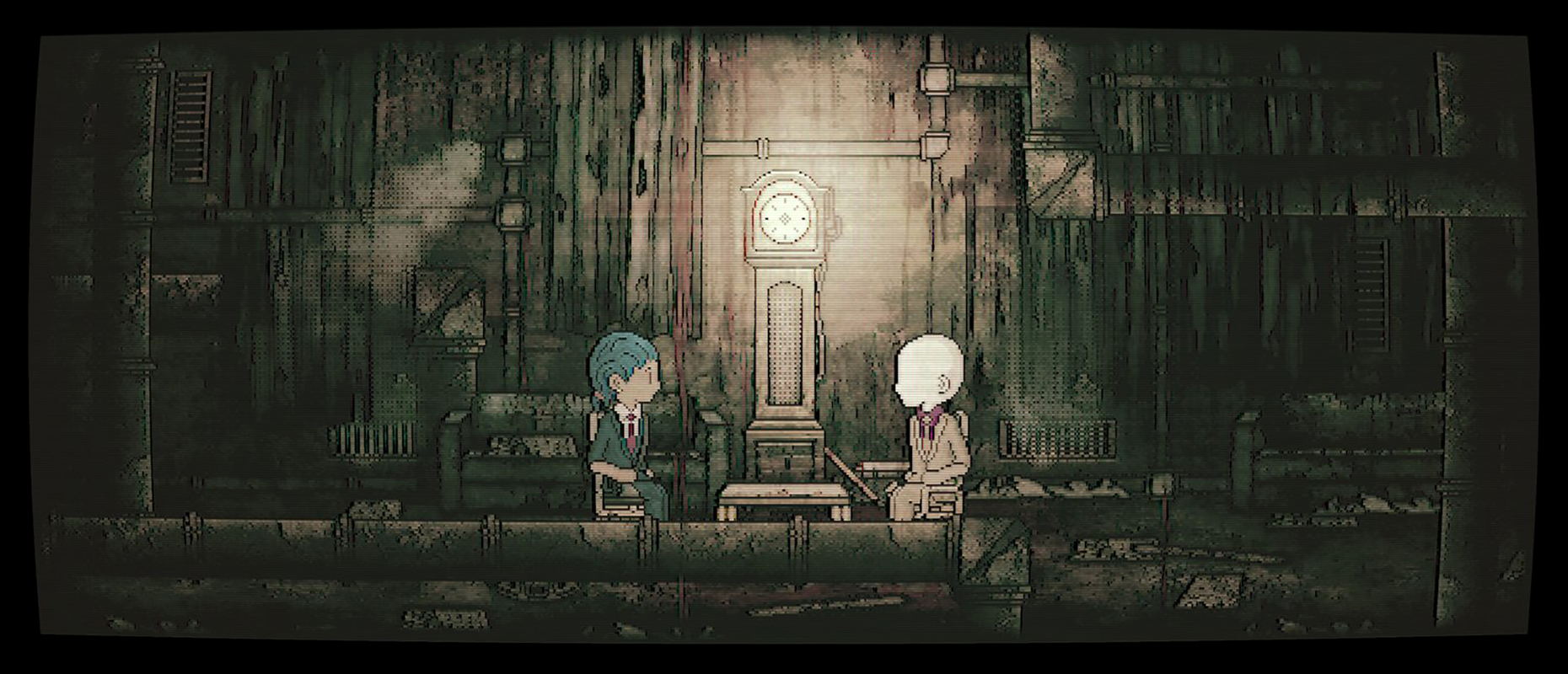
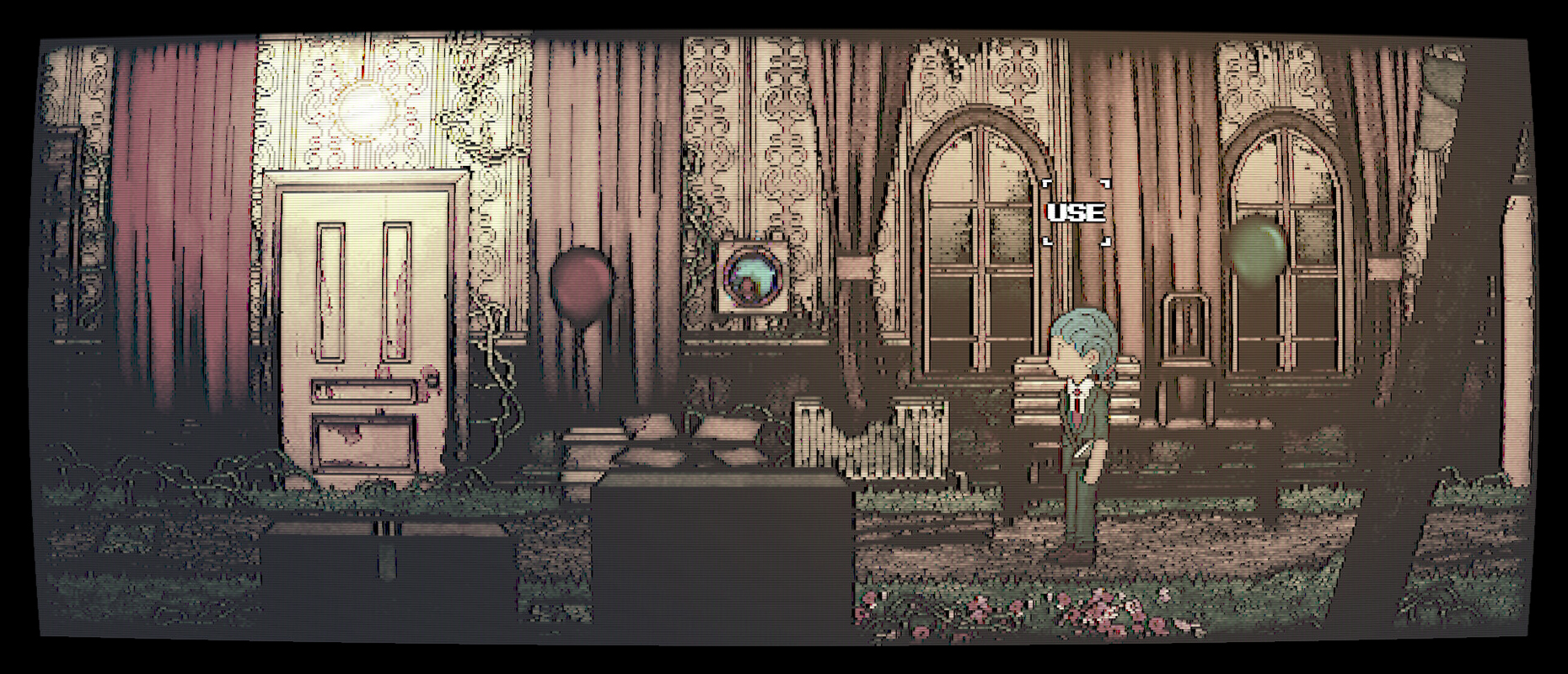
Afterdream is a 2D horror adventure game with puzzle elements and lo-fi pixelated graphics that takes between two to three hours to finish. It’s on Steam, but I played it on Nintendo Switch and had a fantastic time. Afterdream drops you right into the story and immediately grabs your attention, and its pacing is impeccable. The horror is mostly atmospheric, but the game features a great set of jumpscares mixed with short segments of heightened tension.
Afterdream isn’t for people who can’t tolerate horror, but I’d happily recommend it to anyone else who’s interested in trying out a short, original, and creative story game. The puzzles are fun but not too difficult, and the environmental design is really something special.
You play as a woman named Jennifer who wakes up in a filthy derelict room wearing a suit she doesn’t own. During the intermittent frame story, Jennifer relates this situation to an older man who seems to be a psychiatrist, claiming that she’s experienced an unusually realistic nightmare.
Within this nightmare, Jennifer’s job is to navigate a series of haunted houses while finding a series of objects for a series of NPCs. There are no Professor Layton style puzzles relating to number games or spatial arrangement challenges; rather, Afterdream’s puzzles are mainly fetch quests reminiscent of old-school adventure games in which a certain object needs to be applied to a certain environmental obstacle, like a key being needed to unlock a door.
The challenge, such as it is, lies in being able to form a mental map of each area and remembering what goes where. The game mechanics are extremely simple and intuitive, and there are no inventory limits or menu screens to distract the player from the immersive environment. It’s always clear what you can interact with, and the in-game text isn’t cryptic about what needs to happen.
The haunted houses don’t reveal their secrets willingly, but Jennifer is aided by a Polaroid ghost camera that she can use to scan her surroundings. The oddities exposed through the camera’s viewfinder become real once photographed. You might hear an odd ticking sound, for example, in which case your camera will reveal a ghostly clock on the wall. It’s a neat game mechanic, and it’s put to good use in a nice variety of situations.
Jennifer begins in an old and rotting apartment building and then progresses to a fancier but similarly ruined mansion, wherein a helpful ghost tells her that she’s been given an opportunity to make contact with the spirit of her recently deceased father. In order to summon his ghost, Jennifer must first find a special “portal object” hidden within the liminal space between life and the afterlife. Unfortunately, no one can say what this object looks like or where it’s hidden.
Still, Jennifer has no choice but to keep moving forward through progressively spookier areas. As a special present to me personally, there’s a dark and grimy sewer level, and it’s wonderful. There’s also a “creepy little town” level, and it’s beautiful and I love it.
Even though the game is divided into discrete stages, its story isn’t formulaic. To lighten the heavy atmosphere, the writing employs humor at key moments, with both Jennifer and the NPC ghosts occasionally poking fun at the absurdity of various situations. I really enjoyed the instances when I thought something horrible was going to happen but everything actually turned out to be perfectly wholesome. The pacing is excellent, with plenty of fun character interactions and chill periods of downtime between the creepy bits and jumpscares.
Afterdream is the perfect length for its story, and its gameplay goes from strength to strength as its setting becomes stranger and more disturbing. It might not be to the taste of people looking for more action or more explicit horror, but it was perfect for me.
One final thing: When I first saw the game’s trailer, I was like, “This looks cool, but I hope you can turn off the strobe effects.” And thankfully, you can in fact turn off the strobe effects. It’s always nice when game developers take this sort of accessibility issue into consideration.
To celebrate Halloween and everything autumn, Sidequest created a list of cozy horror games for people who enjoy the themes and aesthetics of spooky season but aren’t into jumpscares or explicitly ghoulish imagery. I love every game on this list, and I had a lot of fun writing about three favorites of my own. Here’s a set of excerpts:
Despite its grim premise, Six Cats Under is a chill game with cute pixel graphics and an ambient lo-fi soundtrack. Even watching a short playthrough on YouTube is relaxing.
This is the perfect Pacific Northwest Gothic setting for a haunted house story, but Edith’s former home is actually quite beautiful and charming. Adding to the game’s coziness is its comfortable two-hour playtime, as well its clearly signposted guidance along the critical path.
Although you’ll gradually uncover the town’s secrets during the days leading to and following Halloween, your main goal is to reconnect with old friends in dead malls and empty grocery store parking lots after spending your afternoons strolling through streets filled with gorgeous fall foliage.
I think it’s worth commenting on my criteria for what makes a game “cozy.”
Accessibility is a major factor. You should be able to play a cozy game at your own pace without having to worry about the anxiety of time limits or the frustration of losing progress. Another key element of cozy games is their ability to inspire a sense of comfort through visual presentation. “Cozy graphics” aren’t disposable Instagram aesthetics, but rather a commitment to a distinct visual style that feels hand-crafted and deliberate in its expression of the game’s themes.
More than anything, a cozy game uses its relaxed vibes to create a safe space to ask meaningful questions that the player wouldn’t have the energy to engage with otherwise. Cozy games should be thought-provoking but casual, like a conversation with a friend in front of a fire. “Cozy horror” isn’t an oxymoron, then, as cozy games are perfect for the long nights when you can bundle up, get comfortable, and take the time to study the shadows lurking in the darkness.
I’m excited to share a project I’ve been working on for several months: an annotated list of ten retro horror games that are free to play on Itchio. I posted reviews of many of these games here on this blog over the summer, and I’m grateful to the amazing editors at Sidequest for allowing me to refine my thoughts and present everything in one article.
To me, one of the fun things about indie retro horror games is that many of them deliver their central idea with as much concision and impact as possible, allowing the player to become thoroughly spooked in one sitting. So that readers can get a decent idea of what to expect, I organized my list according to roughly how long each game takes to play.
I recently had the pleasure of writing a review of the Game Boy horror adventure game Soul Void for the online gaming magazine Sidequest. I love Soul Void, and I’d describe it as Undertale for people who love quirky adventures with elements of horror but hate bullet hell. Although the horror elements of Soul Void are quite gruesome, it’s accessible to players of all skill levels. The game is free to play on Itchio (here), but I’d recommend playing it on a Game Boy emulator like mGBA, which you can download (here). Here’s an excerpt from my review:
Soul Void is a dark fantasy Game Boy adventure game that takes about three hours to finish. Its story of a young woman navigating the perils of the underworld is intriguing and cathartic, and its art design makes incredible use of the eeriness of its retro pixel graphics. For anyone who enjoyed the characters and worldbuilding of Undertale, Soul Void offers a similarly offbeat odyssey of mystery and friendship illustrated with disturbing but brilliantly creative horror art.
I want to give a big shout-out to my editor, Maddi Butler, for helping me get my thoughts in order and work through some of the more interesting themes of this game. I’d also like to thank the Sidequest Editor in Chief, Melissa Brinks, for giving me an opportunity to write about Soul Void, and for allowing me to expand on my thoughts about this amazing game. For excellent writing and commentary on video games, you can follow Maddi on Bluesky (here) + Melissa on Twitter (here). If you’re in the mood for gorgeous horror art, you can follow Soul Void’s creator, Kabadura, on Twitter (here) and on Instagram (here).







 Digital Fantasy Diary
