Carpe Noctem

Carpe Noctem: Vampires Through the Ages is an anthology of original art, comics, and historical fiction about vampires around the world. The backer campaign lasts until Saturday, December 11, and you can read about the project and order a copy of the book on Kickstarter (here). Carpe Noctem was fully funded in three days, and four stretch goals have been unlocked since then. You can check out contributor bios, merch illustrations, and previews of art and writing on the project’s Twitter account (here).

I’m contributing a short story about a Heian-period vampire titled “The Kumo Diary,” which follows a Meiji-era scholar’s assistant who discovers an old manuscript that she initially mistakes as a lost chapter from The Tale of Genji. Along with The Tale of Genji, I’ve drawn inspiration from Ryunosuke Akutagawa’s short story “Rashomon” and Fumiko Enchi’s eerie postwar novel Masks. In the excerpt above, you can see my homage to a fictional essay in Masks called “An Account of the Shrine in the Fields.” It was a lot of fun to write about Heian-period demonic women, and I also enjoyed doing research in order to put together the Meiji-period frame story. I’m very proud of the ending, and I hope readers will get a pleasant chill from the gradual transformation of the two narrators’ distinctive voices.

Carpe Noctem is scheduled to be published in August 2022. You can back the Kickstarter campaign to pre-order a copy of the anthology along with a collection of the dark and stylish merch created as a promotion. There’s a special NSFW zine and a bonus story told through a collection of physical documents that are exclusive to the Kickstarer campaign, so please check it out if you’re interested!

Flowerblight Ganon

I posted a short story on AO3 (here) about a minor character in Breath of the Wild named Magda, who is affectionately known by the fandom as “Flowerblight Ganon.”

In Breath of the Wild, Malice is a tangible substance that infests objects and locations controlled by Ganon, including the four Divine Beasts, Hyrule Castle, and the Akkala Citadel Ruins. It also infects the dragon spirit Lanayru who guards the Spring of Wisdom.

While writing this story, I wondered if it were possible for Malice to infect regular people. If so, the woman who zealously guards the garden of flowers surrounding Hila Rao Shrine is as good of a candidate as anyone.

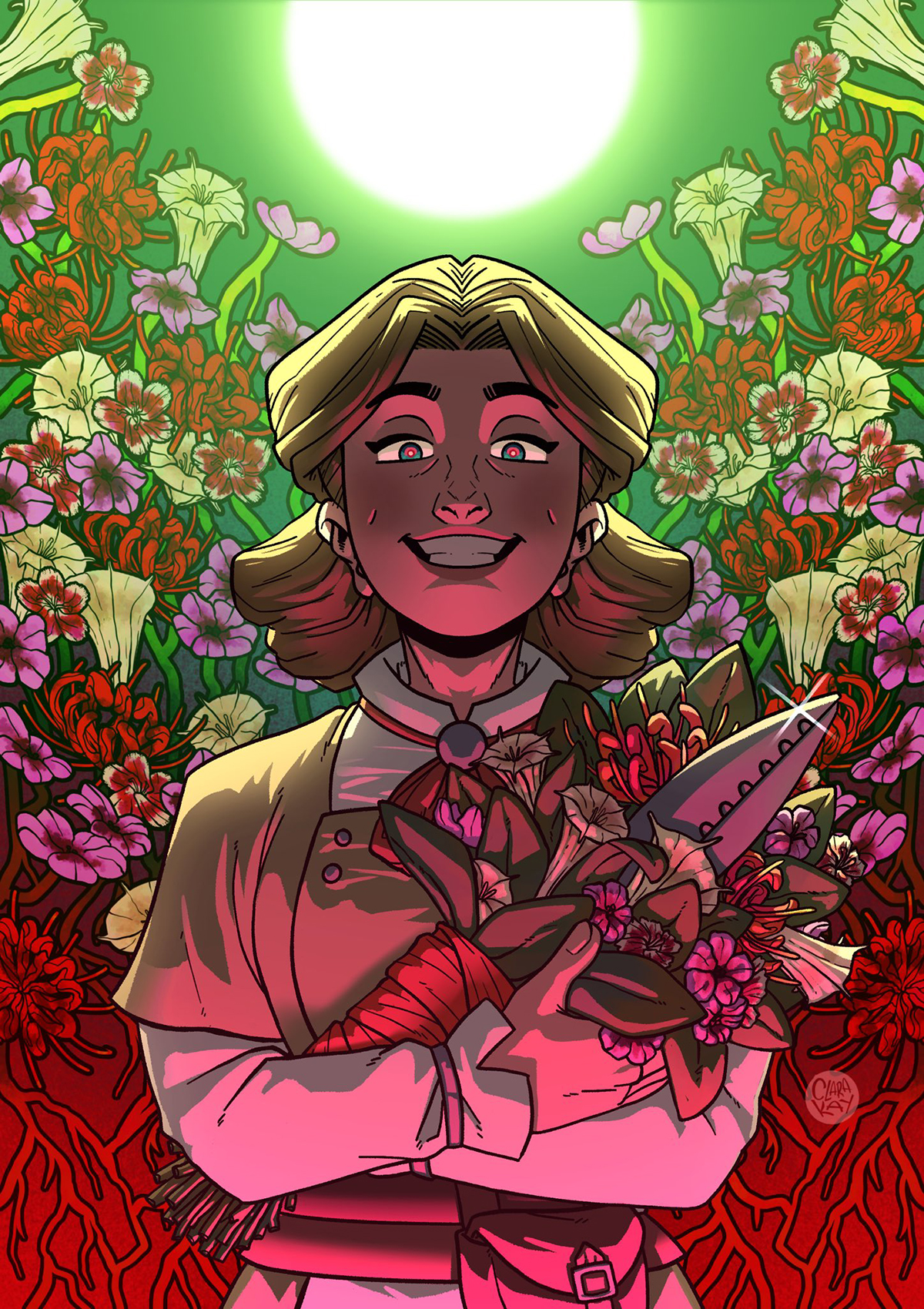
The story illustration is by Clara Kay, whose gorgeously monstrous horror art can be found on Twitter (here) and on Instagram (here). I really enjoyed working with Clara, and I also want to give a shout-out to her store (here), which has all sorts of cool Legend of Zelda merch!

I’d like to share a bit of the artist’s description of this piece, because it’s fascinating:

There’s a lot of symbolism packed into the flowers here. The petunias (pink) represent anger and resentment, the devil’s trumpet (the tall white one) represents power and caution, the spider lily (big spiny red one) represents death and reincarnation, and the carnation (white with red ring) is considered the ‘flower of the gods’ and represents admiration, passion, and love.

Carnations represent “passion and love” because they’re thought to be white flowers dyed red with blood, which is entirely appropriate for this story. “Flowerblight Ganon” is my first foray into botanical horror, and I don’t think it’s necessary to be familiar with Breath of the Wild to understand what’s going on. Magda is a regular woman enjoying gardening, quiet living, and occasional tea with friends in a dying postapocalyptic world, and if she lives her best life by indulging in murder every once in a while, then at least her flowers are well fertilized.

Mount Hiei

My story “Mount Hiei,” a dark fantasy about two young monks navigating the eerie twilight years of the Heian period, was just published in Hyakumonogatari Kaidankai, a special issue of the journal White Enso. The issue is currently ongoing and free to read online (here), and “Mount Hiei” is on (this page).

In this story, a ten-year-old boy becomes an apprentice monk on Mount Hiei, which houses a temple that has been tasked with protecting the nation. The boy grows accustomed to monastic life but never becomes comfortable with the statues of the monstrous Guardian King venerated by the other monks. When he discovers a secret door leading into the mountain, he comes to understand why the deity is depicted in such a frightening manner – as well as what “protecting the nation” actually entails.

Mount Hiei is a real place, as is Enryaku Temple, which serves as the setting of this historical horror story. To the best of my knowledge, the practical details of monastic life are accurate for the time period. I was inspired by the fiction of the Japanese author Ken Asamatsu, who applies a Lovecraftian sensibility to Japanese mythology and folklore, and I wrote this story from a place of admiration and respect for the medieval war epic The Tales of the Heike, on which it’s very loosely based.

By the way, the editors of White Enso are still looking for personal essays and original fiction for the 100 Ghost Stories Kaidankai project. Although they’re selective, they accept shorter and more casual pieces, and the submission process is very chill and relaxed. The editors are a pleasure to work with, and they’ll also create a podcast recording of your writing! If you’re interested, you can send your submission (here).

Apartment Hunting

I moved to Philadelphia earlier this year. The circumstances weren’t ideal, and I only had a few days to find an apartment. I went on several tours of large buildings and fancy condos, all of which were way out of my budget. Besides, I wouldn’t want to live in a place like that anyway.

I decided to pursue a different strategy. Instead of looking for listings online, I drove through several neighborhoods and took photos of places with For Rent signs outside. I sat in my car, made a list of phone numbers, and agreed to meet with anyone who picked up when I called.

This was how I found myself standing on the sagging porch of an old townhouse in West Philadelphia with ornamental spires above the windows and a historic registry plaque beside the front entryway. A woman with a colorless suit and a severe haircut met me at the door and handed me a blank application form. Just in case, she said.

The interior was much larger than I expected. I’d never been inside a townhouse before, and I wasn’t prepared for how far back the hallway would stretch. The doors were strangely small, and the ceiling seemed far too high. This must be the building’s historic character, I told myself. Local color. The realtor wasn’t interested in conversation, so I stopped to take a picture of the crown molding, which was ornamented with carvings of infinitely spiraling vines.

When I looked up from my phone, I realized that I was alone. The hallway in front of me was dark, so I turned around and began walking back the way I came.

There were more turns and staircases than I remembered. As I walked, the floor grew spongy underneath my feet. My shoes made unpleasant squelching noises with every step. I started to notice that there were small mushrooms crouching in the corners of the walls and creeping up the support beams between doors.

I swallowed my embarrassment and called out to the realtor, but no one answered. I tried dialing the number printed on the For Rent sign, but no one picked up. I was lost, I realized. I’d somehow lost my way outside. At least I still had the application form.

It’s not so bad, all things considered. I was alarmed at first, but I’ve gotten used to it, and it’s not as if there’s anything I can do. I guess I live here now.

. . . . . . . . . . .

This was my submission to the 2020 Philly Zine Fest Anthology. You can download a free PDF copy of the anthology (here). The Philly Zine Fest is held every November, and you can stay updated on Twitter (here).

Haunted Houses

Earlier this week I published my newest zine of horror-themed microfiction. Haunted Houses contains fifteen very short stories about haunted spaces and the terrible people who inhabit them. The cover art is by @QuinkyDinky, and the zine contains interior art by @irizuarts. I’ve got a listing up on Etsy (here), and I’m also promoting the zine on Twitter (here) and Instagram (here).

This zine is quite short, with each story and illustration occupying only one page. This is partially a trick of formatting, but it’s also a result of careful editing. You wouldn’t want to spend too much time in these places, after all.

I have to admit that, even though I’m categorizing this zine and the two other collections of microfiction that preceded it as “horror,” I’m on the fence about what genre my stories actually belong to.

In my mind, the genre of horror isn’t about a specific set of tropes or narrative structures. Rather, horror is characterized by the psychological and visceral sensation of unease it inspires.

I personally prefer to think of most horror, including the stories I write, as “dark fantasy,” or perhaps simply “magical realism.” I’m not easily creeped out by fiction, mainly because the real world is so lowkey awful so much of the time. As I write this, the National Guard is setting up base at a West Philadelphia Target in advance of the presidential election next week, ostensibly as a “defense” against people engaging in civic protest. There are actual tanks in the parking lot of the place I go to stock up on toilet paper, and that’s really scary. But monsters? Not so much.

I’ve always tended to identify with monsters, and not simply because so many villain characters are overtly coded as queer. Monsters are about disrupting the status quo, and I can get behind that. Postwar American horror cinema, including the slasher films of the 1970s and 1980s, is all about interlopers quietly invading small-town America and infecting people. The story behind many of these movies basically boils down to this: Can you even imagine scary things like communism and feminism and civil rights secretly gaining a foothold in our town? (Stephen King goes into fantastic detail about this in his 1981 book Danse Macabre, if you’re curious, and I think the book still reads well and holds up in many ways.)

To me, monsters aren’t scary because I am the monster, which is an uncomfortable set of life experiences to try to talk about in fiction or otherwise. There’s nothing you can specifically put your finger on regarding why people treat you the way they do, but you know there’s something a little off.

Fuck Sigmund Freud and his weird misogyny and homophobia, but I think I’m on the same page with him regarding “the uncanny” as one of the primary components of horror. Freud got a lot of things wrong in his career, but something he gets absolutely right is that it’s difficult to discuss the uncanny in concrete terms.

The uncanny doesn’t just apply to appearance, of course – social interactions and environments can be uncanny as well. If what I’m writing is horror at all, it probably falls into the subcategory of social horror, which focuses on people behaving in a way that’s almost human, but not quite. Many horror stories are cathartic, in that the status quo is threatened but ultimately restored at the end. Even if things have changed, we can feel relief in the knowledge that at least they’re getting back to normal. With social horror, however, our anxiety is never resolved, because we now understand that the status quo itself is horrifying.

It’s difficult for me to talk about the details of my identity and life in a mimetic way. When I’ve tried, it’s been my experience that people either won’t believe me, will think I’m being manipulative in an attempt to elicit undeserved sympathy, or will be put off by the political elements underlying my descriptions of the ways in which I’ve had to move through the world.

The point of the stories in Haunted Houses is not to try to explain why certain aspects of my life have been unsettling, but rather to create a sense of the uncanny in order to communicate the sense of feeling unsettled for reasons you can’t quite explain. Sometimes my stories about haunted houses are about the hidden trauma of being queer in a society that goes out of its way to create monsters; but, in the end, I just really like telling stories about strange people occupying uncomfortable places. I enjoy exploring these themes both as a reader and as a writer, and I’ve found that summoning the courage to open the door and peer into the darkness on the other side is, if not total escapism, still good spooky fun.

And right now, at this specific moment in time, I think we can all relate to the uncanny experience of feeling trapped in a haunted space, because this is our daily life – we live here now.

It Never Happened

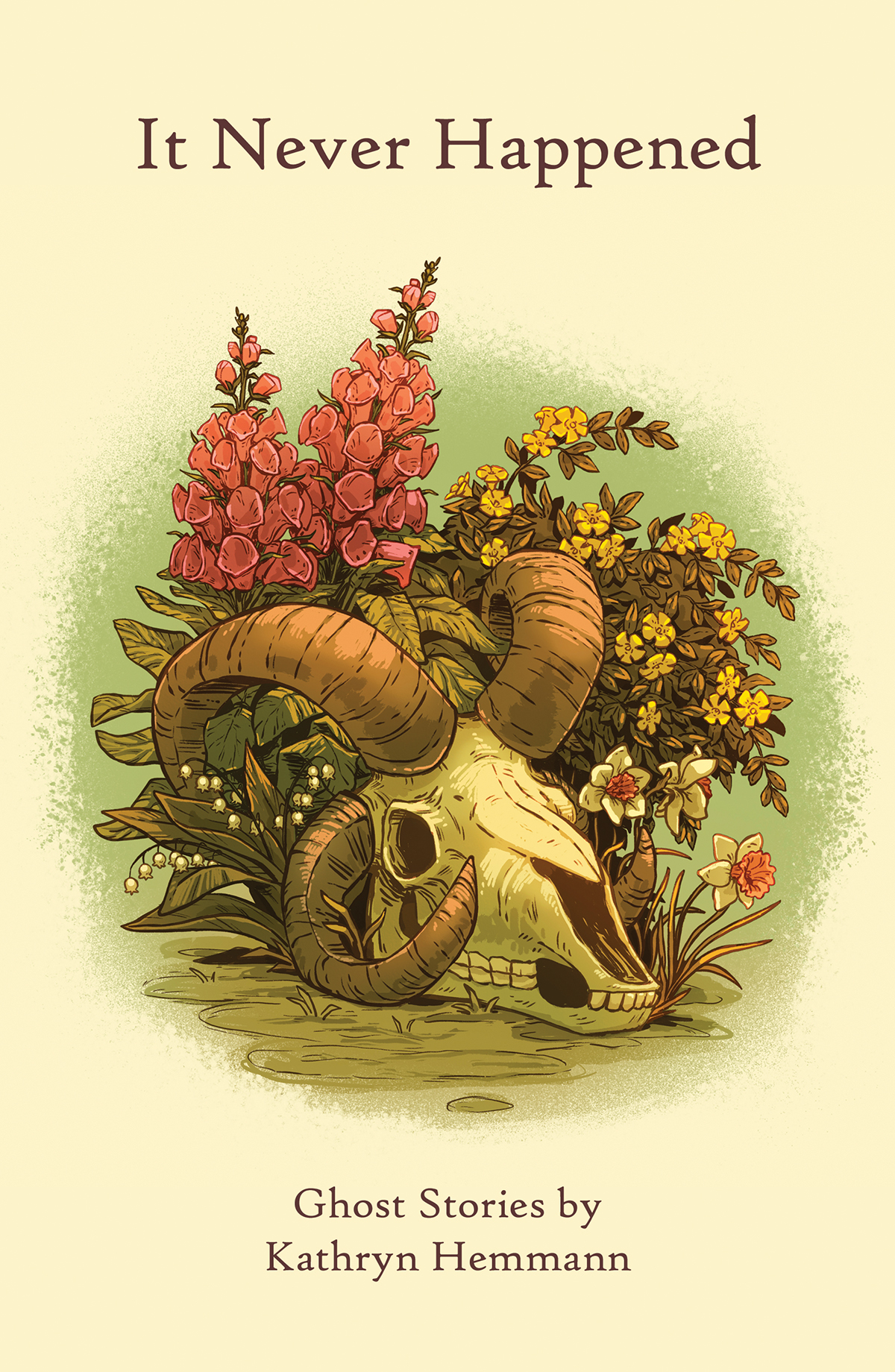
It Never Happened is my second zine of horror-themed flash fiction. It collects fifteen very short stories, as well as a spooky comic (that you can find here) by the artist Frankiesbugs.

This is the zine description:

This zine collects fifteen short stories about finding oneself in strange circumstances and adjusting to a new normal. Nothing that takes place in these stories actually happened, of course. Most of what transpires is a little creepy, but it’s important to remember that none of this is real. If you read these stories, you might not be real either, but don’t let that stop you.

I love autobio comics, and a lot of these stories came from my failed attempts to write comic scripts. What I realized during this process is that it’s very difficult for me to talk about myself. Although I obviously have no trouble sharing my opinions, I never know what to say when I try to describe my own life. All of the stories in this zine are based on real experiences; but, as the title suggests, none of this ever actually happened.

Or rather, that’s not entirely true. One of these stories is 100% factually accurate, but I’m not going to say which one.

If you’re interested, there are still a few copies of this zine (on Etsy).

Haunted Haiku

Haunted Haiku collects of 147 horror-themed haiku. Some are eerie, some are elegiac, some are homages to cult horror films, and some are just weird.

This zine is fifty pages long and standard half-letter size. This was my first time printing a zine with perfect binding (in which the pages are glued instead of stapled together), and I underestimated how large the interior margins need to be. I’m almost sold out of this zine (although there are still a few copies left on Etsy), but I’m going to change the font size if I ever end up doing a reprint.

The cover art is by the Australian writer, illustrator, and comic artist Sarah Winifred Searle (@swinsea on Twitter). It was an incredible honor to be able to work with her! It was actually Sarah who came up with the title of this zine. I was going to call it “Horror Haiku” (like my other two haiku zines), but Sarah suggested that “Haunted Haiku” might sound nicer. She was right, of course, which is one of the many reasons why it’s always wonderful to collaborate with artists on projects like this.

In any case, this is the first zine I took to be sold at Atomic Books in Baltimore, which is one of my favorite independent bookstores in the world. One of the reasons I love Atomic Books is that their shelves of zines are the first thing you see when you walk in the door, which makes you feel as if you’re stepping into a unique and special space. Anyone can buy books on Amazon, which is why I appreciate when independent bookstores use their physical location as a way to bring an actual community of writers and readers together. Getting an email from Atomic Books saying that they would be interested in receiving a few copies of this zine is definitely one of the coolest things to happen to me this year.