An Unfound Door, Chapter 14

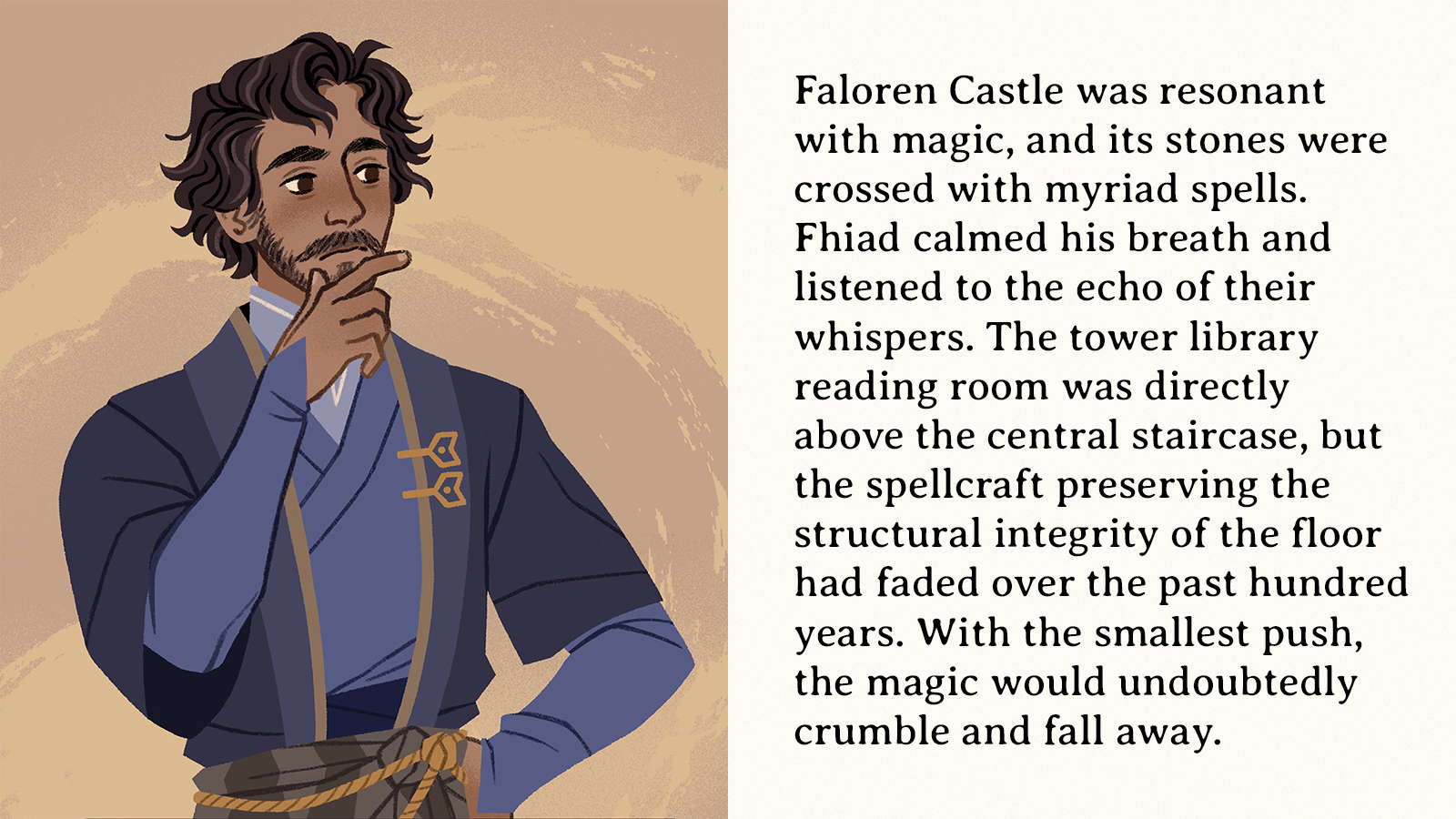
Agnes and Fhiad have a brief conversation with Galien and Caelif before departing from Faloren Castle. Fhiad’s personality becomes warmer and more open as they travel across the countryside. He’s friendly to travelers, and he shares his memories of the university in Cretia with Agnes. In the evenings, Agnes stretches and practices the sword forms that she learned from her mentor Mylah, who left the castle shortly after Fhiad’s arrival and hasn’t returned since.

On the first night after they enter the northern forest, Fhiad watches Agnes practice and confesses that his magic won’t be useful against the dangers they’ll face in Erdbhein. He asks that Agnes remember him as human before transforming himself into a boar.

.

This chapter is the transition stage between narrative acts that Jessica Brody (of Save the Cat Writes a Novel fame) calls “the eye in the calm of the storm.” It’s a seemingly extraneous but actually extremely important part of the story in which the characters take stock of their situation, their relationships, and their goals.

Even before I read Save the Cat, this in-between chapter was always one of my favorite parts of any longer story I wrote. This is especially the case with romances, where this scene is almost always the first intimate moment the characters spend together. If An Unfound Door were a different type of novel, things would have gotten spicy before Fhiad decided to transform himself, but he just kisses her hand. Which is plenty romantic enough, I think.

I end this chapter with the suggestion that Fhiad is going to be reckless and violent as a demonic boar, but this is misdirection. Even in the form of a powerful monster, he isn’t emotionally equipped to handle action, and Agnes is going to have to forcibly transform him back into a human in order to drag him forward in the next chapter.

Even to me, as someone who ostensibly knows how this story ends, it’s been interesting to see how Fhiad has developed as a character. He initially seems strong and dangerous, but his personality becomes more complicated and neurotic as the reality of his trauma sets in. He slowly unravels as he goes from one set of bad behaviors to another, which is always fun to watch. In this chapter, however, Fhiad is a completely normal person, which I think is the key to the story. As long as Fhiad isn’t subjected to the pressure of being involved in history-changing events, he’s fine.

The goal is to get both Fhiad and Agnes to the point where they’re able to accept that they can just leave these ruined kingdoms behind them and start a new life elsewhere. I therefore used this chapter to create foreshadowing that strongly suggests that this is the best possible outcome for them both. Although their respective homelands are beyond redemption, Agnes and Fhiad can still save each other.

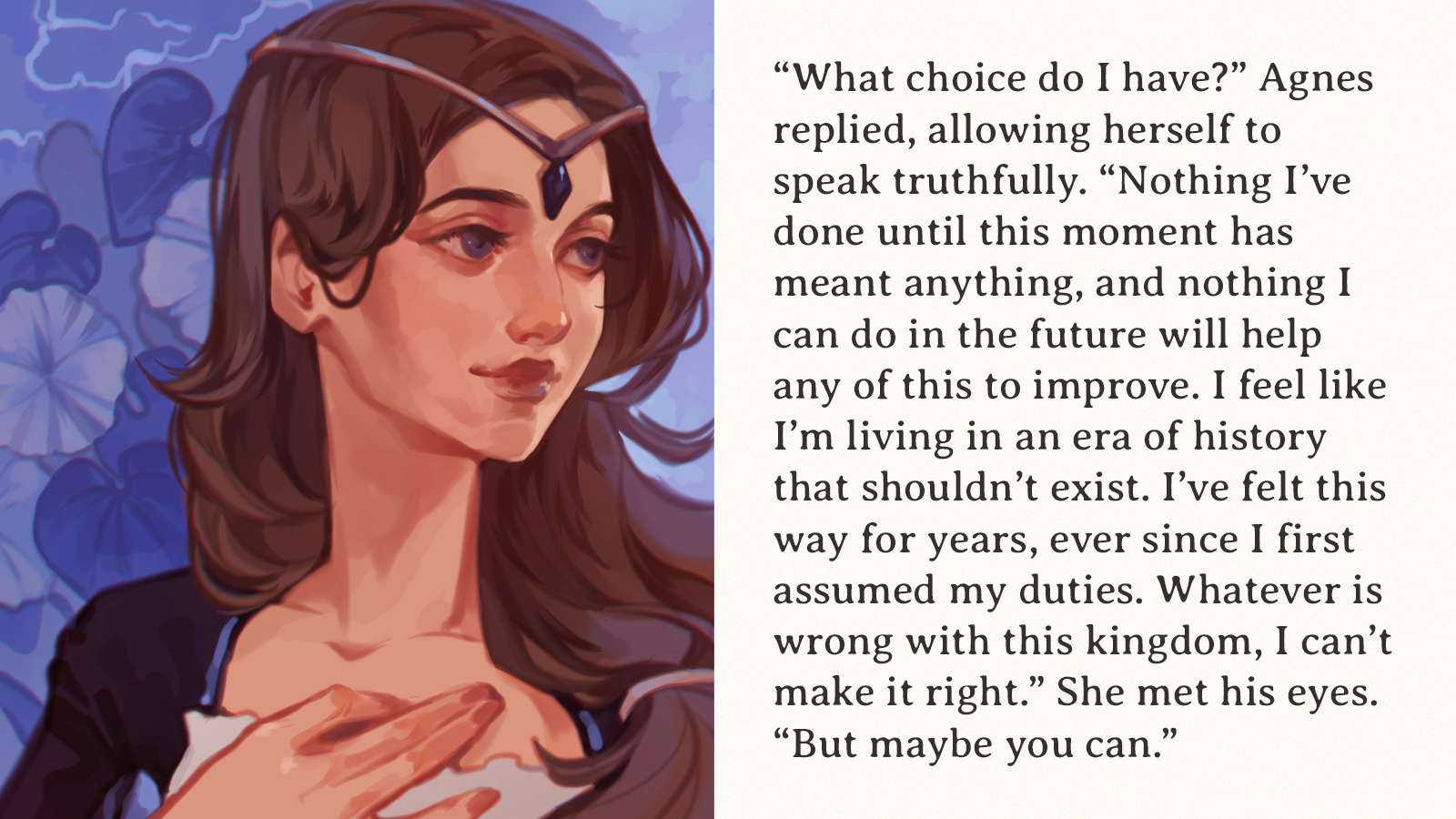
The illustration of Agnes for this week’s preview graphic was created by Anta ARF, who posts brilliant and shining fantasy art on Cara (here), on Tumblr (here), and on Twitter (here).
An Unfound Door, Chapter 13

After crossing the bone-covered courtyard of the west wing, Fhiad and Agnes enter the main library of the former magic academy. It’s in an advanced state of decay, but Agnes finds an isolated reading room that’s still in decent condition. While searching the shelves, Fhiad remembers how he was seduced and betrayed by Agatha, the princess of his era.

Fhiad lashes out at Agnes, who weathers his emotional storm and tells him that she’s found a book with illustrations of the three keystones needed to open the door in the courtyard. Two of the stones are in Faloren, but the third is in Fhiad’s home in Erdbhein. Agnes proposes that they travel there, revealing that she has experience fighting the magically preserved corpses called husks that have infested Erdbhein.

.

This is the last chapter of the “Fun and Games” section of Act 3 of An Unfound Door. In this chapter, Fhiad and Agnes visit the third library of the castle. What’s cool about this library is that it’s been partially exposed to the elements, so it’s filled with trees and mushrooms and bats and centipedes. All of the books are rotting. This is my story, so I get to put in all of my favorite things.

Thankfully, one of the smaller reading rooms has been preserved, and this is where Agnes does some detective work while Fhiad has a minor breakdown. Since this chapter is written from Fhiad’s perspective, the reader gets to follow his mental state as he becomes progressively more upset and unnerved. Agnes is generally fairly observant, but she’s having so much fun going on the magical adventure she’s wanted all her life that she doesn’t pick up on Fhiad’s distress until it’s too late.

Fhiad loses himself for a moment and threatens physical violence in a burst of anger that’s partially fueled by his confused attraction. Agnes responds to this as she always confronts adversity, by coldly insisting on getting back to business. Neither of them looks good in this scene.

Still, the characters need room to grow, and there also needs to be an inciting incident that moves the story forward. Agnes has begun to care for Fhiad, and she’s gotten the message that both of them need to get out of the castle.

After leaving Faloren, are Agnes and Fhiad going to a second ruined castle filled with terrible things? Yes they are! I won’t lie, I love writing stories filled with drama in decaying ruins.

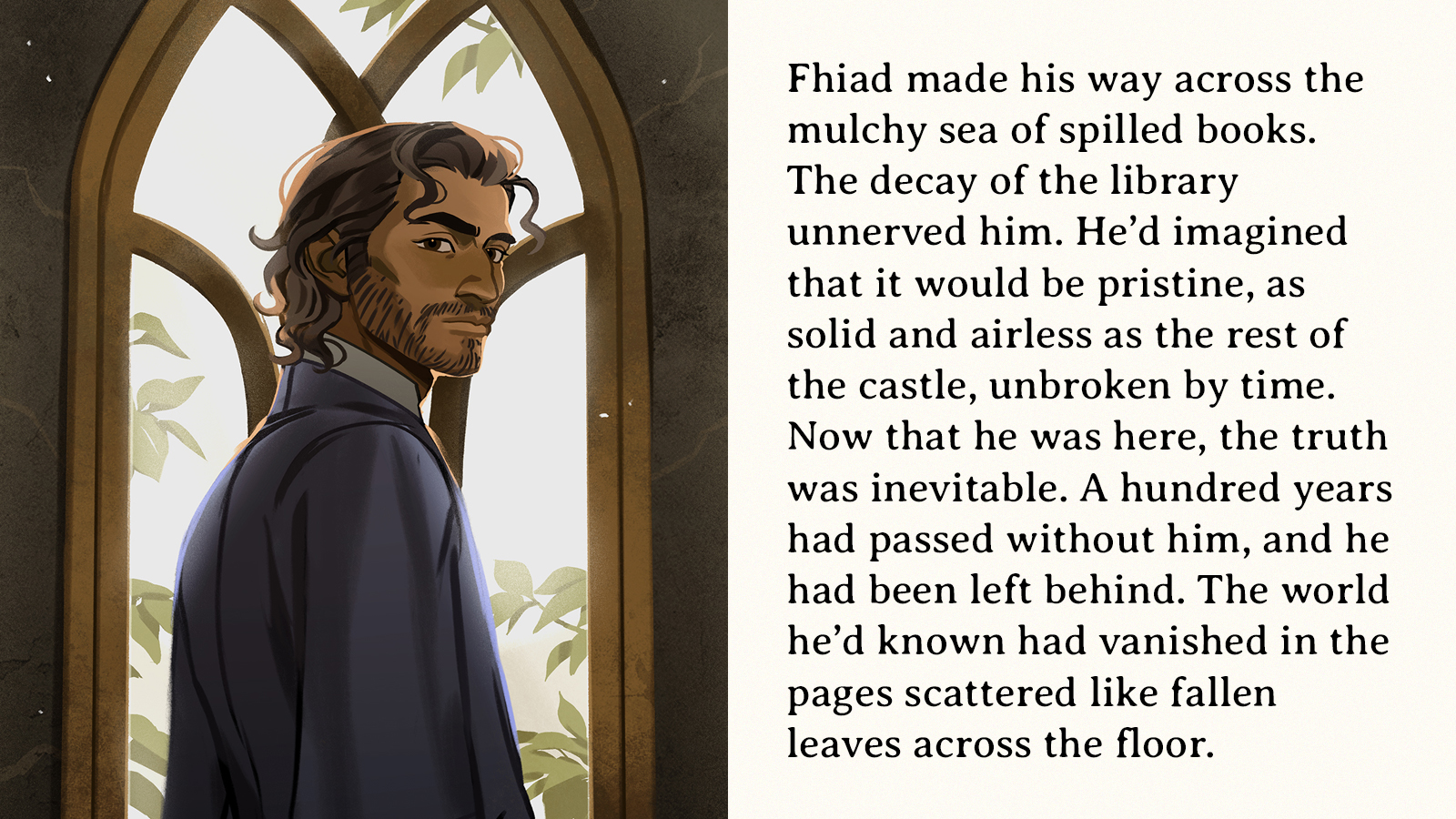
The illustration that graces this week’s chapter preview was created by the marvelous Hansoeii, a connoisseur of darkly compelling characters who posts sharp and handsome artwork on Instagram (here), on Tumblr (here), and on Twitter (here).

An Unfound Door, Chapter 12

Fhiad and Agnes enter the abandoned west wing of Faloren Castle via a covered bridge that crumbles into the lake below as they cross. As they explore the empty corridors, Fhiad admits that he wasn’t particularly well-suited to being a diplomat. All he wanted was to leave for the university in Cretia, as his talent at magic was the only thing that set him apart from his sisters. After entering the ruins of the academy housed in the west wing, Fhiad and Agnes experiment with the magical tools left behind in a lecture hall, gleefully not caring about the wreckage they create.

.

Chapter 12 is at the core of the “fun and games” section of the novel, which mainly involves Agnes and Fhiad exploring an impossibly giant castle. The currently occupied east wing is sad and empty but still livable, while the abandoned west wing is a crumbling ruin barely held together by magic. I did my best not to write too many scenes of characters walking down hallways, but I enjoyed describing the decrepitude of the environment.

This is the chapter in which Fhiad and Agnes begin to flirt with one another. As the culmination of their flirtation in the chapter’s final scene, they experiment with magical tools left behind by dead mages, and they behave a bit like Link smashing pots in a dungeon just because he can. Personally speaking, this is 100% what I’d do if magic were real. I wouldn’t want to hurt anyone, of course. I just think it would be neat to make junk cars explode.

I spent my teenage years in a rural area in the Deep South near where Stranger Things was filmed. I worked a number of garbage part-time jobs with other local kids; and, when we got off our shifts in the evening, we would drive around the country roads and look for abandoned houses where we could sit and smoke weed to chill out for a bit before going home.

A lot of these abandoned houses were filled with literal piles of junk, and there was a certain pleasure in lining up ancient Coke bottles along rotten wooden porch railings and throwing rocks to smash them. The glass made a lovely sound when it shattered, and the broken shards were beautiful in the moonlight.

Fhiad and Agnes aren’t teenagers, and neither of them is the sort of person who would work in a gas station convenience store. Still, I think this is an aspect of human nature that transcends time and place and social class. If the world is already filled with ruins, why not smash some glass? It’s a minor and ultimately meaningless act of rebellion against a system that failed long before you were born, but that doesn’t make it any less satisfying.

The illustration accompanying this chapter preview was created by the magical SashaArts, who draws radiant fantasy portraits that you can find on Instagram (here), on Twitter (here), and on Bluesky (here).

An Unfound Door, Chapter 11

The errant knight Caelif rides to Faloren Castle from the south. Through Caelif’s eyes, the reader sees the castle city, which was once grand but has fallen into decline. Caelif enters the castle and is greeted by Agnes’s cousin Galien, with whom he shares a professional and romantic partnership.

After they indulge in an intimate moment, Caelif reflects on his first acquaintance with Galien in Cretia. He tells Galien that he believes Fhiad to be the demon that Agnes was sacrificed to resurrect, and Galien reveals that he suspected as much. Galien assures Caelif that Fhiad is no danger to Agnes, and he confesses that he’s far more concerned with who may have abducted her in the first place.

.

At the beginning of An Unfound Door, Agnes leads a demon through the woods. To stave off exhaustion, she’s started talking to the demon, complaining that she’s not cut out to be a princess. Agnes argues that her cousin Galien, who is a duke in his own right, would be perfect in her position. He’s a born politician, and he would make a good king.

Agnes has previously shared several conversations with Galien, but this is the first chapter in which he takes the spotlight. He does so through the viewpoint perspective of his partner Caelif, the knight who rescued Agnes immediately before the novel opens.

Caelif serves as Galien’s messenger and fixer, as he’s willing and able to travel freely. A bit later in the story, Agnes explains to Fhiad that Caelif works for her as well, as she’s been asking him to sell the heirlooms of the royal family outside the kingdom, a last-resort fundraising strategy facilitated by Galien.

In another story, Galien would be the villain, but he and Agnes get along well and care for each other a great deal. Agnes had intended to renounce her royal status so Galien would be next in line for the throne, but her plans were complicated by her father’s ill health and her own abduction.

All of the chapters so far have been focused on Agnes and Fhiad, and this is where the story introduces a broader perspective. What I’d like to achieve with Caelif’s chapters (of which this is the first) is to give the reader a sense of the story being set on the edge of a much larger world.

Also, some of the oddness at the beginning of the novel is hopefully starting to make more practical sense. What I’d like to do with the narrative progression of this story is to take the broad archetypes of the initial scenario – a princess walking through the woods with a demon boar, who turns out to be a cursed prince – and gradually add more layers until the reader finally understands exactly how and why these characters arrived in that situation. In other words, the story is something like a mystery that the reader solves along with the characters.

If you’re curious, Caelif’s name comes from Caelifera, the scientific name for the suborder of insects that includes grasshoppers. Meanwhile, the concept art I used for this chapter’s graphic is from Bloodborne. I love how the city of Yharnam feels magnificently grand yet oppressively empty, and I aim to convey the same atmosphere of ruined grandeur in An Unfound Door.

An Unfound Door, Chapter 10

After returning from the library in the east tower, Agnes and Fhiad immediately head to the door in the graveyard via a set of underground access tunnels for the castle staff. They enter the tunnel system through the ground floor library. Along the way, Agnes remarks on how all of the underground areas of the castle have been abandoned for decades. In the courtyard, Fhiad tries to open the door with magic but fails.

The next day, Agnes talks with her father, who is recovering from a lingering illness. He suggests that she should visit the castle’s west wing, which once hosted a world-renowned magic academy but has fallen to ruin after the war with Erdbhein. As she prepares to present herself at court that evening, Agnes reflects on the magic of the lost Soreiya’s Tear and thinks that her own wish would be to see Faloren before its decline.

.

Following two successive library explorations, this chapter is significantly more mundane. Agnes and Fhiad manage to locate the “unfound door” of the novel’s title, but Fhiad can’t open it. Agnes then talks to her father, the king, but he doesn’t know anything either.

The king points Agnes in a potential direction, but his advice is little more than his own wishful thinking. Much later on in the story, it will be revealed that Agnes’s father and mother spent a fair bit of time exploring the castle themselves. Although it may seem like Agnes’s father is an antagonist, he had dreams and ambitions once, and he loves his daughter in his own way.

An Unfound Door isn’t YA fiction – everyone in this story is an adult – but one of the staple elements of the genre of YA fiction that has always bothered me is how anyone over the age of twenty is automatically cast as a villain. I understand why it can be useful to set up “adults” as antagonists from a narrative perspective, but the idea that any given adult would have any actual power in real life is laughable.

Speaking personally, I feel like there are more limitations placed on me with every year I get older, and that’s the theme I want to express through Agnes’s father. Precisely because he’s a king, there are many things he can’t do. Still, when Agnes obliquely mentions that she’s taking up the quest he secretly began when he was younger, he can’t help but get excited. Agnes’s father isn’t a bad person; he’s just the hero of an entirely different story.

Also, although I love novels like those in the Redwall and Harry Potter series, I want to use the setbacks and mundanity of this chapter to challenge the fantasy genre convention that Agnes will be embarking on a fun adventure in a magical castle. I am not made of stone, and I’ve definitely enjoyed writing the adventure segments! Still, the point of this story is for Agnes to realize that her quest to save her kingdom isn’t what she should be doing with her life. Not everyone is meant to be a hero, and that’s okay.

The illustration in this chapter’s graphic was created by the magical Allison McKenzie, a Final Fantasy fan artist who draws colorful and expressive female characters who are always full of life. As you can probably guess from Agnes’s visual design, her character is partially based on Garnet from Final Fantasy IX, so I’m thrilled that Allison drew this illustration for me. You can check out her art on Twitter (here), on Instagram (here), and on Tumblr (here).

An Unfound Door, Chapter Nine

Agnes and Fhiad visit the magic library in the abandoned tower of the east wing of the castle, where Fhiad demonstrates the concept of magical “cost” to Agnes. Fhiad then locates a book about the castle’s architecture left in the library by Agatha, the princess of his era. He explains that Agatha was searching for a secret entrance to the castle’s deeper subterranean levels, where she believed Soreiya’s Tear was hidden. Fhiad shows Agnes an illustration of a door, and she immediately recognizes it as the entrance to a vault in the graveyard adjoining the north courtyard garden.

Fhiad is frustrated that Agnes was able to solve the problem so quickly, while Agnes is jealous of Fhiad’s relationship with Agatha. She snaps at him; and, in retaliation, he creates an entirely new staircase to the main hallway in a grand display of magic. Agnes is impressed, and Fhiad is pleased by her praise. They agree to visit the door in the graveyard immediately in order to see it for themselves.

.

There’s a tidy bit of plot setup in the chapter. This is where the reader learns about the weirdness going on between Fhiad and the princess of his era, and this is also where I introduce the eponymous “unfound door” of the novel’s title.  

This is the second chapter narrated from Fhiad’s perspective. When he sets part of the tower library on fire in order to adjust the castle architecture, he doesn’t remark on the fact that he’s doing anything unusual, but this is where it should become clear to the reader how exceptionally skilled he is. Agnes had a similar scene in Chapter Five, when it’s strongly implied that she’s keeping the bureaucracy of the royal household running almost single-handedly.

An Unfound Door isn’t a power fantasy, however. This is a story about the fall of empires and the gentle beauty of decay, and it ultimately doesn’t matter how talented the characters are. Both Agnes and Fhiad want to restore their kingdoms, but this isn’t possible, not even with their incredible skills. This isn’t a story about being strong and overcoming obstacles. That sort of narrative makes me tired.

I originally wrote this chapter in October 2023 before taking a long hiatus from the project. I returned to the novel this past April, and I’m pleased to say that the first draft is finished. Now that I’ve returned to the earlier chapters, it feels strange to see Fhiad and Agnes at this stage of their relationship. Even though I wrote this story myself, I have to admit that I’m looking forward to watching them gradually warm up to one another.

The illustration of Fhiad in this chapter’s preview graphic was created by the marvelous Emily Cheeseman, whose website is (here). You can follow her work on Instagram (here), and I recommend checking out her postcard club on Patreon (here). The general atmospheric vibe of An Unfound Door was partially inspired by Em’s graphic novella adaptation of Gawain and the Green Knight (here), so it was an incredible honor to have her draw one of my story’s main characters!