変な家: A Mysterious Story of Real Estate

変な家 (Henna ie) is a collection of short horror stories about houses with strange and uncanny floorplans.

The book has four chapters, each of which takes the form of a series of conversations between the narrator, their architect friend, and various people who have seen the houses in person. The first three chapters explore three different houses with extra rooms and mystery spaces, and these explorations are liberally illustrated with diagrams in which certain sections of the floorplan are highlighted and annotated to clarify the text.

Each of these first three stories is like a locked room mystery, except the mystery starts with a floorplan from which the narrator gradually builds a story about what sort of upsetting behavior that type of strange space might enable. In the final chapter, it’s revealed that these houses (and, presumably, many more like them) are all connected to an old and wealthy family with a terrible secret.   

I flew through this book and loved every page. The conversations are easy to follow; and, thanks to the diagrams, the spaces are easy to visualize. I enjoyed the slow build of the overarching mystery, and the revelations about the bizarre family at the center of the strangeness were beyond anything I expected.

It’s worth noting that the first story in this book was originally written as a script for a twenty-minute video on YouTube, which you can find with English subtitles (here). There’s also a manga adaptation. The first three chapters, which form a complete story, have been scanlated and are available to read (here). And finally, I’d like to share a more substantial review posted on one of my favorite book blogs (here). I’ve got my fingers crossed that this strange little book (and its sequel, which is rumored to be even better) will somehow find its way into English translation.

Haunted Houses

I recently published a new edition of my horror fiction zine Haunted Houses!

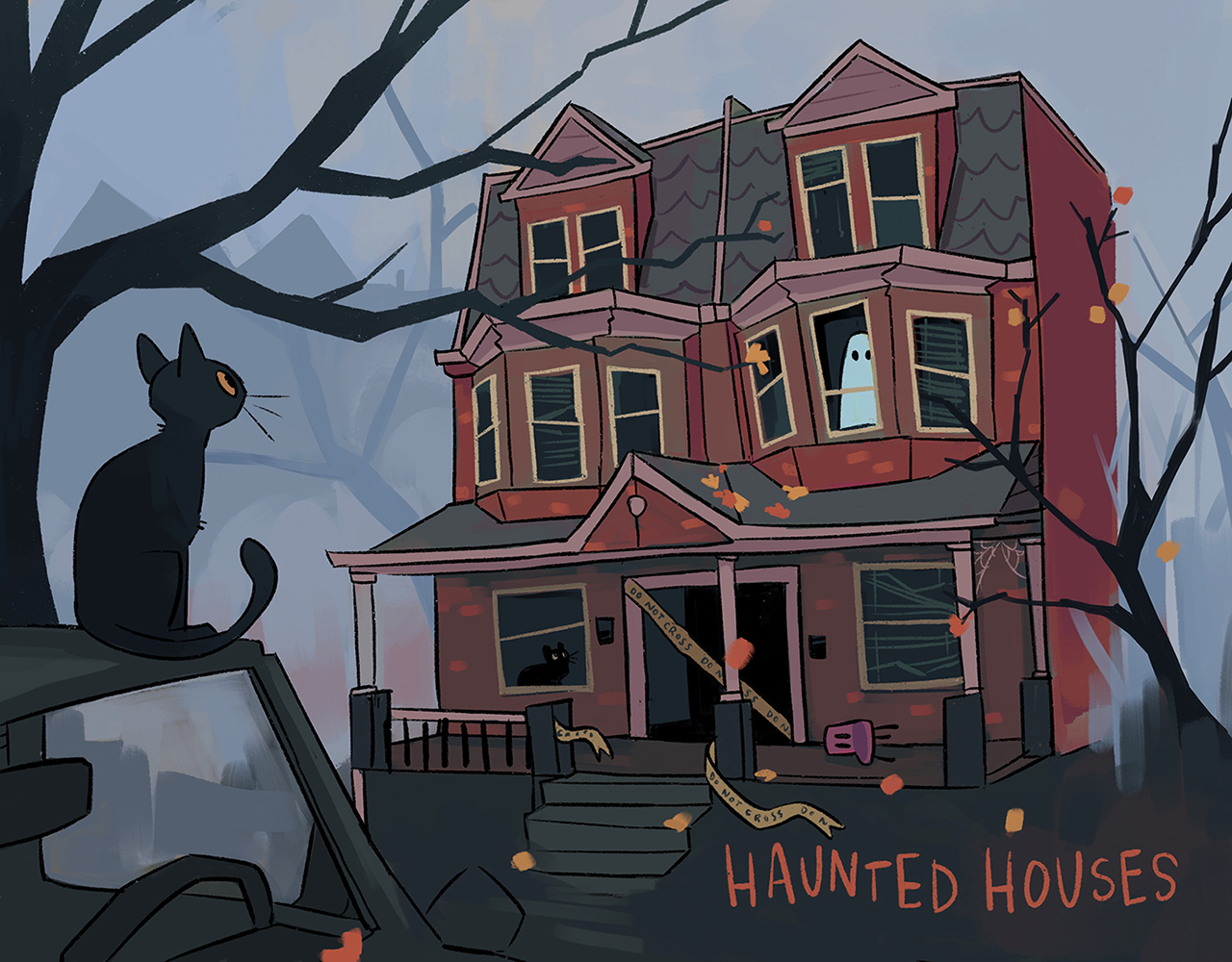
Haunted Houses collects seventeen pieces of surreal flash fiction about haunted spaces and the terrible people who inhabit them. This edition of the zine includes several new stories and illustrations, as well as a gorgeous cover illustration by Megan Crow, who was able to channel the everyday spookiness of West Philadelphia. Although the stories in this zine fit firmly into the mode of magical realism, I wanted to use the medium of fiction to explore a truly terrifying set of real-life themes relating to housing, from gentrification to rent spikes to urban depopulation.

If you’re interested, physical copies of the zine are available on Etsy:
https://www.etsy.com/listing/890744799/haunted-houses-fiction-zine

I’ve also started to host free digital editions of my older zines on Itchio:
https://digitalterrarium.itch.io/

An Unfound Door, Chapter Eight

Agnes and Fhiad meet in the library on the morning after the summer court opens. Agnes wakes before dawn out of habit, while Fhiad has been up all night reading. Fhiad left to get tea, and he returns just as Agnes is studying the books he left on a desk.

They sit down together, and Fhiad apologizes for making wild proclamations. When Agnes asks if Fhiad would truly destroy Faloren if he found Soreiya’s Tear, he explains that doing so would be impossible, as the cost for performing magic on such a large scale would have an unimaginably high cost. Fhiad gives a demonstration of magical cost, and Agnes is so amazed that she asks a clueless question about his past, thus chilling the warmth of an intimate moment. 

. . . . . . . . . . . . . . . . . . . . .

This chapter marks the beginning of what Jessica Brody (of Save the Cat fame) calls the “fun and games” section of the story, which should constitute the bulk of Act Two. While the opening and closing of a novel should ideally follow a set formula that helps guide the reader, the middle of the story offers much more freedom to the writer.

I like to use this freedom to indulge in all of the narrative tropes I enjoy, and this chapter includes one of my favorite scenes. Namely, I love when an intimate conversation in a library helps the protagonist and her foil understand that they should be friends. At the beginning of this chapter, Agnes is characteristically blunt and ready to fight, but she and Fhiad manage to establish a common ground by virtue of the fact that they’re both giant nerds.

Fhiad begins to show his true colors in this scene. He’s more socially polished than Agnes, but he’s a shy academic at heart. In fact, most of Fhiad’s trouble has resulted from him being a pushover. Although he gets in a few good jabs at Agnes, Fhiad also submits to her demands multiple times during this conversation.

I was recently reading an academic book chapter about gothic fiction, and the author was saying that the erotic charge of the narrative is primarily generated by the question of whether a wild and mysterious man will sexually assault the heroine who fears him. This sexual fear turns to romance when the heroine realizes that the man’s menacing aura is a result of his violent passion for her.

I unapologetically appreciate that sort of character dynamic, but it doesn’t fit what’s going on with Agnes and Fhiad. Agnes isn’t fearless, but her extreme pragmatism drives her to behave as if she were. Meanwhile, Fhiad is competent and talented in his own way, but he has no business being “wild” or “menacing.” In a reversal of the classic gothic gender dynamic, Fhiad needs Agnes to push him forward, while what Agnes needs from Fhiad is his patience and kindness.     

More than anything, however, this chapter is about doing magic in a cool library. The next chapter is also going to be about magic and libraries. And the chapter after that? More magic, and more libraries. I love libraries and magic, what can I say. This is my story, and I get to write whatever I want.

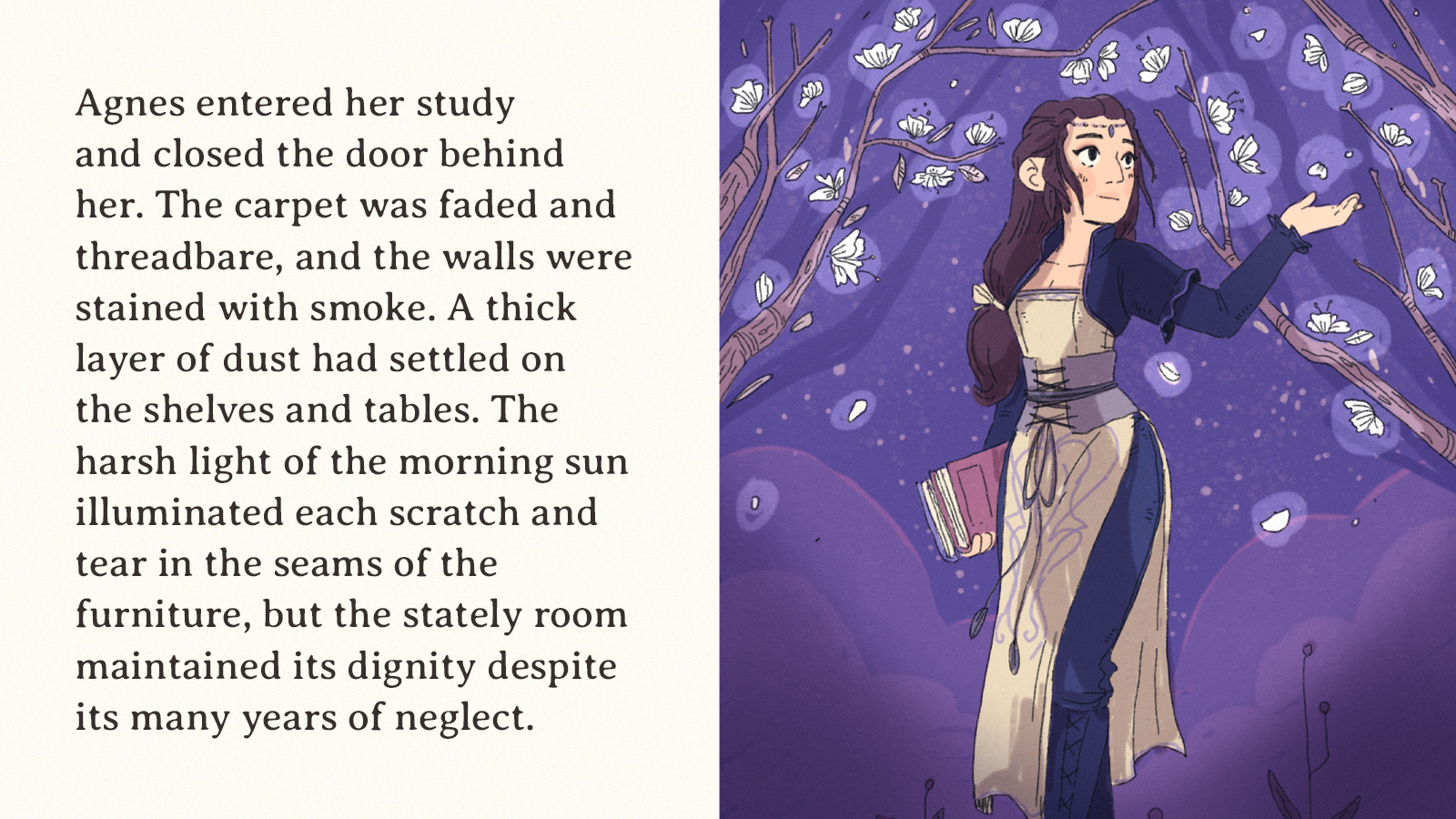
The lovely gothic portrait of Agnes that accompanies this chapter’s preview was created by the magical Emily.E.Draws, whose vibrantly colorful fantasy characters can be found on Instagram (here) and on Tumblr (here).

An Unfound Door, Chapter Five

Agnes rises early the next morning in order to attend to the correspondence that has accumulated in her absence. As she dresses, she reflects on how her mother’s charm and social grace slowed her kingdom’s decline. Unfortunately, her father has done nothing to alleviate the grim atmosphere pervading the castle since the queen’s death.

Agnes proceeds to her study, a dilapidated yet still handsome room where she secludes herself to work. She is interrupted by her cousin Galien, who encourages her to open the summer court. Agnes agrees, believing that a large and lively celebration will be an appropriate symbolic marker of her vow to rejuvenate the kingdom.   

. . . . . . . . . . . . . . . . . . . . .

This chapter is about Agnes’s comfortable existence in the status-quo world. It is indeed a very comfortable and cozy chapter, and I enjoyed writing it.

Aside from establishing the scene of the next chapter, which will be the opening of the summer court, not much happens here. As I wrote in my notes for the previous chapter, it’s important for the reader to understand why Agnes is willing to remain content with the status quo.

It seems as though Agnes is doing useful work and making actionable plans for the future, but none of this actually means anything. An astute reader should be asking the questions that Agnes is aggressively ignoring: How did she find herself out in the woods on the border of her kingdom? Where did the demon come from? Who kidnapped her? Was it someone in the castle? Are they still there?

Agnes needs to start asking herself these questions soon, because Fhiad is going to come back and cause trouble. For the time being, though, it’s nice to have a small interlude of peace.  

I recently read a Tumblr post (here) regarding how the Gothic genre is all about taking four pages to describe a staircase, and there’s a bit of that in this chapter. I want the reader to see how shabby and decrepit Agnes’s castle is, and I want there to be an opportunity to enjoy the comfortable aspects of this state of decay.

All of the chapters in An Unfound Door have titles, by the way. I’m not sure if I’ll end up using them, but I especially like the title for this chapter, “A Slow and Silent Decay.”

The illustration of Agnes that accompanies the chapter preview was created by the fantasy artist and gentle wizard Madeline Hale, whose colorful and whimsical character designs can be found on Instagram (here) and on on Bluesky (here).

Gothic Horror Story Elements

In order for a story to be considered “Gothic,” I think it needs to include…

– A house. This “house” can be a castle or a space station or an abandoned medical research facility or what have you, but it needs to be a place where people live and eat and sleep.

– It has to be a big house. In addition to being big on the outside, it should be larger than it appears. The house should have something along the lines of a secret sub-basement, hidden rooms, tunnels in the walls, a House of Leaves style portal to another dimension, or something along those lines. The house needs to be large enough to be considered a labyrinth.

– The house has to be old and in a state of decay or disrepair. In addition, the house needs to be isolated and surrounded by wilderness. Over the course of the story, the natural environment should intrude on the interior of the house. This should still be the case even if the environment is not technically “natural,” as in the case of Suburban Gothic.

– The house needs to be associated with and occupied by a family.

– The family needs to have a dark secret, preferably one hidden within the house.

– At least one member of the family should still live in the house. “Family” can be loosely defined, but the concept of “family” as such is key.

– If there’s no family living in the house, then the story is a “haunted house” story, not a “Gothic” story. This is also the case if the people living in the house aren’t alive or aren’t human (or whatever passes for “a normative person” in the world of the story). This is important, as “Gothic” is just as much of a narrative structure as it is a collection of tropes. For example…

– The point-of-view character should be a member of the family in some way. Often this character will come into the house through marriage or inheritance. Sometimes they won’t initially know they’re related to the family. In the case of servants and governesses and so on, the point-of-view character will either be secretly related to the family, or they’ll be a parent or spouse in all but name. If the point-of-view character isn’t related to the family, they will gradually fall under the delusion that they are.

– The point-of-view character will obviously be privileged, as they live in a large house and are associated with a wealthy family, but they also need to be disadvantaged in some way. The way in which they’re disadvantaged should have some thematic relevance to the dark secret hidden by the house.

– The point-of-view character must be forbidden from certain behavior by an arcane rule or system of rules. The forbidden behavior will generally involve the navigation of space in or around the house: Don’t go into the forest, don’t go into the cellar, don’t leave your room at night, etc.

– The disadvantage of the point-of-view character will compel them to accept the family rules even though they can intuitively feel that something is horribly wrong. This traps them within the house.

– The goal of the point-of-view character is to escape the maze of the house. The only way to navigate this labyrinth is by breaking the rules, engaging in forbidden behavior, and bringing the dark secret to light.

– The primary antagonist should be a living person in the family, related to the family, or emotionally invested in the family in some way. Although supernatural elements are not out of the question, it’s often the case that the phenomena presumed to be supernatural have a rational (albeit psychologically deranged) explanation. That being said, there’s often a Todorovian elision between “natural” and “supernatural,” with the distinction being left to the reader.

– When the point-of-view character reveals the family’s secret, this destroys the house. This destruction is usually literal. The family almost always dies as well. If the point-of-view character is too closely tied to the family, they may die too. Regardless, the reader will understand that the collapse of the house and the demise of the family is a good thing that needed to happen.

– The house and family should represent an older social system responsible for the disadvantage of a group of people represented by the point-of-view character. This system usually concerns oppression on the basis of class or gender, but it can sometimes be about race, nationality, or colonial heritage.

– The Gothic genre is not conservative, because it’s essentially about how outdated systems of privilege that still continue to oppress people are deeply fucked up and unhealthy and need to be destroyed. “Haunted house” stories are often conservative, but I would argue that Gothic stories advocate for radical systemic change and the self-realization of freedom from social expectations.

– At the same time, Gothic stories are not didactic. The lure of the forbidden goes both ways, after all, and the reader should be able to understand why the point-of-view character allows themselves to become trapped in the house. The old castle is majestic. The beast-husband is attractive. The spoils of ill-gotten wealth are luxurious and comfortable. The ruins are delightfully mysterious. The poison apple looks delicious. The story is queer and problematic, and that’s precisely why it’s appealing.

There are numerous cross-genres and sub-genres of Gothic that have their own specific conventions, like Gothic Romance and Boarding School Gothic. I didn’t address the visual language of the Gothic, or how tropes and conventions vary between times and cultures. Still, I think this is the core of the genre.

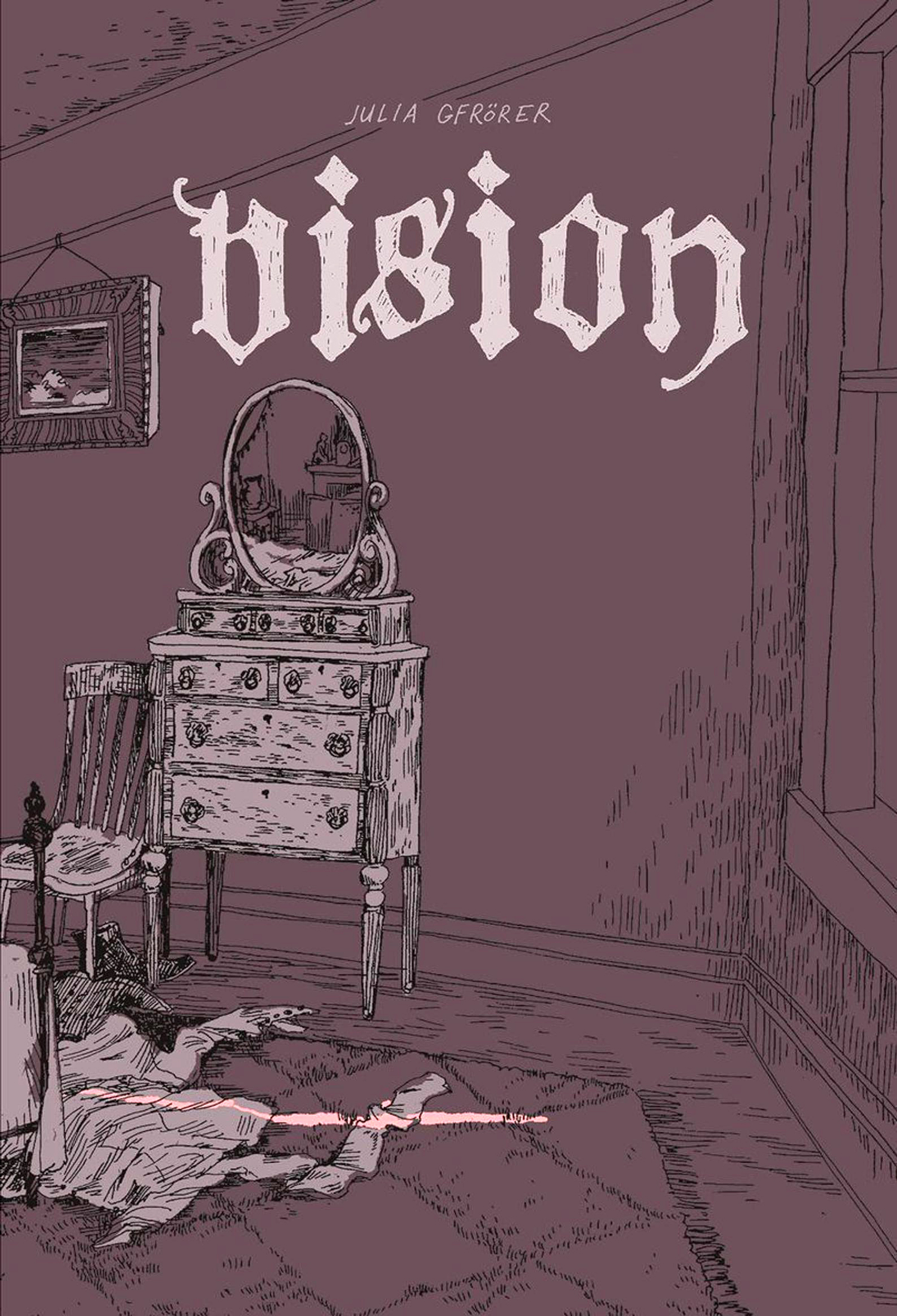
Vision

In nineteenth-century London, Eleanor lives in her deceased parents’ house with her brother Robert and his wife Cora, who is bedridden with a vague illness. Eleanor was previously engaged, but her fiancé died after enlisting in military service. Having become an unmarried woman of a certain age, Eleanor spends her days caring for her sister-in-law. At night, however, she engages in sexual fantasies in front of her mirror, which she imagines as speaking to her in the voice of an unseen lover.

This situation might continue indefinitely were it not for the romantic attentions of a certain Doctor Bishop, who treats Eleanor’s cataracts and prescribes Laudanum to calm Cora’s nerves. Bishop is affectionate and well-meaning, but Eleanor is a quiet storm of resentment and repressed sexuality whose veneer of quiet virtue and good sense is one the verge of cracking.

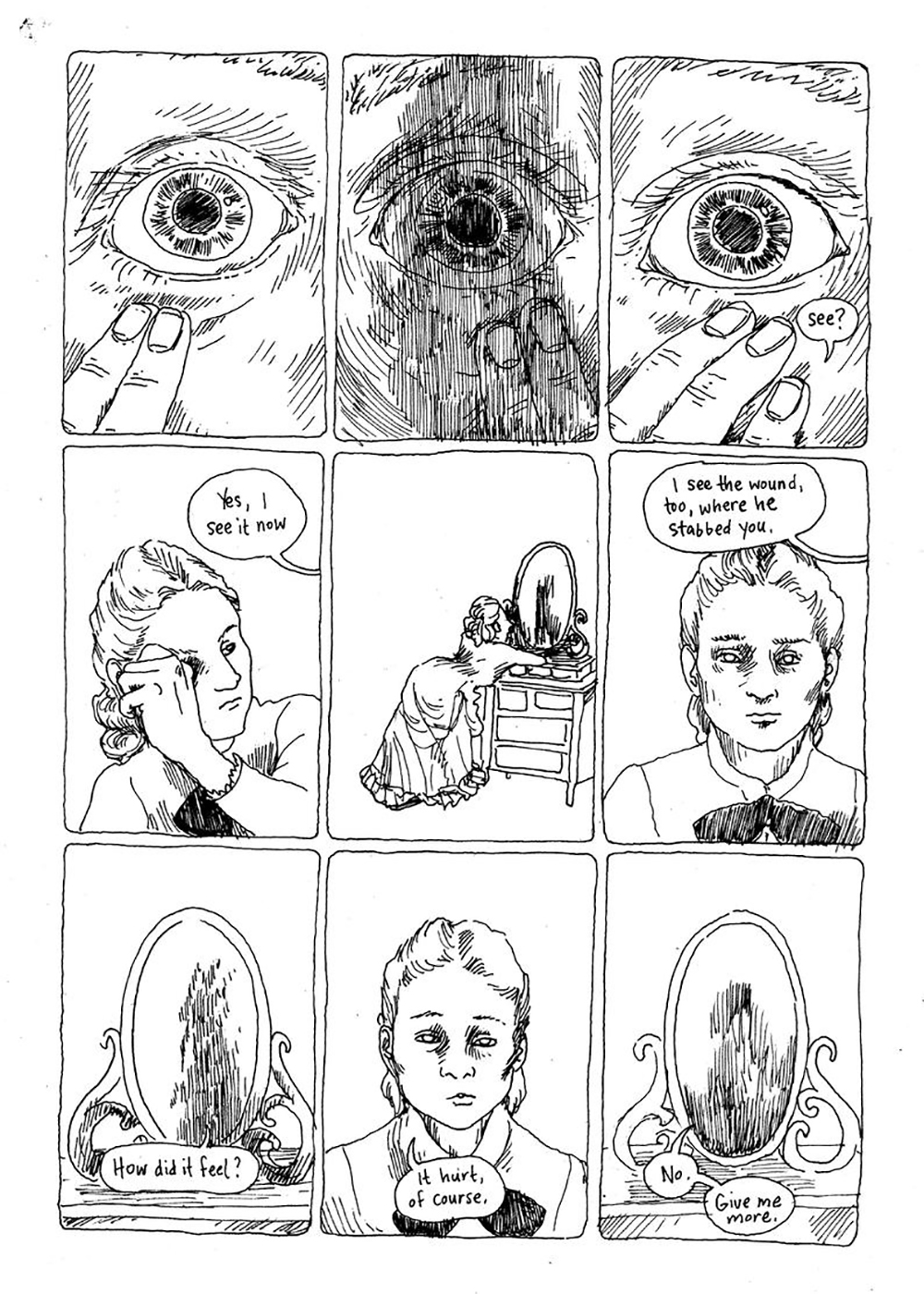
Vision is a brilliantly written and gorgeously drawn graphic novella that explores the subtleties of how trapped and lonely people isolate themselves while simultaneously seeking connection, but it’s also a sharp and disturbing story about sex and death. The death is understated and phantasmal, while Eleanor’s sexuality and desire is on open display. Each of the erotic scenes is mirrored by a grotesque reflection, such as when the imagery of Eleanor’s self-pleasure with a candle is reflected in an extended scene depicting her eye surgery. Julia Gfrörer’s linework is delicate yet expressive, granting her characters warmth and personality while occasionally portraying them as eerily inhuman.

Eleanor’s story becomes stranger as various small mysteries and imbalances accumulate into an ever more fragmented portrait of a haunted household. The climax is shocking but perhaps not unexpected, and far more questions are raised than could ever be answered. The absence of clear explanations and justifications is part of the appeal of the narrative conclusion, however, while gradual shifts in the ink style contribute to an encroaching sense of dread – and curiosity.

Vision was published by Fantagraphics Books in September 2020. You can read more about the book on the press’s website (here), and you can order a copy from the Julia Gfrörer’s store on Etsy via its listing (here). Gfrörer’s two previous graphic novel publications with Fantagraphics, as well as her zines, are also listed on Etsy, and each is as creepy and fascinating as the next.