An Unfound Door, Chapter 16

Fhiad reflects on the uncanny emptiness of Erdbhein Castle as he leads Agnes to the queen’s ruined chambers. While describing Erdbhein before the war, Fhiad tells Agnes about his three sisters, all of whom were highly competent administrators. Fhiad confesses that he dreamed of becoming a mage so he could return to Erdbhein to build monumental stone structures aboveground to rival the stonework in the long-abandoned city underneath the castle.

.

This chapter is about Fhiad processing his grief. It would be the perfect opportunity for an exposition dump, but Fhiad isn’t in a good mental state to deliver a lecture at the moment. Like Agnes, he feels like a failure, and he misses his family.

While Fhiad talks about the past, I hope the reader gets a sense of this character belonging to a much larger story. Unfortunately, Fhiad is never going to be able to live that story, and the reader isn’t going to hear much more about it, either. Fhiad mentions spending time in an ancient city in the mountains below Erdbhein, and tells Agnes that he went to university to study architecture because he always dreamed of building something equally grand aboveground.

That’s an intriguing detail, I hope. It adds another layer of foreshadowing regarding Agnes and Fhiad’s final destination, but the reader is never going to encounter another reference to Erdbhein’s history and culture. That’s what it means for an entire group of people to be destroyed; all of their art and memories and folklore are destroyed along with them.

Agnes is deeply disturbed by this loss, as she should be. Meanwhile, Fhiad’s anger regarding the destruction of Erdbhein has drained away, alongside his sense of agency. At the beginning of the story, he was furious and hostile and scary, but he’s become calmer and more introspective as the reality of his situation becomes clear.

Fhiad’s monologue in this chapter mirrors Agnes’s monologue at the beginning of the novel about how she’s the exact wrong person to handle a difficult situation. Agnes was doing something stupid (bringing a demon back to Faloren) because she felt that she had no power to halt her kingdom’s decline on her own. Fhiad was likewise attempting to do something stupid (stealing a relic that could turn back time) because he saw no other way to address what happened in the past. Fhiad knows that his mother or any one of his sisters could have been effective in restoring his kingdom, but he feels that he himself doesn’t have the power to do anything. And honestly, he’s right.

I think that’s a hard lesson to learn, that sometimes you’re just not the right person to fix a messed-up situation. Not everyone can be a hero. At the same time, if a broken situation can’t be fixed by normal people working together and trying their best while using the tools at their disposal, then perhaps the situation isn’t worth fixing.

In The Demon King, a novel I put on hold to focus on writing An Unfound Door, the main character finds himself in a situation that’s somewhat similar to what Fhiad’s going through. This character is going to succeed by virtue of being ten years older and completely unhinged, and his success will destroy him. Fhiad is going to fail, though. His failure isn’t without sadness, but accepting himself and the reality of his circumstances is going to be the best thing that ever happened to him.

The same goes for Agnes, who needs to understand that she can simply walk away from Faloren. The arc of her character development is longer and more complicated; but, from this point forward, it’s going to be Fhiad’s job to support her.

This chapter is relatively quiet, especially after the action in the previous chapter, but it’s the emotional turning point of the novel. So this chapter is about grief, but it’s also about two tired adults taking a much-needed break to have a nice date with delicious tea in a handsome ruined castle overgrown with beautiful bioluminescent flowers.

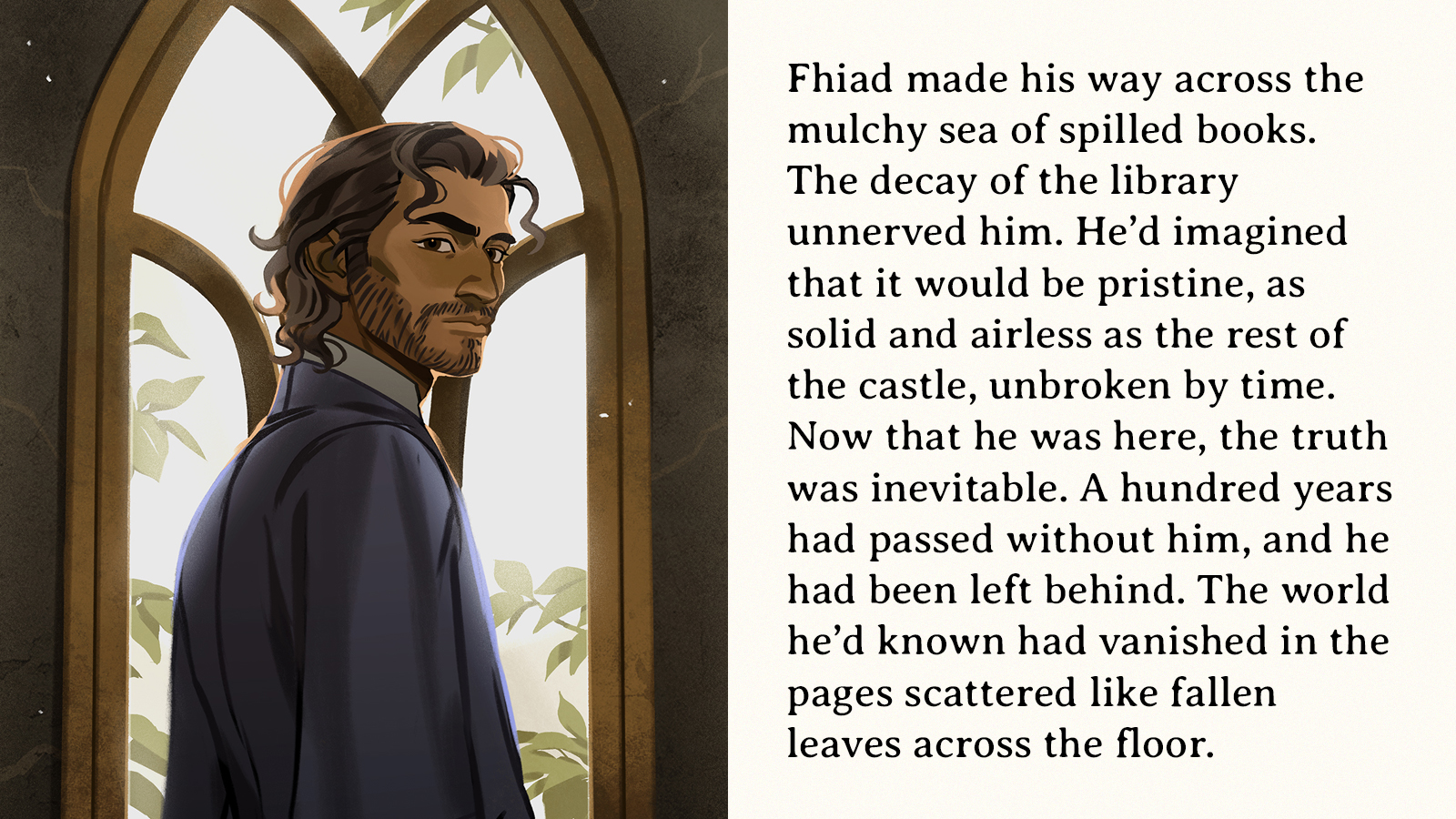
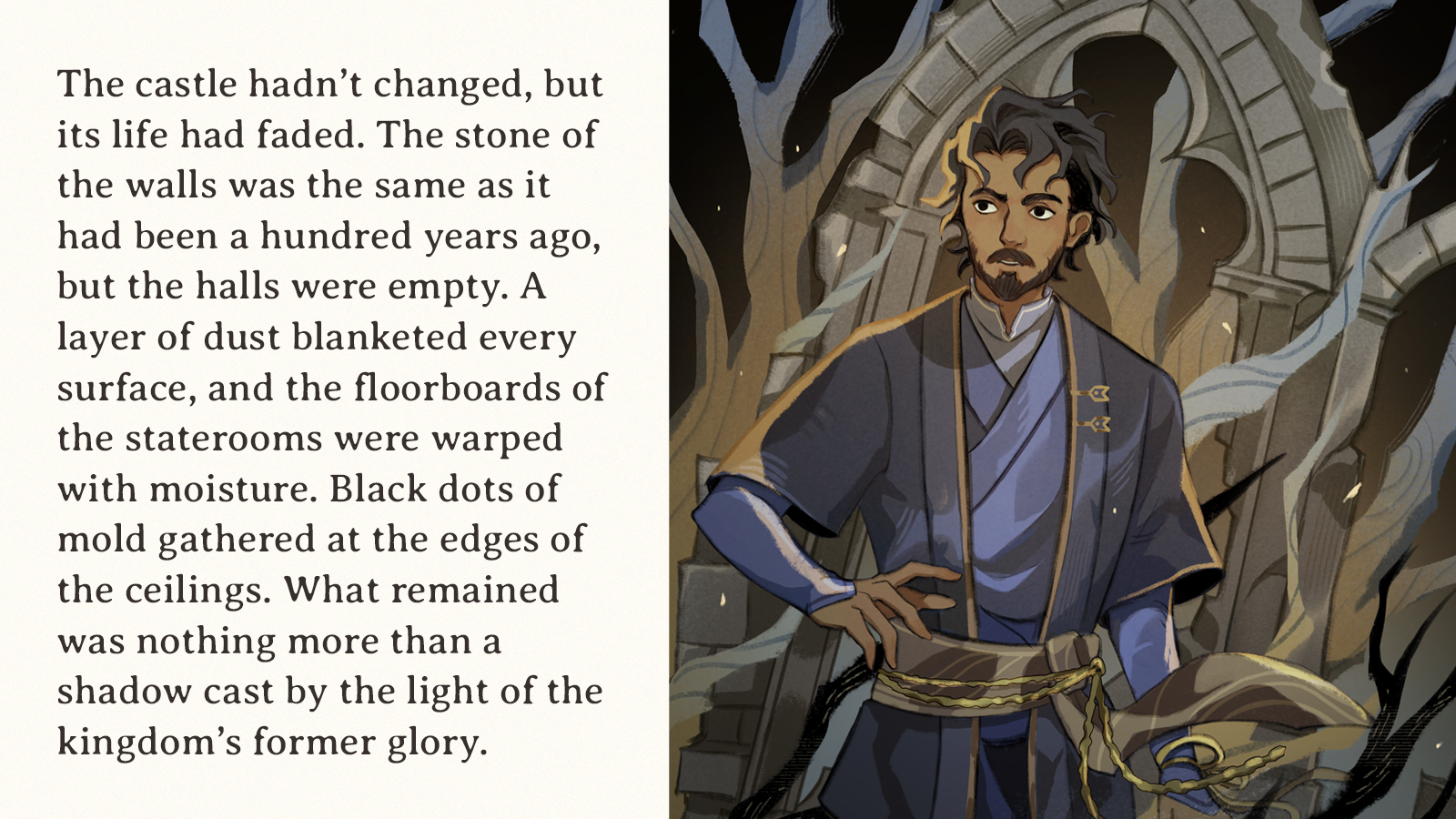
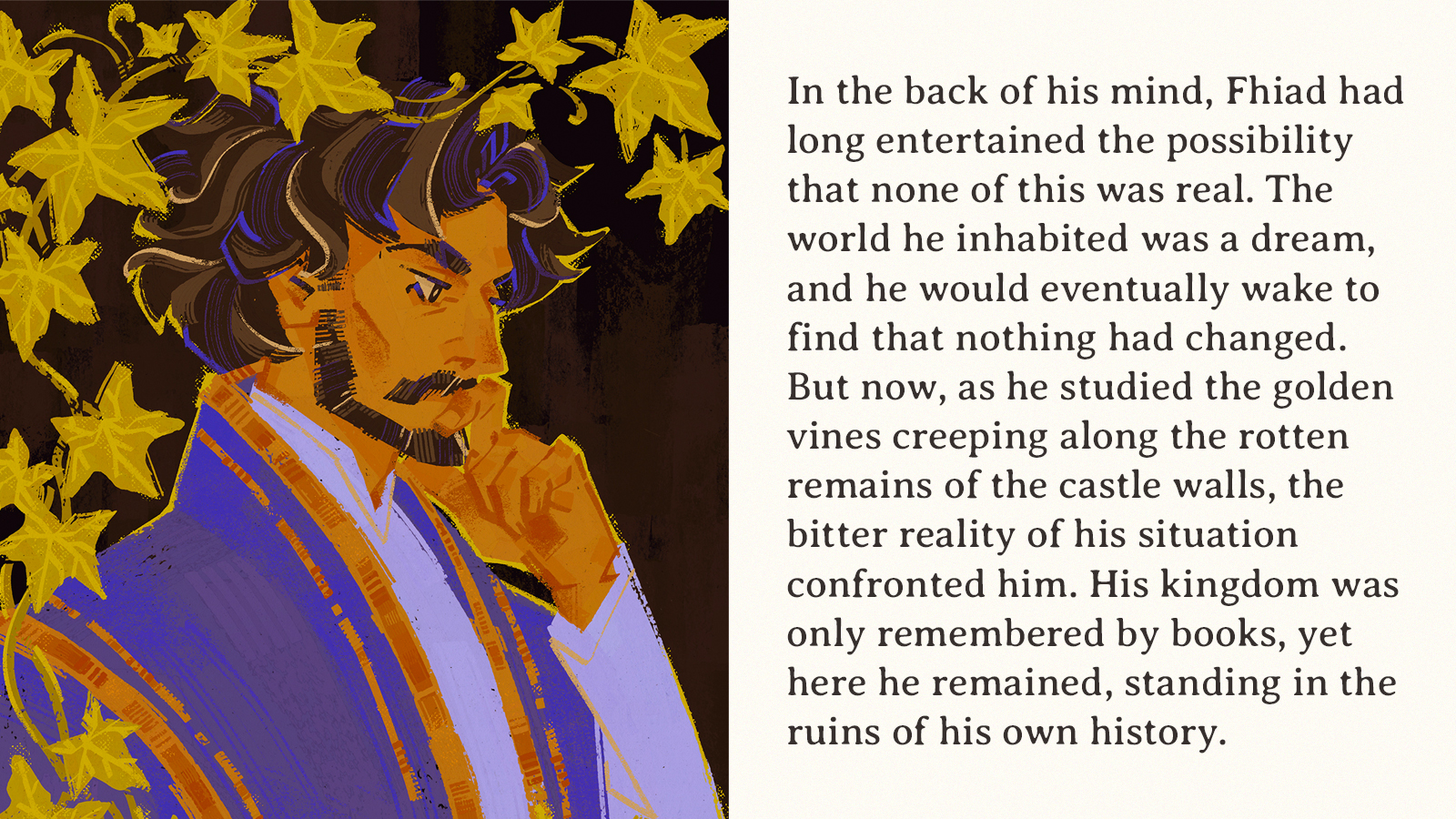
The illustration of Fhiad in this chapter’s preview graphic was created by the bold and brilliant fantasy illustrator Armd39, who posts dynamic and creatively textured artwork on Bluesky (here) and on Instagram (here). You can also find her commission info pinned on Twitter (here) if you’re interested. Arma was wonderful to work with, and the process of creating this illustration was a fantastic experience that easily added a few months to my life.

An Unfound Door, Chapter 15

Now that Fhiad has taken the form of a demon boar, Agnes rides him through the mountain forest on the way to Erdbhein. They make quick progress, stopping only for Agnes to rest. As they approach Erdbhein Castle, Fhiad leads Agnes to an overlook from which she can see the overgrown ruins of the city in the valley.

At the cliffside castle’s back entrance, severely decayed husks emerge from what used to be a village that housed the castle staff. Fhiad is frightened, so Agnes dismounts and comforts him as she leads him across a bridge and into the castle’s rear courtyard. More husks emerge, and Fhiad is paralyzed with fear. Agnes forcibly reverts him to his human form, and they escape into the castle keep.

.

Based on the synopsis, you might think there’s fighting in this chapter, but the truth is that I dislike writing action. As much as I enjoy the choreography of cinematic fight scenes, I find prose descriptions of battles to be tedious. I always skim through action sequences as a reader. Why subject myself to this sort of thing as a writer?

In my defense, neither Fhiad nor Agnes is an action hero. Fhiad is an extremely cowardly demon, and Agnes wields a sword the way I imagine most people would, which is to panic and swing it around wildly. When she actually hits something, she’s horrified and disgusted.

Instead of a thrilling adventure, this chapter is more of an extended meditation on death and decay. In particular, I really enjoyed writing about the slow creep of the husks. My personal take on zombies is that they’re scariest when they take the “persistence predator” aspects of human physicality to an extreme. Fast zombies are a lot of fun! But slow zombies that just keep coming? That’s what really creeps me out.

On a more serious note, zombies are an indirect way to think through the indignity of certain types of death. An Unfound Door isn’t a political novel by any means, but I can’t deny that I wrote this story while watching a genocide unfold. It’s important to bear witness, I think. Still, I’m disturbed by the media spectacle of destruction, in which the victims of war are reduced to nothing more than their blunt physicality in order to sell an enticing narrative to a public that passively consumes death on television or online. As my academic work has (hopefully) demonstrated, I care deeply about these issues, and fiction is another way to explore the complications and consequences of an empire lashing out at imagined enemies as it crumbles from the inside. Let it suffice to say that I have a great deal of sympathy for zombies.

In any case, Agnes isn’t particularly afraid of husks, which she sees as pathetic but harmless. There are a whole lot of husks in this ruined castle, however, and Agnes has a difficult time shepherding Fhiad inside the keep while doing her best to keep both of them safe. Consequently, the main narrative breakthrough that occurs in this chapter is a demonstration that Agnes has become much more sensitive to Fhiad’s emotional state. I guess riding a man through the forest like a horse will do that.

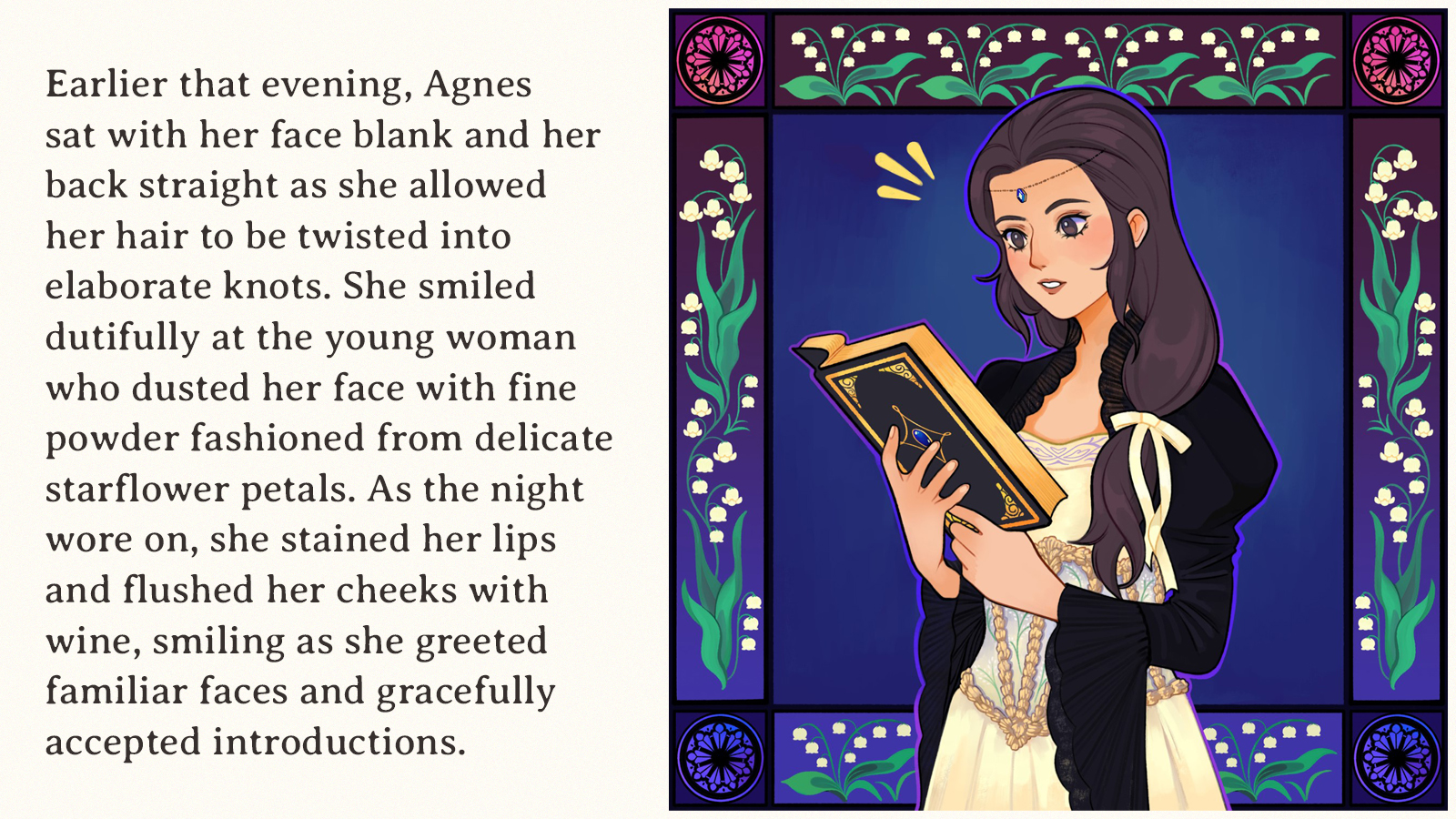
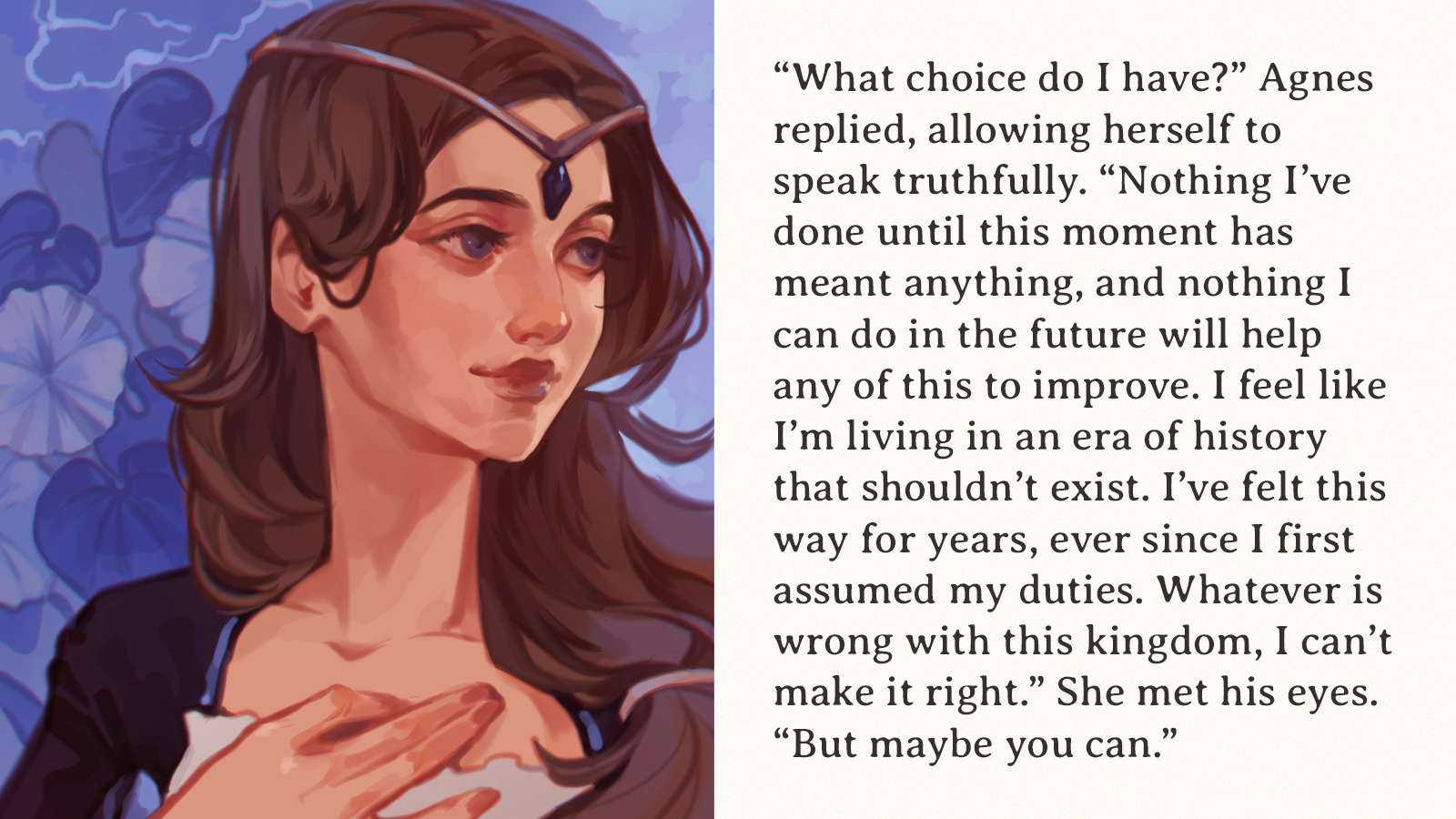
The illustration of Agnes in the chapter preview graphic was created by Loustica Lucia, a bright and shining fantasy artist who posts colorful battle scenes and character portraits on Instagram (here), on Tumblr (here), and on Bluesky (here).

An Unfound Door, Chapter 14

Agnes and Fhiad have a brief conversation with Galien and Caelif before departing from Faloren Castle. Fhiad’s personality becomes warmer and more open as they travel across the countryside. He’s friendly to travelers, and he shares his memories of the university in Cretia with Agnes. In the evenings, Agnes stretches and practices the sword forms that she learned from her mentor Mylah, who left the castle shortly after Fhiad’s arrival and hasn’t returned since.

On the first night after they enter the northern forest, Fhiad watches Agnes practice and confesses that his magic won’t be useful against the dangers they’ll face in Erdbhein. He asks that Agnes remember him as human before transforming himself into a boar.

.

This chapter is the transition stage between narrative acts that Jessica Brody (of Save the Cat Writes a Novel fame) calls “the eye in the calm of the storm.” It’s a seemingly extraneous but actually extremely important part of the story in which the characters take stock of their situation, their relationships, and their goals.

Even before I read Save the Cat, this in-between chapter was always one of my favorite parts of any longer story I wrote. This is especially the case with romances, where this scene is almost always the first intimate moment the characters spend together. If An Unfound Door were a different type of novel, things would have gotten spicy before Fhiad decided to transform himself, but he just kisses her hand. Which is plenty romantic enough, I think.

I end this chapter with the suggestion that Fhiad is going to be reckless and violent as a demonic boar, but this is misdirection. Even in the form of a powerful monster, he isn’t emotionally equipped to handle action, and Agnes is going to have to forcibly transform him back into a human in order to drag him forward in the next chapter.

Even to me, as someone who ostensibly knows how this story ends, it’s been interesting to see how Fhiad has developed as a character. He initially seems strong and dangerous, but his personality becomes more complicated and neurotic as the reality of his trauma sets in. He slowly unravels as he goes from one set of bad behaviors to another, which is always fun to watch. In this chapter, however, Fhiad is a completely normal person, which I think is the key to the story. As long as Fhiad isn’t subjected to the pressure of being involved in history-changing events, he’s fine.

The goal is to get both Fhiad and Agnes to the point where they’re able to accept that they can just leave these ruined kingdoms behind them and start a new life elsewhere. I therefore used this chapter to create foreshadowing that strongly suggests that this is the best possible outcome for them both. Although their respective homelands are beyond redemption, Agnes and Fhiad can still save each other.

The illustration of Agnes for this week’s preview graphic was created by Anta ARF, who posts brilliant and shining fantasy art on Cara (here), on Tumblr (here), and on Twitter (here).

An Unfound Door, Chapter 13

After crossing the bone-covered courtyard of the west wing, Fhiad and Agnes enter the main library of the former magic academy. It’s in an advanced state of decay, but Agnes finds an isolated reading room that’s still in decent condition. While searching the shelves, Fhiad remembers how he was seduced and betrayed by Agatha, the princess of his era.

Fhiad lashes out at Agnes, who weathers his emotional storm and tells him that she’s found a book with illustrations of the three keystones needed to open the door in the courtyard. Two of the stones are in Faloren, but the third is in Fhiad’s home in Erdbhein. Agnes proposes that they travel there, revealing that she has experience fighting the magically preserved corpses called husks that have infested Erdbhein.

.

This is the last chapter of the “Fun and Games” section of Act 3 of An Unfound Door. In this chapter, Fhiad and Agnes visit the third library of the castle. What’s cool about this library is that it’s been partially exposed to the elements, so it’s filled with trees and mushrooms and bats and centipedes. All of the books are rotting. This is my story, so I get to put in all of my favorite things.

Thankfully, one of the smaller reading rooms has been preserved, and this is where Agnes does some detective work while Fhiad has a minor breakdown. Since this chapter is written from Fhiad’s perspective, the reader gets to follow his mental state as he becomes progressively more upset and unnerved. Agnes is generally fairly observant, but she’s having so much fun going on the magical adventure she’s wanted all her life that she doesn’t pick up on Fhiad’s distress until it’s too late.

Fhiad loses himself for a moment and threatens physical violence in a burst of anger that’s partially fueled by his confused attraction. Agnes responds to this as she always confronts adversity, by coldly insisting on getting back to business. Neither of them looks good in this scene.

Still, the characters need room to grow, and there also needs to be an inciting incident that moves the story forward. Agnes has begun to care for Fhiad, and she’s gotten the message that both of them need to get out of the castle.

After leaving Faloren, are Agnes and Fhiad going to a second ruined castle filled with terrible things? Yes they are! I won’t lie, I love writing stories filled with drama in decaying ruins.

The illustration that graces this week’s chapter preview was created by the marvelous Hansoeii, a connoisseur of darkly compelling characters who posts sharp and handsome artwork on Instagram (here), on Tumblr (here), and on Twitter (here).

An Unfound Door, Chapter Seven

Fhiad leaves the court and walks through the halls of the castle as he reflects on the circumstances that brought him to Faloren. Guerig, the king’s secretary and acting regent, has granted Fhiad permission to live in the castle while supposedly doing research on the building’s architecture. Fhiad curses himself for being drawn back to the kingdom, but he has few resources and fewer choices.

As he wanders, Fhiad reflects on how he was originally sent to Faloren as a replacement for a retired diplomat during what he intended to be a temporary break from his studies. He reflects on how the kingdom has declined during the past hundred years, and he wonders why Agnes seems to be a ghost of the person he met in the northern forest. 

. . . . . . . . . . . . . . . . . . . . .

An Unfound Door is written in limited third-person perspective, and this is the first chapter that focuses on Fhiad. As the representative of the novel’s “B Story,” Fhiad represents the upside-down world of Act Two, which begins when the “A Story” character’s status quo is disrupted. Fhiad is the catalyst for this disruption, but his arc is also a mirror of Agnes’s character development. Fhiad and Agnes ultimately want the same thing – the power to choose the direction of their lives – but their initial motivations and goals are drastically different.

Fhiad may have told Agnes that he intends to destroy her kingdom, but what he truly wants is to understand what happened to him. He’s suffering from severe trauma that he hasn’t been able to process, and he alternates between distraction and intense anger. He attempts to distract himself from his grief by tasking himself with a quest. Meanwhile, his frustration has no outlet save for Agnes, who became his target simply because she’s the only living person he knows. Fhiad is doing his best to survive, but he’s a hot mess.

More than anything, this chapter establishes how and why Fhiad has come to Faloren Castle. It also provides a second perspective on the setting.

What the reader is able to see through Fhiad’s eyes are two things that Agnes takes for granted. First, Agnes is subtly shunned by the members of her court; and second, Faloren Castle is impossibly large and labyrinthine. These two observations help justify the “fun and games” portion of Act Two, which will involve Agnes and Fhiad hunting for a hidden relic. In other words, Fhiad’s observations hint that Agnes is free to search the castle precisely because she doesn’t have many social obligations, and that her search is going to be interesting because it isn’t going to be easy.

Something else Fhiad has noticed is that there’s something suspicious about Agnes’s cousin Galien. This is fair, as Galien is hiding a number of unpleasant secrets. Still, Galien is no more a villain than Fhiad. I like to think of An Unfound Door as a “gothic fantasy mystery,” which means that everyone has secrets. This is why, at this point in the story, the main task of the characters is to learn how to communicate with each other. If they’re going to figure out who the actual villains are, they’ll need to be able to trust each other.

The portrait of Fhiad in the chapter preview was created by the heroic Silverpeel, a fantasy artist with a gothic flair. You can see more of Peel’s illustrations of knights and forests and gods and legends on Instagram (here), on Bluesky (here), and on Tumblr (here).

An Unfound Door, Chapter Six

The summer court opens with a celebration attended by the wealthy families and nobility of Faloren. After the ailing king retires for the evening, Agnes is introduced to Fhiad, who claims to be a university student from Cretia studying architecture. Later, when Agnes escapes to a shadowy corner for a moment of quiet, Fhiad approaches her and quickly becomes cruel and insulting. He tells Agnes that his homeland of Erdbhein has been destroyed, and he declares his intention to take revenge by visiting the same ruin on Faloren by finding Soreiya’s Tear, the legendary relic he was once accused of stealing.

. . . . . . . . . . . . . . . . . . . . .

This chapter is the transition between Act One and Act Two. Fhiad has returned, and he establishes himself as an antagonist. He states his goal to uncover a magical artifact with the intention of destroying Agnes’s kingdom. Fhiad’s anger is not the real problem, however, and it will Agnes’s goal to find a means of addressing the atrocity he survived.

It’s always bothered me when a villain is angry about something legitimately upsetting, but then the writer has this character kick a puppy to show that their anger is bad. What I mean by “kicking a puppy” is that the villain will do something excessively violent or disturbing that is either entirely out of character or framed in such a way as to make their actions seem irrational and done solely for the sake of being evil.

A villain typically represents a challenge to an established order, especially an order built on arbitrary divisions that inform a hierarchy. In the case of fantasy, there is often a class of “monsters” who are sentient yet still positioned as being okay to kill. When a villain wants to establish an alternate power structure in which “monsters” are not killed, it’s only natural to wonder if they might indeed be justified in doing so. The villain must therefore be shown kicking a proverbial puppy so that we do not begin to feel sympathy for them. Based on my observations of various fandom discourse wars, a surprising number of people take this puppy kicking very seriously as an indication that a villain is irredeemably evil.

It’s important to me that Fhiad is portrayed as a legitimate antagonist, at least at first. In this chapter, he proves himself to be two-faced, manipulative, and more than a little creepy. He invades Agnes’s personal space, physically threatens her, and mocks and insults her. He verbally attacks her at a vulnerable moment, and he says horrible things that are all the more hurtful because they’re true. Even worse, he’s cruel to Agnes precisely because he knows she can do nothing to stop him. In addition, it’s implied that he may no longer be entirely human.

Regardless, the root cause of Agnes’s problem – the decline of her kingdom – is not Fhiad, nor is it anything he’s said or done in the past or the present. Rather, this problem is a direct result of a horrible atrocity committed in the past by Agnes’s ancestor. I therefore had to make sure that what Fhiad does at the beginning of Act Two is upsetting but doesn’t fall to the level of puppy kicking. In other words, I attempted to create tension by means of the antagonist’s bad behavior while still being fair to the complexity of his character and his experience of justified anger.

Meanwhile, surrounding both of these characters is the opening of the summer court, a lavish gathering that offers a possibility of what Faloren could be if the kingdom weren’t in decline. Despite the good cheer of the party, Agnes is acutely uncomfortable in her role as a princess. Her keen displeasure in being made an object of display is a window into her essential character, as well as foreshadowing for the development of her story.

The illustration that accompanies the chapter preview was created by Arte072, a fantasy artist inspired by medieval fashion and illuminated manuscripts. You can find their work on Instagram (here) and on Tumblr (here).

An Unfound Door

The sacrificial princess Agnes spares the life of a demon from the blade of the hero who rescued her from certain demise, but was this the wisest decision? Upon returning to her decaying kingdom, she finds the beast waiting for her, now in the form of a man. He is determined to restore the ruins of his homeland to their former glory, but his ambition presages calamity. As Agnes follows her enemy through the shadows, she must shine light onto the mysteries of the past if she wishes to restore hope for the future.

This is my working description for An Unfound Door, the dark fantasy mystery novel that I’m currently writing. I borrowed the title from this passage in Thomas Wolfe’s Look Homeward, Angel, a coming-of-age story primarily set in an old and decrepit town: “Remembering speechlessly we seek the great forgotten language, the dark lane into heaven. A stone, a key, an unfound door. O lost and by the wind grieved ghost, come back again.”

The character illustrations are by Marianne Lalou, who is on Tumblr, on Twitter, and on Instagram. Lalou was able to take my amateur designs (that I posted here) and polish them into something magical. They’re one of my favorite fantasy illustrators and character designers, and it was an amazing experience to work with them!