Dorotea

Dorotea
https://pasquiindustry.itch.io/Dorotea

Dorotea is a spooky ten-minute narrative adventure game made in Game Boy Studio and set in the medieval castle town of Conversano in southeast Italy.

You play as Dorotea, a researcher who has been hired by a local museum to catalog the books, manuscripts, and art objects in a neglected storage room housing a collection dating from the 1600s. Upon opening and passing through a strange door at the back of the room, Dorotea finds herself transported to the medieval era, when the museum was still a convent.

Thankfully, Dorotea is intercepted by a nun before she can land herself in trouble, but she’s not entirely out of danger. The lord of the castle on the hill isn’t a good person, and there also seem to be monsters of a more literal sort in the vicinity.

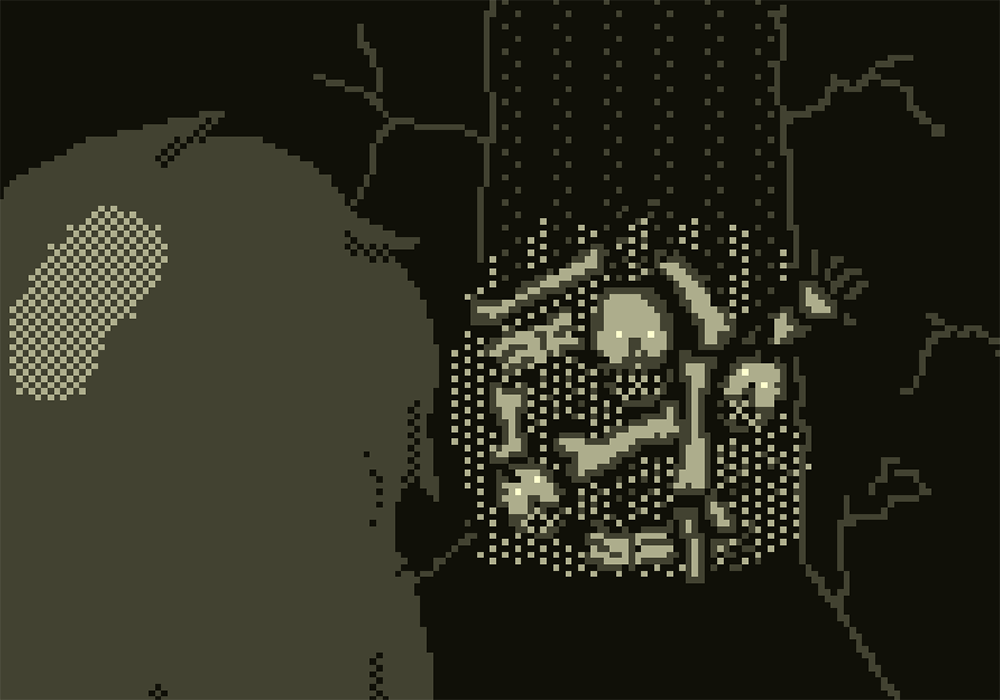
Dorotea features a suspenseful (but no-penalty) chase sequence, but its horror is largely atmospheric. The game’s uncanny pixel-art insert illustrations contribute to the feeling of something being terribly amiss, as do the ghosts and monsters, but the game also explores the anxiety generated by the prospect of being trapped in the past. As much as we might like to romanticize the medieval period, the culture shock experienced by most people – especially women – would likely be atrocious.

Putting its supernatural elements aside, Dorotea dwells in what might be called “archive horror,” or the morbid claustrophobia of a closed room filled with the relics of people long dead. There’s the dankness of the space itself, as well as the fear of the door swinging closed behind you, trapping you inside with nothing but dust. Then there’s the very real possibility that, in all the detritus of the past, you might find something deeply disturbing that you wish you hadn’t seen – or that someone very much wanted to hide. With its retro graphics and creepy pixel illustrations, Dorotea is a fantastic vehicle for conveying a sense of unease.

Dorotea is a short game, but it nevertheless manages to pull off a gut punch of a twist ending while indulging in a few interesting experiments with the ludic medium. The game was created for Italocurso Game Jam 2025, which is themed on folk horror specific to regional cultures in Italy. The 33 entries include a number of games offered in English, and all of them look amazing.
Neko Can Dream Review on Sidequest

I’m excited to have published a review of the indie narrative adventure game Neko Can Dream on Sidequest. Neko Can Dream was created by the Japanese yuri manga artist Nekobungi Sumire, who captures a complex and beautiful world inside the simple Game Boy graphics.

Here’s an excerpt from my review:

Neko Can Dream will take most players about two and a half hours to finish. Even though the narrative tone is gentle, the pace is quite brisk, and the excellent game design ensures that the player never becomes lost or confused. Certain elements of the individual character stories will resonate strongly with players interested in themes relating to queer identity; however, at its core, Neko Can Dream is about how the dream worlds of video games can help people at all stages of life recover from trauma and reach out for connection.

If you’re interested, you can read the full review on Sidequest here:
https://sidequest.zone/2024/05/27/neko-can-dream-bittersweet-nostalgic-treat/

Fishing Vacation Review on Sidequest

I’m excited to have published my first video game review for Sidequest! I had the opportunity to write about Fishing Vacation, a Game Boy horror adventure game from 2020 that was released for Nintendo Switch at the beginning of June. Here’s an excerpt from my review…

What intrigued me about Fishing Vacation wasn’t necessarily its atmosphere of creeping horror, but rather how its story provides a critical perspective on the fantasy of “getting away from everything to live in nature.” During the prologue, your friend jokes about having quit his job, but there’s a sense of unease to his cheerfulness that’s later reflected in his nightmares. I imagine that many people harassed by the pressures of a prolonged economic recession have experienced similar anxieties, and perhaps many of us have entertained a similar fantasy of dropping everything to disappear into the woods. Fishing Vacation forces the player to confront the unpleasant consequences of cutting oneself off from society.

You can read the full review on the Sidequest website here:
https://sidequest.zone/2023/06/19/review-fishing-vacation-dredges-up-unwholesome-summer-fun/

Deadeus

Deadeus
https://izma.itch.io/deadeus

Deadeus is a retro Game Boy horror adventure game in which you have three days before the apocalypse. If you play the game straight, you quietly enjoy your remaining time in your small seaside town before climbing a scenic hilltop to watch the sky fall. If you discover the hidden passageway underneath the town church, however, you can join an evil cult and get the party started early.

You play as a young boy who lives with his mother. Attendance at the local school is voluntary, so you’re free to explore anywhere you like in your town, which is large but not unmanageably so. The town consists of about thirty screens (not including indoor areas), and you can pull up a map with Select if you need it. There are about forty people you can talk with, and their dialogue changes every day. There’s no time limit to these days, which end when you decide to go to bed. If you’re doing a pacifist run, it takes about twenty minutes to explore everything each day has to offer.

The premise of Deadeus is that all the town children are having bad dreams. In the first of these dreams, an eldritch horrorterror informs the children that it will manifest in three days. The town itself seems quaint and utopian; but, as you talk to people and read various documents in the library, you learn that the area has a dark history. There have been waves of unexplained disappearances, for instance, as well as a surprising number of attempted murders.  

If you want, you can steal a ceremonial knife from the town cult and attempt some murders yourself. The game subtly guides you in this direction, and this is where most of the potential gameplay lies.

Deadeus has eleven endings, and the more interesting of these endings involve killing people in specific ways. In order to get the most satisfying (by which I mean the most gruesome) ending, you need to play through the three days while collecting objects to use in a cult ritual.

Meanwhile, the most gameplay-intensive ending involves killing every single NPC in town without getting caught. Deadeus has no combat, so this is largely a matter of stealth and strategy. A few murders require you to be clever, and I enjoyed the challenge.

Still, you don’t have to hurt anyone, and the default ending of Deadeus stands on its own. I think this might actually be the ending I prefer, especially considering what you learn about yourself and your town.

If you make use of your Game Boy emulator’s Save State function, it takes about three hours to see everything there is to see in Deadeus. Some of the endings are much better than others, so I recommend consulting the list of endings (here) and following your heart. The spoiler-free town map (here) is also useful.

A lot of homebrew Game Boy horror games are rough around the edges, but Deadeus is extremely polished. The gameplay is great, the art is perfect, the writing is decent, and even the music choices are interesting. Despite the disturbing imagery, there are no jumpscares in the game, and it’s entirely up to the player how gory they want their experience to be. It’s also up to the player how much reading they want to do, and there’s a fair bit of text on offer if you’re into lore hunting.

And finally, I like how your character’s eyes seem to be bleeding throughout the entire game. Understated pixel horror is always appreciated.

The Mist

The Mist
https://yliader.itch.io/the-mist

The Mist is a Game Boy horror adventure game based on Cthulhu mythos and inspired by the 2019 movie The Lighthouse. Despite only consisting of about twenty side-scrolling screens, it’s an intricate game that takes around 40 to 45 minutes to finish.

You play as an old man sent to maintain an isolated lighthouse for two months. Your job is simple: keep the light at the top of the tower going, maintain the chapel, and don’t try to look for the body of the previous lighthouse keeper.

This potential gameplay loop is quickly interrupted when your character starts having strange dreams involving a sea monster calling him “son” and asking him to return to the ocean. Your character’s dreams become progressively stranger, and what you end up doing is completely neglecting the lighthouse as you poke around the tower to satisfy his curiosity.

About halfway through the game, you begin to navigate dream sequences as well as the waking world, and these dreams are a lot of fun. There are no jumpscares in the dreams, but there are a few (excellent) monster animations that you’re forced to watch become progressively more disturbing. In addition to the in-game cutscenes, there are about two dozen illustrations for longer conversations and reading passages. The pixel art in this game is wonderful, especially given the graphic limitations.

The Mist includes a few puzzle sequences, but these sequences mainly consist of figuring out what you need to do next. Given that your range of motion is limited, these “puzzles” can be solved by process of elimination. There’s one puzzle about thirty minutes into the game that might be a little frustrating, but the creator has embedded a full playthrough video in the game’s page on Itchio if you get stuck.

The creator of The Mist is French, which means two things. First, their English is a little off, but it’s off in a way that makes sense in French and is still completely comprehensible to English speakers. Second, their concept of Christianity is extremely Catholic, and it was amusing to me to imagine a grizzled New Englander consecrating an altar with wine and praying to various saints. It’s always interesting to see how other cultures interpret the Cthulhu mythos, and I unironically loved this.

The Mist loses its footing for a bit in the middle – especially around the puzzle I mentioned earlier – but it’s a neat piece of storytelling that creates an immersive environment at a slow but steady pace. Even if you’re not a Lovecraft fan, The Mist is an interesting and atmospheric game about slowly losing your mind on the fragile shell of land suspended above the massive horrors of the watery depths.

An Autumn With You

An Autumn With You
https://leafthief.itch.io/autumn

An Autumn With You is a short and nonviolent Game Boy adventure game that you can play for free in your browser window. You are Daynese, who is five and three quarters years old, and you’ve just moved with your parents from the city to your nana’s house in the country.

On the game’s Itchio page, the creator says An Autumn With You was inspired by My Neighbor Totoro, and I can see the influence. The forest around your nana’s house is home to magical creatures called Wichu that are attracted to acts of kindness. As her parents deal with their own issues, Daynese explores the beautiful area around her new house and makes a friend.

The interesting pull from My Neighbor Totoro isn’t the forest creatures, however; it’s the way Daynese creatively engages with her environment in to help her process what’s going on with her parents. Like Mei and Satsuki’s father, Daynese’s mother is a scholar working on a manuscript, and her writing schedule is intense. Meanwhile, Daynese’s father seems to have lost his job, and the family couldn’t afford to stay in the city on an academic salary.

I imagine this situation will be spookily relatable to the many Millennial parents who had to move back in with their own parents during the pandemic, or perhaps during the prolonged economic depression preceding it. Daynese is five (and three quarters) years old, and she just wants to play outside. Meanwhile, her parents aren’t doing well. In between Daynese’s jaunts into the forest, the player watches her parents gradually break down while her grandmother stands outside and waits for the storm to pass.

The main narrative drive of An Autumn With You is figuring out whether Daynese’s parents are going to be okay. It’s a short game that should take about ten to fifteen minutes to play, but I nevertheless managed to become extremely invested the story.

Unfortunately, a few of gameplay elements toward the end of the game are somewhat opaque. To give an example, I had to consult a video playthrough (here) in order to figure out the next-to-last action necessary to finish the game. You know you have to fetch food for Daynese’s forest creature friend, but there are no clues to indicate that the game expects you to go fishing with the fishing rod in the back of the car parked outside the house. If your family just moved from the city, why would there be a fishing rod in their car? I spent a solid ten minutes searching for something to interact with in and around the house before I finally gave up and went online.

If you’ve just read the above paragraph, however, then you already know about the fishing rod, and rest of the game shouldn’t be too tricky. In fact, I’d say that An Autumn With You is a perfect game for its length, not to mention a wonderful use of the medium to tell a story. The art is lovely, and An Autumn With You is filled with small but significant grace notes that add color and depth to its world.

There’s Nothing To Do In This Town

There’s Nothing To Do In This Town
https://donotrunwithpixels.itch.io/theres-nothing-to-do-in-this-town

There’s Nothing To Do In This Town is a nonviolent Game Boy adventure game that takes about ten minutes to play. The story set on a section of high street in a town in Wales and seems to be vaguely contemporary, although it gives me a strong early 2000s vibes. You play as a young man who has no money and nothing to do. Also there are some zombies having an office party.

The game is essentially a trading sequence. You talk to people on the street, and you can go in several of the buildings and talk to people there. Your alcoholic father lives in an apartment under the zombie office, and he’s annoyed by the loud music. You therefore need to convince the town’s secret zombie slayer to take care of them.

The graphics are quite good for a Game Boy game, and the trading sequence fits together nicely. The character interactions have big Scott Pilgrim energy, meaning that your character is a loser but means well, thus encouraging all sorts of weird people to open to him. Along with the retro graphics, the various nods to late 1990s grunge culture give the story a lovely sense of nostalgia, and I really enjoyed the experience of playing a game that’s essentially indie alt comix come to life.

The music is great, and it totally got stuck in my head. The game creator also makes short albums of Game Boy chiptunes, and the songs from There’s Nothing To Do In This Town are the last three tracks of this one: https://donotrunwithpixels.bandcamp.com/album/the-outside

Red Trees

Red Trees by Caramel
https://caramel.itch.io/redtrees

Red Trees is a free nonviolent adventure story game made with RPG Maker in a style that emulates the Game Boy Color. It’s about a small village that might be haunted by ghosts in the woods, and it’s adorable.

The game is divided into three sections: the village’s residential area, its business center to the north, and the forest to the south. In order to progress from one area to another, you embark on an extended trading quest. For example, someone asks you to find their cat. To convince the cat to follow you, you need to feed it fish. In order to procure a fish, you need to give a can of worms to the person fishing at the local pond. The trading sequence isn’t strictly linear, but it’s not so complicated that you’d get lost or frustrated.

Red Trees isn’t a horror game by any means, but it gives me strong Omori vibes. (Although, having made that comparison, I should say that Red Trees was originally released in 2016, four years before Omori.) The music is relaxing, the character portraits are super cute, and the writing is wholesome with a touch of light humor reminiscent of Tumblr circa 2015. I especially love the menu screen’s character log, which collects short profiles of everyone you’ve met. The item portraits and descriptions are lovely as well.

Red Trees takes about an hour to complete, but this is mainly because of the game’s spatial layout. Your character can’t run, and the town is so spacious that it takes time to walk from place to place. This never becomes frustrating, but you may want to download the game so you can save your progress, step away, and come back later. Red Trees is extremely charming, and the experience of playing it is much more enjoyable if you take your time instead of rushing to finish it.

If you’re going to download Red Trees, you have the option of paying $2 to get an extra file folder of illustrations and a PDF booklet with annotated concept and development art. I highly recommend this extra material, but I’d also recommend not checking it out until you finish the game, as it spoils the ending. In fact, the bonus content functions almost like a separate postgame story, and it’s just as sweet and adorable as the game itself.

Deep Forest

Deep Forest by Small is Beautiful
https://small.itch.io/deep-forest

Deep Forest is a free GB Studio adventure game that takes about 45 minutes to play. There’s no combat, and the game is driven by puzzle-solving and exploration. You play as a forest witch tasked with helping three trees that have become mysteriously cursed. To purify a tree, you must first find it by exploring the forest. You then enter its nightmare, which functions as a dungeon. Once the tree’s curse is lifted, its thorny roots vanish, thereby allowing you to explore more of the forest.

This is the basic gameplay cycle of the Legend of Zelda series, and the simple puzzles of Deep Forest remind me of certain segments of Oracle of Seasons and Oracle of Ages wherein you:

(1) Use an animal to procure a seed.
(2) Find a patch of soil to plant the seed,
(3) which sprouts into a vine
(4) that allows you to climb a cliff.

If this similarity is intentional, it’s a lovely homage to the debut work of Hidemaro Fujibayashi, who went on to become the director of Breath of the Wild. In addition, I had a nice “Legend of Zelda” moment when I found a secret in Deep Forest. I was delighted when I realized that you can water the single square of roots in front of an otherwise unremarkable cave in order to discover a hidden spring. This moment of discovery lit a spark of excitement that reminded me of exploring Hyrule for the first time.

In terms of its visual style, Deep Forest is reminiscent of the Game Boy games that were released in the West under the “Final Fantasy” logo, which include the first Secret of Mana game and the first three games in the SaGa series. This style feels extremely nostalgic, and it’s cool to see it used to depict a thriving forest.

Deep Forest is fairly linear, and the gameplay mechanics are beautifully intuitive. I would have loved this game as a kid, and I’m extremely fond of it as an adult. It’s exactly the perfect length, and I enjoyed the exploration elements and wholesome story. As a unexpected bonus, the interactive postgame credits sequence is beautiful and genuinely feels like a reward for playing.

A Time for Giving

A Time for Giving by CobGoblin
https://cobgoblin.itch.io/a-time-for-giving

A Time for Giving is a free Game Boy “dark cottagecore” horror game about being a human sacrifice. It takes five to ten minutes to play, and it’s divided into three main areas: your protagonist’s cozy family cabin, an isolated village preparing for its winter festival, and the haunted snow-covered woods. The overworld graphics remind me of the cute rounded style of A Link to the Past, and the character artwork that appears during the dialog screens is delightfully eerie and upsetting. The dialog is well-written and communicates the themes of the game without pulling any punches.

A Time for Giving was created for a winter solstice-themed game jam, and the creator apologizes that there’s no sound because they ran out of time. I’m of the opinion that the lack of music is actually quite lovely, as it creates an environment reminiscent of a silent forest blanketed by snow so heavy that it muffles all sound.

A Time for Giving is very short and very simple, but the writing and visual style are exactly what I want from a handmade Game Boy game. It’s also a perfect combination of nostalgia and “what the fuck did I just play,” which is a major component of what makes these games so fun.

I played A Time for Giving a few times and made varying choices in an attempt to get a different ending, but alas. I wonder if there’s a way for this poor kid to make it out of the forest…?