An Unfound Door, Chapter 10

After returning from the library in the east tower, Agnes and Fhiad immediately head to the door in the graveyard via a set of underground access tunnels for the castle staff. They enter the tunnel system through the ground floor library. Along the way, Agnes remarks on how all of the underground areas of the castle have been abandoned for decades. In the courtyard, Fhiad tries to open the door with magic but fails.

The next day, Agnes talks with her father, who is recovering from a lingering illness. He suggests that she should visit the castle’s west wing, which once hosted a world-renowned magic academy but has fallen to ruin after the war with Erdbhein. As she prepares to present herself at court that evening, Agnes reflects on the magic of the lost Soreiya’s Tear and thinks that her own wish would be to see Faloren before its decline.

.

Following two successive library explorations, this chapter is significantly more mundane. Agnes and Fhiad manage to locate the “unfound door” of the novel’s title, but Fhiad can’t open it. Agnes then talks to her father, the king, but he doesn’t know anything either.

The king points Agnes in a potential direction, but his advice is little more than his own wishful thinking. Much later on in the story, it will be revealed that Agnes’s father and mother spent a fair bit of time exploring the castle themselves. Although it may seem like Agnes’s father is an antagonist, he had dreams and ambitions once, and he loves his daughter in his own way.

An Unfound Door isn’t YA fiction – everyone in this story is an adult – but one of the staple elements of the genre of YA fiction that has always bothered me is how anyone over the age of twenty is automatically cast as a villain. I understand why it can be useful to set up “adults” as antagonists from a narrative perspective, but the idea that any given adult would have any actual power in real life is laughable.

Speaking personally, I feel like there are more limitations placed on me with every year I get older, and that’s the theme I want to express through Agnes’s father. Precisely because he’s a king, there are many things he can’t do. Still, when Agnes obliquely mentions that she’s taking up the quest he secretly began when he was younger, he can’t help but get excited. Agnes’s father isn’t a bad person; he’s just the hero of an entirely different story.

Also, although I love novels like those in the Redwall and Harry Potter series, I want to use the setbacks and mundanity of this chapter to challenge the fantasy genre convention that Agnes will be embarking on a fun adventure in a magical castle. I am not made of stone, and I’ve definitely enjoyed writing the adventure segments! Still, the point of this story is for Agnes to realize that her quest to save her kingdom isn’t what she should be doing with her life. Not everyone is meant to be a hero, and that’s okay.

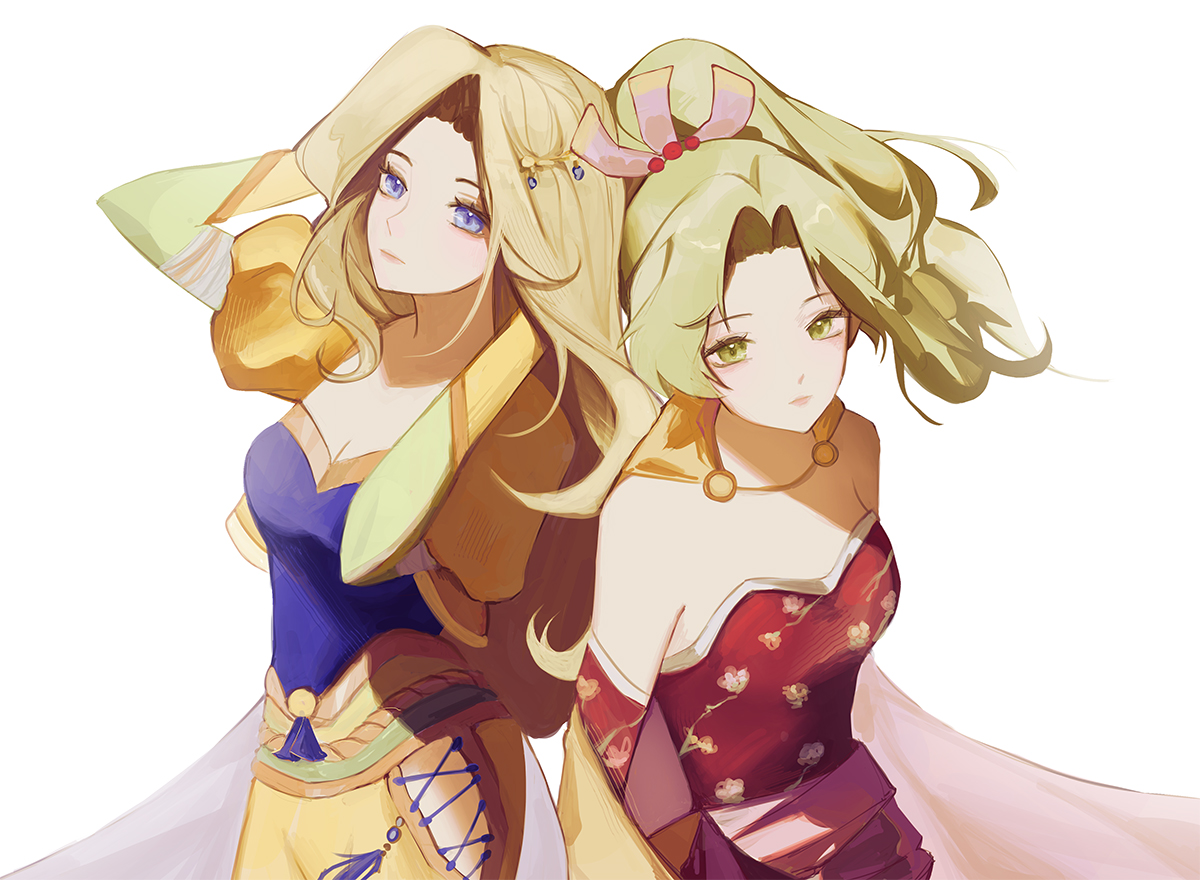
The illustration in this chapter’s graphic was created by the magical Allison McKenzie, a Final Fantasy fan artist who draws colorful and expressive female characters who are always full of life. As you can probably guess from Agnes’s visual design, her character is partially based on Garnet from Final Fantasy IX, so I’m thrilled that Allison drew this illustration for me. You can check out her art on Twitter (here), on Instagram (here), and on Tumblr (here).
Gender and Magic in Final Fantasy VI

Final Fantasy VI is deeply concerned with the relationship between human beings and technology. The game borrows many elements from Western fantasy and science fiction, yet the story and action are centered around two teenage female protagonists, Terra and Celes, who are variations on the “magical girl” and “beautiful fighting girl” archetypes of Japanese popular culture.

Back in 2016, I published an essay about “Gender and Magic in Final Fantasy VI” on the website of the sadly defunct gaming magazine Kill Screen. Since then, I’ve made substantial edits for clarity, and I posted the updated version on AO3.

This meta essay situates Final Fantasy VI within the cultural context of Japan in the 1990s in order to discuss how the game explores its posthuman themes through the bodies of its female characters. I demonstrate how Final Fantasy VI uses gender as a lens for its exploration of the intersections between biology and technology, and I argue that the otherness associated with Terra and Celes serves as a powerful analogy for anxieties surrounding the future of the human species in relation to seemingly magical biotechnologies.

You can read the essay on AO3 here:
https://archiveofourown.org/works/53596483

The cover illustration was created by Palliceart, an artist with a dual specialty in magical girls and beautiful fighting girls. You can find her gorgeous and ethereal artwork on Twitter (here), on Instagram (here), and on Tumblr (here).

Retro JRPG Lessons from Final Fantasy Mystic Quest

In 2023, I tried to play about a dozen indie retro JRPGs. I’ve always loved the JRPG play cycle of slowly gaining strength and resources through turn-based battles and dungeon exploration, and I don’t necessarily find repetitive simplicity boring. Still, I bounced off almost all of the games I tried within the first hour.

In order to think through why I’ve had so much trouble getting into more contemporary retro JRPGs, I returned to Final Fantasy Mystic Quest, which was originally released for the Super Nintendo in 1992. Mystic Quest was intended to introduce American console gamers to the conventions of JRPGs, and its various ease-of-use features allow the player to complete the story in less than five hours. Despite its primitive graphics and gameplay, I had a good time with Mystic Quest, and I took away five lessons about why this simple-as-bricks game works for me while so many contemporary retro JRPGs don’t.

(1) If the game is more than an hour long, there needs to be actual gameplay.

I have a soft spot for indie retro RPGs in which the player does nothing but walk around and talk to people, but there’s a limit to how much of this I’m willing to engage with. Even in a story-focused game, there needs to be some sort of activity that isn’t reading text on a screen.

(2) The player needs to experience this gameplay within the first ten to fifteen minutes.

I think a major aspect of what people liked about old JRPGs is that the player could generally progress from the first town to the first dungeon right at the beginning of the game. Exposition and worldbuilding are important, but not as important as the game being fun to play. Even Final Fantasy VII, which has a famous opening cutscene, sees Cloud and Barret fighting enemies and navigating a dungeon within the first five minutes.

(3) Battles with minor enemies should be over quickly.

This is especially the case at the beginning of the game, when the player is still getting a feel for how everything works. If every random battle is two minutes long, these minutes add up. It doesn’t matter how clever the battle-specific character dialogue or flavor text is; it loses its charm when I see it repeated dozens of times across dozens of random battles.

(4) There should be a bell curve for complexity.

The opening of a game needs to demonstrate the game’s aesthetics and mechanics in a way that shows the player what the game is about. This doesn’t need to be dramatic or flashy or cinematic, and the point is definitely not to overwhelm the player with a giant town filled with NPCs or endless text reels of exposition. All of that should come later, when the player is already invested and eager for more. A game should start simple and gradually become more complex before opening up somewhere in the middle. By the end of the game, though, the complexity needs to decrease as the player becomes more focused on finishing the story. Structure is important.

(5) The player should be able to interact with the environment in region-specific ways.

This is the key ingredient that makes the Legend of Zelda games work so well, and even standard JRPGs like Final Fantasy IV and Final Fantasy VI incorporate elements of environmental exploration as well. If I’m in a forest, I want to be able to find an axe that I can use to chop down trees. If I’m navigating the sewer system under a castle, I want sluice gates that raise and lower the water level. If I’m in a seaside merchant town, I want there to be secret passages filled with treasure. Exploration is infinitely more enjoyable if the player has something to do.

Okay, one more:

(6) It’s fun to be able to jump.

I’m not going to elaborate on this, because it’s a self-evident truth: It’s fun to be able to jump. Also, if there are cute animals, the player should be able to pet them.

The End of the Line for the Shinra Corporation

Over the course of its expansive story, Final Fantasy VII changes direction and shifts focus but holds fast to the goal of saving the world from a crisis created by Shinra. Even if there were no interstellar demons or mad scientists, the Planet would never have survived were it not for a small group of activists who dared to challenge the most powerful corporation in the world…

I contributed a meta essay titled “The End of the Line for the Shinra Corporation” to the Return to the Planet fanzine, which celebrates the 25th anniversary of the original 1997 release of Final Fantasy VII. My piece is about how the game references the corporate critique and real-world grassroots environmental activism in Japan during the 1990s. The zine is filled with gorgeous artwork, stories, and nonfiction, and it’s free to download. You can read my essay on my Japanese fiction blog (here), and I also posted it on AO3 (here). You can check out the zine via these links:

🌿 https://twitter.com/ff7ogzine
🌿 http://whitemateria.net/ff7ogzine/
🌿 https://archiveofourown.org/collections/FF7OGZine