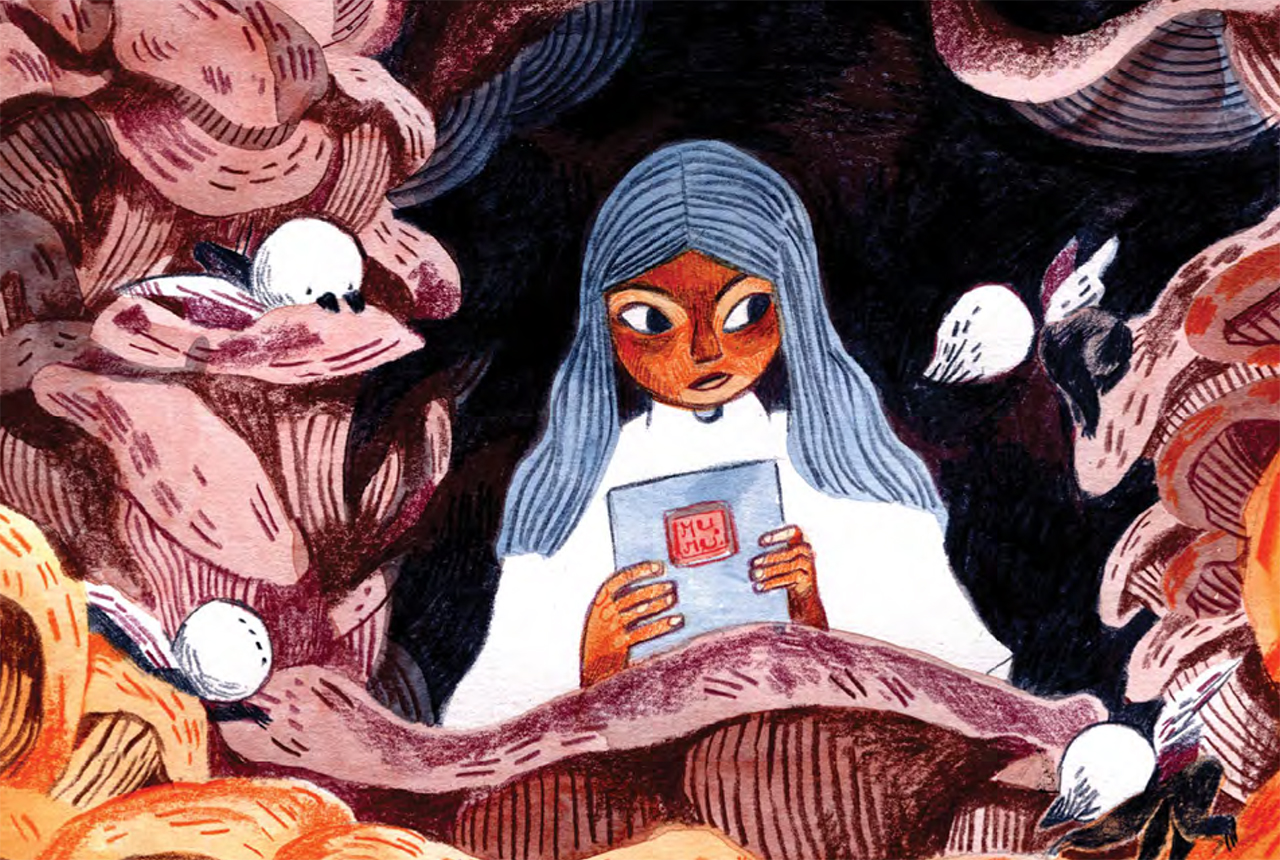
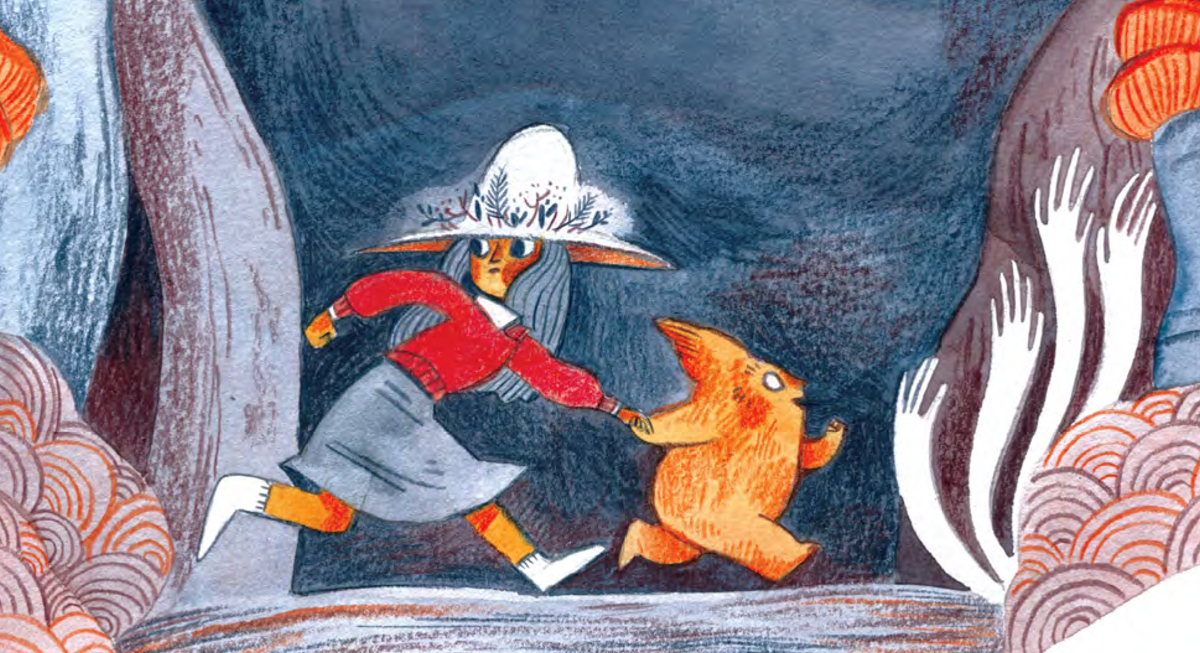
I recently had the opportunity to write a review of The Book of Murmurs, a new graphic novel from Fantagraphics about a young girl who goes on a magical journey through a fantasy world.
You probably think you know what you’re getting from that description, but this is an incredibly rich and dense story. I actually had to push back my review because, as I explained to my editor, I wasn’t expecting this book to be House of Leaves Junior. Formulating the basic outline of the plot was an intriguing challenge, and I had to do a fair bit of outside research, which included finding interviews with the artist while studying her social media posts. In case this sounds like a bad thing, please rest assured that The Book of Murmurs is well worth the time and effort.
Here’s an excerpt from my review:
In a launch day interview, Purwin describes her work as a reflection of her experience as a child growing up in the 1980s, when lush fantasy films like Labyrinth and The Secret of Nimh were suffused with sinister undertones and didn’t always make sense. Purwin says that she created The Book of Murmurs for her younger self, who would stay up late to watch movies like Stand by Me and then spend days dwelling on the unfamiliar imagery while processing a lingering sense of unease. The Book of Murmurs perfectly captures the sense of fascination with forms and meanings half-glimpsed through shadows, always asking compelling questions that don’t have straightforward answers.
I’d like to expand on my review here and say that I would have loved The Book of Murmurs as a kid. As an adult who appreciates the fragmented and nonlinear storytelling of The Magnus Archives and Bloodborne, I really enjoyed getting lost in this graphic novel. Based on the artist’s gorgeous and heartbreaking social media minicomics about Palestinian refugees, I also get the sense that there are strong political currents underlying the adventure story, and I hope this book receives the sympathetic scholarly attention it deserves. It’s so good.
I’m going to start writing my query letter for The Demon King soon, so I’ve been thinking about how to describe the story, which has two parallel threads that unspool in alternating chapters. The eponymous “demon king” Balthazar (he’s not really a demon king) is the main point-of-view character, as it’s his actions that push the larger narrative forward, but the role of his “nemesis” Princess Ceres (she’s not really his nemesis) as a deuteragonist is equally important and will only become more important as the story progresses.
Balthazar’s plot arc in the first novella is simple: he says he will go to a temple and find a magical artifact, and he goes to a temple and finds a magical artifact.
Meanwhile, what’s going on with Ceres is more complicated and can’t be succinctly summarized.
Ceres opens the story by sending a hero to fight Balthazar. This “hero” is actually a convict whom she has effectively exiled, and she intends for Balthazar to dispose of him. He does so, but not before the hero kills two people and injures a third.
Back in Whitespire, Ceres grants a private audience to a viscount from an outlying territory who essentially asks to stop paying taxes. Ceres dismisses him, but she allows herself to be seduced by his daughter, who wants the viscount to step down so that she can manage her family’s estate. While engaging in an openly sexual relationship with the viscount’s daughter, Ceres realizes that the viscount is being manipulated by a shadowy anti-monarchist political faction. In an attempt to provoke the members of the faction to reveal themselves, Ceres orders the head of her intelligence staff to direct a covert attack on the viscount’s estate.
Members of a separate anti-monarchist faction, fearing that they will be blamed for this attack, offer a scapegoat in the form of an advanced student of magic – a grad student, basically – who has been distributing seditious tracts. Ceres has actually discussed the matter beforehand with one of the leaders of the grad student’s faction, who is her close friend (and happens to be the author of the ongoing series of romance novels that Balthazar is addicted to). She therefore exiles the student, ostensibly to die at the hands of the demon king but actually to study with his friend Melchior, a wizard from a foreign kingdom who has strong anti-monarchist leanings of his own.
Ceres has grown fond of the viscount’s daughter, and she doesn’t want her or her father to become pawns of court politics in the way that the grad student did. She therefore engineers a minor scandal involving the viscount, which serves as the excuse the daughter needs to transfer power away from her father.
At the end of the first story arc, the viscount and his daughter leave the castle alive and unharmed. Ceres hasn’t been able to figure out who was manipulating the viscount at court, but she’s content to have secured an ally in the viscount’s daughter, who will almost certainly manage her family’s estate better than her father.
All’s well that ends well, but the reader is left with the dangling thread of why Ceres is so amenable to the idea of deposing herself from her own throne. In addition, how does she know Balthazar, and why is she so friendly with him? There’s also the matter of Ceres having sent Balthazar a “hero” that he was given no choice but to murder. Balthazar alludes to the fact that this isn’t the first time Ceres has done this, which is even more disturbing.
At the beginning of the second story arc, probably at the end of the second chapter, Ceres is going to address this matter directly and reflect the main theme of the story back on Balthazar by saying that these “heroes” have a choice. What she means is that no one is forcing them to attack the people they see as their enemies, but this raises the question of whether Ceres is giving Balthazar a choice in how he handles the circumstances she has created. This digs even deeper into the story’s theme by suggesting that some choices aren’t so simple, and that people suffer when they try to deal with making these choices on their own.
Also I intend for Ceres to make a lot of jokes about oral sex in her second story arc.
This summary is much more complicated than the story itself, hopefully. Ceres is not an unreliable viewpoint character, and none of these plot elements are supposed to be confusing or mysterious to the reader.
In the end, the goal of all this political intrigue is to set up Ceres’s kingdom as a battleground while establishing that it is primarily a battleground of relationships and feelings.
If Balthazar is a means to look at high fantasy heroic quest narratives from a different perspective, then Ceres is my take on the traditional “pure-hearted princess” trope. Ceres is in her early thirties, and I don’t think a princess can survive that long in a position of near-absolute power without being extremely clever and at least a little evil.
The above illustration of Ceres was created by the stylish and magical Fernanda V. (@artesiants on Instagram and on Twitter + @artesiant on Tumblr), who draws bold and fashionable designs of witchy characters. The prompt I gave her was “an elven princess who is beautiful and ethereal but delights in destroying her enemies,” and I love how she’s mixed diaphanous skirts and delicate jewelry with a lightly armored Amazonian halter that leaves Ceres’s arms free and ready to handle any conflict that comes her way.
It’s so interesting to see how various artists interpret this character, and every illustration of her makes me even more committed to telling her story despite the occasionally stress-inducing intricacies of its twists and turns.