Urban Gardening with Aerith Gainsborough

I’m excited to share a short story titled “Urban Gardening with Aerith Gainsborough,” which is based on the Final Fantasy VII Remake prequel novel, Traces of Two Pasts. This story is about Aerith’s relationship with the planet, especially how it manifests through her love of plants and flowers.

Despite the nurturing elements of her personality, something I love about Aerith is that she’s always kind but never fails to speak her mind. There’s an edge to her personality that I can’t help but admire, especially when she’s being passive-aggressive. It’s always fun to write characters who have this sort of complexity.  

You can read my story on AO3 here:
https://archiveofourown.org/works/65035672

On a personal note, I live in South Philadelphia, which is about as close as you can get to the Sector 5 slums in real life. I played FFVII Remake for the first time last October, and I fell so head-over-heels in love with Aerith that I was inspired to begin planting flowers in my neighborhood. I know it sounds trite to say “Aerith is an inspiration,” but she really is.

The illustration of Aerith showing off the small garden at the Leaf House orphanage was created by the bright and shining Artofpipeur, who posts colorful character portraits on Instagram (here).

Divine Beast

Zelda returns to her original form after the defeat of the Demon King. But, after so many years, is the being that comes back to Link entirely human? Zelda has appetites better suited to claws and fangs, but Link resolves to care for her, no matter the cost. This is a story about Zelda attacking and eating frogs, and cuccos, and horses… and possibly something with even sweeter flesh.

I’ve been enjoying Tears of the Kingdom, but I’m frustrated by its story. I love all the characters, and I think the game’s broad narrative arc is an interesting reimagining of Ocarina of Time. Still, there are many elements of Tears of the Kingdom that I find unsatisfying, especially its ending. I understand the plot mechanics of what happens, which are nicely explained in (this post) on Tumblr, but Zelda’s complete reversion to her human form doesn’t sit easy in my mind. Is it really possible for a transformation of such magnitude to have no lasting effects? Did the sacrifice Zelda made really have such little weight?

Tears of the Kingdom fails to attach meaning to its worldbuilding in a way that very few Legend of Zelda games have in the past. It’s understandable to dismiss these games as childish heroic fantasies. Still, at some point, the true darkness of each game’s story expresses itself. The player may have seen the plot through the limited viewpoint of Link, the teenage “chosen one,” but the crumbling kingdom of Hyrule looks substantially different through the eyes of other characters. Link will emerge triumphant and ride off into the sunset, but everyone else has to live in the ruins, and it’s only very late in his quest that Link realizes this. With this realization, the player can begin to put together the missing pieces of a much larger story.

Despite having an incredible potential to expand on the many mysteries of Hyrule, Tears of the Kingdom does its best to simplify its story to a single one-dimensional layer: Ganon is bad. By defeating Ganon, Link gets rid of everything that’s wrong with the world, meaning that everything in Hyrule is now good again. This is all that matters. What happened in Breath of the Wild doesn’t matter. What happened in the ancient era doesn’t matter. What happened to the Zonai doesn’t matter. None of Hyrule’s past matters, nor does its future. In the endless present of the game, Zelda only exists as a vessel for “good,” and the only important thing is that Link saves her.

As much as I love Zelda, I resent that she only exists as a plot device and a reward for the player. While superficially turning Zelda into a superhero, Tears of the Kingdom robs her of agency. I generally like happy endings, but I hate the conclusion of Tears of the Kingdom. Simply put: it’s happy, but it’s boring. What I therefore wanted to do with “Divine Beast” was to make Zelda’s decision more interesting by ensuring that it has consequences. I also wanted to give the worldbuilding of Tears of the Kingdom a bit of the weight and depth it deserves.

And, more than anything, I want Link and Zelda to be free.

“Divine Beast” is complete at 2,000 words, and you can read it on AO3 here:
https://archiveofourown.org/works/49296496

I drew the illustration myself. You can follow my art on Tumblr (here) or on Instagram (here).

The Flower Thief

“The Flower Thief” is a story about how Ganondorf visits Hyrule as a child and falls in love with the green and beautiful land, even as he is warned away by the queen who will become Zelda’s mother.

What fascinates me about Ganondorf (at least prior to Tears of the Kingdom) is that he’s a villain whose actions seem far more evil than his character. Given that he’s not necessarily an evil person, what would drive him to such extremes?

In my own experience, evil is boring and mundane. “Evil” is someone who sends hateful messages on social media because they know they can get away with it, or someone who pretends not to see when a colleague is being harassed at work. People who are born into privilege can often be evil without even thinking about it, as the rules that govern the actions of other people don’t apply to them. People in positions of authority are often evil simply because it’s the path of least resistance. So, in most cases, evil is passive; it’s a matter of not challenging the baser impulses of human nature, or not bothering to fix a system that’s become twisted and broken.  

It’s therefore intriguing to me that, when Ganondorf wants “power,” what he’s seeking is the ability to upset the established order. Even if it’s for his own selfish reasons, he aims to transform the world, whether by undoing the mistakes of the past or creating an ideal future. He fails – and he fails miserably – but at least he tries.

I grew up with shōnen adventure manga, and I’m interested in seeing a similar coming-of-age story about someone like Ganondorf, who is talented and works hard but still ends up as the villain. “The Flower Thief” was my attempt to write a story like this for myself, and I think I managed to do a decent job of creating a nice parallel to Link’s first journey to Hyrule Castle in Ocarina of Time.

You can read “The Flower Thief” on AO3 here:
https://archiveofourown.org/works/32033518

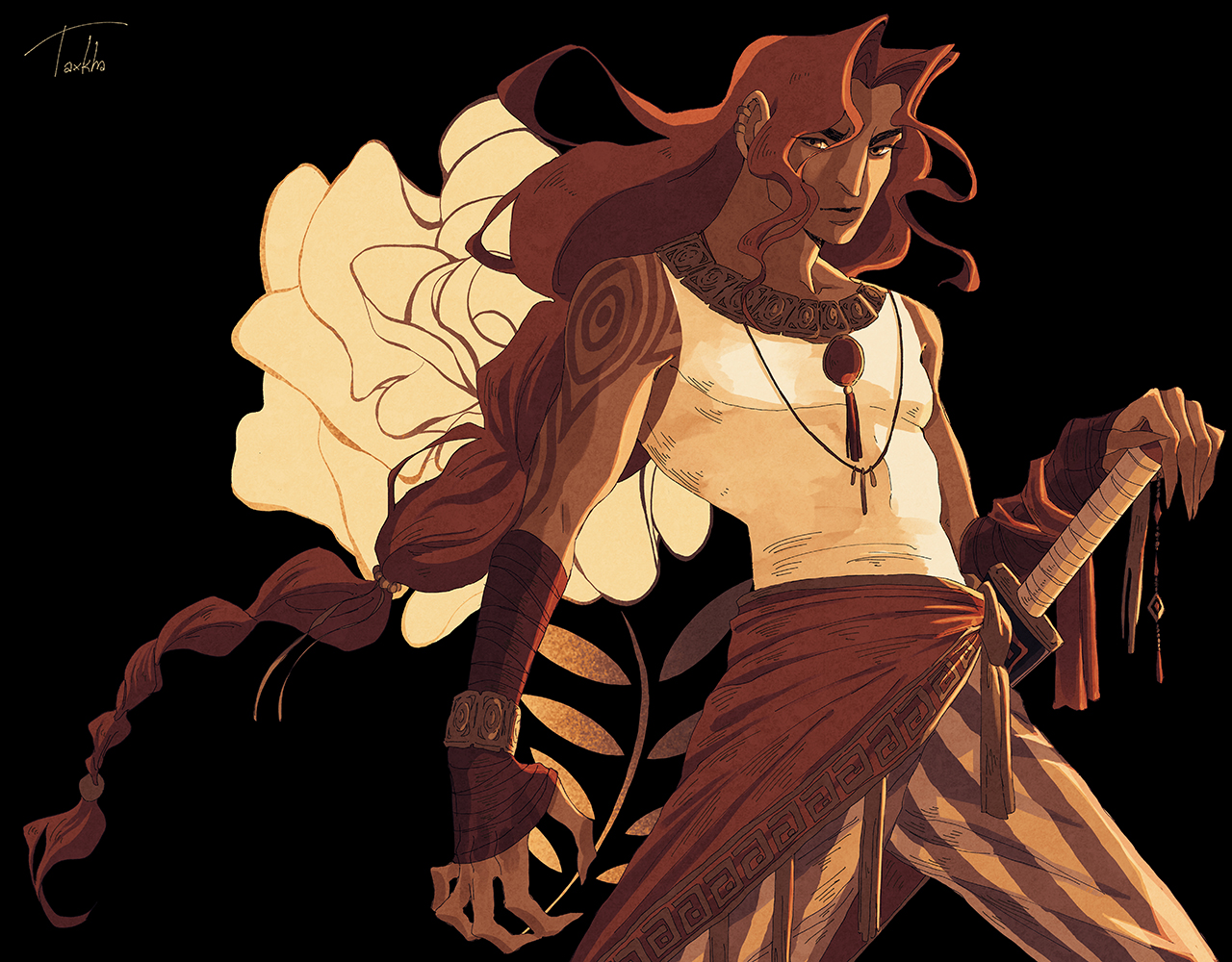
This story was written for Ties of Time, an Ocarina of Time and Majora’s Mask fanzine. Ties of Time was published back in 2021, but you can still see the zine’s artwork on Twitter (here), and the zine’s stories have been collected on AO3 (here). The character illustration of teenage Ganondorf is by the bold and daring Taxkha, who shares their art on Tumblr (here) and on Twitter (here).

You’re Not Lost, You’re Here!

Plenty of people want to leave Possum Springs. But what about the people who are happy to stay? “You’re Not Lost, You’re Here!” is a linked trio of short stories about a day in the life of the strange little town of Possum Springs. Mae’s aunt Molly reflects on the eeriness of depopulation, Mae’s father Stan fantasizes about breaking corporate windows, and Mae’s mother Candy wonders what her daughter will see when she returns home with nightmare eyes.  

Something Night in the Woods does really well, I think, is to offer the player an opportunity to glimpse into the lives of people whose perspectives might be difficult to understand out of context. To give an example, Mae hates the police and teases her Aunt “Mall Cop” Molly with more than touch of hostility, but why would Molly have wanted to become a police officer in the first place? Why would Mae’s father, a former factory technician, embrace worker solidarity but still distrust unions? And why would Mae’s mother, who doesn’t necessarily believe in God, feel such a strong connection to the Possum Springs church that she runs its business office?

It’s easy enough to sympathize with Mae and Bea and Gregg and Angus, whose attitudes of progressive Millennial cosmopolitanism presumably reflect the player’s own, but I think the older characters in Night in the Woods are just as interesting and compelling. I come from a working-class background myself, and I wanted to try to make these secondary characters more relatable as the heroes of their own stories.

You can read this trio of vignettes on AO3 here:
https://archiveofourown.org/works/49029619

I wrote this piece for At the End of Everything, a Night in the Woods fanzine. Their website on Carrd is (here), and you can check out everyone’s artwork on Twitter (here) and on Tumblr (here). If you’re interested in ordering a copy of the zine, leftover sales are open throughout August.

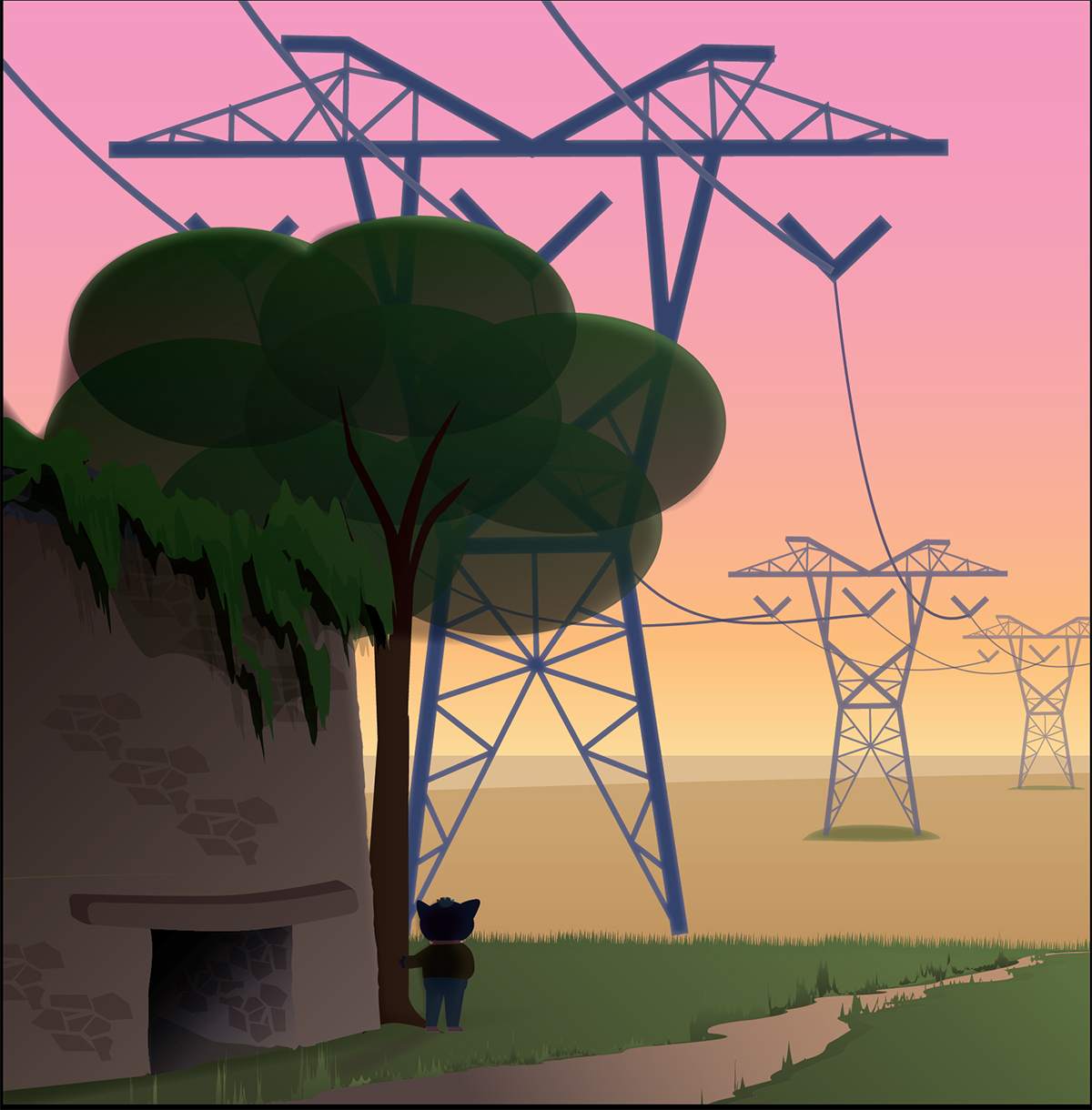
I had the pleasure of working on an illustration with the brilliant and multitalented Wolf Godwin. You can find his art and photography on Instagram (here), his animations on YouTube (here), and his music on Soundcloud (here). Wolf has written lovely piano versions of several songs from the Night in the Woods OST, so please check out his work if you’d like to indulge in some fun and eerie autumn vibes.

The Girl in the Screen at the End of the World

It’s been more than twenty years since rumors about a cursed videotape began to spread. The stories were true, and Japan is in ruins. Can the people who survived the collapse of civilization escape Sadako’s curse? Or do they seek her out instead?

“The Girl in the Screen at the End of the World” is a series of four short vignettes about the last living humans making their peace with the end of the world as Sadako bids a gentle goodbye to modern civilization. All of the human characters in the story die, but all the animals go on to live their best lives.

The story is complete at 1,800 words, and it’s on AO3 here:
https://archiveofourown.org/works/47735320

I had the immense privilege of working with an artist who goes by Vani on an illustration for this story. I was inspired by his short Animal Crossing comic about grief (here), and I love the way he draws handsomely rendered characters in lush environments brought to life by bold colors. You can find more of his evocative art on Twitter (here), on Instagram (here), and on Tumblr (here).

Hyrule’s Finest Teas

Link is a second-year college student who works as a barista at a small café on a cobblestone street next to his university. Every day he waters the plants, samples new teas, and listens patiently to the concerns of the people who visit. He especially enjoys the company of one of the regulars, a posh upperclassman named Zelda who comes to the café every day to write. It would be the perfect job if not for his boss, whose excellent taste does little to blunt the edge of his exacting standards.

It took me years of being in fandom to reach this point, but I finally embraced the cliché of writing a Coffeeshop AU. I had an intense Fall 2022 semester, and I wrote “Hyrule’s Finest Teas and Imports” to let off steam during the winter break. This started as a wholesome story about delicious café food, but it gradually transformed into something a bit darker. While I was thinking about why someone like Ganondorf would manage a café, I did a lot of research into the shady real estate practices common around college campuses in the United States. I ultimately decided that it would be fun for Ganondorf to commit tax fraud. As a treat.

The story is complete at four chapters and 9,200 words. It’s on AO3 here:
https://archiveofourown.org/works/43918116/chapters/110424639

I was extremely fortunate to work with the magical Mirarasol on an illustration for this story. Mirarasol creates lovely artwork of cute characters inhabiting stylish interiors, and they’ve done fan art for a number of games in addition to their original illustrations. If you’re interested, you can check out their work on Twitter (here) and on Instagram (here).  

Varré’s Bouquet

Deep under the Royal Capital of Leyndell, the cursed Omen son of Queen Marika bides his time within a prison of shadows. When the ambitious young surgeon Varré is summoned to attend to Mohg’s crown of horns, the two men forge a close bond, yet Varré can do nothing as the shining prince Miquella tempts Mohg with tales of a frightful power hidden within the dark hollows of the earth. As the Lands Between fall to ruin, Varré realizes the wisdom of Miquella’s dream, and he once again offers himself to Mohg, along with his love – and his blood.

While sweating through a set of analytical essays and academic book reviews earlier this year, I amused myself by writing a short story about the two worst characters in Elden Ring, White Mask Varré and Luminary Mohg. They’re both terrible people, but I’m intrigued by the unwritten backstory of their relationship. Because Varré is so unapologetically supportive of Mohg’s evil schemes, the pair has become the subject of a number of silly tongue-in-cheek memes (this one on Tumblr is probably of my favorite), but I followed my heart and wrote unironic gay monster romance. Game Rant may have called Mohg the “worst LGBT+ representation,” but I think he and Varré are adorable.

My story is complete at 3,800 words, and you can read it on AO3 here:
https://archiveofourown.org/works/46268107/chapters/116484187

I consider myself extremely lucky to have been able to work with Paristandard to create an illustration for the story. Along with Elden Ring, they also draw fan art for Lord of the Rings and The Silmarillion, and their original comics and character designs are fantastic. You can find their work on Twitter (here) and on Instagram (here).

The Eyes of Hyrule Zine Preview

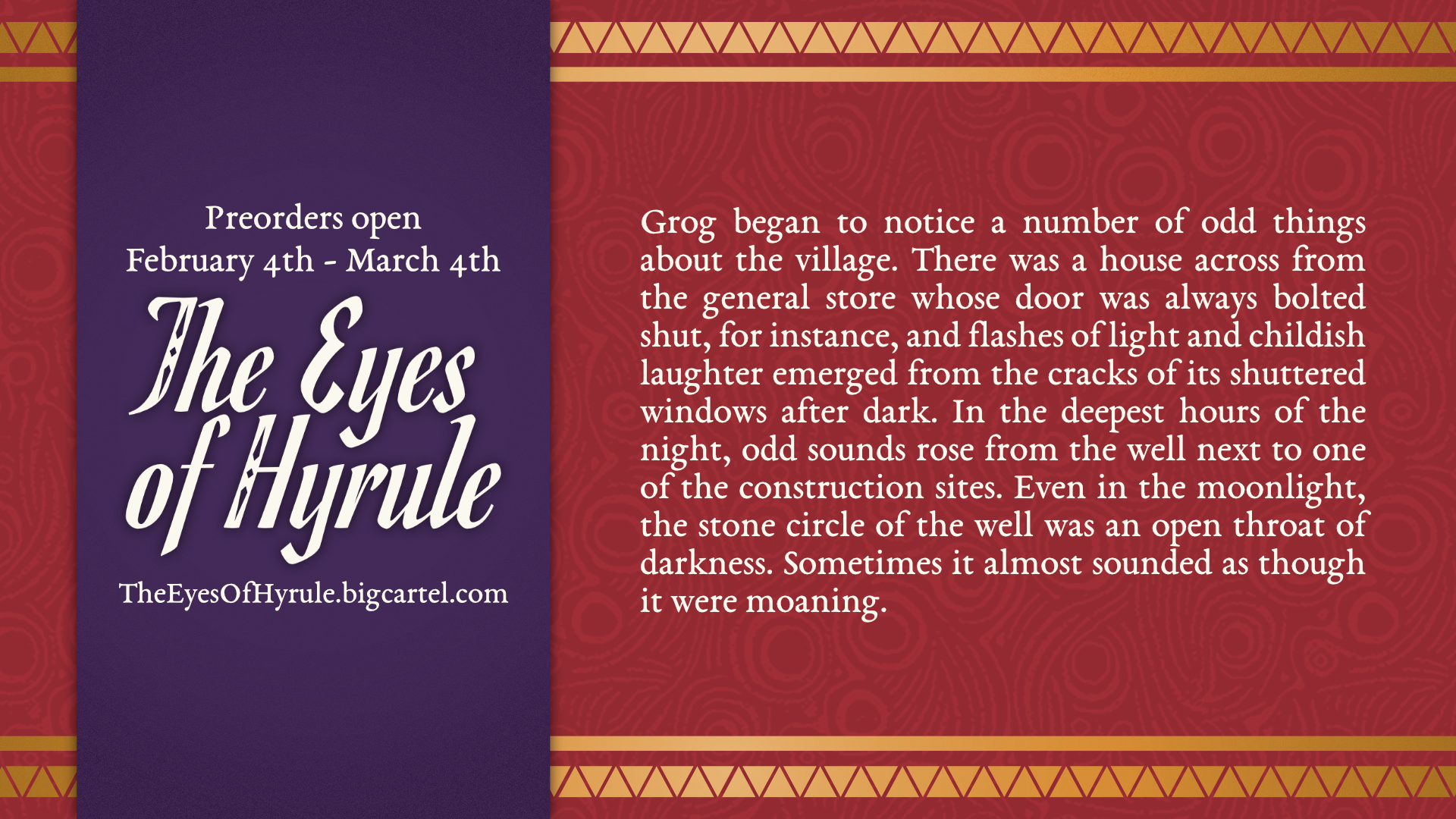
I’m excited to announce that preorders are open for The Eyes of Hyrule, a Legend of Zelda fanzine devoted to the Sheikah. The zine’s Carrd is (here), and you can check out more previews on its Twitter account (here).

There’s a lot of talent involved in this project, and the mods have been totally on the ball at keeping everything organized for the zine, which is expected to ship out this summer. It’s always a pleasure to be part of a project where everything clicks and comes together so well. Also, I might be biased, but I think the stories (and comics!) in this zine are especially interesting and unique.  

My own piece, “The Only Come Out at Night,” is a soft horror story about Kakariko Village in Ocarina of Time. It’s narrated from the perspective of Grog, the punk kid who hangs out near the entrance of the village at night. During the trading sequence necessary to acquire Biggoron’s Sword, the player can pick up hints that Grog’s story is much darker and more complicated than his initial appearance would suggest. I therefore wanted to use this character to explore the darker side of the Sheikah through the medium of a Stephen King style “peculiar little town” story. I had a lot of fun writing this piece, and I can’t wait to share it.

If you’re interested, you can preorder a copy of The Eyes of Hyrule via Bigcartel (here).

Malice

(The above illustration is by the amazing @mehkuno on Tumblr.)

In my writing logs, I keep mentioning the fanfic novel based on the Breath of the Wild sequel trailer that I’m writing, so I thought I’d try to describe the project. Here goes!

Story
When the long-dormant Guardians begin attacking Hyrule, Zelda, Link, and Ganondorf go underground to try to find the source of energy powering them.

Background Setting
This is an urban fantasy set in a modern-day version of Hyrule based on New York City. In this setting, the cave that Link and Zelda are exploring in the BotW sequel trailer translates to the sewer tunnels underneath the old site of Hyrule Castle, which has been converted into government offices. Everything that happened in BotW took place about three hundred years prior to the present day, but all mentions of magic, the Triforce, and the true nature of the Calamity have been erased from history. Ancient technology is exhibited in museums, but people treat it like art and have no understanding that it’s actually machinery. When the Guardians and other artifacts of ancient technology start going berserk, no one knows what’s happening.

Zelda (visual reference)
Although she comes from a powerful political family, Zelda is interested in the history and functionality of ancient technology. She’s 26 years old and about one or two years out of a Master’s program in Chemistry. She wants to get away from her family’s influence, so she currently works as a lab technician. Her intention is to succeed through her own efforts while pursuing her research. She was reserved and uptight when she was younger, but her relationships with Link and Ganondorf have helped her to become braver and more self-confident.

Link (visual reference)
He works as a courier for a delivery company, and there’s nothing he loves more than driving around Hyrule on his motorcycle. He’s into urban exploration and has a hugely popular account on Skyloft (Hyrule’s equivalent to Instagram). Like Link in BotW after he’s lost his memories of being constantly under pressure, this Link is easygoing, clever with his words, and a lot of fun to be around. He’s a year older than Zelda, and he gradually becomes friendly with her while making deliveries to her lab. As Zelda discovers odd inconsistencies regarding Hyrule’s history and technology, Link corroborates her suspicions by offering evidence of the strange things he’s seen with his own eyes in some of the city’s more out-of-the-way places.

Ganondorf (visual reference)
He works at a prestigious investment firm that specializes in technology. He’s only around thirty years old, but he’s inhumanly good at what he does and has managed to become extremely wealthy. Unlike Zelda and Link, Ganondorf was never in doubt that magic exists, mainly because he himself is a powerful wizard who is able to control both hardware and software. He knows what ancient technology is and what it can do, and he’d like to figure out a way to make it profitable. When his path crosses with Zelda’s, he becomes interested in her research, and he inadvertently becomes friendly with Link in the process. He’s an intense and unpleasant person, but being with Link and Zelda mellows him out and helps give him a sense of humor and perspective.

. . . . . . . . . . . . . . .

I’m afraid that I may have misrepresented this story as a lighthearted adventure. It’s a psychosexual melodrama with some fairly dark themes.

Link is smart, hard-working, attractive, and charming, but he doesn’t come from privilege, so he’s been jumping from one pointless temp job to another. He does good and interesting work on social media, but he can’t monetize it, which makes him bitter. He doesn’t feel as though he’s allowed to express negative emotions, though, so he comes off as fairly shallow. Later in the story he is going to snap and go feral.

Zelda was horribly abused as a child by her family, who tried to use psychiatric medication to control her. She represents a conflict between science as an incredible driving force of civilization and science as a means of social control, but she’s also my vehicle for working through my own experiences with how I’ve been dehumanized by the mental healthcare industry.

What’s going on with Ganondorf is something of a spoiler, but it’s distinctly unpleasant. On top of some Akira-style body horror, he’s an immigrant in a country where there’s a distinct possibility that the police could arrest (or even murder) him for no good reason. Even though he has an excellent grasp on human psychology, he sees empathy as a luxury he can’t afford, and the way this mentality influences his behavior toward Zelda can be creepy and uncomfortable.

I don’t openly talk about mental illness, but Zelda and Ganondorf are both coping with intense trauma. Neither of them is mentally “healthy,” and I don’t clearly signpost their toxic behavior as such. There’s no violence or angst or abuse for the sake of being edgy, but there’s not a lot of healing. Their character development goes from “bad” to “bad in a different way,” with “empowerment” being an unhealthy but necessary response to horrible circumstances.

When I started writing, I told myself that I would allow this story to become as dark as it needed to be, and it has gone to some places.