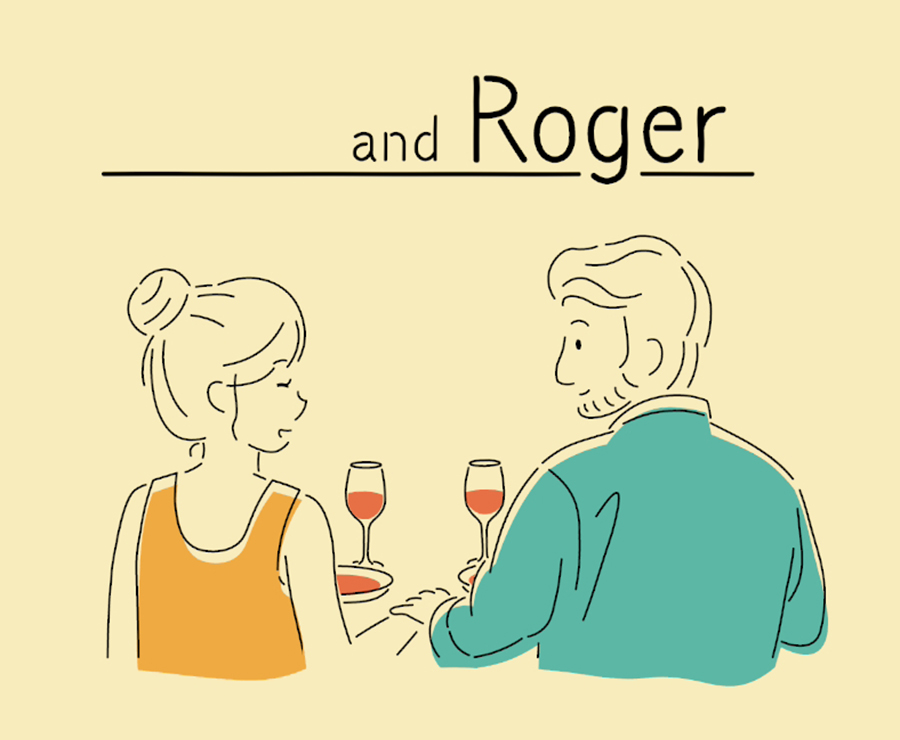
And Roger (on Steam here) is a high-interactivity visual novel that takes about an hour to finish. You play as Sofia, a woman suffering from Alzheimer’s who is being cared for at home by her husband Roger. Through simple (and occasionally not-so-simple) button-sliding minigames, the game models Sofia’s memory loss and cognitive impairment, as well as Roger’s kind and loving assistance.
Perhaps this might change in the near future, but we’re not yet at a point where the effects of Alzheimer’s can be reversed, and there’s really only one way that Sofia’s story can end. Appropriately enough for the narrative perspective, the game also features some tense and anxiety-inducing gameplay sequences. If you have a sense that this game isn’t for you, you should probably trust your gut instinct. Still, I’m happy that And Roger exists, and I’m grateful for the experience of playing it.

The first chapter of And Roger plays like a horror story. Sofia, who sees herself as a young girl, wakes up in a strange bed and finds herself trapped in an apartment by a man she doesn’t recognize. He doesn’t respond to her questions and instead attempts to convince her to take pills that he doesn’t bother to explain. As Sofia, the player must navigate a series of stealth sequences to leave the apartment without being noticed by the man, who is actually her husband Roger.
The second chapter is much warmer. Sofia’s memory has improved somewhat, and she can now remember herself as a younger woman. In Sofia’s memories, the game asks the player to trace the connections that form between her and her future husband Roger with interactive lines that run opposite to one another before finally running in parallel. In the present, Roger’s lines help to bridge the gaps between Sofia’s lines as they cook and eat together.
The third and final chapter is more bittersweet. Despite occasional moments of lucidity, Sofia still has trouble eating, brushing her teeth, and doing laundry, and the game’s brilliantly unintuitive interface communicates her confusion with painful accuracy. Roger reveals that he has moments of weakness as well, but he continues to guide Sofia through her daily life with love and kindness.
In the end, though, Roger is only human, as is the player. The simple touchscreen slider minigames necessary to progress the story become progressively more difficult, and you’re going to fail eventually.
Though I talk about its gameplay elements being “difficult,” And Roger is designed in such a way that you don’t need a walkthrough, just a certain degree of patience. Nevertheless, seemingly simple gameplay tasks like connecting pairs of dots and dragging puzzle pieces to their proper places can be surprisingly complicated given the limitations imposed. The gameplay and the story are so tightly bound together that these tasks never feel extraneous; rather, the gameplay conveys precisely what words would be unable to express. Even when And Roger’s story had me completely in its grip, a part of me still admired how well-designed this game is.

A somewhat discordant element, at least for me, is the characters’ Christianity. The game ends with a thematic epigraph from the Book of Corinthians, and Roger and Sofia frequently invite each other to pray. Given that And Roger is a Japanese indie game (albeit an indie game backed by a major publishing corporation), I suppose it makes sense for its creator, who goes by the pseudonym Yona, to express the centrality of his religious identity in the story he’s trying to tell.
At the same time, I didn’t really get a sense of what Sofia and Roger’s Christian faith means to them. I also have to admit that I found it upsetting that they’re so completely alone in their struggle. Where are the other members of their church? Where is their pastor? Why do none of their fellow Christians extend a helping hand? Since they’ve been (seemingly?) abandoned by their Christian community in their hour of greatest need, is their faith not tested?
As someone who doesn’t take Christian faith for granted, I found its inclusion in this game to be both shallow and uncomfortable. To be brutally honest, I understood Roger’s Protestant valorization of self-reliance and virtuous suffering to be profoundly toxic to himself, not to mention literally fatal to Sofia. I’m not sympathetically inclined toward religion to begin with, and I don’t personally think that And Roger casts a particularly flattering light on Protestant Christianity.
I also question the wisdom of the game’s marketing, which treats its premise as a spoiler. End-of-life care is a heavy topic, and I think it’s a bit unfair not to give potential players a sense of what they’re getting into, especially given the cuteness of the graphics. Also, though it’s ultimately proven to be incorrect, the game’s opening implication that Sofia is a victim of child trafficking is something that could have been treated with more sensitivity at a metatextual level.
As I wrote at the beginning, though, I’m grateful for what I learned during the experience of playing this game, especially concerning what Sofia’s husband Roger is going through. I feel like I never had a good real-life model for what elder care is supposed to look like, but And Roger gifted me with a glimpse into the sort of life experience that I wish I could have gotten with my grandparents.
Even for people with more life experience, it’s always good to have another perspective, especially in the form of a such a thoughtfully scripted narrative. Despite its difficult subject matter and its slightly awkward handling of religious faith, And Roger tells a very sweet and lovely story, and the gameplay mechanics do a lot of heavy lifting in telling this story with as much sympathy as possible.