Green Dreams: Tales of Botanical Fantasy

I’m excited to announce that I published a new zine! Green Dreams: Tales of Botanical Fantasy collects six illustrated stories about our relationships with plants and nature.

“Each turn of the seasons brings an end to lives both large and small, but new seeds sprout joyously from the ruins” is the zine’s tagline, and disaster is a major theme of the collection. One of the opening stories is about the gradual effects of climate change; and, in the closing story, environmental catastrophes have become so severe that humans have disappeared completely. The zine also features stories about a medical tragedy narrowly averted, the aftermath of a devastating war, and a porous biological quarantine.

I considered subtitling the zine “Tales of Botanical Dark Fantasy,” but the truth is that none of the stories are actually that “dark.” In fact, I’d say the main theme of the collection is a persistent hope for the future. At this particular moment in history, the state of the world seems very bleak, so it’s good to remember that the environment that surrounds us is much larger – but also much more personal – than whatever horrors are currently unfolding.

Precisely because are so many fires burning in the world, I think it’s important to spend time in thriving green spaces that suggest futures of shifting and changing growth. I believe that a mindful contemplation of our natural environment can also be useful in the uncomfortable but necessary process of decentering normative humanity while challenging the artificial divisions we impose on ourselves and each other.

The incredible cover art by Frankiesbugs captures the mood of these stories perfectly.

Frankie creates bold and imaginative botanical fantasy art, and I asked them to illustrate the pagan archetypes of the flower maiden and the horned god, who together represent the endless natural cycle of death and rebirth. In this zine, I wanted to play with symbols that convey the beauty and mystery of the natural world, and Frankie embraced this theme, tinging the painting with potent Christian motifs and a powerful sense of fertility.

It’s an extremely impressive piece of art, and you to check out more of the artist’s work on Instagram (here), on Bluesky (here), and on Redbubble (here).

In this collection, I did my best to share a sense of fertile “green dreams” for the future. Mostly, though, I just really wanted to write some fun ecofiction about plants and mushrooms.

If you’re interested, you can read a free digital version of the zine on Itch.io or order a print copy from Etsy.

🌿 https://digitalterrarium.itch.io/green-dreams
🌿 https://www.etsy.com/listing/4351990958/green-dreams-fantasy-fiction-zine
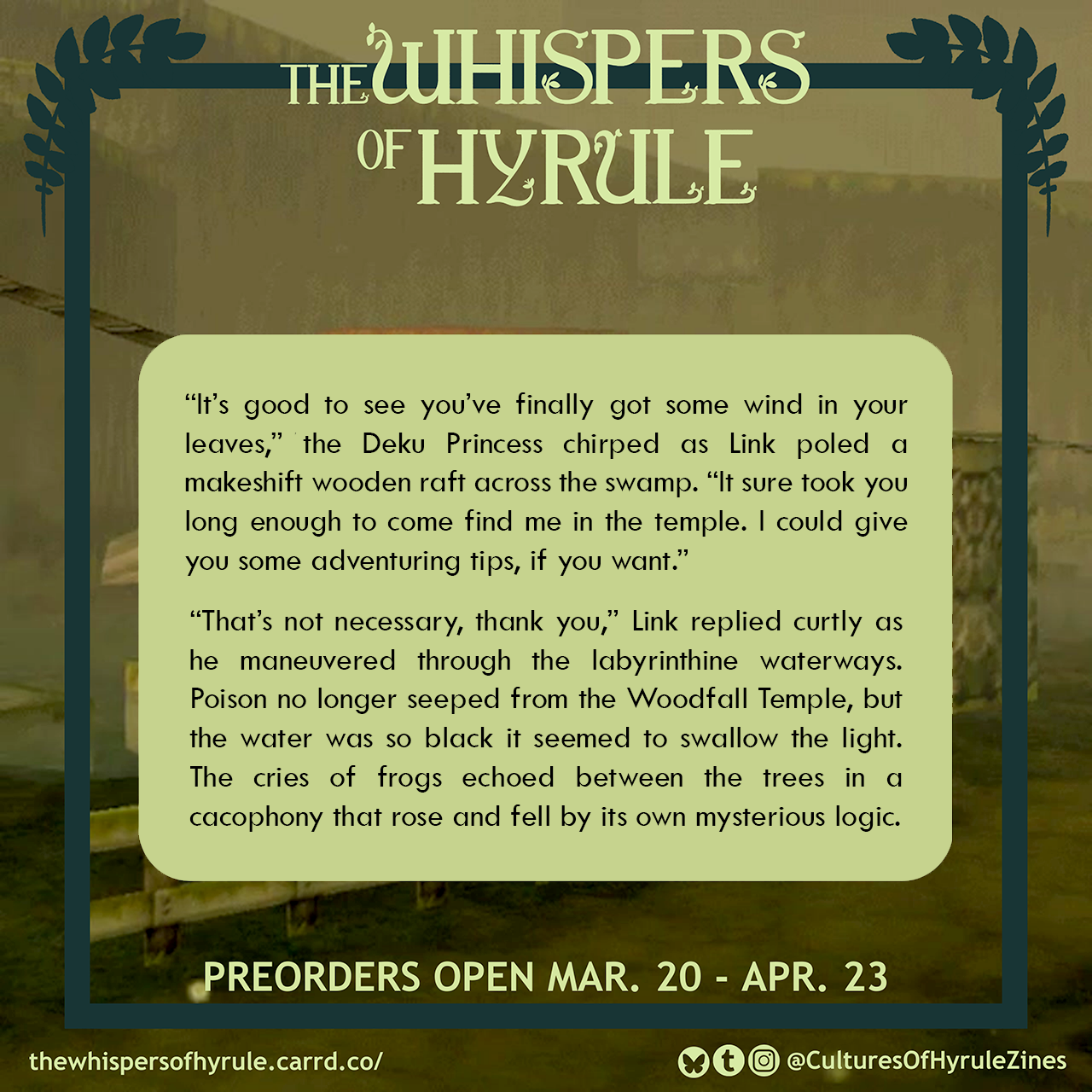
Legend of Zelda Forest Zine Preorders Open

I’m excited to share the news that preorders are now open for The Whispers of Hyrule, a Legend of Zelda fanzine celebrating Hyrule’s beautiful green spaces and the creatures that make their homes in the trees.

I contributed a short story about Majora’s Mask titled “The Brave Tale of the Heroic Swamp Princess.” My story follows Link and the Deku Princess as they venture through the swamp on their way home from the Woodfall Temple. I did my best to capture the exuberant spirit of the Deku Princess, who helps Link work through the trauma he experienced in Ocarina of Time, as well as the warm atmosphere created by the vibrant plant growth in the swamp.

It’s been a privilege to see the drafts shared by the writers, artists, and musicians who have joined me on this journey. From sunlit meadows to deep forest shadows, everyone has worked hard to convey the wonder and mystery of getting lost in the woods. I know I say this about every fanzine, but this book is going to be gorgeous.

Preorders for the zine are open until April 23, and three stretch goals have already been exceeded. If you’re interested, you can check out the project at the following links:

🌿 https://thewhispersofhyrule.bigcartel.com/
🌿 https://culturesofhyrulezines.tumblr.com/
🌿 https://thewhispersofhyrule.carrd.co/

Crow Country

Crow Country is a retro-styled 32-bit survival horror game that takes about four hours to play. What I love about Crow Country is its Story Mode, which removes all enemies and allows you to enjoy the game as an atmospheric adventure in an abandoned amusement park.

The year is 1990, and you (ostensibly) play as a police detective named Mara Forest. Mara is investigating the disappearance of Edward Crow, the owner of a small amusement park called Crow Country. Crow Country shut down and closed to the public two years ago after a girl named Elaine Marshall was severely injured in an accident.

Although Elaine’s family sued Edward Crow for the hospital fees, he never responded to court summons, and now the park sits boarded up and abandoned. Mara has reason to believe that Crow has holed up on the property, so she breaks in and begins searching for clues pertaining to his whereabouts.

Unfortunately for Mara, there are zombies about. Thankfully, she has a gun and a car trunk full of ammo. There’s also ample ammo scattered throughout the park, as well as various types of guns (and grenades) for Mara to pick up and experiment with. I’ve heard that the zombies aren’t particularly aggressive, and that shooting them isn’t particularly difficult, but I wouldn’t know. I didn’t bother with combat, and I have no regrets.

Even in Story Mode, Crow Country is a dense game with a lot to do. The map isn’t actually that big, but every “room” has multiple points of interaction. Most of this interaction provides atmosphere and flavor text, but Mara also needs to solve environmental puzzles in order to find the tools she needs to progress deeper into the park.

Mara can collect bits and pieces of brochures that she assembles into a map that proves to be extremely useful, as locked doors and unsolved puzzles are clearly marked. Although I did have to look up one or two solutions for optional challenge puzzles, I was never lost or confused about what I needed to do next. Unlike many puzzle-based adventure games, Crow Country is entirely possible to play without a guide.

In terms of its PlayStation-era retro graphics, Crow Country looks exactly like Final Fantasy VII. All of the character models are composed of charmingly blocky polygons, and the environments are pre-rendered and gradient shaded. Points of interaction are easy to distinguish, and you can rotate the camera a full 360 degrees. It’s a joy to move through this environment, especially once you begin to open Dark Souls style shortcuts.

Crow Country isn’t a cozy horror game; there’s no learning or friendship or beautiful autumn leaves. That being said, the horror elements are very mild, especially in Story Mode. Despite the atmospheric creepiness of its setting, Crow Country is less of a horror story about zombies and more of a speculative fiction story about how humans process the reality of climate change – or rather, how we will do anything to avoid processing this reality. The game’s conclusion is fantastic, as is the foreshadowing leading to its final reveals.

I wasn’t expecting Crow Country to be so fun to play, or for its environment to be so creatively designed, or for its story to hit so hard. I have zero patience for “intentionally inaccessible” retro game nonsense at this point in my life, but Crow Country wants to be experienced. Since it’s so short and accessible, I’d recommend the game to anyone who’s interested in the premise, even if you’re not typically a fan of survival horror.