In Praise of Moss Disability Zine

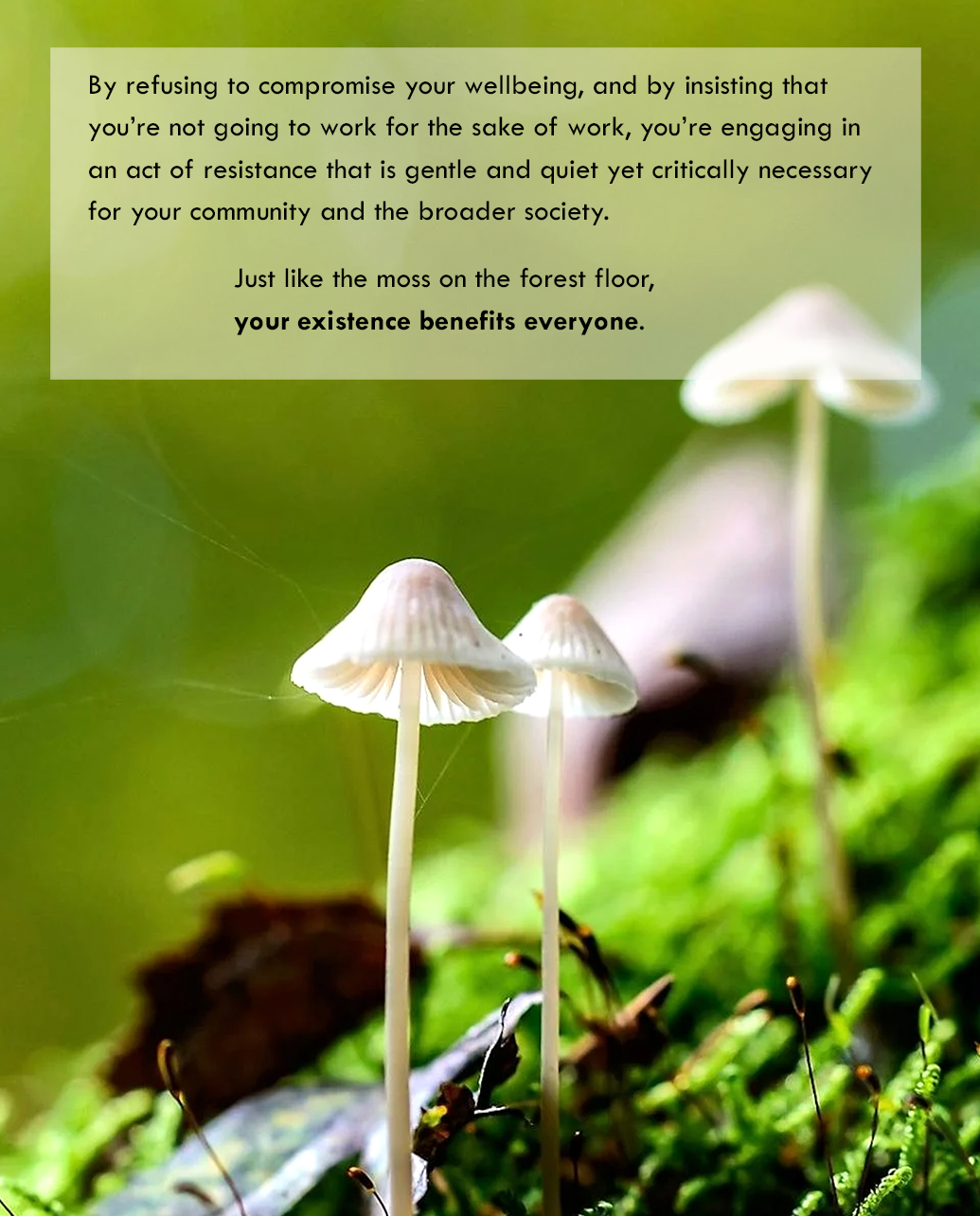
In Praise of Moss is a zine that argues against the myth of productivity while celebrating the value of a diversity of contributions to our culture and communities. Not everyone can be a tree, and that’s okay. Moss is an equally important part of an ecosystem.

I wrote this zine from a perspective that respects people of all abilities, but I think it’s important to acknowledge the more challenging aspects of disability. Disabled people are often expected to “pull their weight,” usually with the assumption that there’s only one way to measure success. In addition, people who live with invisible disabilities are often met with frustration and accusations of laziness when we’re unable to work or behave “normally.”

Moss is a useful metaphor for a recontextualization of what it means for disabled people to be useful to our communities and valued in our relationships. By exploring how moss can support an entire ecosystem, we can craft a model for how disability positivity can benefit society.

In addition, moss is remarkably adept at surviving disaster, which makes it an engaging analogy for resistance against the pressures of self-optimization exerted by neoliberal capitalism. While my focus is on disability, I believe that all readers can benefit from a shift in perspective that encourages us to grow naturally without worrying about productivity. 

When I write about “resisting productivity,” I’m speaking from the position of someone in academia who is directly affected by the myth that hard work will lead to prosperity. I hate the way this myth is weaponized against disabled people in the realm of higher education, and I want to destroy it. Very softly and quietly. Like moss.

While I love the lo-fi DIY aesthetic of many of the disability zines I’ve found on Etsy and in indie bookstores, it was important to me to create an attractively formatted physical object that feels good in my hands and accommodates my own disabilities by being easy to read. I want people who encounter this zine to feel that it’s valuable, and that they’re valuable too. I was fortunate to be able to work with Fireball Printing, a local Philadelphia service that creates gorgeous full-color publications.

If you’re interested, you can order a copy of the zine from Etsy, or you can download a free digital version on Itch.io.

🌿 https://digitalterrarium.itch.io/in-praise-of-moss
🌿 https://www.etsy.com/listing/1881401704/in-praise-of-moss-disability-zine
Summer Break

In December 2019, I printed a chapbook that contains my unofficial translation of Hiromi Kawakami’s “Summer Break” (Natsu yasumi), the second story in the author’s prizewinning 1998 collection Kamisama. This story has not been officially translated, so I created a translation of my own to use in my Japanese literature classes.

“Summer Break” is a Studio Ghibli style celebration of the magic of the natural world and a quiet meditation on coping with mental illness. The narrator spends a few weeks working at a pear orchard, where they unwittingly adopt a trio of small tree spirits. One of these creatures is humorously neurotic, and its anxiety for the future resonates with the worries of the narrator, who feels that the world is slipping away from them.

You can download a free PDF copy of the chapbook from Itch.io here:
🌿 https://digitalterrarium.itch.io/summer-break

The cover illustration was created by Koyamori, who goes by @maruti_bitamin on Instagram.

Article about Ender Lilies on Sidequest

I got to write my dream article for Sidequest about Ender Lilies, one of my favorite games! Here’s the opening paragraph:

In Binary Haze’s 2021 Soulslike Metroidvania Ender Lilies: Quietus of the Knights, a young girl named Lily navigates a hostile postapocalyptic world with the help of grotesquely mutated undead monsters. As the game progresses, Lily becomes increasingly reliant on her monstrous companions as she becomes more monstrous herself. Ender Lilies functions as an intriguing model of mutual aid, especially in relation to its gradual descent into fungal horror. As the world changes around us, Ender Lilies asks, is it really so horrific to develop radical new relationships with the environment?

You can read the full piece on Sidequest here:
https://sidequest.zone/2024/09/05/ender-lilies-fungal-horror/

A Man Outside

A Man Outside
https://litrouke.itch.io/a-man-outside

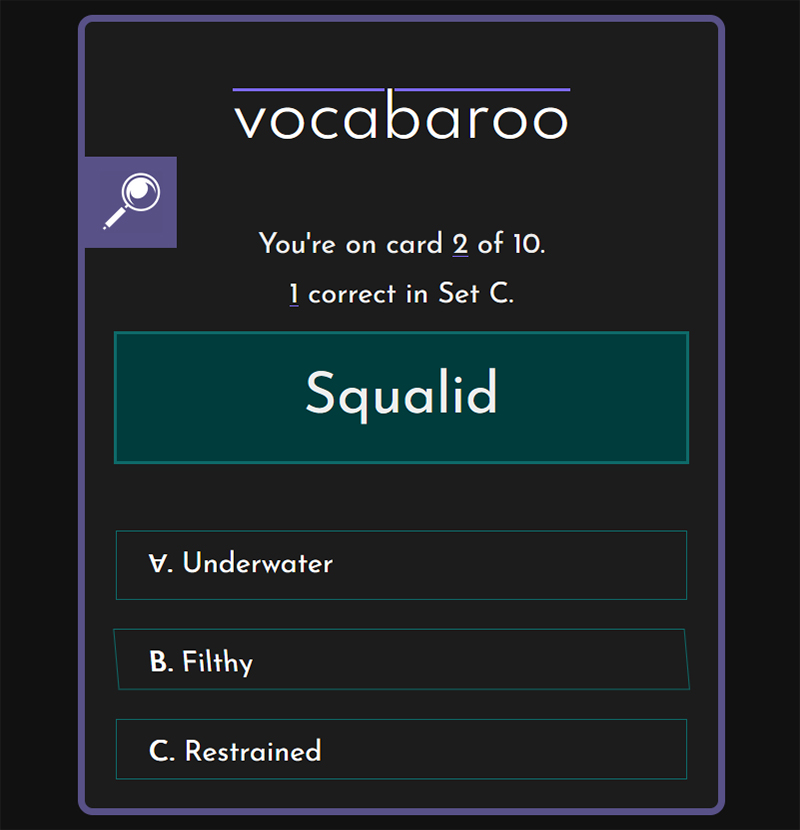
A Man Outside is a short vocabulary quiz game. This twist is that, while you play, a creepy shadow man watches you from outside your bedroom window. You’re tasked with doing three sets of ten vocab cards as spooky ambient sounds play in the background, and you can look out of the window at any time to see if the man has gotten closer. Between quiz sets, you can text a friend to update them on the situation.

I hope it doesn’t spoil this game to say that there are no jumpscares. The vocabulary gets progressively creepier, though, and there are fun distortions in the quiz interface. The vocab game itself is quite good, even without the added attraction of the creepy man. Necrophagy is my new favorite word.

Based on what I’ve seen in YouTube playthroughs, your vocab score doesn’t matter, and the choices you make in the text conversations simply add a bit of extra flavor. In order to get the true ending of the game, you have to play it from start to finish three times. There are three different vocab difficulty levels, so I suppose that adds a bit of replay value. Each run only takes about seven or eight minutes, but I don’t think the second or third ending is anything special. The alternate endings are nice bonuses for vocab flash card enthusiasts who want to try every difficulty level, but the first ending is perfect.

As an aside, as someone with ADHD, I often have to pretend that someone is watching me in order to get past executive dysfunction. I used to “have someone watch me” by going to coffee shops, but that only worked in Tokyo and Washington DC, which are beautiful and walkable and filled with cafés. Philadelphia has many charms, but it’s not that sort of city. Now, if I’m having trouble sending emails or whatever, I have to conjure an amorphous imaginary person who’s sitting in the room with me just out of eyesight like some sort of sleep paralysis demon.

So, for me, playing A Man Outside was kind of comforting. Cozy, even. Honestly, this might actually be a decent way to study vocab.

Fishy

Fishy
https://i-choose-paradise.itch.io/fishy

Fishy is a horror-themed “wholesome” visual novel that takes about twenty minutes to finish. You play as a sweet middle school girl who’s spending the night at an aquarium for a friend’s birthday party. The problem is that she’s deathly afraid of the ocean, and it doesn’t help that there’s mild friendship drama afoot. She gets separated from the group and wanders into a restricted area, where she encounters fish that aquarium guests are never meant to see.

The art of Fishy is fantastic and alternates between genuinely gorgeous and genuinely creepy. Putting the spooky fish aside, the environmental illustrations perfectly capture the magical atmosphere of what it might be like to spend the night in an aquarium. The character designs are lovely as well.

The writing is competent, but the game seems to be aimed at the same audience as its preteen characters. In its determination to be wholesome and teach the player a positive life lesson, the story hesitates to create a sense of tension, dread, or even character development.  

Fishy’s message is that having a prosthetic limb is cool, actually. And that’s great! Prosthetic limbs are in fact cool as hell. Still, the twenty minutes that most players will spend with the game isn’t quite enough time to tie all the various thematic threads together. There’s the player-character’s anxiety + her relationship with her friends + her fear of the ocean + the potentially haunted aquarium; and then, on top of that, there’s the positive message about disability positivity. It’s a lot!

The lack of any real darkness or specificity makes the experience of the player-character somewhat confusing, at least to my adult sensibilities. Like, what exactly is the source of the friendship drama? Why is the player-character afraid of the ocean? Is there something going on in her life that makes her prone to attacks of social anxiety? Why does she react to this situation in such an extreme way? Is she having a legitimate psychotic break?

I always appreciate stories that reach for big goals, of course, and the writing is quite compelling. If nothing else, the characters all seem like real people, and I was interested in learning more about them.  

Also, I have a bit of a crush on the girl in the friend group who knows all sorts of disturbing facts about the ocean and doesn’t mind bringing them up at (in)appropriate moments. I want a whole game about Weird Fish Girl and whatever her damage is. She’s wonderful, and I love her.

All in all, Fishy is a fun story with a few spooky scenes, and it feels like a good visual novel to share with younger children. The hand-drawn art is appealing, and the story goes to some interesting places in a relatively short amount of time. In any case, it’s free to play, so no complaints there. Even if you’re not into preteen friendship drama, it’s always good to spend quality time with the terrors of the deep.