In Praise of Moss Disability Zine

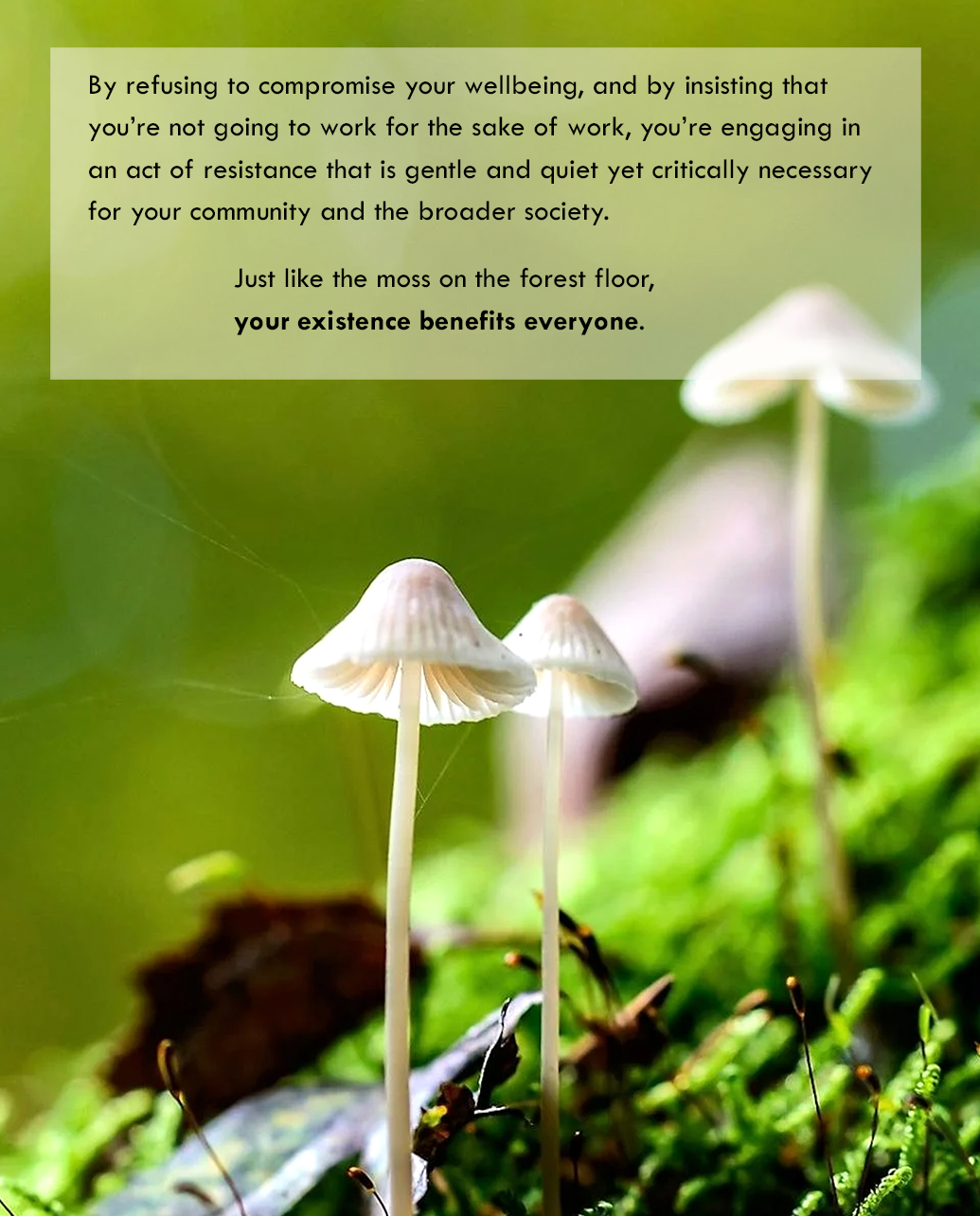
In Praise of Moss is a zine that argues against the myth of productivity while celebrating the value of a diversity of contributions to our culture and communities. Not everyone can be a tree, and that’s okay. Moss is an equally important part of an ecosystem.

I wrote this zine from a perspective that respects people of all abilities, but I think it’s important to acknowledge the more challenging aspects of disability. Disabled people are often expected to “pull their weight,” usually with the assumption that there’s only one way to measure success. In addition, people who live with invisible disabilities are often met with frustration and accusations of laziness when we’re unable to work or behave “normally.”

Moss is a useful metaphor for a recontextualization of what it means for disabled people to be useful to our communities and valued in our relationships. By exploring how moss can support an entire ecosystem, we can craft a model for how disability positivity can benefit society.

In addition, moss is remarkably adept at surviving disaster, which makes it an engaging analogy for resistance against the pressures of self-optimization exerted by neoliberal capitalism. While my focus is on disability, I believe that all readers can benefit from a shift in perspective that encourages us to grow naturally without worrying about productivity. 

When I write about “resisting productivity,” I’m speaking from the position of someone in academia who is directly affected by the myth that hard work will lead to prosperity. I hate the way this myth is weaponized against disabled people in the realm of higher education, and I want to destroy it. Very softly and quietly. Like moss.

While I love the lo-fi DIY aesthetic of many of the disability zines I’ve found on Etsy and in indie bookstores, it was important to me to create an attractively formatted physical object that feels good in my hands and accommodates my own disabilities by being easy to read. I want people who encounter this zine to feel that it’s valuable, and that they’re valuable too. I was fortunate to be able to work with Fireball Printing, a local Philadelphia service that creates gorgeous full-color publications.

If you’re interested, you can order a copy of the zine from Etsy, or you can download a free digital version on Itch.io.

🌿 https://digitalterrarium.itch.io/in-praise-of-moss
🌿 https://www.etsy.com/listing/1881401704/in-praise-of-moss-disability-zine
League of Enthusiastic Losers

League of Enthusiastic Losers is a chill and beautiful visual novel set in Moscow in the 1990s. You play as Vitya, a handyman, who is often accompanied by his friend and roommate Volodya, a copywriter who’s working on a novel. It’s not clear whether the two men are in a romantic relationship; but regardless, they’re close friends who love and support one another. Unfortunately, while all of their friends from high school are off being successful and moving up in the world during the boom economy, the two of them can barely pay rent.

As the player, your task is to follow Vitya and Volodya as they try to figure out how to pay their landlord a portion of the rent they owe. Both men are extremely sweet and gentle, and they keep getting sidetracked as they do things like adopting a stray dog and helping their landlord’s son fix his toy airplane. Their grand plan is to dig up a “buried treasure” in the local public park that ends up consisting of several small tokens of Soviet life. Thankfully there are no antagonists in this game, and everything turns out okay. The men’s landlord is just as much of a sweetheart as they are, and their friends are happy to help support them.

The player can control Vitya and Volodya’s movement through linear 2D spaces, make a few dialog choices, and enjoy a few simple flash games like “glue the wings on the toy airplane” and “use the metal detector in the park.” There’s no stress and no point of failure, just two soft but handsome men and their adorable dog navigating a beautiful city depicted in a colorful painterly art style.

There are two things I love about the character Volodya in particular. First, he walks with a pronounced limp. It’s never explained, and no one ever comments on it, but people slow down their own pace when they walk with him. I don’t think Volodya has a “disability,” necessarily, but the game does a good job of depicting that sort of human difference.

Second, everyone around Volodya understands and accepts the fact that it takes time to write a novel, and that it probably won’t be picked up by a publisher right away. In fact, the first press he submits the manuscript to rejects it. When I compare this to the writer plot in the game Coffee Talk, in which Freya takes five days to write a novel that’s immediately accepted by a publisher with no agent necessary, I appreciate this game’s honesty about the fact that no one is immaculately conceived as a literary genius.

Everything about League of Enthusiastic Losers is honest, and the honest truth about life is that sometimes everything really is going to be okay. More than anything, League of Enthusiastic Losers is a game about being in your late twenties and gradually finding your place in the world. None of the characters is “good” or “bad,” but all of them are human, and it’s a joy to follow them through their everyday lives.

League of Enthusiastic Losers takes about half an hour to play, and you can pet the dog anytime you want.