The Annotated Kitab al-Azif on The New Absurdist

I’m excited to announce that my short story “The Annotated Kitab al-Azif” is free to read on The New Absurdist here:

📖 https://newabsurdist.com/editors-picks/the-annotated-kitab-al-azif/

“The Annotated Kitab al-Azif” is a queer Lovecraftian romance about the slow decline of American academia and the supernatural perils of translation. In this story, a burnt-out Millennial podcaster flees the high rent of Boston and accepts a position as a departmental admin assistant in the suburban Miskatonic University, which is suffering from budget cuts and declining enrollments. During the lull of his first summer on the job, the podcaster meets a grad student working on the Gnostic religious traditions of the southern Mediterranean while attempting a translation of the Kitab al-Azif, more popularly known as the Necronomicon.

As you might imagine, this area of study has consequences for the grad student. The podcaster isn’t too concerned, however. He’s already seen all manner of awful things while doing research online, and why let something as trivial as ageless extradimensional horrors get in the way of a budding relationship?

Though I’ve never accidentally summoned an eldritch abomination, the setting of “The Annotated Kitab al-Azif” is partially based on my own experience as a grad student at the University of Pennsylvania. The “horror” part of this experience is the constant scramble for funding, the awkward negotiations with libraries for access to research material, and the unspoken expectation that you’ll work in decaying buildings that haven’t been maintained since the early twentieth century.

Meanwhile, the “romance” part is the opportunity to share space with people from all over the world. When you use the same office (and the same refrigerator and bathroom) with other people, pre-existing differences in culture, language, and nationality quickly become secondary to the warmth of the personal relationships that form between you. Universities aren’t cultural melting pots by any means, but they’re as good of a place as any to realize that cultural differences really don’t matter all that much in the face of genuine friendship.

Though I’ve largely set aside my ambitions to become a translator, one of the reasons I got into academia was to model the positive change I wanted to see in the broader field of literary studies, especially with regards to de-mystifying stories written by authors from “non-Western” countries. Even when it’s done respectfully, the academic tendency to treat these stories as “subaltern” and “marginalized” is frustrating. To begin with, nobody thinks of their own language and culture as “other”; but, more importantly, people are just people.   

The Necronomicon is an interesting base for an exploration of this theme. In my understanding of the lore of the Cthulhu mythos, the Necronomicon is essentially an expression of popular turn-of-the-century Spiritualism, which was in turn inspired by the various strands of medieval Gnostic thought that sprung up along the Silk Road.

Though this sort of spiritually inclusive worldview may have seemed “mystical” to people living in Christian-majority cultures in the late nineteenth century, it’s completely normal to someone coming from a Buddhist or a Hindu tradition. All things considered, the cyclical view of time and the multidimensional view of space suggested by the Necronomicon are completely normal for many people who weren’t raised as Christian, and it’s interesting to consider the real-world foundations of this infamous fictional text without the narrative trappings of Orientalism.

But also…… What if magic were genuinely real? What then?

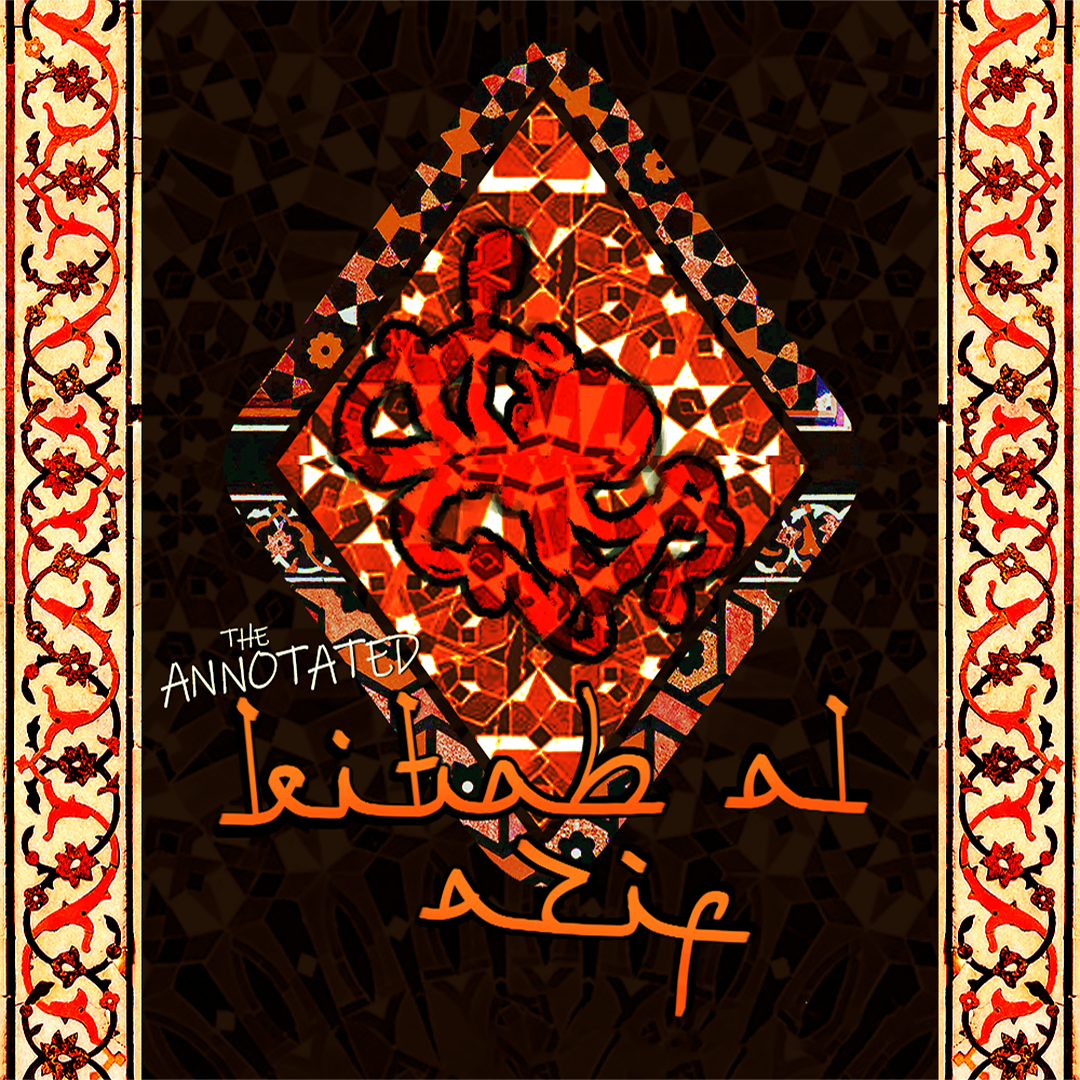
I’m grateful to The New Absurdist for taking a chance on this odd piece of weird fiction. I also want to express my appreciation to the story’s cover artists, Katie Rejto and Wally Tigerland, for creating such a unique and intriguing illustration.

If your curiosity is piqued by the prospect of true-to-life dark academia haunted by a touch of cosmic horror, please check out my story on The New Absurdist (here).
The Annotated Kitab al-Azif

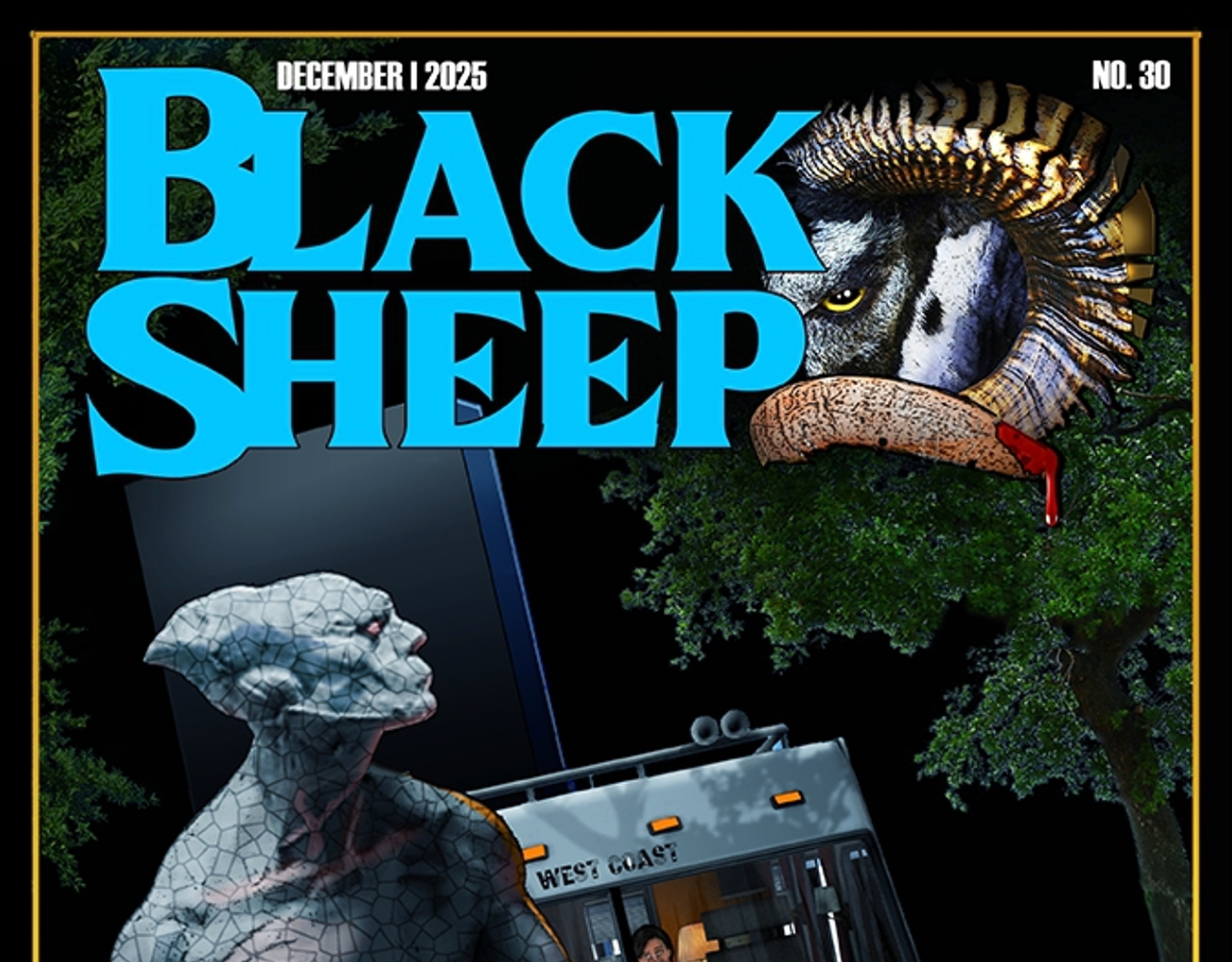
My queer Lovecraftian romance, “The Annotated Kitab al-Azif,” was just published in the latest issue of Black Sheep, a magazine for weird fiction. This story treats the gnostic origins of the Necronomicon with respect while being slightly silly about grad students.

You can order a copy of the issue with my story here:

🐙📖 www.amazon.com/dp/B0G25R82TY

It’s very cool to have the opportunity to publish a Lovecraft pastiche in an honest-to-god pulp magazine, which seems appropriate. At the same time, I definitely feel the friction of using Lovecraft’s own tropes to push back against the ugly Orientalism surrounding the Necronomicon.

The truth is that, while I admire Lovecraft, but I wouldn’t consider myself a fan. Rather, I spent a formative part of my childhood in a small town in the Deep South whose public library was severely limited by budget constraints. The only thing remotely close to fantasy fiction they had on their shelves was Stephen King, the lone second volume of Lord of the Rings, and a handful of ancient paperback collections of H.P. Lovecraft.

I didn’t really have the cultural context to understand Stephen King, and I wouldn’t recommend The Two Towers as the place to start reading Tolkien. Lovecraft grabbed me, though. Even as a kid, I understood the xenophobia expressed in Lovecraft’s stories. Believe me, I understood all too well. Still, I guess I was young enough that this wasn’t a dealbreaker, especially since there was nothing else to read during the summer where I practically lived at this tiny little library.

I had more resources the following year, when I started attending an international school in Atlanta and began to read more widely. But Lovecraft stuck with me, and a small but significant goal of my writing now is to try to capture and explain why that is.

I sincerely believe that people should write whatever they want, but a part of me still questions the value of aligning myself with the work of such a problematic author. The truth remains, though, that these Lovecraft stories only occupy a small closet in the house I’m trying to build with my writing. What I want to do is expand the scope of the small rural library that only had room for Stephen King and H.P. Lovecraft, as well as to create space for original work that dismantles the toxic feedback loop of preset responses to human difference.

Much love to Black Sheep magazine for giving a home to this story. 

Essay about Elden Ring and Dark Academia

I’m excited to share an essay I wrote for Bloodletter Magazine, a stylish biannual anthology of queer and feminist horror. The piece is titled “Dark Academia for Dark Times: Elden Ring and the Fall of the Academy,” and I’m writing about how the haunted lore of the game’s cursed university reflects real-world academic anxieties. 

You can read the essay here:
https://bloodlettermag.com/dark-academia-for-dark-times-elden-ring-and-the-fall-of-the-academy/

While I use the character Rennala from Elden Ring as an illuminating point of focus, my piece is really about the uncanny connections between the crisis currently facing universities and the social media aesthetic of “dark academia” embraced by young women. I’m arguing that the association of dark academia with the corruption of female bodies reflects deeper concerns regarding the ties between academic liberalism and the decay of imperial privilege. 

Basically: Is the wokeness of postcolonial queer feminism ruining college? I would like to believe that it is, and I think this is kind of neat, actually.

My piece is graced with a creepy spot illustration by the magical Katy Horan, who goes by @goodyhoran on Instagram, and you can follow Bloodletter at @bloodlettermag, where they post eye-catching film stills from indie horror movies created by emerging female directors. 

The Kumo Diary

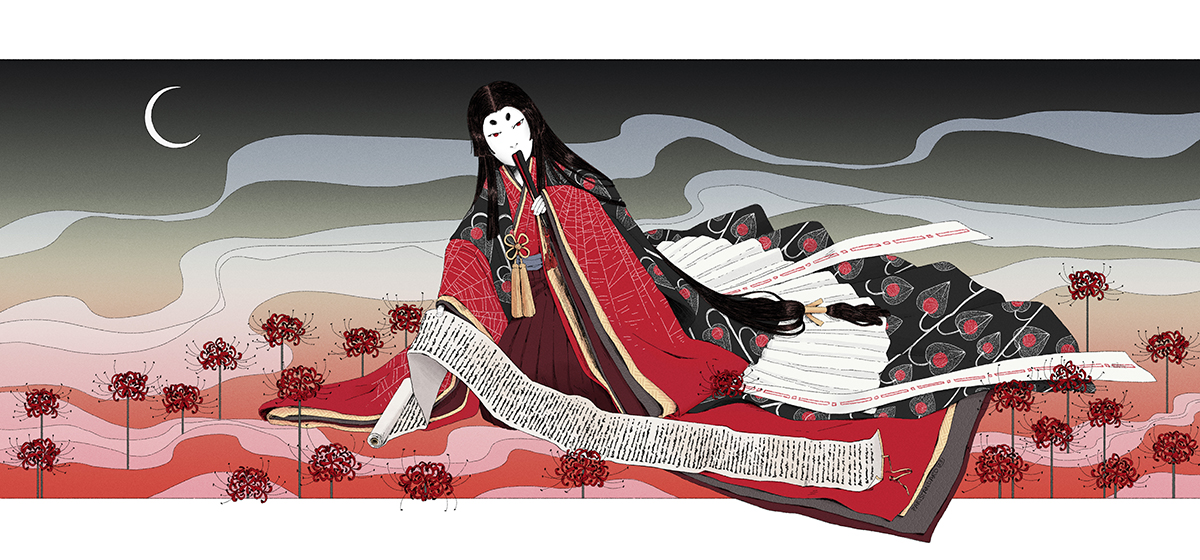
A professor’s assistant at Tokyo Imperial University uncovers a curious manuscript whose author weaves an elegant tale of the twilight years of the Heian court. As she reads between the gossamer lines of the narrator’s account of a moonlit assignation, the quiet and unassuming scholar reflects on what happens in the shadows cast by civilization and enlightenment.

This story is a play on The Tale of Genji that I contributed to Carpe Noctem: Vampires Through the Ages, an anthology of historical fantasy fiction, illustrations, and comics about vampires in historically specific settings.

I wouldn’t say I’m a “fan” of The Tale of Genji in the same way that I’m a fan of the Legend of Zelda series, but I’ve read multiple translations of the book and enjoyed them all. When you engage with a story so deeply, it’s difficult not to come up with fun theories. I certainly wouldn’t be the first person in Japanese literary history to make this suggestion, but please consider: Why are the characters in The Tale of Genji always described as being so pale, and why are many of them only active between dusk and dawn?

“The Kumo Diary” is set in the Meiji period (1868-1912), Japan’s industrial era of “civilization and enlightenment.” As Japan attempted to establish itself as a nation that could compete with Western powers, its intelligentsia were motivated to create a unified “Japanese culture.” The Tale of Genji occupied an interesting place in this movement. On one hand, it could easily be regarded as the quintessential work of classical Japanese literature. On the other hand, its plot is largely concerned with the love affairs of a rotating cast of beautiful but neurotic women. Japanese scholars were therefore tasked with making The Tale of Genji a respectable classic to be held in esteem by a modern nation.

Scholars had been compiling and revising the chapters of The Tale of Genji for centuries, so it was necessary to create a “definitive” version of the text. While I was studying the history of The Tale of Genji, I couldn’t help but wonder about all the apocryphal chapters that never made it into the canonical text.

It took me ten years, but finally I wrote one of these apocryphal chapters myself. I embedded the so-called “Kumo Diary” into a frame story about a woman who finds the manuscript and decides not to share it with the stodgy male professor who employs her. It’s interesting to imagine there being a secret history of The Tale of Genji, and I really enjoyed writing the ending of my story. After all, who’s to say there aren’t demonic women pulling the strings from the shadows? If they do their work correctly, we’d never know they were there at all.

I’ve posted the story on AO3, and you can read it here:
https://archiveofourown.org/works/50802628

The illustration is by the darkly brilliant Paristandard, whose creepy and creative illustrations can be found (on Twitter), (on Tumblr), and (on Instagram). It was an amazing experience to work with them, and I can’t recommend them enough for character designs, book covers, short comics, and other illustration projects. For this project in particular, the historical specificity of their costume design was uncanny, and I am in awe.