Dark Souls Fandom Essay on Sidequest

“The Softer Side of Dark Souls Fandom,” my essay about a major shift in internet culture, was published on Sidequest. Everybody loves Bloodborne and Elden Ring now; but, ten years ago, FromSoft fans were a fairly isolated group, not to mention some of the most hateful people I’d ever encountered online. At about 1,400 words, this piece is far shorter than it should be, but I still had a fun time writing about how FromSoft fandom has become much more welcoming and inclusive over the past decade. Here’s an excerpt:

I’ve put untold hundreds of hours into Dark Souls and its sequels. When the game first came out almost fifteen years ago, however, there was nothing I hated more than Dark Souls. I refused to play it. I associated the game with the worst people on the internet, who spewed hate while using Dark Souls memes to shame and attack anyone they felt challenged the hegemony of their male-dominated subculture of video game fandom.

I therefore feel an ironic pleasure in the fact that, these days, Dark Souls and the other FromSoft games have been embraced by women and the queer community, the exact people these angry online gaming communities loved to hate. In a strange twist of fate, the games weaponized to mock diversity have become a sanctuary for many of the people who were once excluded.

You can read the full essay here:
https://sidequest.zone/2025/07/14/dark-souls-fandom/

An earlier version of this essay was published in Act Your Age, Vol. 2: Dark, a fandom memoir anthology zine that you can check out (here).

I decided to publish this piece online when the host of one of my favorite video game podcasts, Bonfireside Chat, came out as transgender. Since she’s not really a public figure, I don’t mention her in the essay itself, but her announcement made me incredibly happy. Regardless of gender and sexuality, I hope everyone can find a place where they feel accepted and supported in their interests… even if their interest is in dark fantasy games about dying in all sorts of grisly and horrifying ways!

Best Horror Comics on How to Love Comics

I had the immense honor of being able to contribute to a list of “The 45 Best Horror Comics You Should Read” on the website How To Love Comics. Here’s how I pitched the eight titles I recommended…

Betwixt: A Manga Horror Anthology, edited by Fawn Lau and Mayuko Hirao
A diverse collection of big-name creators showcasing manga-style stories that focus on urban legends and folk horror.

Bloodborne: The Healing Thirst, by Ales Kot and Piotr Kowalski
A stand-alone story that captures the oppressive gothic atmosphere of Bloodborne while being accessible to readers with no knowledge of the game.

The Crossroads at Midnight, by Abby Howard
A single-artist collection of queer short stories with distinctive monochromatic art and intensely disturbing imagery. 

The Hills of Estrella Roja, by Ashley Robin Franklin
A lushly illustrated graphic novel about a college student on the hunt for cryptids in the beautiful but eerie Texas desert.

Loving, Ohio, by Matthew Erman and Sam Beck
A suburban gothic horror story about a small town quietly controlled by an all-too-realistic cult. 

Not Drunk Enough, by Tess Stone
A colorful and stylish horror comedy about being trapped in a mad science corporation after dark.

PTSD Radio, by Masaaki Nakayama
A quiet but intensely creepy collection of Japanese urban legends loosely connected by an overarching narrative.

The Shadow over Innsmouth, by Gou Tanabe
A painstakingly faithful Lovecraft adaptation with meticulously drafted art and a well-researched translation. 

You can check out the fully annotated list (here). There are a lot of famous heavy hitters on this list, and it was a pleasure to be able to include a few lesser-known manga and indie graphic novels.

An Unfound Door, Chapter 11

The errant knight Caelif rides to Faloren Castle from the south. Through Caelif’s eyes, the reader sees the castle city, which was once grand but has fallen into decline. Caelif enters the castle and is greeted by Agnes’s cousin Galien, with whom he shares a professional and romantic partnership.

After they indulge in an intimate moment, Caelif reflects on his first acquaintance with Galien in Cretia. He tells Galien that he believes Fhiad to be the demon that Agnes was sacrificed to resurrect, and Galien reveals that he suspected as much. Galien assures Caelif that Fhiad is no danger to Agnes, and he confesses that he’s far more concerned with who may have abducted her in the first place.

.

At the beginning of An Unfound Door, Agnes leads a demon through the woods. To stave off exhaustion, she’s started talking to the demon, complaining that she’s not cut out to be a princess. Agnes argues that her cousin Galien, who is a duke in his own right, would be perfect in her position. He’s a born politician, and he would make a good king.

Agnes has previously shared several conversations with Galien, but this is the first chapter in which he takes the spotlight. He does so through the viewpoint perspective of his partner Caelif, the knight who rescued Agnes immediately before the novel opens.

Caelif serves as Galien’s messenger and fixer, as he’s willing and able to travel freely. A bit later in the story, Agnes explains to Fhiad that Caelif works for her as well, as she’s been asking him to sell the heirlooms of the royal family outside the kingdom, a last-resort fundraising strategy facilitated by Galien.

In another story, Galien would be the villain, but he and Agnes get along well and care for each other a great deal. Agnes had intended to renounce her royal status so Galien would be next in line for the throne, but her plans were complicated by her father’s ill health and her own abduction.

All of the chapters so far have been focused on Agnes and Fhiad, and this is where the story introduces a broader perspective. What I’d like to achieve with Caelif’s chapters (of which this is the first) is to give the reader a sense of the story being set on the edge of a much larger world.

Also, some of the oddness at the beginning of the novel is hopefully starting to make more practical sense. What I’d like to do with the narrative progression of this story is to take the broad archetypes of the initial scenario – a princess walking through the woods with a demon boar, who turns out to be a cursed prince – and gradually add more layers until the reader finally understands exactly how and why these characters arrived in that situation. In other words, the story is something like a mystery that the reader solves along with the characters.

If you’re curious, Caelif’s name comes from Caelifera, the scientific name for the suborder of insects that includes grasshoppers. Meanwhile, the concept art I used for this chapter’s graphic is from Bloodborne. I love how the city of Yharnam feels magnificently grand yet oppressively empty, and I aim to convey the same atmosphere of ruined grandeur in An Unfound Door.

Bloodborne Background Lore

While waiting for the Elden Ring DLC to be released, I decided to try my hand at Bloodborne, a gorgeous and atmospheric gothic action adventure game that somehow manages to withhold even more of its story from the player than Elden Ring. I haven’t seen a concise and accurate summary of Bloodborne’s background lore, so I thought I’d take a shot at creating one.

Before anything, it’s important to establish that Bloodborne is loosely based on H.P. Lovecraft’s Cthulhu mythos, whose premise is as follows:

The earth is billions of years old, and it has supported multiple civilizations that rose and fell without leaving any trace of themselves behind. One of these civilizations was that of the Great Ones, whose fungal bodies allowed them to benefit from long lives and peaceful societies. The Great Ones developed technology that assisted them in communicating across time and thereby making contact with other civilizations on the planet, including humans. Because the Great Ones are so physically and mentally inhuman, however, these connections are flawed. Sometimes human communication with Great Ones invokes fear, and sometimes it invokes madness that results in aberrant behavior. 

In order to facilitate more productive communication, the Great Ones created dream spaces that exist alongside the waking world as separate dimensions. In Homestuck terms, these dimensions are “dream bubbles” that function as self-contained terrariums. In other words, a dream bubble preserves a certain place at a specific moment for the educational benefit of whoever accesses it, kind of like an interactive movie. Time doesn’t flow inside the dream; it repeats. This means that you can trap someone in a dream and use it as a type of prison. In the most famous example, this is what the Great Ones did with Cthulhu, a priest of malevolent cosmic elder gods that would destroy organic life on earth if the planet came to their attention.

Using this mythos as an inspiration, the world of Bloodborne has been shaped by three broad categories of Great Ones.

The first is a group of Great Ones who have tried to communicate with humans. Humans have taken blood from the immortal physical bodies of these creatures. In small doses, the administration of this blood cures illness and prolongs life. In larger doses, the blood induces physical transformation. A coalition of surgeon-scholars called “the Healing Church” has established itself as a religious organization in the city of Yharnam so that they may perform “blood ministration” on the populace, whom they’re using as test subjects in their experiments to bring humans physically and mentally closer to the Great Ones.

The second group of Great Ones eschews this sort of direct contact and communion between Great Ones and humans. Their motives have little to do with the welfare of human beings, but they’ve nevertheless acted in opposition to whatever is going on in Yharnam. One of these Great Ones, called “the Moon Presence,” has created a dream bubble for the ostensible purpose of training hunters to kill the humans maddened and transformed by blood ministration. This is the “Hunter’s Dream” that serves as the central hub of Bloodborne.

The third faction is a loosely federated group of spiderlike Great Ones called Amygdala, who have created their own set of dream bubbles. Some of these dream bubbles are maintained in cooperation with humans seeking eternal life in a timeless space, while some were created seemingly for the purpose of feeding from the human souls trapped inside them. I believe the version of Yharnam that the player-character navigates exists within a dream bubble created by Amygdala. 

Essentially, the world of Bloodborne is a dream inside a connected network of dreams that can be accessed by the player-character as they dream. While the Hunter’s Dream exists as a sanctuary for would-be hunters, the dream that contains Yharnam is something like a training simulation. Your character can only wake from these interconnected dreams (meaning: finish the game) by completing the task they are given as they fall asleep during Bloodborne’s opening cutscene: “Seek Paleblood to transcend the hunt.”

It’s not entirely clear what “Paleblood” refers to, but the game offers two primary interpretations.

The first interpretation is that Paleblood is the blood of the Great Ones that caused the scourge of beasts in Yharnam. Once the player-character understands the full extent of the effects of Paleblood on human physiology and society by witnessing the downfall of Yharnam, they are qualified to become a hunter in the waking world. At the end of Bloodborne, the player-character’s mentor Gherman offers a choice. He can release them from the Hunter’s Dream, or they can best him in combat in order to earn the (highly dubious) honor of replacing him as its warden.

The second interpretation is that the term “Paleblood” refers to the human-adjacent children of the Great Ones, who cannot produce offspring on their own and must rely on human hosts. The conditions for the creation of Paleblood children are unclear, and various factions of the Healing Church have undertaken ghastly experiments on the population of Yharnam in order to pursue this knowledge.

If the player locates and consumes three umbilical cords from unsuccessful Paleblood pregnancies, it’s possible for them to be reborn as a Paleblood squid baby (and future Great One) within the Hunter’s Dream. According to the interpretation suggested by this ending, the Hunter’s Dream was created by the Moon Presence in order to select and nurture potential candidates capable of becoming its child.

The game’s title, Bloodborne, therefore refers to the player-character’s ultimate goal. Either they will be reborn as a fully-fledged Hunter after awakening from the bloody chaos of the Hunter’s Dream, or they will be reborn as a Great One after inheriting the Paleblood of their “parent,” the Moon Presence. 

The story of Bloodborne (such as it is) focuses on the player-character’s journey through the city of Yharnam and its outlying areas as they fight the humans who have been transformed into monsters by the blood of Great Ones. The game’s DLC, called “The Old Hunters,” provides additional background information concerning the origins and establishment of the Healing Church through dream encounters with the key figures in its history.

For an excellent synopsis of the story presented by the DLC, I recommend this article: https://www.eurogamer.net/bloodborne-whats-going-on-in-the-old-hunters

For a deeper dive into Bloodborne‘s story presented in well-organized chapters that arrange the aspects of the plot in chronological order, I’d recommend checking out this fan-created wiki, which can be read like a novel: http://soulslore.wikidot.com/bb-plot

Review of A Guest in the House on WWAC

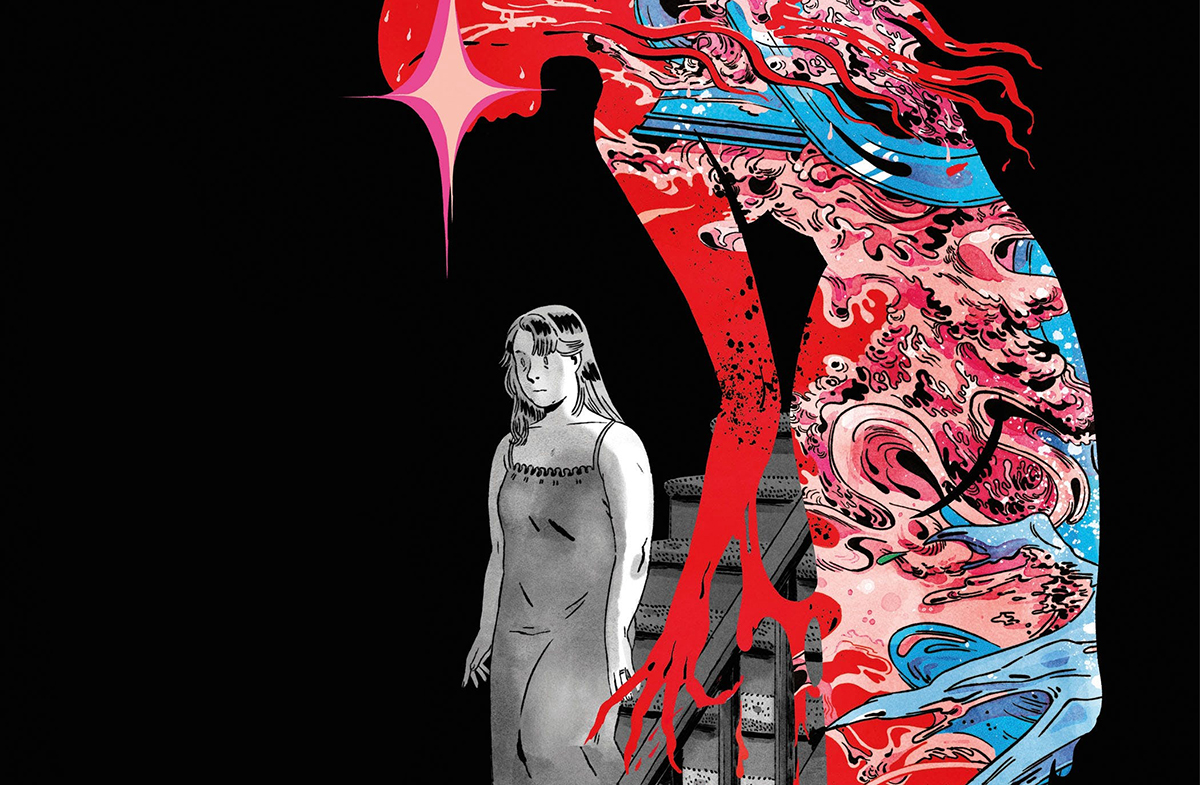
I had the pleasure of writing a review of Emily Carroll’s darkly brilliant graphic novel, A Guest in the House, for Women Write About Comics. The story gazes into the moonlit shadows of “traditional” families, and it’s gothic horror at its sexiest and most subversive. Here’s an excerpt from my review:

Carroll’s visual representation of Abby’s inner world is brilliantly strange and gorgeously queer. In her more introspective moments, Abby indulges in a fantasy of herself as a heroic knight fighting dragons, who lay waiting for her, hot and wet in their dark caves. Having slain a dragon while remaining protected and genderless inside her full-body armor, Abby seeks comfort in the arms of the beautiful ladies that await her arrival. While the majority of the artwork in A Guest in the House is painted in black ink with gradations of gray, Abby’s fantasies practically scream from the page in lurid full color that slowly begins to bleed into Abby’s waking life.

You can read the full review here:
https://womenwriteaboutcomics.com/2023/10/a-guest-in-the-house-review/

If you’re interested, I also recommend checking out Emily Carroll’s website (here) for a curated selection of horror art and short comics. It’s not for the faint of heart, but it’s one of the best sites on the internet.

While I was writing this review, I told a friend that A Guest in the House is like Dark Souls, but if Dark Souls were about a housewife in rural Canada in the 1990s. I stand by this evaluation, and I think it makes sense given the artist’s love of FromSoft games. Carroll recently released a short fancomic about Bloodborne, and you can download it for free from Itchio (here). As with A Guest in the House, I might offer a content warning for body horror and violence, but the art and writing are gorgeous.

Momodora: Reverie Under The Moonlight

Momodora: Reverie Under The Moonlight is a 2D fantasy Metroidvania with adorable 16-bit pixel graphics and an emphasis on cute magical girls. It has an Easy Mode that’s genuinely chill, and it took me about seven hours to get 100% completion. Momodora features a lot of nods to the Dark Souls games in general and Bloodborne in particular, but I think a more accurate comparison (at least on Easy Mode) is the mellow Nintendo DS adventure-platformer Super Princess Peach.

I came to Momodora not knowing what to expect, and I was pleasantly surprised to find that it’s absolutely delightful. The game is relatively simple, but that’s okay, because it’s very good at what it does.

You play as Kaho, a cute girl wearing a white mage hood over a black miniskirt dress and thigh-high stockings. I get the feeling that her theme is supposed to be “sexy Shintō shrine maiden,” and she uses a giant red maple leaf as a sword. She also has a bow with unlimited arrows whose attack can be charged, an adorable dodge roll, and the ability to double-jump right out of the box. Her animations are lovely, and she’s a lot of fun.

Kaho is a silent protagonist, but what you pick up from other characters is that she’s come from abroad to talk to the Queen of Karst about a curse that has spread from the castle city into her small village. You begin the game on the border of a beautiful and vibrant 16-bit pixel forest before entering Karst, which is what the gothic Victorian city of Yharnam (from Bloodborne) would look like if it were rendered in Chrono Trigger style graphics. Whatever curse is threatening Kaho’s village has subsumed Karst in full force, and Kaho has to fight all manner of cute imps, cute witches, cute sorceresses, and cute devils, all of whom have colorful and interesting anime designs.  

Before you can go into Karst Castle proper, you need to find four seals that unlock its gate. This quest sends you into a maze of interconnected areas that include a flooded graveyard, an overgrown garden, a giant crematorium, and the rafters of a ruined cathedral. All of these areas are beautifully rendered and a joy to explore, and along the way Kaho meets a handful of cute NPCs and picks up a limited arsenal of items whose flavor text provides a hint of worldbuilding in classic Dark Souls fashion. Kaho gains a few more abilities – one in particular is a true blessing and a miracle on this earth, but I won’t spoil it – but Momodora sticks to its core gameplay and never gets too complicated.

In addition, you can find and collect 17 health upgrades, as well as 20 silver bugs to trade to a garden rabbit for prizes. About half of these collectables require minor exploration and backtracking, and the other half are hidden in ridiculous ways that I don’t think most players would be able to find without a walkthrough. Thankfully, if you’re playing on Easy Mode, it’s totally fine not to worry about the collectables you don’t find naturally.

You also pick up currency from defeated enemies that you can use to buy relics (which are essentially magic spells) from various merchants, but none of these items are necessary. Since Kaho doesn’t otherwise gain levels or become more powerful, I can imagine that some of the boss fights might be challenging and require a bit of an extra advantage, but this isn’t an issue in Easy Mode, in which Kaho begins the game with two powerful relics that will carry the player through the entire game.

In conclusion, Momodora is a chill and beautiful Metroidvania style action-exploration game that’s like Bloodborne for people who want to enjoy the gothic story and atmosphere without having to spend dozens of hours slamming their head against a wall to git gud. Also, since almost every character and enemy is a super cute magical girl or sexy adult witch-demon, I guess you could say that Momodora is like Bloodborne for lesbians.

I mean, Bloodborne itself is very much “Bloodborne for lesbians,” but you get what I’m saying.