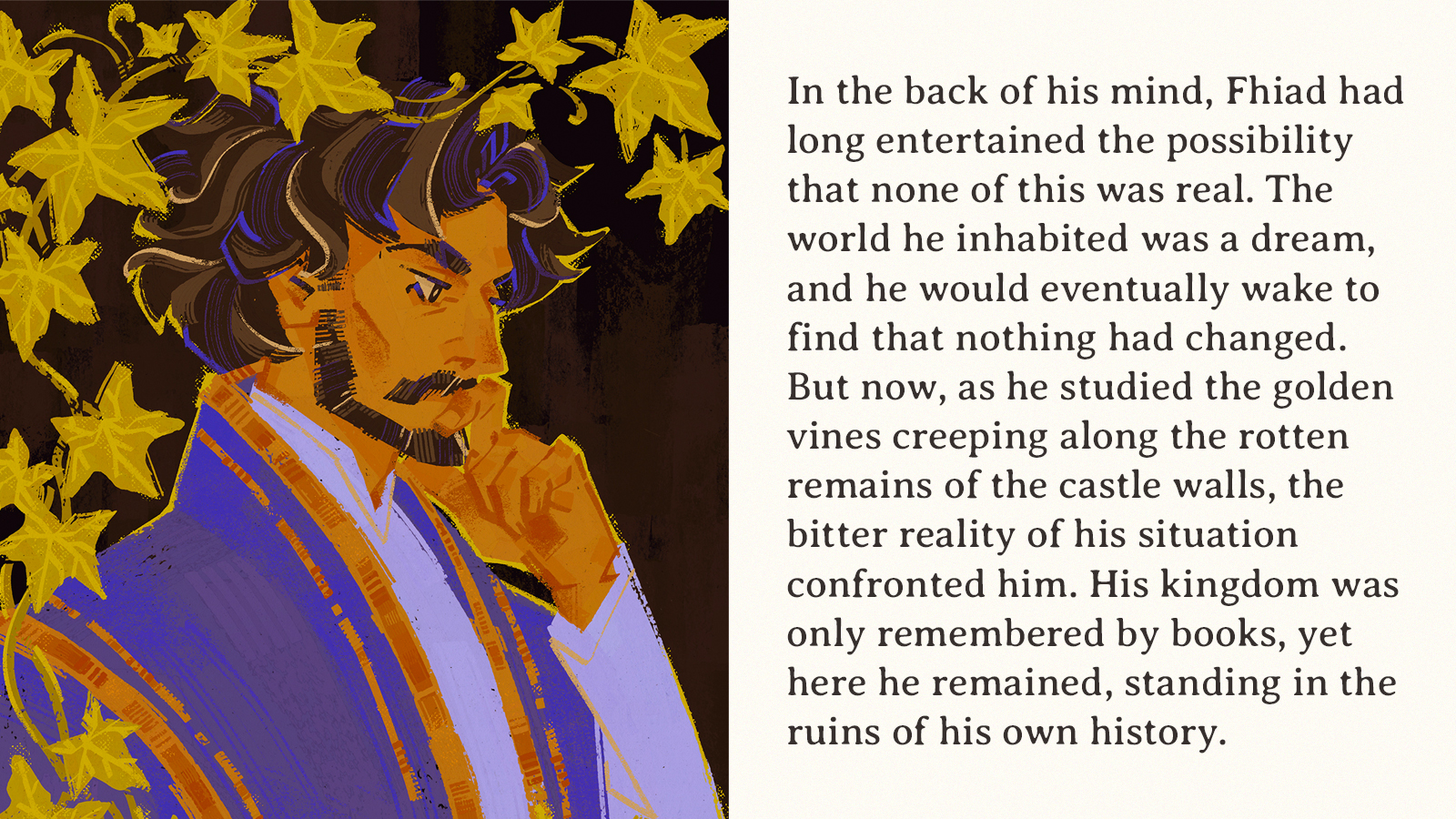
Fhiad reflects on the uncanny emptiness of Erdbhein Castle as he leads Agnes to the queen’s ruined chambers. While describing Erdbhein before the war, Fhiad tells Agnes about his three sisters, all of whom were highly competent administrators. Fhiad confesses that he dreamed of becoming a mage so he could return to Erdbhein to build monumental stone structures aboveground to rival the stonework in the long-abandoned city underneath the castle.
.
This chapter is about Fhiad processing his grief. It would be the perfect opportunity for an exposition dump, but Fhiad isn’t in a good mental state to deliver a lecture at the moment. Like Agnes, he feels like a failure, and he misses his family.
While Fhiad talks about the past, I hope the reader gets a sense of this character belonging to a much larger story. Unfortunately, Fhiad is never going to be able to live that story, and the reader isn’t going to hear much more about it, either. Fhiad mentions spending time in an ancient city in the mountains below Erdbhein, and tells Agnes that he went to university to study architecture because he always dreamed of building something equally grand aboveground.
That’s an intriguing detail, I hope. It adds another layer of foreshadowing regarding Agnes and Fhiad’s final destination, but the reader is never going to encounter another reference to Erdbhein’s history and culture. That’s what it means for an entire group of people to be destroyed; all of their art and memories and folklore are destroyed along with them.
Agnes is deeply disturbed by this loss, as she should be. Meanwhile, Fhiad’s anger regarding the destruction of Erdbhein has drained away, alongside his sense of agency. At the beginning of the story, he was furious and hostile and scary, but he’s become calmer and more introspective as the reality of his situation becomes clear.
Fhiad’s monologue in this chapter mirrors Agnes’s monologue at the beginning of the novel about how she’s the exact wrong person to handle a difficult situation. Agnes was doing something stupid (bringing a demon back to Faloren) because she felt that she had no power to halt her kingdom’s decline on her own. Fhiad was likewise attempting to do something stupid (stealing a relic that could turn back time) because he saw no other way to address what happened in the past. Fhiad knows that his mother or any one of his sisters could have been effective in restoring his kingdom, but he feels that he himself doesn’t have the power to do anything. And honestly, he’s right.
I think that’s a hard lesson to learn, that sometimes you’re just not the right person to fix a messed-up situation. Not everyone can be a hero. At the same time, if a broken situation can’t be fixed by normal people working together and trying their best while using the tools at their disposal, then perhaps the situation isn’t worth fixing.
In The Demon King, a novel I put on hold to focus on writing An Unfound Door, the main character finds himself in a situation that’s somewhat similar to what Fhiad’s going through. This character is going to succeed by virtue of being ten years older and completely unhinged, and his success will destroy him. Fhiad is going to fail, though. His failure isn’t without sadness, but accepting himself and the reality of his circumstances is going to be the best thing that ever happened to him.
The same goes for Agnes, who needs to understand that she can simply walk away from Faloren. The arc of her character development is longer and more complicated; but, from this point forward, it’s going to be Fhiad’s job to support her.
This chapter is relatively quiet, especially after the action in the previous chapter, but it’s the emotional turning point of the novel. So this chapter is about grief, but it’s also about two tired adults taking a much-needed break to have a nice date with delicious tea in a handsome ruined castle overgrown with beautiful bioluminescent flowers.
The illustration of Fhiad in this chapter’s preview graphic was created by the bold and brilliant fantasy illustrator Armd39, who posts dynamic and creatively textured artwork on Bluesky (here) and on Instagram (here). You can also find her commission info pinned on Twitter (here) if you’re interested. Arma was wonderful to work with, and the process of creating this illustration was a fantastic experience that easily added a few months to my life.

 Digital Fantasy Diary