Essay about Final Fantasy VII’s Anti-Capitalist Critique

I’m excited to say that my essay “Final Fantasy VII Confronts Capitalism: Tifa Lockhart vs. Medical Debt” is now on Sidequest (here)! 👊🌟

I recently read the official Final Fantasy VII Remake prequel novel, Traces of Two Pasts. I was fascinated by Tifa’s backstory, especially how she was driven to the starting point of the game by medical debt. I hadn’t come across a serious discussion of this book in fandom or elsewhere, so I wanted to write a short but accurate summary with substantial analysis. My goal was to situate the book’s anti-capitalist themes in the context of the game’s story, Japan’s economic recession in the 1990s, and our current hellworld.

Here’s an excerpt from my article…

Tifa is twenty years old at the beginning of Final Fantasy VII. Despite her youth, she’s calm and level-headed, yet Tifa willingly becomes a member of Avalanche, an armed militia that conducts terrorist attacks on Midgar’s power grid. Though she questions the use of violence, Tifa understands that aggressive action is necessary.

The juxtaposition between Tifa’s personality and her involvement in an active terrorist organization begs the question of how such a kind and gentle woman could become so politically radicalized. The question Kazushige Nojima asks in Traces of Two Pasts is much sharper: under the circumstances, how could she not? If you had to walk in Tifa’s shoes, wouldn’t you become radicalized too?

You can read the full piece on Sidequest here:
https://sidequest.zone/2025/06/02/final-fantasy-vii-confronts-capitalism/

In Praise of Moss Disability Zine

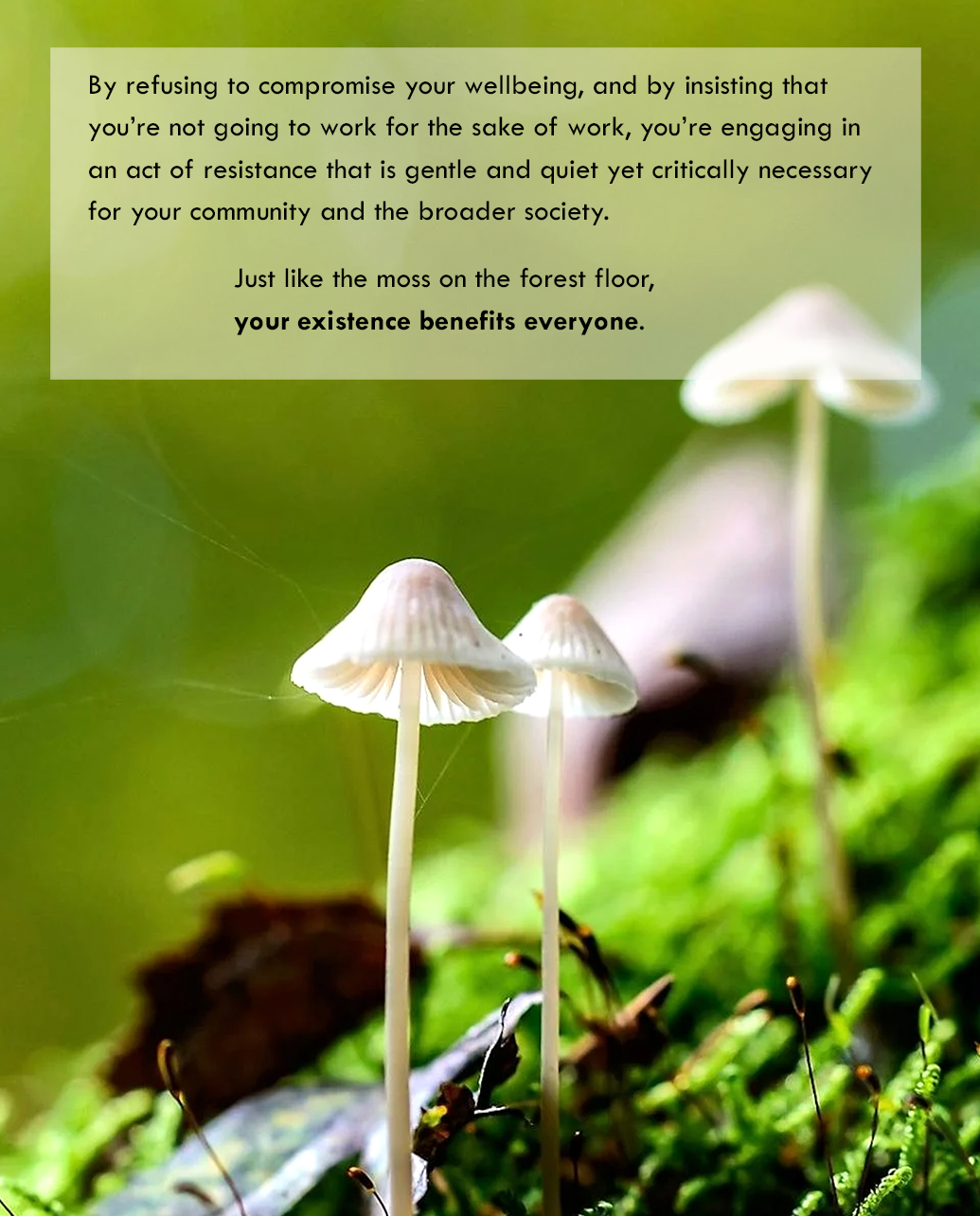
In Praise of Moss is a zine that argues against the myth of productivity while celebrating the value of a diversity of contributions to our culture and communities. Not everyone can be a tree, and that’s okay. Moss is an equally important part of an ecosystem.

I wrote this zine from a perspective that respects people of all abilities, but I think it’s important to acknowledge the more challenging aspects of disability. Disabled people are often expected to “pull their weight,” usually with the assumption that there’s only one way to measure success. In addition, people who live with invisible disabilities are often met with frustration and accusations of laziness when we’re unable to work or behave “normally.”

Moss is a useful metaphor for a recontextualization of what it means for disabled people to be useful to our communities and valued in our relationships. By exploring how moss can support an entire ecosystem, we can craft a model for how disability positivity can benefit society.

In addition, moss is remarkably adept at surviving disaster, which makes it an engaging analogy for resistance against the pressures of self-optimization exerted by neoliberal capitalism. While my focus is on disability, I believe that all readers can benefit from a shift in perspective that encourages us to grow naturally without worrying about productivity. 

When I write about “resisting productivity,” I’m speaking from the position of someone in academia who is directly affected by the myth that hard work will lead to prosperity. I hate the way this myth is weaponized against disabled people in the realm of higher education, and I want to destroy it. Very softly and quietly. Like moss.

While I love the lo-fi DIY aesthetic of many of the disability zines I’ve found on Etsy and in indie bookstores, it was important to me to create an attractively formatted physical object that feels good in my hands and accommodates my own disabilities by being easy to read. I want people who encounter this zine to feel that it’s valuable, and that they’re valuable too. I was fortunate to be able to work with Fireball Printing, a local Philadelphia service that creates gorgeous full-color publications.

If you’re interested, you can order a copy of the zine from Etsy, or you can download a free digital version on Itch.io.

🌿 https://digitalterrarium.itch.io/in-praise-of-moss
🌿 https://www.etsy.com/listing/1881401704/in-praise-of-moss-disability-zine