Whispering Willows

Whispering Willows (on Steam here) is a 2D adventure game set in a haunted mansion. There’s no combat, and the game takes about three hours to finish. It’s a small indie game made in 2014, and it’s not perfect. Still, I enjoyed the time I spent in Willows Mansion, and I’d recommend giving this game a shot if you’re into spooky gothic stories.

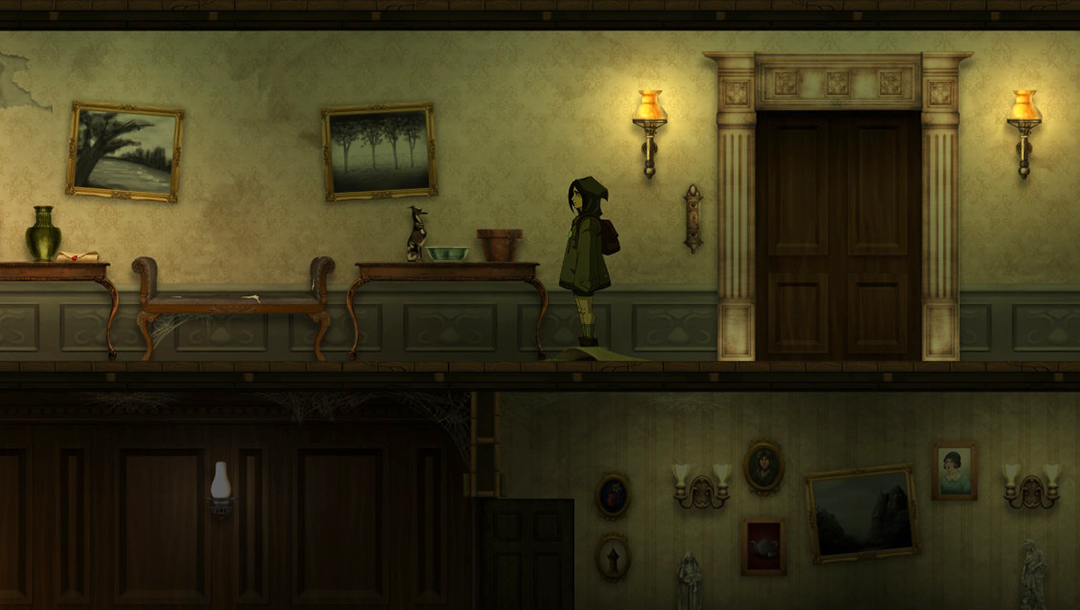
You play as Elena Elkhorn, a teenage girl whose father works as the groundskeeper at the derelict and abandoned Willows Mansion. Elena’s father doesn’t return one night, and she has a bad feeling about the mansion. Hoping to bring her father home, Elena sneaks onto the property and immediately falls headlong into an underground crypt. There she meets the ghost of her ancestor, who teaches her how to use the power of her magical pendant to leave her body to go spiritwalking. In a cursed mansion filled with phantoms, this is an extremely useful ability to have.  

Before I jump into the many things I love about this game, let me be upfront about its flaws:

– There’s not much actual gameplay.
– The hand-drawn cutscene art is unpolished.
– The writing is good but a bit uneven.
– The background music is limited.
– Your character walks very slowly.
– There’s no map to help you navigate.

Essentially, this is a small indie game that indeed looks and feels like a small indie game. I’m not complaining about the rough edges of Whispering Willows; I just want to make it clear that it’s a game made ten years ago on a tiny budget earned from a Kickstarter campaign. Still, I found its simplicity and amateurish aspects charming, and it has many strong points.

To begin with, the map is surprisingly large, and there’s a lot of space to navigate. You’ll explore the mansion’s crypt, its garden, and various outbuildings; but mainly you’re going to be walking around the house itself. The mansion is impossibly large and includes all the standard gothic flourishes: locked doors, grisly kitchens, moldy bathrooms, crooked paintings, peeling wallpaper, taxidermied hunting trophies, creepy dolls, and all the secret passageways you could ever want.

Of course there are all manner of notes lying around, and these notes collectively tell a suitably gothic story about the very wealthy but very evil man who built the mansion. This story never quite comes together in terms of plot or themes, and the character motivations are ridiculous. Still, all the individual bits and pieces are gothic catnip, from a lover kept in a secret room to a murdered best friend to a servant driven mad by what he’s seen.
This all takes place in California during the Wild West days, meaning that the land occupied by the mansion had to be taken from someone. It turns out that it was forcibly wrested from Elena’s own ancestors. Alongside his more intimate crimes, then, the mansion’s owner became the mayor of a frontier town by means of enacting war and genocide on First Nations people.

We tend to think of gothic mansions as being located in Europe, or perhaps New England. There are definitely nineteenth-century mansions in California, though (like the Carson Mansion), and they’re built on land soaked in blood.

Importantly, the First Nations people in Whispering Willows aren’t all ghosts. Elena and her father are very much alive, and they’re not tempted by the faded pseudo-grandeur of the former colonists. At the end of the game, it’s extremely satisfying to see Elena essentially say “fuck all this” as she walks away from the mansion with her father.  

This is an interesting perspective on classic gothic story tropes that I love to see. And honestly, Whispering Willows isn’t such a bad game. The puzzles are easy, but the lack of difficulty is a selling point for me. Also, the gameplay mechanic of Elena spiritwalking to interact with the numinous aspects of the environment is used in clever ways, and it’s a lot of fun.  

Aside from Elena’s slow walking speed, my only real complaint is that this game would benefit immensely from a map. Even though navigation isn’t particularly complicated, I got lost a few times and had to resort to a walkthrough (this one here) a few times, which wouldn’t have been necessary if the player could just pull up a subscreen.

Whispering Willows definitely feels like an indie game, but it’s got a delightfully grisly story and an excellent sense of atmosphere, and it’s worth checking out if you’re interested in Wild West Gothic from an indigenous perspective.

As a side note, this was apparently the game that launched Akupara Games, a publisher that specializes in quirky indie games with a strong sense of style and setting. Two of my favorite titles they’ve helped get off the ground are Rain World and Mutazione, and it’s cool to know that this was where they started.  

Mutazione

On its Steam page, Mutazione bills itself as “a mutant soap opera where small-town gossip meets the supernatural.” This is wonderfully catchy, but this atmospheric story game is much more chill and relaxed than its tagline would suggest.

Mutazione is about a normal teenage girl named Kai who takes a ferry out to an island to visit her sick grandfather. Her mother, who left the island with her own mother when she was still a child, is busy with Kai’s baby brother and sends Kai in her place. When Kai arrives on the island after a short prologue, the player realizes that it’s a special place. The island is littered with the overgrown ruins of highways and office buildings, and many its flora and fauna – including its human inhabitants – have undergone dramatic mutations.

Playing as Kai, your goal is to interact with the islanders and their environment in order to care for Kai’s grandfather, whose health turns out to be connected to the health of the island’s ecosystem. Mutazione is divided into seven days, with each day being further divided into different times (such as morning, afternoon, and so on). Every character on the island offers a new conversation during each time division, which can perhaps be thought of, in gaming terms, as “stages.” The game is clear about which conversation will end a stage and move time forward, and the player is free either to explore as they wish or move straight from one objective to another. To my knowledge, nothing in the game is hidden or missable, and the player’s dialogue choices don’t seem to affect the outcome of the main story.

The landscape of the island is divided into a series of small areas, each of which is a static screen that scrolls as the player moves through it. Some of these areas are more central than others, and some are only unlocked later in the week, but the island isn’t that big. There are only about seven or eight areas that most players will visit with any regularity, so it’s not prohibitively time-consuming to go from screen to screen to check in with the island inhabitants.

Mutazione also incorporates a gardening minigame that isn’t so much a “game” as it is a natural element of the story. To simplify, there are seven small gardens on the island, and every garden is associated with a “mood” such as “harmony” or “wanderlust.” Every day Kai learns a new song that will help foster the growth of plants associated with a given mood. You can run around the island and collect plant seeds, but it’s not necessary to go out of your way to do so. The gardening elements are all very relaxed, and the player can put as much effort or as little effort into this minigame as they want.

The “soap opera” story elements involve the love stories of two adult women on the island. Although these two stories do indeed feature dramatic elements, they’re both actually quite mature and understated, as well as appropriate to the setting of a small community. Kai, who has a crush on a girl on her swim team back home, is mercifully free from being romanced or having to romance anyone, and she’s mostly a passive observer and casual confidant. Mutazione isn’t aggressively wholesome, as people’s emotions and reactions are genuine and relatable, but there are no dramatic slap fights or screaming matches. Thankfully, neither women nor men are nasty to each other, and everything is very friendly and chill.

Unfolding alongside these small stories is the larger story of what happened to the island, as well as what the older generation of people on the island were doing there before the incident that caused the biological mutations. Many of the details of this background narrative are never fully explained, and honestly, that’s okay – we get the details that matter and enough pieces of the puzzle to fill in the rest for ourselves.

All of the people on the island have interesting personalities even if they don’t have a full story arc, and I appreciated the opportunity to get to know a few characters whom I don’t often encounter in video games. I was especially intrigued in Yoké, an older man who runs the island archive. He’s been in a wheelchair all of his life, which is handled with a welcome degree of realism, and he’s also beginning to lose his sight. The ways in which Yoké processes the indignities of aging are handled with just as much nuance and sensitivity as the game’s two love stories, and the sense of community is just as integral. In addition, given the racial and ethnic diversity on the island, as well as the mutations of the inhabitants, the game contains a few subtle but pointed conversations about tradition and transmission from a perspective in which whiteness has been refreshingly decentered.

Despite Mutazione’s exploration of themes such as difference, aging, and legacy, Kai is still a teenager who is largely uninterested in such things, which prevents any of the conversations in the game from becoming getting too heavy or academic. The fact that Kai is a teenager with a concomitant lack of perspective is sometimes frustrating, especially in her occasional solipsism and lack of concern for aspects of the island that turn out to be dangerous. Regardless, she’s friendly and open-minded in a way that perhaps an adult character wouldn’t be, and she functions well as a point-of-view character in both lighthearted and more serious scenarios.

In terms of its graphics, Mutazione is unique and gorgeous. The character designs are distinctive, the environments are lush and evocative, the mutant animals are brilliantly fantastic, and the mutant plants are creative yet feasible. The game also contains its own herbiary that’s accessible from the main menu. It’s completely optional, but it’s really fun to flip through. I’m not an expert on plants, but I know just enough to be able to understand that there are some cool references to the real-world scientific field of botany in both the main game and the herbiary.

The Mutazione OST, which you can find on Bandcamp, is one of the best things I’ve discovered in This Wild Year of Our Lord 2020. I’m not sure how to describe it except to say that it’s an extended LoFi Beats to Chill To playlist mixed with a few Riot Grrrl style anthems. I have to admit that I’m not a fan of the wordless punk songs, but the rest of the OST is lovely, both as an accompaniment to the game and as a nice background for writing or studying. My favorite tracks are the three “What’s on the Menu” pieces, which are super ambient and relaxing.

The closest comparisons to Mutazione are probably Oxenfree and Night in the Woods, but Mutazione is much more secure in its identity as a story game. It doesn’t require any platforming, puzzle solving, or reflex-based minigames, and it tackles real and interesting topics and themes without forcing the player to sit through extended scenes of teenagers being awkward and unpleasant to one another. Mutazione does have a few creepy moments, and some of the revelations Kai uncovers about the island are genuinely upsetting. These darker elements add stakes and momentum to the story, and the ending of the game is incredibly satisfying.

You can probably finish Mutazione in about two to three hours if you just want to get through the main storyline, but I spent about ten hours with the game over the course of three weeks, playing a bit at a time and making sure to check in with everyone to get all of their stories. That being said, because of the gradual building of narrative momentum, I got hooked at the end and eventually reached a point where I couldn’t put the game down until I saw how everything turned out. I played Mutazione on PlayStation 4 on a big HD television, where it was absolutely gorgeous, but I’d gladly play it again on the small screen of a Nintendo Switch if it were ever released on that platform.

As much as I’m currently enjoying Age of Calamity, I found that Mutazione scratched a specific itch left by Breath of the Wild, specifically regarding gentle exploration and patchwork storytelling that proceeds at a pace set by the player, with careful attention to the environment rewarded by strange seeds. I’m actually surprised that I haven’t seen more people talking about how amazing Mutazione is, because the game is engrossing and beautiful and original, not to mention a refreshingly accessible vehicle for an incredible story.

By the way, the writer and narrative designer for Mutazione, Hannah Nicklin, has a piece on Gamasutra about how her creative philosophy is expressed in some of the decisions she made regarding this game, and it’s a really fun read.