Review of Textual Cacophony

I was honored to write a review for Pacific Affairs of Daniel Johnson’s 2023 monograph Textual Cacophony, a critical analysis of Japanese internet culture between roughly 2006 and 2014. Johnson is especially interested in the anonymous message board 2channel and the video sharing site Niconico, and my review highlights why the online subcultures associated with these sites are still relevant and worth studying. Here’s the opening paragraph:

It’s no secret that a great deal of twenty-first century media has been influenced by internet subcultures; unfortunately, much of this culture has been lost to time. Many emergent online cultures of the 2000s have proved tragically ephemeral, with the scarce documentation that exists often falling into the trappings of cultural nostalgia. Thankfully, Daniel Johnson’s Textual Cacophony: Online Video and Anonymity in Japan functions as a critical analysis that documents and preserves an important moment in Japanese media history that continues to resonate across national borders.

You can read the full review on the Pacific Affairs website here:
https://pacificaffairs.ubc.ca/book-reviews/textual-cacophony-online-video-and-anonymity-in-japan-by-daniel-johnson/
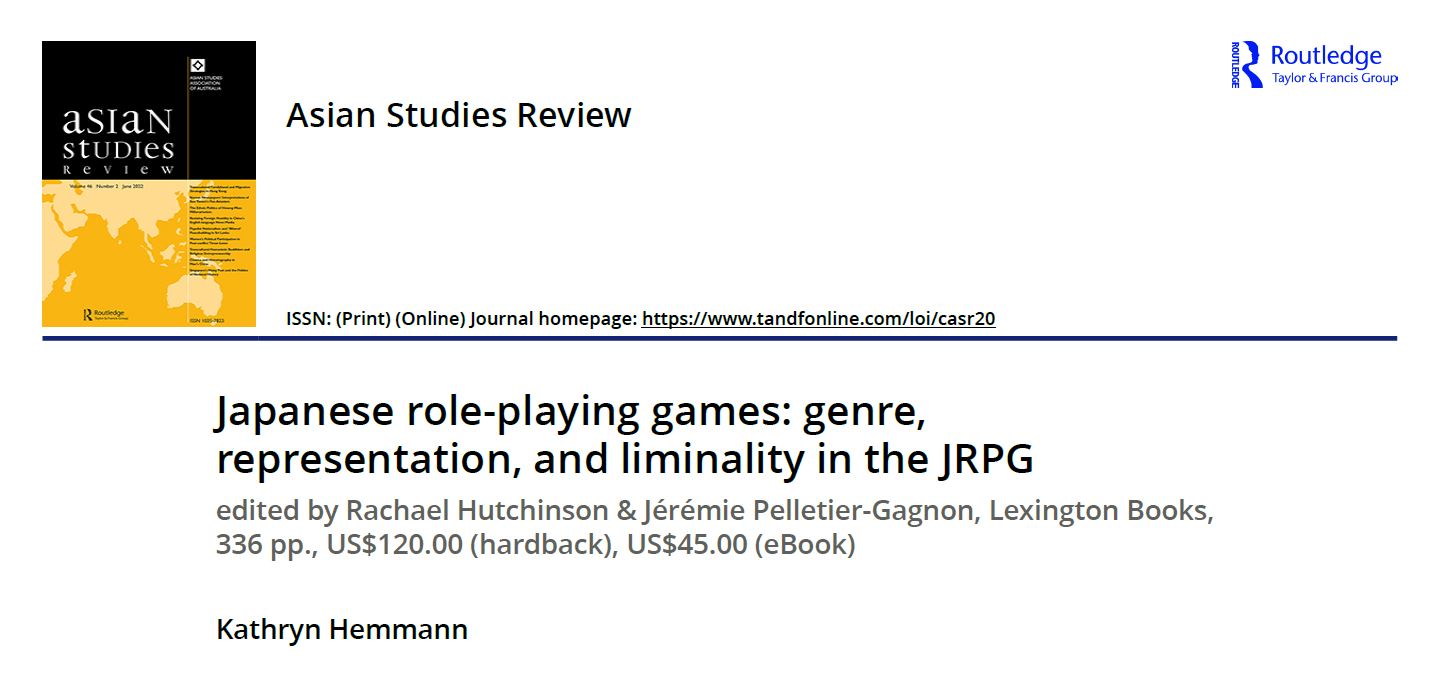
Review of Japanese Role-Playing Games

This past summer I was given an opportunity to review an academic essay collection titled Japanese Role-Playing Games: Genre, Representation, and Liminality in the JRPG. The work the two editors did for this collection is incredible, and every single essay is fantastic. Here’s a short excerpt from the book review that I published in the journal Asian Studies Review:

Japanese Role-Playing Games: Genre, Representation, and Liminality in the JRPG is the first English-language collection of essays focusing entirely on a genre of Japanese games known for their complex stories and rich worldbuilding. The fourteen essays in this collection cover the construction of the JRPG genre, the formation of transcultural gaming communities, and the representation of issues such as nationality, gender, and disability.

Japan Studies scholars with varying degrees of familiarity with the specific titles used as case studies will find a wealth of information and resources in these essays, which briefly summarize the games while explaining why they are representative, important, and connected to broader currents in Japanese history and society. Meanwhile, Game Studies scholars will find approachable yet intellectually rigorous discussions of culture and national origin, which have thus far been relatively few and far between in the field outside of the work of a few specialists.

If you’d like to read the full review, you can find it (here). I understand that not everyone has institutional access to academic journals, so I’m also hosting the PDF on my own website (here). In addition, you can find Japanese Role-Playing Games on the publisher’s website (here), and you can follow the journal Asian Studies Review on Twitter (here).