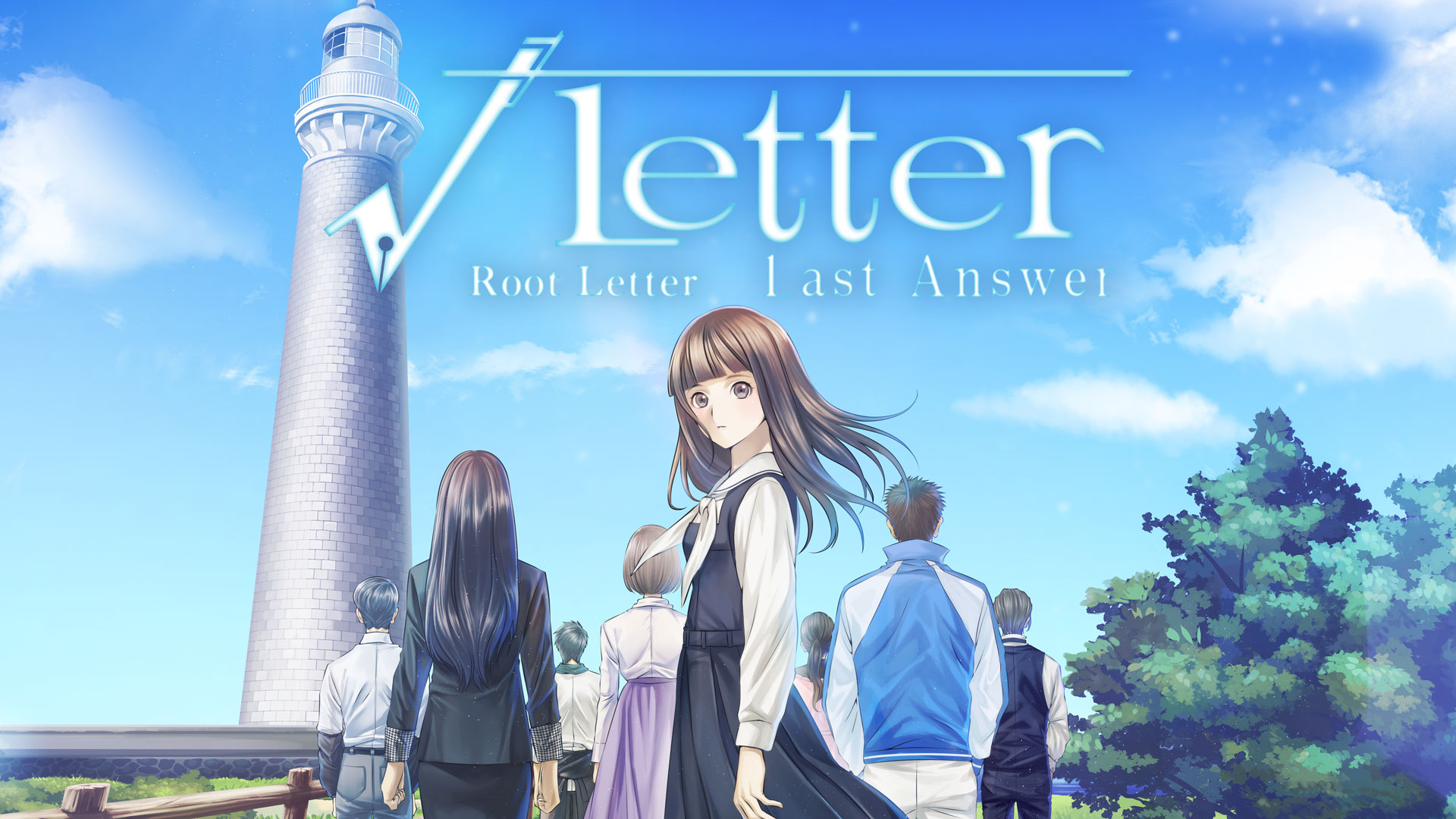
Root Letter

Root Letter is a mystery-themed visual novel that should take most people about six or seven hours to play. I’ve read a number of positive reviews of the game, so I went ahead and downloaded a copy onto my Nintendo Switch when it went on sale at the end of the year.

You play as Takayuki, a thirty-something white collar worker who’s left his job at a design firm and has a bit of free time before he’s scheduled to start a new job. When he goes home to visit his parents, he finds a set of letters from Aya Fumino, his pen pal from his senior year of high school. He’d exchanged nine letters with her, but he discovers a tenth at the bottom of the stack that he doesn’t remember reading. In this letter, Aya tells Takayuki that she can no longer continue their correspondence. She apologizes, saying that she has killed someone.

Takayuki decides to try to find her in Matsue, a city on the Sea of Japan about halfway between Osaka and Hiroshima. When he arrives at the address on the letters, however, he finds an empty lot. A passing neighbor tells him that the house burned down fifteen years ago, so he checks the records at the city library. He learns that, while a girl named Aya Fumino used to live in that house, she died twenty-five years ago, long before she could have written to him.

Why did the house burn down? Who was pretending to be Aya Fumino? And who did she kill?

With a week of free time and an intriguing mystery on his hands, Takayuki sets about tracking down the seven friends his pen pal mentioned in her letters. None of them want to talk to him, however, and everyone claims not to know anyone named Aya Fumino, even when presented with her photo. Your goal, as Takayuki, is to find and interrogate these seven adults in an attempt to figure out who “Aya Fumino” was and what happened during her senior year of high school.

There are five possible endings to Root Letter, but its gameplay is almost completely linear. You use a drop-down menu to move between various locations in Matsue as you follow various hints and clues, and the “Think” command on your menu will (almost) always tell you where the game wants you to go next. The interrogation scenes feature a few Ace Attorney style elements that involve presenting the right piece of evidence at the right moment, but this is also extremely linear. There’s no reward for exploration or creativity; but, thankfully, there’s no punishment for failure. Root Letter is much more of an interactive novel than a game, and it’s not interested in derailing your progress through the story.

The ending you see is determined by your choice of how Takayuki responded to the letter from Aya Fumino that’s presented at the beginning of each of the game’s chapters. You’re given two sets of choices per letter, and your options tend to fall into discrete categories at don’t make much sense unless you already know which ending you’re trying to unlock. Like the shitty casual gamer I am, I chose a “normal” (to me) range of mixed responses and got the worst ending, in which the whole mess about Aya Fumino was a government conspiracy to cover up an alien invasion.

My advice would be to avoid my rookie mistake by consulting a guide to the endings before you begin. Don’t worry about spoiling yourself, because Root Letter’s story is so convoluted that none of the endings will make sense if you haven’t played the game.

It’s my understanding that the “default” ending, meaning the ending you’ll see if you always choose the first response option, is a bittersweet story about missed connections, growing up, and letting the past go as you move on with your life. Another ending, the “Cursed Letter” ending, is about the power of teenage imagination to create both urban legends and personal identity; while another, the “Princess of Himegamori Forest” ending, is a horror-themed exploration of local Shintō folklore.

One of the main benefits of playing the Last Answer edition of the game (as opposed to the original 2016 release) is that it contains an optional “drama mode.” The drama version of the game uses photos of real actors and locations; and, based on what I’ve seen, the photography is quite polished and surprisingly faithful. Having played the game through once with anime illustrations, I’m looking forward to playing it again in drama mode at some point in the future.

While Root Letter pushes the player forward with the strong forward momentum of its mystery story, it also invites you to take time to appreciate the sights of Matsue. As Takayuki, you’ll get to stay at a traditional hot springs inn, stroll through the forested grounds of Matsushiro Castle, visit art museums, and eat at trendy cafés. Root Letter leans especially hard into its celebration of the local cuisine, and I’m excited about the prospect of being able to enjoy photographic depictions of Matsue’s food culture.

Unfortunately, some elements of the game haven’t aged well, probably because they were never attractive to begin with. To give an example, one character admits to a violent attempted rape, and the other characters just sort of shake their heads and move on. If this assault only comes up briefly and is never mentioned again, why include it in the story at all? Likewise, “Aya Fumino’s” fake suicide is teased fairly early in the game but isn’t given any dramatic weight. Rather, it’s played purely for shock value, with the implicit understanding that this sort of thing is just what moody high school girls do.

Some of the most uncomfortable parts of the game involve a character nicknamed “Fatty.” This character’s entire arc is about how he’s overweight, and about how overweight people are weak and gross and unlovable. In order to psychologically break this character during his investigation, Takayuki taunts him with chocolate-covered potato chips, which he can’t resist because, at the deepest core of his being, he is and will always be a big fat fatty. The whole thing is super gross, especially in combination with the casual gay panic thrown into this chapter. I feel that this is one of the many instances in which a more judicious localization could have made some slight changes, not to erase this type of bigotry and meanness, but to mitigate it somewhat.

The player’s enjoyment of Root Letter is largely based on its story, so it’s a shame that the translation is so lackluster. It’s perfectly serviceable, and it’s far from unreadable, but it has numerous quality control issues that would be tedious to list. My main complaint is that the translation received very little localization, which is frustrating in terms of both story and gameplay.

Regarding gameplay, the lack of a localization has rendered it somewhat difficult to talk to or interrogate people, as there are numerous instances in which none of the dialog choices make the slightest bit of sense. The game isn’t that complicated, so you can brute-force your way through the poorly translated bits by trial and error, but it goes without saying that you shouldn’t have to.

It’s tricky to discuss the situations in which localization would have been preferable to a direct translation without resorting to an infodump, but I can give one example that’s fairly self-explanatory. One of the friends Aya Fumino mentions in her letters is nicknamed “Bitch.” In Japanese, the loanword bicchi doesn’t necessarily mean “mean girl,” as it does in English. Rather, it’s the 2015 version of gyaru or kogal, and it refers to a teenage girl who dyes her hair and uses tanning lotion and dresses in trendy clothes and pays a lot of attention to the entertainment industry. The English equivalent of this term changes from decade to decade; but, given that Takayuki probably went to high school around 1998-2001 or thereabouts, “valley girl” or “Barbie girl” might work. The character nicknamed “Bitch” is actually quite friendly, so listening to the other characters talk about how much they used to admire their friend “Bitch” is bizarre.

Root Letter has some definite rough patches, but I want to emphasize that I enjoyed this game. I spent a week playing it, reading for about an hour every day, and I had a lot of fun with its ridiculous characters, charmingly convoluted plot, and unapologetic embrace of virtual tourism. I’m happy that I finally got a chance to play Root Letter, but I’m also happy that I was able to get the game on sale, because I’m not sure it’s worth more than $20.

The Demon King, Chapter 7

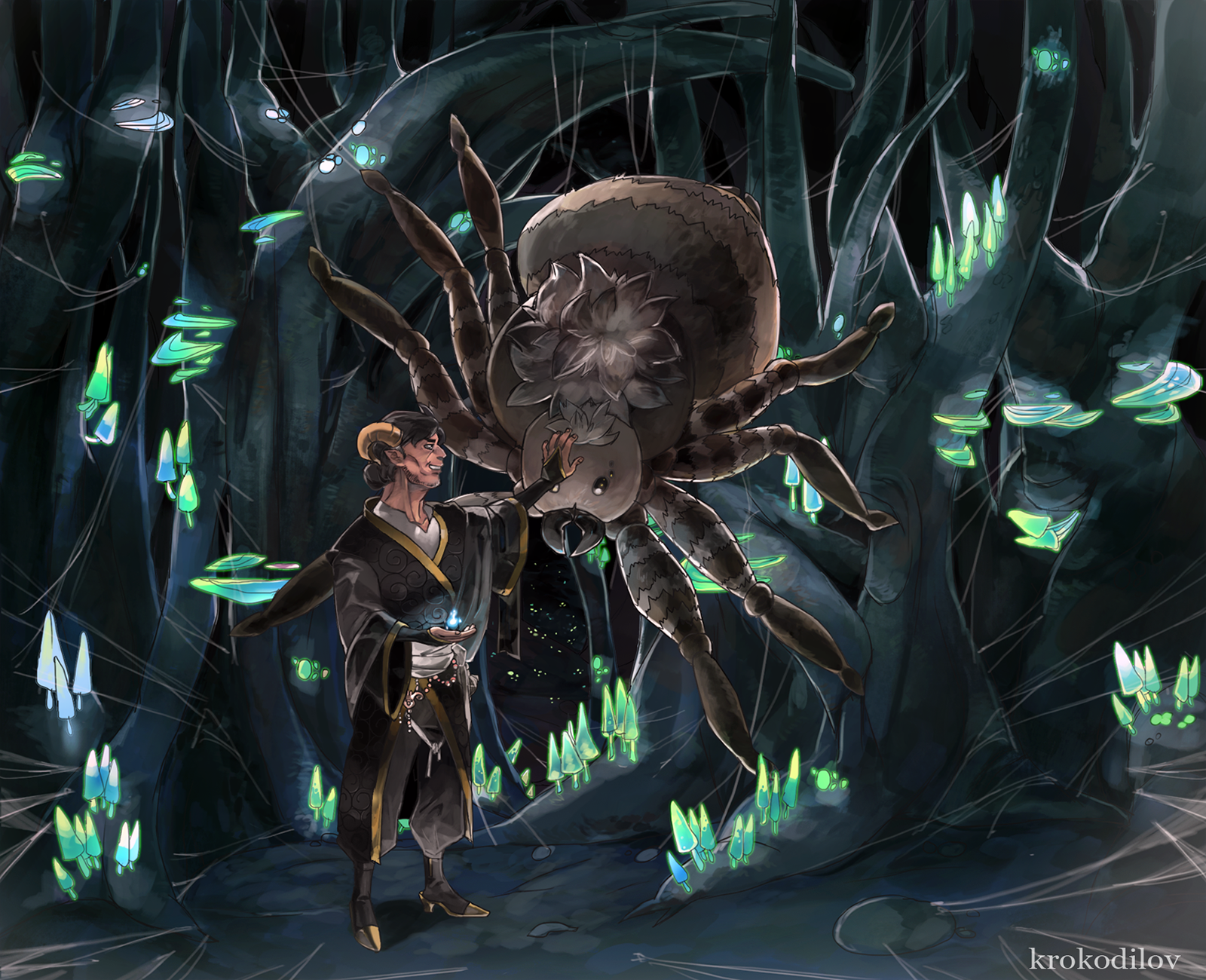
This illustration is by the brilliant Yura Krokodil (@KrokodilYura on Twitter and @krokodilov on Tumblr). She also posts original comics on DeviantArt (here). This artist is a genius when it comes to environmental painting, and she’s magnificently talented at creature and costume design.

This is a scene from the seventh chapter of The Demon King, in which Balthazar ventures into a creepy mushroom forest and has a meandering conversation with a giant spider named Uniagoliantia. You can read the chapter on AO3 starting (here).

In Return of the King, Frodo and Sam cross through Cirith Ungol (“the pass of the spider”) on their way to Mordor, and along the way they encounter a giant spider named Shelob. The Silmarilion mentions that Shelob’s mother was Ungoliant (“dark spider”), a primordial spirit who took the form of an even larger spider. I think “Ungoliant” is a cool name, but it’s a shame it doesn’t have eight syllables, so I expanded it while making it sound more feminine.

Although there are definitely weird and creepy spiders in the world – just as there are weird and creepy fish and weird and creepy mammals – most spiders are just minding their own business, and I think their big bright eyes and round fuzzy bodies and short little legs are kind of cute.

When it comes to creepy things, I tend to think that mushrooms are much creepier than spiders. Still, they’re very cool-looking. I was talking with the artist about this, and about how the “evil forest” area that always seems to be one of the first dungeons in a lot of RPGs inevitably looks really interesting and beautiful, and she told me that she was inspired by the opening dungeon of Final Fantasy IX, which is called, appropriately enough, Evil Forest. It feels a bit anthropocentric to refer to a place that humans aren’t comfortable as “evil,” and I imagine that the creatures who live in any given “evil forest” are probably quite happy there.

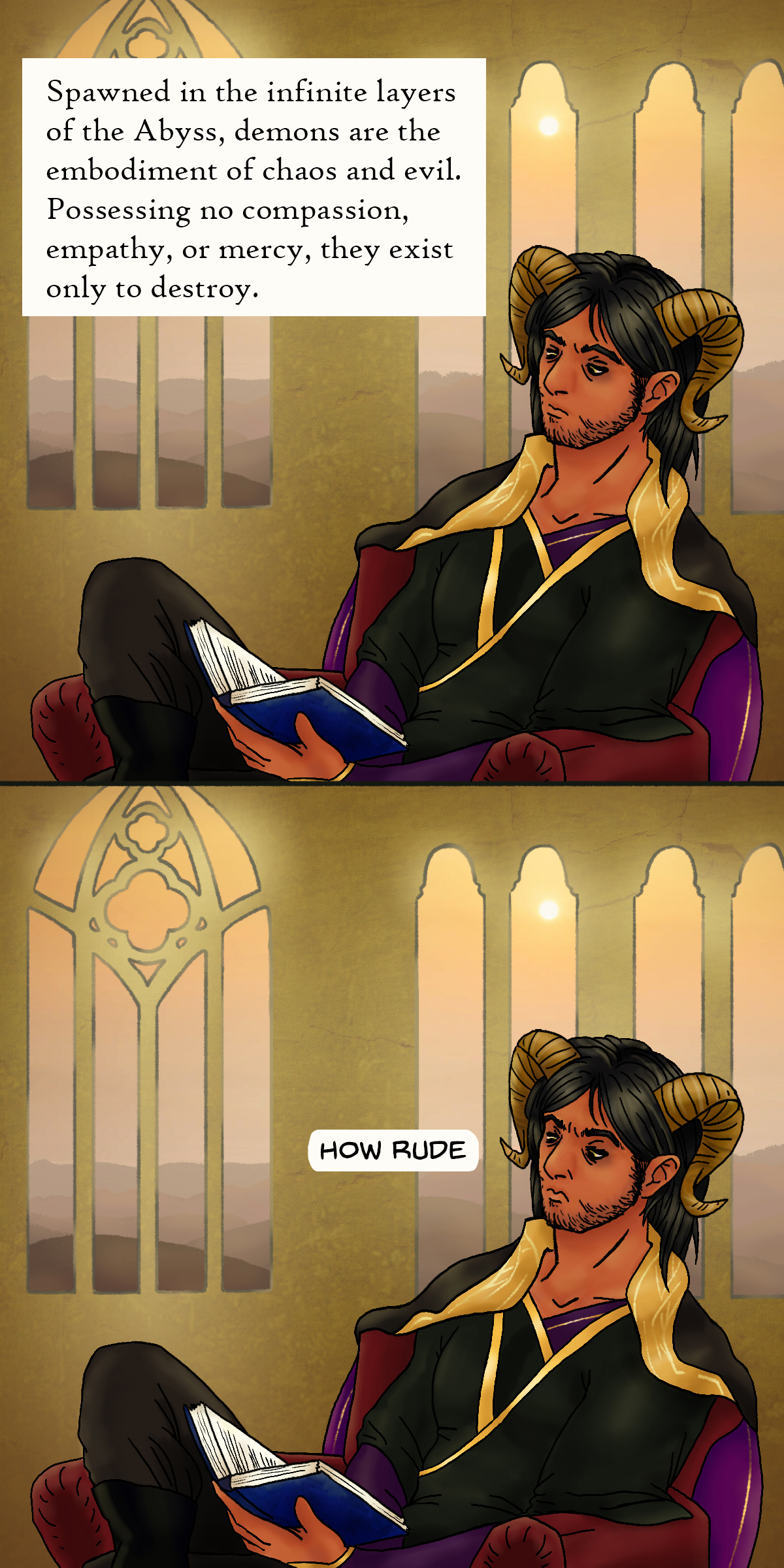
Demons Have Feelings Too

The passage Balthazar is reading is from the introduction to the “Demons” entry of the Dungeons & Dragons Monster Manual. The full paragraph reads:

Spawned in the Infinite Layers of the Abyss, demons are the embodiment of chaos  and evil – engines of destruction barely contained in monstrous form. Possessing no compassion, empathy, or mercy, they exist only to destroy. The Abyss creates demons as extensions of itself, spontaneously forming  fiends out of filth and carnage.

And this is just not a very nice thing to say, honestly.

I drew this comic to include as the interstitial illustration following the sixth chapter of The Demon King, which I’m posting on AO3 (here).

School’s Out

I’m like this at the end of every semester, but it hits especially hard this year.

It’s tough to get to know a group of interesting and talented people as you watch them learn and grow from week to week, only to then no longer see or talk to (most of) them ever again.

Mutazione

On its Steam page, Mutazione bills itself as “a mutant soap opera where small-town gossip meets the supernatural.” This is wonderfully catchy, but this atmospheric story game is much more chill and relaxed than its tagline would suggest.

Mutazione is about a normal teenage girl named Kai who takes a ferry out to an island to visit her sick grandfather. Her mother, who left the island with her own mother when she was still a child, is busy with Kai’s baby brother and sends Kai in her place. When Kai arrives on the island after a short prologue, the player realizes that it’s a special place. The island is littered with the overgrown ruins of highways and office buildings, and many its flora and fauna – including its human inhabitants – have undergone dramatic mutations.

Playing as Kai, your goal is to interact with the islanders and their environment in order to care for Kai’s grandfather, whose health turns out to be connected to the health of the island’s ecosystem. Mutazione is divided into seven days, with each day being further divided into different times (such as morning, afternoon, and so on). Every character on the island offers a new conversation during each time division, which can perhaps be thought of, in gaming terms, as “stages.” The game is clear about which conversation will end a stage and move time forward, and the player is free either to explore as they wish or move straight from one objective to another. To my knowledge, nothing in the game is hidden or missable, and the player’s dialogue choices don’t seem to affect the outcome of the main story.

The landscape of the island is divided into a series of small areas, each of which is a static screen that scrolls as the player moves through it. Some of these areas are more central than others, and some are only unlocked later in the week, but the island isn’t that big. There are only about seven or eight areas that most players will visit with any regularity, so it’s not prohibitively time-consuming to go from screen to screen to check in with the island inhabitants.

Mutazione also incorporates a gardening minigame that isn’t so much a “game” as it is a natural element of the story. To simplify, there are seven small gardens on the island, and every garden is associated with a “mood” such as “harmony” or “wanderlust.” Every day Kai learns a new song that will help foster the growth of plants associated with a given mood. You can run around the island and collect plant seeds, but it’s not necessary to go out of your way to do so. The gardening elements are all very relaxed, and the player can put as much effort or as little effort into this minigame as they want.

The “soap opera” story elements involve the love stories of two adult women on the island. Although these two stories do indeed feature dramatic elements, they’re both actually quite mature and understated, as well as appropriate to the setting of a small community. Kai, who has a crush on a girl on her swim team back home, is mercifully free from being romanced or having to romance anyone, and she’s mostly a passive observer and casual confidant. Mutazione isn’t aggressively wholesome, as people’s emotions and reactions are genuine and relatable, but there are no dramatic slap fights or screaming matches. Thankfully, neither women nor men are nasty to each other, and everything is very friendly and chill.

Unfolding alongside these small stories is the larger story of what happened to the island, as well as what the older generation of people on the island were doing there before the incident that caused the biological mutations. Many of the details of this background narrative are never fully explained, and honestly, that’s okay – we get the details that matter and enough pieces of the puzzle to fill in the rest for ourselves.

All of the people on the island have interesting personalities even if they don’t have a full story arc, and I appreciated the opportunity to get to know a few characters whom I don’t often encounter in video games. I was especially intrigued in Yoké, an older man who runs the island archive. He’s been in a wheelchair all of his life, which is handled with a welcome degree of realism, and he’s also beginning to lose his sight. The ways in which Yoké processes the indignities of aging are handled with just as much nuance and sensitivity as the game’s two love stories, and the sense of community is just as integral. In addition, given the racial and ethnic diversity on the island, as well as the mutations of the inhabitants, the game contains a few subtle but pointed conversations about tradition and transmission from a perspective in which whiteness has been refreshingly decentered.

Despite Mutazione’s exploration of themes such as difference, aging, and legacy, Kai is still a teenager who is largely uninterested in such things, which prevents any of the conversations in the game from becoming getting too heavy or academic. The fact that Kai is a teenager with a concomitant lack of perspective is sometimes frustrating, especially in her occasional solipsism and lack of concern for aspects of the island that turn out to be dangerous. Regardless, she’s friendly and open-minded in a way that perhaps an adult character wouldn’t be, and she functions well as a point-of-view character in both lighthearted and more serious scenarios.

In terms of its graphics, Mutazione is unique and gorgeous. The character designs are distinctive, the environments are lush and evocative, the mutant animals are brilliantly fantastic, and the mutant plants are creative yet feasible. The game also contains its own herbiary that’s accessible from the main menu. It’s completely optional, but it’s really fun to flip through. I’m not an expert on plants, but I know just enough to be able to understand that there are some cool references to the real-world scientific field of botany in both the main game and the herbiary.

The Mutazione OST, which you can find on Bandcamp, is one of the best things I’ve discovered in This Wild Year of Our Lord 2020. I’m not sure how to describe it except to say that it’s an extended LoFi Beats to Chill To playlist mixed with a few Riot Grrrl style anthems. I have to admit that I’m not a fan of the wordless punk songs, but the rest of the OST is lovely, both as an accompaniment to the game and as a nice background for writing or studying. My favorite tracks are the three “What’s on the Menu” pieces, which are super ambient and relaxing.

The closest comparisons to Mutazione are probably Oxenfree and Night in the Woods, but Mutazione is much more secure in its identity as a story game. It doesn’t require any platforming, puzzle solving, or reflex-based minigames, and it tackles real and interesting topics and themes without forcing the player to sit through extended scenes of teenagers being awkward and unpleasant to one another. Mutazione does have a few creepy moments, and some of the revelations Kai uncovers about the island are genuinely upsetting. These darker elements add stakes and momentum to the story, and the ending of the game is incredibly satisfying.

You can probably finish Mutazione in about two to three hours if you just want to get through the main storyline, but I spent about ten hours with the game over the course of three weeks, playing a bit at a time and making sure to check in with everyone to get all of their stories. That being said, because of the gradual building of narrative momentum, I got hooked at the end and eventually reached a point where I couldn’t put the game down until I saw how everything turned out. I played Mutazione on PlayStation 4 on a big HD television, where it was absolutely gorgeous, but I’d gladly play it again on the small screen of a Nintendo Switch if it were ever released on that platform.

As much as I’m currently enjoying Age of Calamity, I found that Mutazione scratched a specific itch left by Breath of the Wild, specifically regarding gentle exploration and patchwork storytelling that proceeds at a pace set by the player, with careful attention to the environment rewarded by strange seeds. I’m actually surprised that I haven’t seen more people talking about how amazing Mutazione is, because the game is engrossing and beautiful and original, not to mention a refreshingly accessible vehicle for an incredible story.

By the way, the writer and narrative designer for Mutazione, Hannah Nicklin, has a piece on Gamasutra about how her creative philosophy is expressed in some of the decisions she made regarding this game, and it’s a really fun read.

Balthazar from The Demon King

I’m working on creating a character design for Balthazar, the main character of The Demon King.

The visual aspects of his magic are based on the Twilight magic from Twilight Princess, which is a lot of fun to draw. Unfortunately for me, the reader isn’t going to see him casting the magic he specializes in until much later in the story, although other characters will occasionally allude to the fact that he’s able to do something they can’t fully perceive or understand. A large part of the story’s broader narrative arc therefore involves a lead-up to the revelation of what type of magic Balthazar is using, as well as how he’s using it – and why. The Demon King begins as something like a high fantasy sitcom, but (hopefully) it will gradually get deeper into worldbuilding and character backstories as it progresses.

Anyway, I’m still trying to settle on Balthazar’s face model, but I’m moving in the direction of Ranveer Singh, who has interesting and expressive features.

I’m also still trying to figure out his clothing. Specifically, I can’t decide whether his outer robe is the robe of a Roman Catholic priest or a Japanese Buddhist priest, or whether he just threw a blanket over his shoulders.

And please don’t think too hard about how his horns are attached to his head. It’s… magic?

The Sun Also Sets

This is an illustration of Ceres, one of the main characters in an original story I’m working on called The Demon King. (If you’re interested, I’m posting my first draft on AO3, but it’s still very much a work in progress.)

The idea behind this character is that “pure-hearted” video game princesses like Peach and Zelda always seem to rule their kingdoms mainly by themselves, which is a bit disturbing if you think about it. The Demon King has a larger narrative arc, but for now it’s mainly a play on video game tropes, and Ceres is a way for me to explore questions relating to how “legitimate” power and authority are often presented as “feminine” in many fantasy-themed games.

In any case, I’m writing Ceres as a horrible dramatic bitch, and I love her.

The Liar Princess and the Blind Prince

The Liar Princess and the Blind Prince is a 2D puzzle platform game about two small children making their way through a creepy murder forest. Unlike similar games (such as Limbo, which jumps immediately to mind), The Liar Princess might best be described as an interactive storybook. The game’s emphasis is not so much on puzzles or platforming, but rather on using the conventions of gaming to help deepen the player’s connection with the characters as they travel through the story together.

This game was created by Nippon Ichi Software, which has developed a reputation for cute horror games with titles like Yomawari: Night Alone and A Rose in the Twilight. Still, I think The Liar Princess isn’t so much horror as it is dark fantasy, or fantasy with a few creepy elements and a touch of dark humor. There’s nothing explicitly violent or disturbing in the story or imagery, and the game itself is quite easy. I probably wouldn’t give this game to a young child, but playing it was a relaxing experience for me as an adult horror fan.

The plot and the gameplay go hand-in-hand, much like the eponymous princess and prince. The story has strong fairy tale elements, with a wolf asking a witch to turn her into a human so that she can save a prince. The prince’s misfortune is the wolf’s own doing, as she accidentally blinded him with her claws. The player’s goal is therefore to help the “princess” escort the prince to the forest witch to be cured before he discovers that she’s the wolf who blinded him. In her beast form, the wolf is powerful and impervious to attack, but she can only hold hands with the prince to guide him forward when she’s in her human form. The wolf can change forms at will, so the main challenge lies in positioning the prince in exactly the right way so that he can walk forward while remaining safe from harm.

The Liar Princess has five levels with four stages each, with a short prologue and a longer “final boss” level. (I’m using scare quotes because this final level is more of an obstacle course than an actual boss fight.) It’s relatively easy to figure out most of the puzzles through trial and error, and the death of either character usually only results in a small setback that generally involves the welcome reset of a specific puzzle. The game also gives the player the option to skip a stage after ten minutes if there’s a puzzle that’s just not clicking. Most of the actual fun of the gameplay involves searching each stage and taking calculated risks to find secret collectibles, which unlock pages of concept art and segments of the forest witch’s backstory. More than anything, The Liar Princess reminds me of the Metroidvania-lite feel of Super Princess Peach in that there’s no real sense of danger and failure is never punished.

The sort of people who complain about games being “too easy,” including no small number of professional reviewers, didn’t hesitate to make that complaint about The Liar Princess when it came out in English translation back in early 2019. The undemanding level of difficulty isn’t a deal-breaker for me personally, but I have to admit that the game isn’t without annoyances. There are a few number puzzles in the third level that are bizarrely tricky, for example, and sometimes it can be hard to tell whether you’re taking the incorrect approach to a puzzle or whether there’s been a glitch in the hitbox for a certain switch that isn’t triggering for some reason.

That being said, the main appeal of this game is visual, with its expressive characters and stylish backgrounds. (In fact, I might even go so far to say that The Liar Princess is perfect for people who love the visual design of Hollow Knight but don’t have the patience to deal with the gameplay.) The character designs are especially interesting and creative, from the weakest enemy in the first stage to the flower-eating “mole” creatures at the end of the game. Although the basic shape outlines are cute and simple, there’s always a fun twist somewhere – when the first mole creature opens its mouth, for instance, you are in for a treat. The game plays with its visual style to make all manner of (relatively gentle) jokes about how the prince doesn’t know that the characters he encounters are all people-eating monsters, and these jokes collectively raise questions about “blindness” and “monstrosity” that are subtle but engaging (and not in the least bit ableist).

My favorite part of the game is the wolf herself, who makes horrible decisions but is basically decent. Despite the fact that she is clearly lying in a way that hurts other people and herself, you can’t help but sympathize with her as her good intentions lead her increasingly astray. The development of the friendship between her and the prince is extremely cute, as is the way both characters smile when they’re holding hands. I’m also a fan of the unapologetically evil witch, and it’s worth seeking out the game’s collectibles in order to learn more about her story.

The Liar Princess and the Blind Prince isn’t a perfect game, and many people will probably think it’s too easy and too short. Playing it from start to finish took me about five hours, including the time I spent going back to earlier stages in order to pick up collectibles I missed and rewatch the cutscenes I unlocked. Despite a few frustrations with the gameplay mechanics, I loved The Liar Princess. I’m somewhat surprised that this game is considered to be a niche title, because it’s refreshingly accessible and a lot of fun. Although the most obvious comparison would seem to be something like Limbo, The Liar Princess actually feels much more like Journey – it’s a visually immersive and relatively chill game about loneliness and companionship that’s easy to dip into for fifteen minutes at a time when you want to relax and unwind.