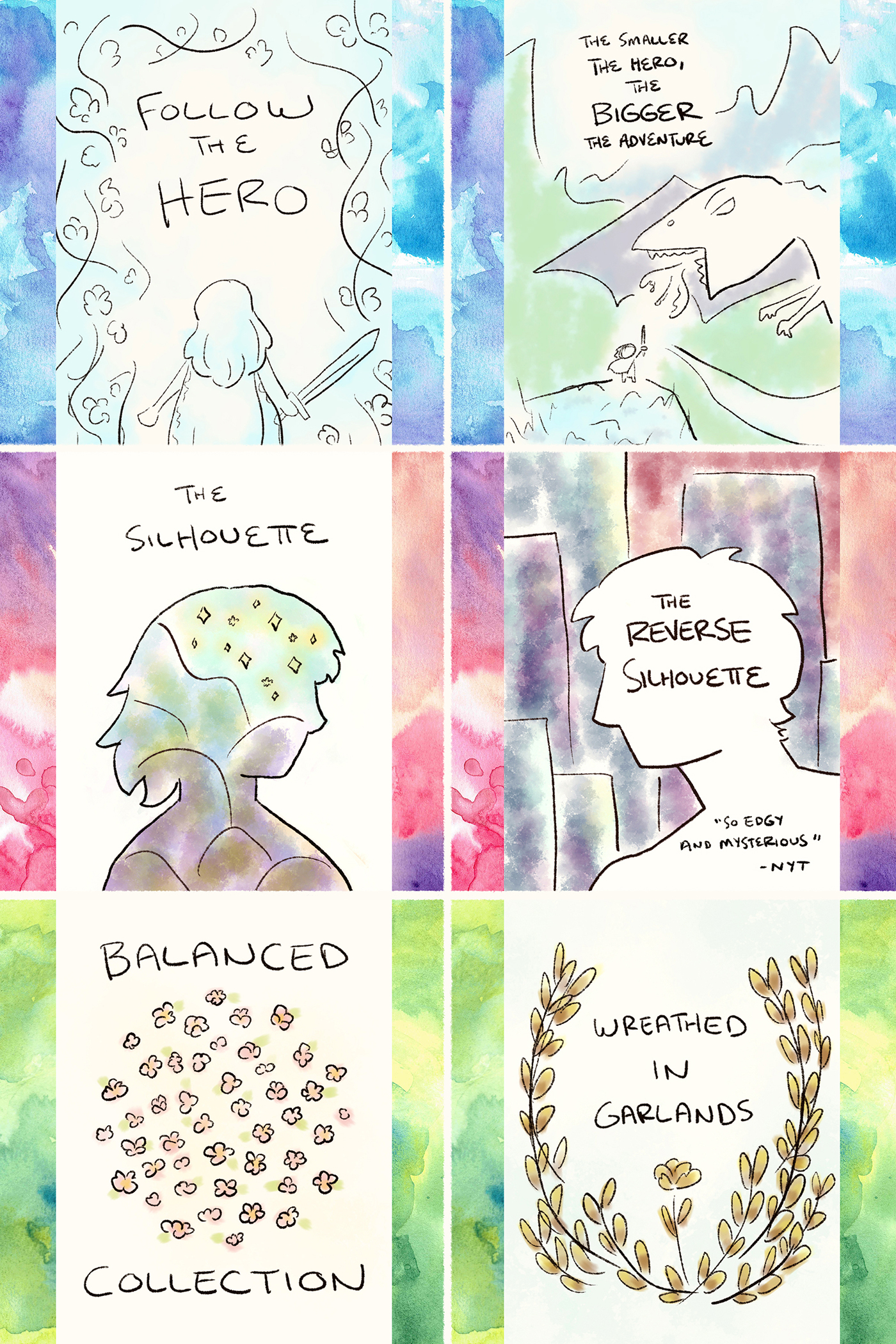
Book Cover Studies

I’ve been thinking about graphic design a lot recently, especially as a tool to help writers promote their work. Contemporary mainstream social media is extremely image-oriented, which puts writers at a disadvantage. I therefore think it’s worthwhile to figure out how to create graphic images that focus on text but are still visually striking and easily shared.

Since book covers serve the same purpose, I decided to launch this project by thinking about how certain compositions are used to convey specific moods, and I’ve been drawing quick studies along the way. Silja Götz’s online class Book Cover Illustration has been an incredible resource!

It probably won’t surprise anyone to learn that I love horror novel covers. “Modern gothic” is one of my favorite genres, and I could sketch these types of covers all day (and night).

My Husbando

A true story from These Trying Times™

The song my husband is singing is (this one) from Azumanga Daioh.

“I would have just moved to another apartment,” someone commented when I posted this on Instagram. And I totally agree, but at the same time, moving during the COVID-19 pandemic wasn’t easy, and I don’t want to do it again. My illustrated piece of flash fiction “Apartment Hunting” (here) is actually about how strange and unpleasant this experience was. It’s been difficult to try to navigate my professional life without a stable internet connection, but at least I have a large library of anime to help me make it through.

The Demon King, Chapter 8

This illustration of Ceres is by Sali (@salisillustrations on Instagram and @saliechelon255 on Tumblr), who creates beautiful digital paintings based on books and anime, including Studio Ghibli movies and the Harry Potter novels, alongside her original work. Her characters are fashionable and expressive, and they always fit perfectly into their richly detailed environments. Sali has a talent for drawing fancy wizards, and it was a pleasure to be able to work with her on this illustration for The Demon King.

The eighth chapter of The Demon King is the culmination of Ceres’s first character arc. It echoes her introduction, in which she glibly treats murder as the only viable option to a tricky political problem, but now the reader is able to see the deliberation that leads to her decisions.

I’m interested in female political leadership, especially at high levels, when an executive’s position is just as symbolic as it is practical. It’s my impression that, whether it’s Hillary Clinton or Kamala Harris or Tsai Ing-wen or Angela Merkel, there’s an expectation that a woman needs to be perfectly competent and capable while still being both “rational” and having all the charm and charisma of a male politician. This is impossible in real life, of course, but it’s fun to exaggerate these pressures and expectations in fiction to see where they lead.

In any case, the prompt I gave the artist was “a beautiful fairytale princess quietly plotting murder.”

Although it’s still rough around the edges, I’m posting the first draft of The Demon King on AO3, and you can find it (here).

Apartment Hunting

I moved to Philadelphia earlier this year. The circumstances weren’t ideal, and I only had a few days to find an apartment. I went on several tours of large buildings and fancy condos, all of which were way out of my budget. Besides, I wouldn’t want to live in a place like that anyway.

I decided to pursue a different strategy. Instead of looking for listings online, I drove through several neighborhoods and took photos of places with For Rent signs outside. I sat in my car, made a list of phone numbers, and agreed to meet with anyone who picked up when I called.

This was how I found myself standing on the sagging porch of an old townhouse in West Philadelphia with ornamental spires above the windows and a historic registry plaque beside the front entryway. A woman with a colorless suit and a severe haircut met me at the door and handed me a blank application form. Just in case, she said.

The interior was much larger than I expected. I’d never been inside a townhouse before, and I wasn’t prepared for how far back the hallway would stretch. The doors were strangely small, and the ceiling seemed far too high. This must be the building’s historic character, I told myself. Local color. The realtor wasn’t interested in conversation, so I stopped to take a picture of the crown molding, which was ornamented with carvings of infinitely spiraling vines.

When I looked up from my phone, I realized that I was alone. The hallway in front of me was dark, so I turned around and began walking back the way I came.

There were more turns and staircases than I remembered. As I walked, the floor grew spongy underneath my feet. My shoes made unpleasant squelching noises with every step. I started to notice that there were small mushrooms crouching in the corners of the walls and creeping up the support beams between doors.

I swallowed my embarrassment and called out to the realtor, but no one answered. I tried dialing the number printed on the For Rent sign, but no one picked up. I was lost, I realized. I’d somehow lost my way outside. At least I still had the application form.

It’s not so bad, all things considered. I was alarmed at first, but I’ve gotten used to it, and it’s not as if there’s anything I can do. I guess I live here now.

. . . . . . . . . . .

This was my submission to the 2020 Philly Zine Fest Anthology. You can download a free PDF copy of the anthology (here). The Philly Zine Fest is held every November, and you can stay updated on Twitter (here).

Emotional Support Photo

Embarrassingly enough, this actually happened to me in 2018.

The one thing I didn’t miss in 2020 was having to go to academic conferences. I’m not crazy about infinite Zoom meetings, but flying across the country to spend two nights in an expensive conference hotel so that I could work sixteen hours in one day wasn’t fun either. I used to love flying when I was younger, but I eventually got to a point where it started to stress me out. If nothing else, it’s nice to be able to take a break from conference travel.

I still use (this photo) to help myself cope with Zoom meetings, though.

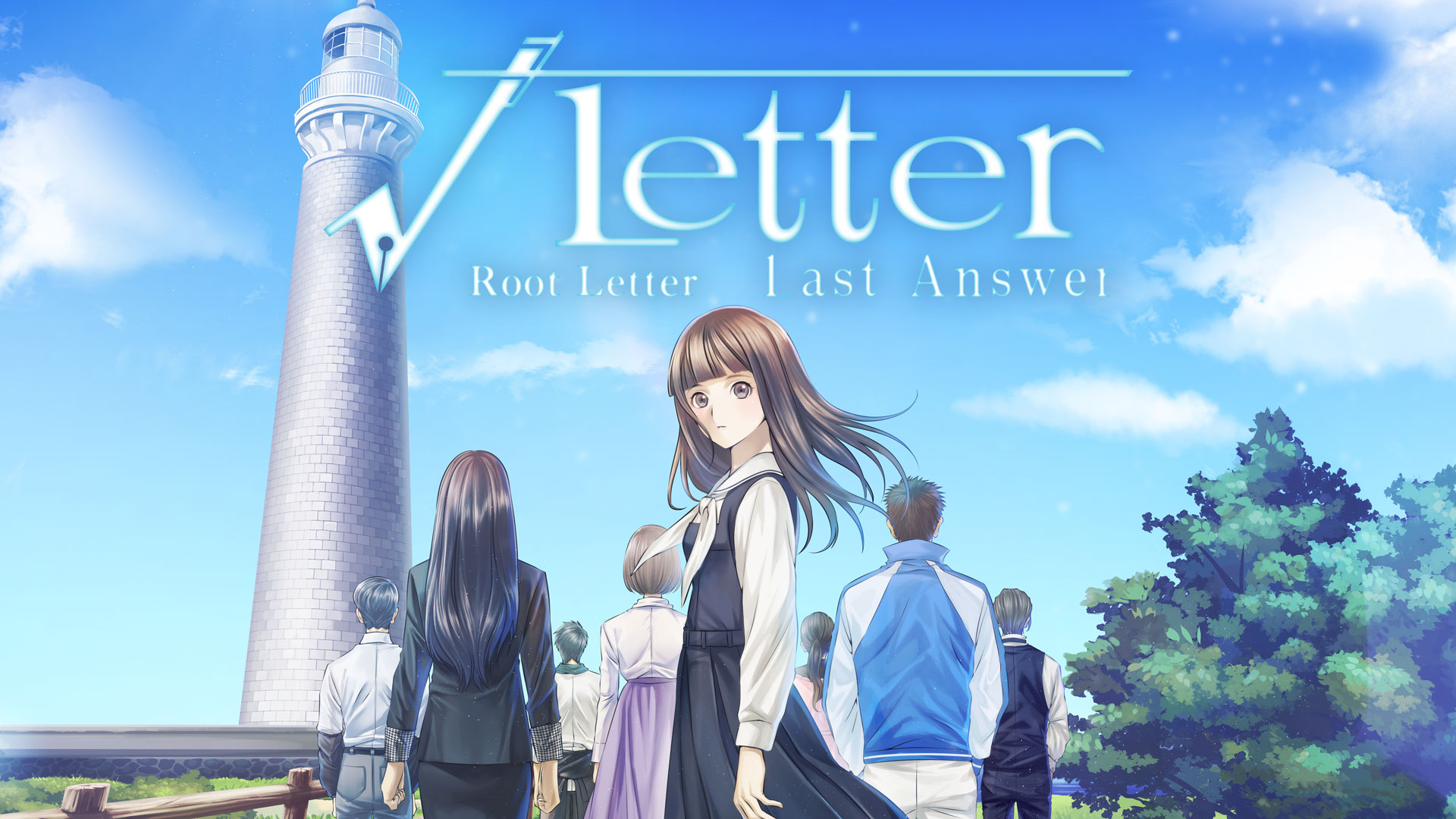
Root Letter

Root Letter is a mystery-themed visual novel that should take most people about six or seven hours to play. I’ve read a number of positive reviews of the game, so I went ahead and downloaded a copy onto my Nintendo Switch when it went on sale at the end of the year.

You play as Takayuki, a thirty-something white collar worker who’s left his job at a design firm and has a bit of free time before he’s scheduled to start a new job. When he goes home to visit his parents, he finds a set of letters from Aya Fumino, his pen pal from his senior year of high school. He’d exchanged nine letters with her, but he discovers a tenth at the bottom of the stack that he doesn’t remember reading. In this letter, Aya tells Takayuki that she can no longer continue their correspondence. She apologizes, saying that she has killed someone.

Takayuki decides to try to find her in Matsue, a city on the Sea of Japan about halfway between Osaka and Hiroshima. When he arrives at the address on the letters, however, he finds an empty lot. A passing neighbor tells him that the house burned down fifteen years ago, so he checks the records at the city library. He learns that, while a girl named Aya Fumino used to live in that house, she died twenty-five years ago, long before she could have written to him.

Why did the house burn down? Who was pretending to be Aya Fumino? And who did she kill?

With a week of free time and an intriguing mystery on his hands, Takayuki sets about tracking down the seven friends his pen pal mentioned in her letters. None of them want to talk to him, however, and everyone claims not to know anyone named Aya Fumino, even when presented with her photo. Your goal, as Takayuki, is to find and interrogate these seven adults in an attempt to figure out who “Aya Fumino” was and what happened during her senior year of high school.

There are five possible endings to Root Letter, but its gameplay is almost completely linear. You use a drop-down menu to move between various locations in Matsue as you follow various hints and clues, and the “Think” command on your menu will (almost) always tell you where the game wants you to go next. The interrogation scenes feature a few Ace Attorney style elements that involve presenting the right piece of evidence at the right moment, but this is also extremely linear. There’s no reward for exploration or creativity; but, thankfully, there’s no punishment for failure. Root Letter is much more of an interactive novel than a game, and it’s not interested in derailing your progress through the story.

The ending you see is determined by your choice of how Takayuki responded to the letter from Aya Fumino that’s presented at the beginning of each of the game’s chapters. You’re given two sets of choices per letter, and your options tend to fall into discrete categories at don’t make much sense unless you already know which ending you’re trying to unlock. Like the shitty casual gamer I am, I chose a “normal” (to me) range of mixed responses and got the worst ending, in which the whole mess about Aya Fumino was a government conspiracy to cover up an alien invasion.

My advice would be to avoid my rookie mistake by consulting a guide to the endings before you begin. Don’t worry about spoiling yourself, because Root Letter’s story is so convoluted that none of the endings will make sense if you haven’t played the game.

It’s my understanding that the “default” ending, meaning the ending you’ll see if you always choose the first response option, is a bittersweet story about missed connections, growing up, and letting the past go as you move on with your life. Another ending, the “Cursed Letter” ending, is about the power of teenage imagination to create both urban legends and personal identity; while another, the “Princess of Himegamori Forest” ending, is a horror-themed exploration of local Shintō folklore.

One of the main benefits of playing the Last Answer edition of the game (as opposed to the original 2016 release) is that it contains an optional “drama mode.” The drama version of the game uses photos of real actors and locations; and, based on what I’ve seen, the photography is quite polished and surprisingly faithful. Having played the game through once with anime illustrations, I’m looking forward to playing it again in drama mode at some point in the future.

While Root Letter pushes the player forward with the strong forward momentum of its mystery story, it also invites you to take time to appreciate the sights of Matsue. As Takayuki, you’ll get to stay at a traditional hot springs inn, stroll through the forested grounds of Matsushiro Castle, visit art museums, and eat at trendy cafés. Root Letter leans especially hard into its celebration of the local cuisine, and I’m excited about the prospect of being able to enjoy photographic depictions of Matsue’s food culture.

Unfortunately, some elements of the game haven’t aged well, probably because they were never attractive to begin with. To give an example, one character admits to a violent attempted rape, and the other characters just sort of shake their heads and move on. If this assault only comes up briefly and is never mentioned again, why include it in the story at all? Likewise, “Aya Fumino’s” fake suicide is teased fairly early in the game but isn’t given any dramatic weight. Rather, it’s played purely for shock value, with the implicit understanding that this sort of thing is just what moody high school girls do.

Some of the most uncomfortable parts of the game involve a character nicknamed “Fatty.” This character’s entire arc is about how he’s overweight, and about how overweight people are weak and gross and unlovable. In order to psychologically break this character during his investigation, Takayuki taunts him with chocolate-covered potato chips, which he can’t resist because, at the deepest core of his being, he is and will always be a big fat fatty. The whole thing is super gross, especially in combination with the casual gay panic thrown into this chapter. I feel that this is one of the many instances in which a more judicious localization could have made some slight changes, not to erase this type of bigotry and meanness, but to mitigate it somewhat.

The player’s enjoyment of Root Letter is largely based on its story, so it’s a shame that the translation is so lackluster. It’s perfectly serviceable, and it’s far from unreadable, but it has numerous quality control issues that would be tedious to list. My main complaint is that the translation received very little localization, which is frustrating in terms of both story and gameplay.

Regarding gameplay, the lack of a localization has rendered it somewhat difficult to talk to or interrogate people, as there are numerous instances in which none of the dialog choices make the slightest bit of sense. The game isn’t that complicated, so you can brute-force your way through the poorly translated bits by trial and error, but it goes without saying that you shouldn’t have to.

It’s tricky to discuss the situations in which localization would have been preferable to a direct translation without resorting to an infodump, but I can give one example that’s fairly self-explanatory. One of the friends Aya Fumino mentions in her letters is nicknamed “Bitch.” In Japanese, the loanword bicchi doesn’t necessarily mean “mean girl,” as it does in English. Rather, it’s the 2015 version of gyaru or kogal, and it refers to a teenage girl who dyes her hair and uses tanning lotion and dresses in trendy clothes and pays a lot of attention to the entertainment industry. The English equivalent of this term changes from decade to decade; but, given that Takayuki probably went to high school around 1998-2001 or thereabouts, “valley girl” or “Barbie girl” might work. The character nicknamed “Bitch” is actually quite friendly, so listening to the other characters talk about how much they used to admire their friend “Bitch” is bizarre.

Root Letter has some definite rough patches, but I want to emphasize that I enjoyed this game. I spent a week playing it, reading for about an hour every day, and I had a lot of fun with its ridiculous characters, charmingly convoluted plot, and unapologetic embrace of virtual tourism. I’m happy that I finally got a chance to play Root Letter, but I’m also happy that I was able to get the game on sale, because I’m not sure it’s worth more than $20.
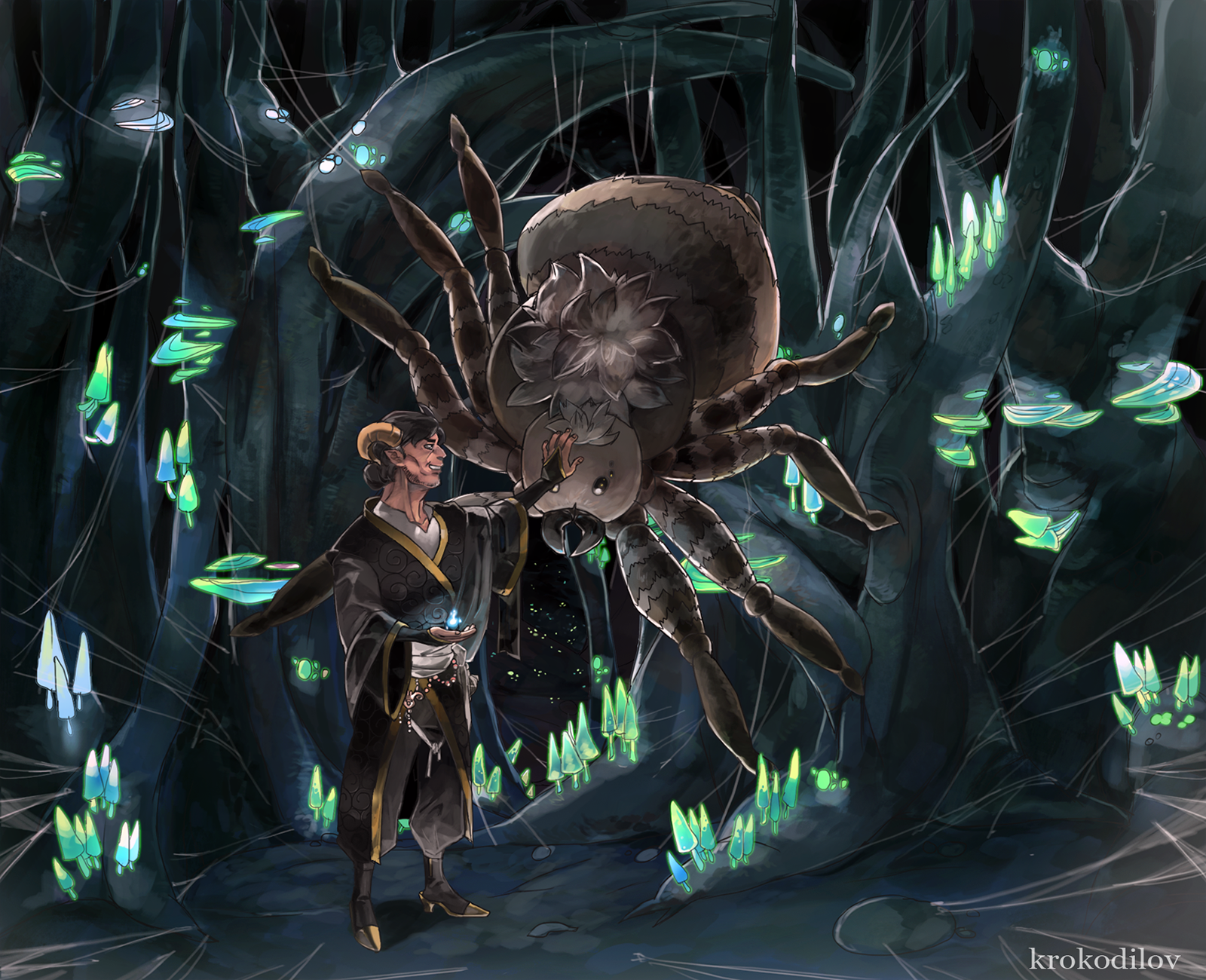
The Demon King, Chapter 7

This illustration is by the brilliant Yura Krokodil (@KrokodilYura on Twitter and @krokodilov on Tumblr). She also posts original comics on DeviantArt (here). This artist is a genius when it comes to environmental painting, and she’s magnificently talented at creature and costume design.

This is a scene from the seventh chapter of The Demon King, in which Balthazar ventures into a creepy mushroom forest and has a meandering conversation with a giant spider named Uniagoliantia. You can read the chapter on AO3 starting (here).

In Return of the King, Frodo and Sam cross through Cirith Ungol (“the pass of the spider”) on their way to Mordor, and along the way they encounter a giant spider named Shelob. The Silmarilion mentions that Shelob’s mother was Ungoliant (“dark spider”), a primordial spirit who took the form of an even larger spider. I think “Ungoliant” is a cool name, but it’s a shame it doesn’t have eight syllables, so I expanded it while making it sound more feminine.

Although there are definitely weird and creepy spiders in the world – just as there are weird and creepy fish and weird and creepy mammals – most spiders are just minding their own business, and I think their big bright eyes and round fuzzy bodies and short little legs are kind of cute.

When it comes to creepy things, I tend to think that mushrooms are much creepier than spiders. Still, they’re very cool-looking. I was talking with the artist about this, and about how the “evil forest” area that always seems to be one of the first dungeons in a lot of RPGs inevitably looks really interesting and beautiful, and she told me that she was inspired by the opening dungeon of Final Fantasy IX, which is called, appropriately enough, Evil Forest. It feels a bit anthropocentric to refer to a place that humans aren’t comfortable as “evil,” and I imagine that the creatures who live in any given “evil forest” are probably quite happy there.

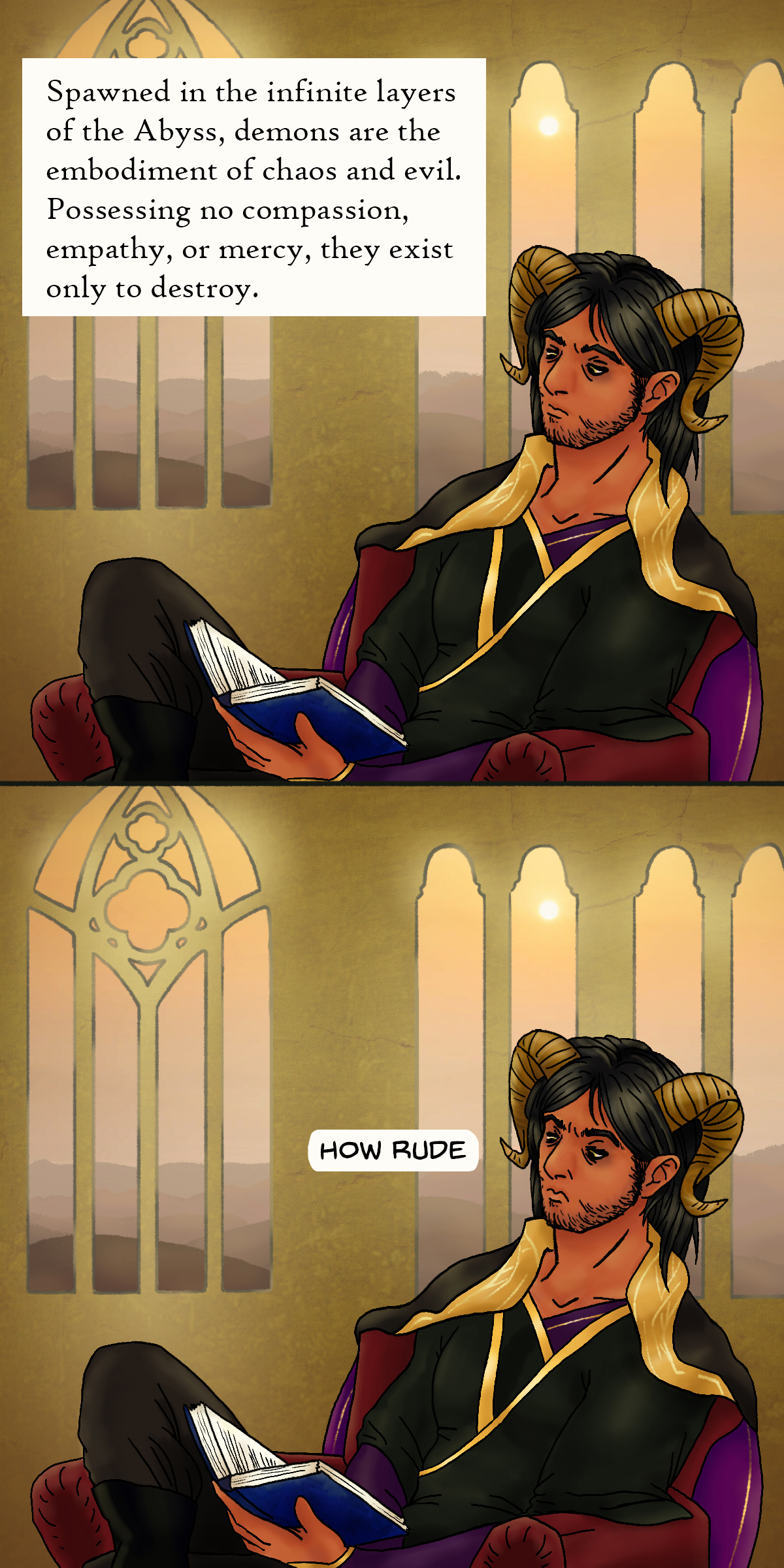
Demons Have Feelings Too

The passage Balthazar is reading is from the introduction to the “Demons” entry of the Dungeons & Dragons Monster Manual. The full paragraph reads:

Spawned in the Infinite Layers of the Abyss, demons are the embodiment of chaos  and evil – engines of destruction barely contained in monstrous form. Possessing no compassion, empathy, or mercy, they exist only to destroy. The Abyss creates demons as extensions of itself, spontaneously forming  fiends out of filth and carnage.

And this is just not a very nice thing to say, honestly.

I drew this comic to include as the interstitial illustration following the sixth chapter of The Demon King, which I’m posting on AO3 (here).

School’s Out

I’m like this at the end of every semester, but it hits especially hard this year.

It’s tough to get to know a group of interesting and talented people as you watch them learn and grow from week to week, only to then no longer see or talk to (most of) them ever again.