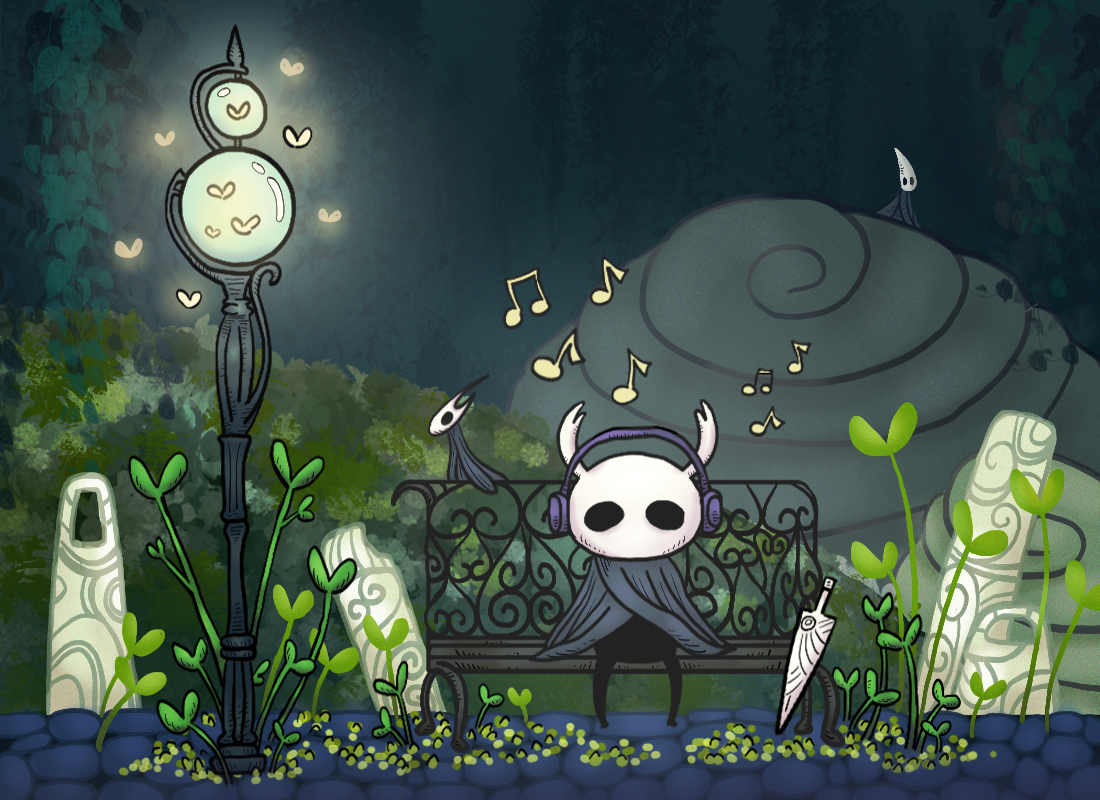
Greenpath

Hollow Knight is a Metroidvania-style adventure game set in the forgotten underground kingdom of Hallownest. The kingdom fell to ruin after a viral blight infected its citizens, transforming them into mindless husks. As a knight in the form of a small beetle wielding a nail, you venture below the surface through a secret entrance in an old well to challenge the mysteries of Hallownest.

The old underground roads are long abandoned, and there are no helpful signs to guide the player through the maze of passages. The necessity of careful exploration as you find your own path forward is one of the primary appeals of Hollow Knight, but it’s easy to lose your way and fall victim to the undead husks or become trapped in the dilapidated infrastructure.

The tiny protagonist’s journey through Hallownest is lonely, but the ruins of the old kingdom are far from empty. Where there were once cities and markets and train stations, dense vegetation now breaks through the paving stones and covers crumbling structures in blankets of flowering plants. Nowhere is this postapocalyptic explosion of nature more apparent than an area called Greenpath, where small birdlike creatures flutter through the underbrush while giant dragonflies glide in lazy circles above bubbling pools of acid water.

Hollow Knight’s soundtrack, written and digitally performed by the Australian composer Christopher Larkin, captures both the loneliness and wonder of the kingdom of Hallownest. I find the background music for Greenpath especially atmospheric and evocative. It begins with bright and gentle strings that suggest the twinkling of fresh dew and the whisper of wind over moss. Soft and airy notes from a flute and xylophone join the song to create a melody reminiscent of the rustling of leaves as you scuttle through the bushes. 

The environmental music in Hollow Knight is adaptive, meaning that it changes according to gameplay. Some of the more challenging sections of Greenpath necessitate precisely timed jumps over deadly beds of tangled thorns, and the song crescendos into string chords as staccato as your character’s footsteps as you rush through the beautiful yet menacing jungle. You feel as though you’re truly exploring overgrown ruins, brushing aside vines as you navigate the twisting stone corridors.

The quietly elegiac environmental songs of the Hollow Knight soundtrack are oddly relaxing and make excellent ambient background music. If you’re in the mood for something more upbeat, the boss fight battle songs are fantastic as well. You can listen to the complete album on Spotify and YouTube, and (this link) will take you directly to the song “Greenpath” on Bandcamp. 

. . . . . . . . . . . .

This essay was published in the “Playlist” issue of the West Philly Dog Bowl Zine, which debuted at the Philly Comics Expo this past weekend. You can download a free digital version of the zine via their Linktree site (here).
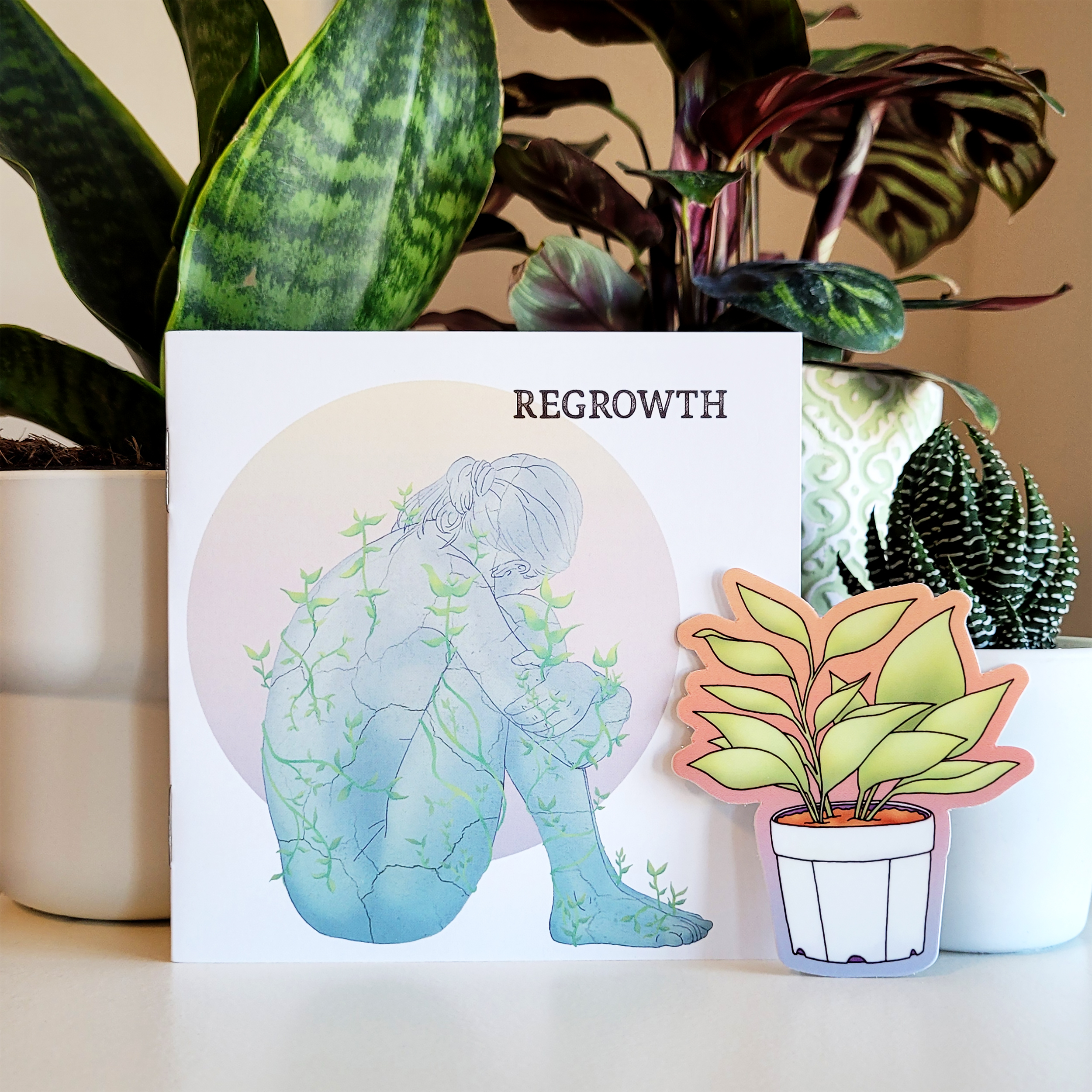
Regrowth Minicomic

Regrowth is a short comic is about how trauma isn’t just something that one overcomes on the road to personal character development, but rather a significantly transformative experience with lingering aftereffects. I wanted to illustrate how difficult it is to cope with trauma, but how it’s also an opportunity to grow and change.

You can download a free digital version of the zine from Gumroad (here), and it’s (here) on Etsy if you’d like a physical copy.

Wanderers

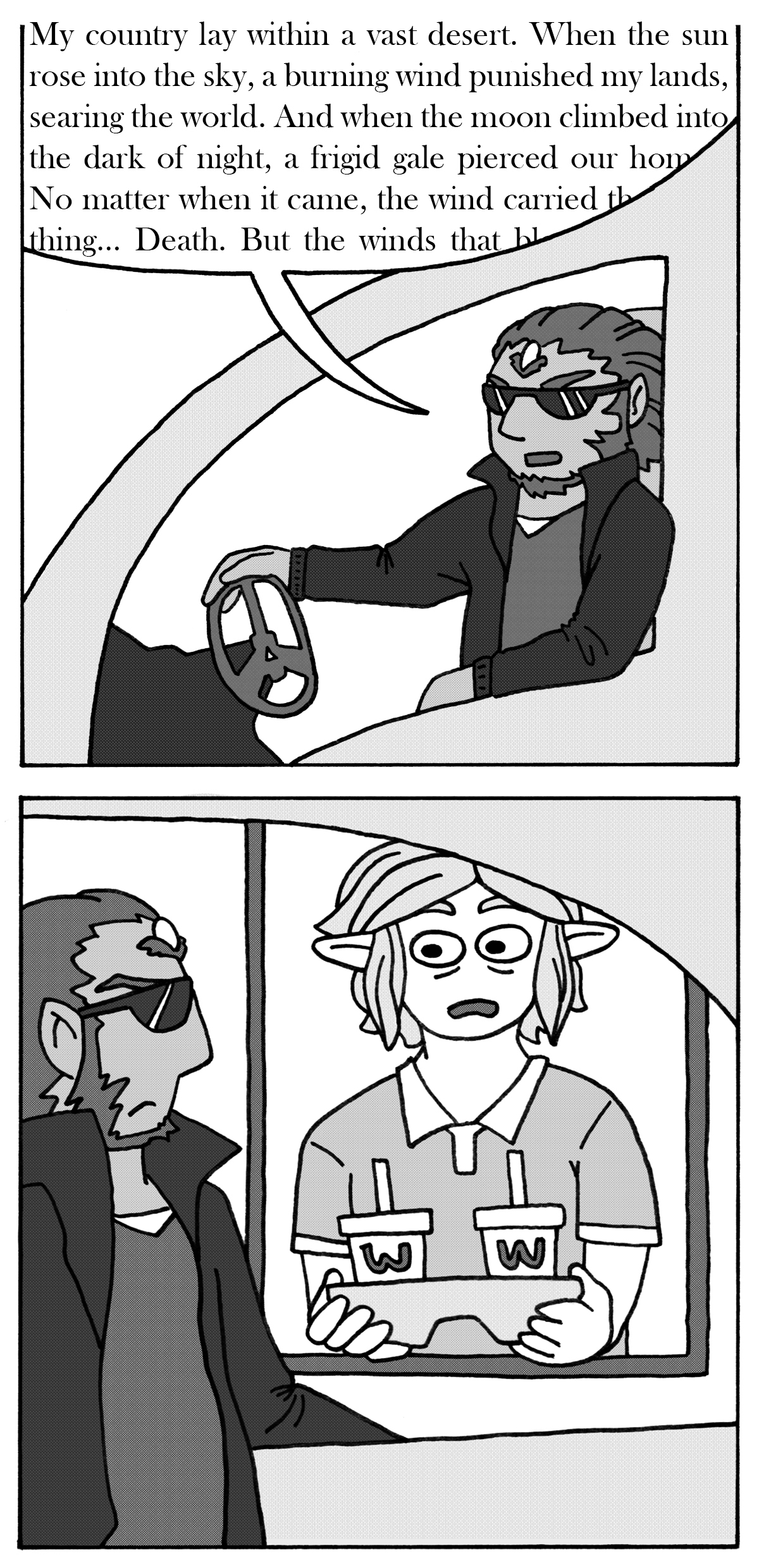
This comic was written by me and drawn by LunaArtGallery, whose work can be found on Tumblr, on Instagram, and on Twitter. You can read their commentary on the piece on their Tumblr post (here).

Given that the universe of the Legend of Zelda games is characterized by its disparate timelines, I’d like to think that there’s at least one timeline in which Zelda and Ganondorf work out their differences peacefully instead of enacting the cycle of destruction brought about by a war between two ancient gods. Every game in the series is filled with abandoned ruins that Link explores but never questions, so it might be interesting for Zelda and Ganondorf to seek out the truth underlying the legends that have shaped their lives. This idea was inspired by the game Journey, which is about bearing witness to the mistakes of the past in a quest for atonement and enlightenment. If we ever get to play as Zelda, it would be lovely for her adventure to take her in a similarly compelling direction.

Mount Hiei

My story “Mount Hiei,” a dark fantasy about two young monks navigating the eerie twilight years of the Heian period, was just published in Hyakumonogatari Kaidankai, a special issue of the journal White Enso. The issue is currently ongoing and free to read online (here), and “Mount Hiei” is on (this page).

In this story, a ten-year-old boy becomes an apprentice monk on Mount Hiei, which houses a temple that has been tasked with protecting the nation. The boy grows accustomed to monastic life but never becomes comfortable with the statues of the monstrous Guardian King venerated by the other monks. When he discovers a secret door leading into the mountain, he comes to understand why the deity is depicted in such a frightening manner – as well as what “protecting the nation” actually entails.

Mount Hiei is a real place, as is Enryaku Temple, which serves as the setting of this historical horror story. To the best of my knowledge, the practical details of monastic life are accurate for the time period. I was inspired by the fiction of the Japanese author Ken Asamatsu, who applies a Lovecraftian sensibility to Japanese mythology and folklore, and I wrote this story from a place of admiration and respect for the medieval war epic The Tales of the Heike, on which it’s very loosely based.

By the way, the editors of White Enso are still looking for personal essays and original fiction for the 100 Ghost Stories Kaidankai project. Although they’re selective, they accept shorter and more casual pieces, and the submission process is very chill and relaxed. The editors are a pleasure to work with, and they’ll also create a podcast recording of your writing! If you’re interested, you can send your submission (here).

How to Board the West Philly Ghost Bus

(1)  It needs to be after dark.
(2)  You should be standing at a bus stop.
(3)  You need to be horribly, desperately lonely.
(4)  You can’t have a specific destination in mind.
(5)  You’ll see a bus with no route number on the display.
(6)  It will slow down but not stop, so you need to chase it.
(7)  You probably won’t catch it, but if you do…
(8)  The driver will let you on without asking you to pay.
(9)  You’ve made it this far. You might as well sit down.

I’ve recently found myself asking people I meet in West Philadelphia if they know any urban legends. Most of what I’ve heard are rumors about real people who have become local characters or stories about bodies being buried under public places. (Because Philadelphia is a relatively old city, the stories about buried bodies are mostly true!) A few people also told me about a ghostly SEPTA bus, which is famous enough to be mentioned a few times online.

According to the stories I’ve heard from university students and friendly strangers I’ve spoken with at local bars, the ghost SEPTA bus picks up people late at night, but only if they have nowhere to go and no one to miss them once they disappear onto the bus. 

There are actually a number of non-supernatural SEPTA buses that drive back along their routes through West Philly when they aren’t in service, and I occasionally see them pick up city maintenance workers and hospital staff late at night. What’s different about the ghost bus is what happens once you get on.

Apparently, there are three possibilities. The first is that the bus vanishes, and you’re never heard from again. The second is that you’re now trapped on the SEPTA bus along with the other desperate and unlucky souls who boarded before you. The third is that the bus travels back in time, albeit within a span limited to the history of the bus, and that you can signal the driver to stop when you’ve reached your desired destination in the past. 

The third possibility seems the most likely, as no one who has vanished or become trapped on the bus would be able to tell other people how this process works. Then again, it may be that a person who boards the mysterious SEPTA bus seems to vanish or sit in stasis from the perspective of someone who’s still in our timeline. There’s only one way to find out for sure…

Sparkle

“They’re for my niece,” he explained to the clerk who rang up the pair of earrings. He was too young to have a niece, and he wouldn’t have given her cheap dollar store earrings anyway, but oh how they sparkled when he clipped them to his ears later that night.

. . . . .

I wrote this 50-word story for the “Dollar Store” issue of a magazine called Blink Ink, which describes itself as “home to the finest in contemporary 50 word fiction.” Blink Ink is only available in print, and you can get a subscription on their website (here) if you’re interested.

Half Past Fate

Half Part Fate is a visual romance novel by an American developer that follows three couples on their journey to their first date. There’s a long list of possible achievements to unlock, but the story itself is entirely linear. Although the characters are adults, the tone is 100% PG, and everything is very sweet and wholesome.

The game is divided into twelve chapters, each of which takes about ten to fifteen minutes to complete depending on how quickly you read and how much you want to explore. You play each chapter as one of the romantic leads in a top-down environment, each of which functions as a small and self-contained stage reminiscent of the “town” sections of a 16-bit JRPG. Your job is to walk around and talk to people, and the gameplay elements are limited: Person A will give you Object B, but only if you trade it for Object C that you get from Person D. There are (mercifully) no puzzles or reflex-based minigames, making Half Past Fate a chill and relaxing experience.

The environments are a lot of fun. The game is set in a romanticized hybrid of Los Angeles and Austin, and there is no crime, poverty, or infrastructural decay. Everything is clean and neat and aesthetically pleasing, and no one is rude or creepy. You can therefore walk around urban environments like coffee shops, public parks, outdoor shopping arcades, and waterfront bars without worrying that someone is going to report you to the police for striking up conversations with strangers. Half Past Fate reminds me a lot of Earthbound in that it offers the player an opportunity to stroll around a contemporary city and read quirky flavor text while catching small glimpses of people’s lives.

The three love stories are just as cute and charming as the pixel art. One couple has been friends since college but never found the right time to confess their feelings, and now they find themselves realizing how much they mean to each other as their artistic careers have started to take off. One couple meets randomly at a tea-themed street fair and has a lovely afternoon together, but then the boy loses the girl’s phone number and has to track her down. The third couple is entangled in a high-stakes game of money and power and deception, and it admittedly takes a willing suspension of disbelief to fit them into the same world as the other characters, but I still liked their story a lot.

The three main couples are straight, but they’re surrounded by representatives of a rainbow of genders and sexualities. Many of the queer side characters are involved in romantic dramas that you can piece together if you take your time exploring, and queerness is so open and omnipresent that the straightness of the main characters doesn’t feel forced.

In addition, the diversity of the cast is taken entirely for granted, which I appreciate. The racial and ethnic identities of the characters are specific and affect more than their family names and physical appearance, but they’re never the sum total of any character’s personality or backstory. Speaking personally, it’s rare to see multiethnic friend groups represented in popular media in a way that doesn’t involve tokenism, but the characters’ networks of relationships felt very real and natural to me.

I picked up Half Past Fate on Nintendo’s online storefront, and I enjoyed playing it as a handheld portable game on the Switch Lite. I’m not sure if the full $10 list price will be worth the three hours of gameplay for everyone, but it definitely was for me (especially considering that paperback novels cost almost $20 these days). Although I would have preferred a bit more bite and tension in the storytelling, the art and graphics are wonderful, and I’m a big fan of this retro JRPG style of structuring a visual novel. I’ve already downloaded the second game in the series, Half Past Fate: Romantic Distancing, and I’m looking forward to sitting down with it the next time I want to spend a relaxing afternoon in a softer and brighter version of reality.

The Coming Storm

This is a tribute to the iconic Zac Gorman comic, but with a twist.

I sometimes think about how Ganondorf more than likely didn’t start out as evil. I imagine that he probably went on a journey that paralleled Link’s, but his reaction to the secrets he found in hidden caves and forgotten temples was substantially different due to the circumstances of his life and destiny. While the Legend of Zelda games contain subtle elements of melancholy from Link’s perspective, Ganondorf’s story is more like a full-on Greek tragedy.

Mad Father

Mad Father is a retro survival horror game about a cute girl named Aya who lives in an isolated mansion with her father. As you might be able to guess from the title, her dad is not 100% sane.

The game was originally designed with RPG Maker and released on Steam in 2012, but it’s been remastered for Nintendo Switch with updated graphics and sound design, as well as a few postgame bonus segments. It takes about three hours to play, and I felt that it was a good value when I bought it on sale on Nintendo’s digital storefront for $5. The horror is ghoulishly cheesy, and the jump scares are a lot of fun.

The opening of the game is nonlinear, as Aya has the run of the entire aboveground portion of the mansion. It’s somewhat difficult to understand what to do at first, and I admit that I had to consult a walkthrough to figure out how to get started. Once you gain access to the family’s sprawling underground murder dungeon, however, the path forward becomes easier to discern. Also, once you figure out how the environmental puzzles are supposed to work, they become much more entertaining.

As you grow accustomed to Mad Father during the first hour of playing, the jump scares become less effective, and the game compensates by leaning hard into camp. I don’t mean to suggest that anime can’t be scary, but Mad Father’s combination of over-the-top character portraits and cute pixel art amps up the carnivalesque elements of the story. By the time the dad starts chasing you with a chainsaw, my main reaction to the various horrors on display was delighted amusement.

There is one genuinely creepy moment toward the beginning of the game involving the father’s (nonsexual) reaction to the distress of a naked preteen girl, and it’s creepy because the game knows this reaction is upsetting but still treats it as perfectly natural. The killer dolls and unquiet ghosts haunting the tunnels of the murder dungeon aren’t actually all that scary, but the “kind” behavior of the father during the sepia-tinted nostalgia flashbacks is super disturbing. Mad Father is officially rated Teen, but it’s definitely not for kids (or adults sensitive to depictions of child abuse).

The basement of this family’s house is truly epic, by the way. The other day I was reading that a lot of families who live in McMansions don’t actually have any furniture in most of the rooms, and that makes sense to me. If you’re not imprisoning people to use as subjects for occult medical experiments, then what are you supposed to do with all that space, exactly? If nothing else, I suppose Aya’s dad is to be commended for his commitment to his interior decorating theme. It’s a shame that this theme is “horrible grotesque murder,” but if he’s paying the property tax on all those rooms then he might as well put them to good use.