Ananth and the World of Demons

Most of my novel The Demon King is set in postapocalyptic New Jersey in an era far in the future, but the world before the apocalypse is my attempt at imagining a contemporary “low fantasy” society where magic is commonplace but not particularly fantastic. Almost anyone can perform magic, just as anyone can play an instrument or do math without a calculator, but most people either don’t care or don’t bother.

The difference is that being good at guitar or having the ability to solve equations in your head can’t directly hurt people or reshape reality. Kids therefore have magic classes in school from age nine to age fourteen; and, starting at around age ten, children attend magic academies for three or four weeks over the summer. Attendance at summer academies is mandatory during middle school and optional during high school. Some of these academies are private, while others are state sponsored. Most of the subsidized summer academies are hosted by local colleges and universities, while others are conducted at specialized institutions.

Magic classes and summer academies are ostensibly intended to train children and teenagers to use magic responsibly while helping them to develop their talents, but most kids take magic class about as seriously as they take art class – which is to say, not very seriously at all. The real purpose of magical education is to alert professional magic users called mages to children with unusual talents.

Most people don’t have much magical aptitude, but a small percentage of children demonstrate powerful magic from an early age. Performing magic is a complicated process that requires an external point of focus, meaning that it’s not something that can be done unconsciously or accidentally. Regardless, any type of magic can be dangerous if the user is powerful and untrained. Children with an unusually high level of magical ability are therefore singled out for extra attention and education.

Many magically talented children grow up to use their magic professionally. Almost all sports involve an element of magic, for example, so most athletes are skilled magic users. People who specialize in “shadow” magic, which involves manipulation of the perception of light, often go into the arts, while people who are skilled at “sun” magic, which involves the manipulation of organic matter at an elemental level, go into medicine. This doesn’t mean that magic is necessary to become an artist or a doctor, but rather that many professional fields accommodate magic.

Highly trained professionals called mages study magic for its own sake. Mages work (and often live) at the magic academies that run summer programs for children, and one of their primary duties is to monitor and police the use of magic. Although mages may be occasionally be affiliated with law enforcement, they mainly operate according to traditional codes of law that are international in scope. As a result, their activities may be extralegal at times. This is because magical threats are extremely dangerous, and it’s necessary to contain such threats as quickly as possible.

Thankfully, magical crises are highly uncommon, as sociopaths and gifted magic users are equally rare. Moreover, the vast majority of potential problems are neutralized at the summer academies, which serve as an opportunity for mages to keep watch for antisocial behavior and dangerous magical talents.

Each of the permanent academies that train mages houses an “elemental keystone,” which is a physical object that functions as a magical battery. A keystone can be anything, but it’s often symbolic and generally small enough to be held in one hand. These keystones contain traces of the power of every mage who has studied at the academy, and they distribute magical energy to the academy’s infrastructure while serving as a repository of tradition and knowledge.

The process used to transfer individual magical power into and away from the keystone can also be weaponized to permanently drain someone’s magical ability. Although this happens only in the most extraordinary of circumstances, the complete absorption of someone’s magic into a keystone can be used as a punishment or a preemptive measure. In most cases, the person is unharmed; while in others, the process renders them physically and psychologically inhuman.

The victims of such tragedies are called “demons,” and their existence is unknown to everyone but the most advanced of mages. The process that creates demons is horrible and inhumane, but the alternative of giving free rein to dangerous magic users is unthinkable.

In order to prevent keystones from being easily accessible, they are hidden within labyrinths that can’t be navigated by anyone who isn’t a mage-level specialist in the particular type of magic contained within the keystone. Human interactions with these keystones are therefore infrequent. Some cultures view them as sacred objects, while the more secular view is that prolonged contact with keystones is demonstrably unhealthy. Starting in the late nineteenth century, there’s been a halting but gradually growing movement to do away with them altogether. Nuclear power is a useful but imperfect analogy, as keystones remain the only way to neutralize dangerous magical abilities.

Like any other magically enchanted object, keystones gradually lose their charge if not maintained. There is nevertheless a covert and illegal trade in keystones, which are perceived as art objects of historical and archaeological significance even if they no longer contain magical power. By the twenty-first century, fully active keystones have become extremely rare, so much so that most people consider accounts of their power to be mere legends.

The apocalypse was triggered by a young researcher at an East Coast R&D branch of a large and wealthy tech company. The researcher and her team had access to multiple keystones in close proximity to each other, a situation that never would have been possible without the company’s extraordinary wealth, prestige, and power. To make matters worse, this researcher was working outside of the academy system with no oversight by more mages who possessed a better understanding of how keystone magic works and what makes it so dangerous.

In the process of triggering the apocalypse, the researcher managed to absorb a portion of the magical energy of the disaster into a new keystone, which happened to be the closest thing she had at hand – her smartphone. After decades of postapocalyptic turmoil, this smartphone-turned-keystone eventually became the magical relic that powers the water purification facility hidden in the mountains separating the kingdom of Whitespire from the ocean, whose water has become toxic to humans. The relic’s existence is a secret guarded by the royal family of Whitespire and the esoteric order of monks who serve them, as its destruction would mean the certain demise of the kingdom.

Ananth, the eponymous “demon king,” comes from the world before the apocalypse. His parents are both specialists in sun magic; but, instead of being able to manipulate matter at a quantum level, he can manipulate time. Suspecting that his magic is highly illegal and would result in his detention at a magic academy if its nature became known, he presented himself as completely unable to use magic for most of his life. When the apocalypse happened, however, the benefits of time travel suddenly outweighed its risks.

As well as going back in time, Ananth is able to jump forward into the future. There are a number of limitations and caveats to what his magic can achieve, however; and, on top of that, he’s a normal person with no magical training. Through extensive trial and error, he’s realized that his best bet for preventing the apocalypse is to steal the keystone from Whitespire and return to the past with it, where he could hopefully use its power to cancel out the initial magical chain reaction.

When The Demon King opens, Ananth has been time traveling for years, but he hasn’t gotten anywhere. He’s seen the apocalypse happen countless times and been unable to stop it, and he’s seen countless people killed in countless wars as he watched civilization re-establish itself. He’s almost been killed countless times himself. He’s gotten older, and he’s tired. Despite himself, he’s managed to become friends with Ceres, the reigning queen of Whitespire, and he finds himself increasingly involved with the people who live in her era.

Ananth is therefore faced with a terrible choice. Is it worth saving his world if he has to destroy another world in the process? More importantly, if Ananth can’t save the world, who’s going to save him?

. . . . . . . . . . . . . . . . . . . .

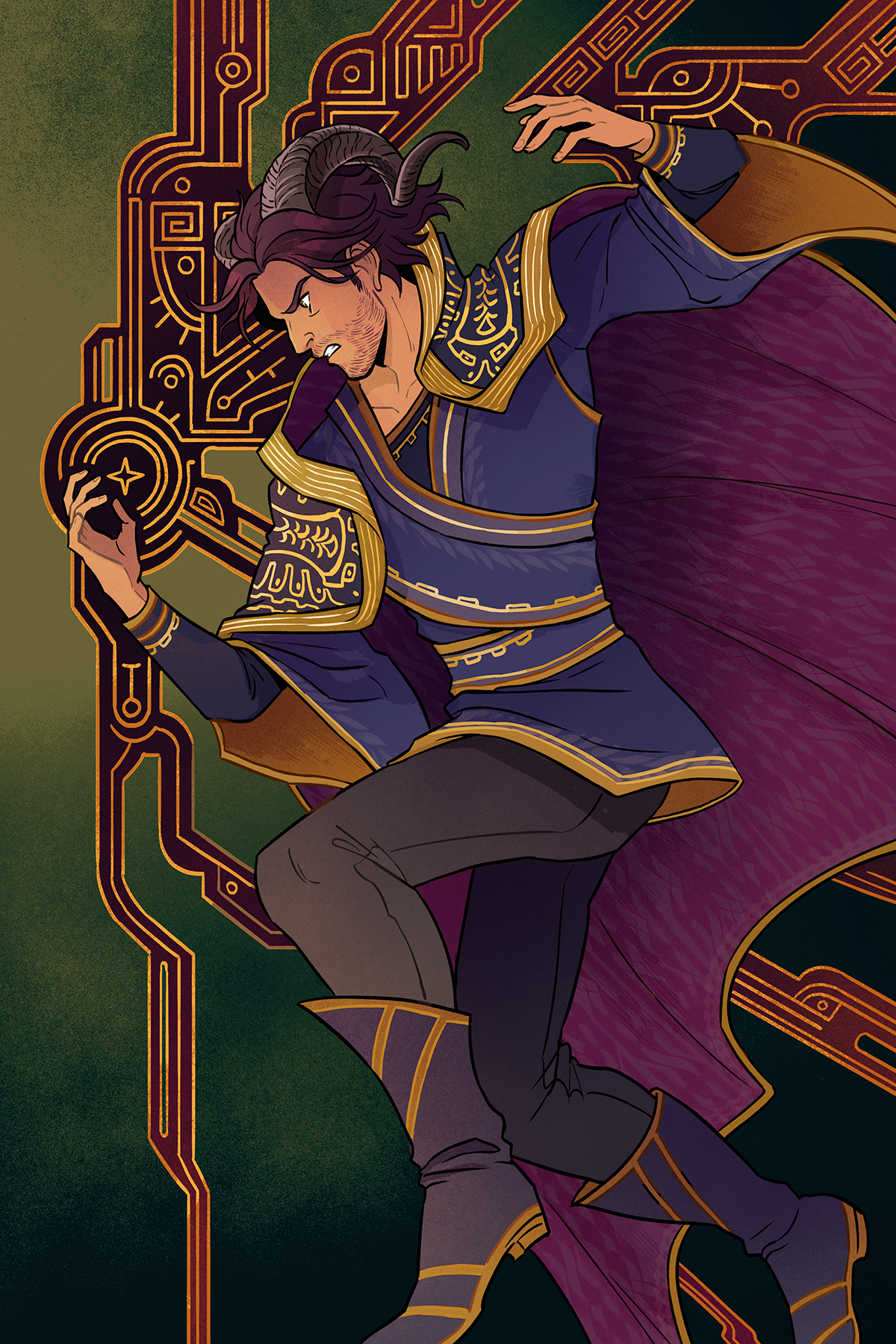
This illustration of Ananth was created by the legendary Sam Beck, who writes and draws a fascinating and nuanced comic about lost magic and renegade wizards called Verse, which you can check out (here). Sam goes by @sambeckdraws on Twitter and on Instagram, and you can see more of her professional comic and illustration work on her portfolio site (here).

The Life-Changing Magic of Just Letting Things Break

Solarpunk Is Not About Pretty Aesthetics. It’s About the End of Capitalism.
https://www.vice.com/en/article/wx5aym/solarpunk-is-not-about-pretty-aesthetics-its-about-the-end-of-capitalism

Many solarpunks agree that the “punk” element becomes clear when they go past the movement’s visuals and into the nitty gritty. Solarpunk is radical in that it imagines a society where people and the planet are prioritized over the individual and profit. Of course utopian visions of the future aren’t new and art and technology have long drawn from nature: Just take the example of Belgian architect Luc Schuiten, whose drawings and buildings often employ biomimicry, where the form and function of organic elements influence design. The movement gained traction in progressive circles on early 2010s Tumblr, but as its popularity has bloomed over the past 10 years, early Solarpunks fear capitalist co-option. Flynn calls it “fake Solarpunk urbanism,” luxury condos with a green roof that price out existing communities and might end up doing more environmental damage.

This is a lengthy article with a lot of interesting links, and it’s worth checking out solely for the beautiful embedded video.

I think the emphasis on “radical action” might be somewhat misguided, though. My concern, as always, is the way anti-capitalist movements are embedded within the language of capitalism. Like, we have to be active! And go out and do things! And harness our energy as our best and most productive selves! I think this neoliberal emphasis on individual agency and power strays a bit too far into the territory of ecofacism, which holds that people who don’t have the skills or resources to survive environmental catastrophe deserve to die.

For me, the appeal of solarpunk is that you don’t have to do shit. You don’t have to work. You don’t have to make money. You don’t have to buy things. You don’t have to participate in “community improvement” projects. Instead, leave your job early and turn off your phone. Stay at home and chill out. Sit out on your porch and have a drink with your neighbors. Grass and flowers will grow in the cracks of the concrete without your help. All you have to do is literally nothing.

One of the reasons I enjoy living in Philadelphia is that it’s a very compact but very green city. The great thing is that it’s not green because of city planning or district gardening budgets, but rather the exact opposite. The city just lets plants grow, and nobody who lives here does anything to stop them. The Amish set up farmer’s markets on the weekends, and nobody bothers them. People sell fresh fruits and vegetables out of the backs of U-Haul trucks in parking lots on the weekdays, and nobody cares. Nobody chases away the urban outdoorspeople who plant gardens in the larger public parks. The city is covered in folk art, from Isaiah Zagar’s broken glass murals to the work of street artists whose tags are elaborate illustrations of Studio Ghibli characters. This aesthetic exists because nobody “did” anything to “fix” it, and it makes Philadelphia a comfortable and interesting place to live.

At the same time, a cleaner and more carefully managed solarpunk aesthetic would make much more sense for a place like New York, where “just letting things break” would result in most of Manhattan Island flooding in less than 48 hours. The sea level is rising, and I assume that the flooding is going to happen eventually, but that doesn’t mean you can’t have stylish vertical gardens while the city is still above water. People have to eat, and people have to live somewhere, so your rent might as well pay for community deck gardens and solar panels.

Ceres and the Poison Sea

I just finished Chapter 10 of The Demon King, an original fantasy novel about adult wizards making terrible decisions. This chapter is an extended flashback to the time before the apocalypse that created the world of the story. Although I’m still brainstorming the details of this disaster in terms of the universe’s magical system, what essentially happened is that a frustrated researcher with a wealth of funding but no oversight managed to create the equivalent of a miniature sun that exploded into a supernova before collapsing into a black hole. This set off a chain reaction that rapidly accelerated climate change, which in turn significantly raised the sea level and irradiated the ocean.  

The researcher’s tech firm was located in New York. Because of the disaster, the city no longer exists, nor does anything east of Newark Bay and the Arthur Kill Straight. In order to prevent the decimation of the entire Mid-Atlantic region, mages pushed the landmass of Manhattan Island and Staten Island westward to create a mountain range protecting the mainland from the toxic ocean and its storms. This mountain range also serves as a water filtration system that feeds a system of freshwater lakes and rivers to its immediate west, which has become a kingdom known as Whitespire.

Geographically speaking, Whitespire is somewhere in the vicinity of Elizabeth Seaport in New Jersey. Although a great deal of I-95 is underwater, Route 1 still functions as a major trade route, and Whitespire is about halfway between the Northern Kingdoms (Hartford, Springfield, and a bit of Rhode Island) and the Southern Territories (Baltimore and Washington DC). Because of changing climate patterns, everywhere north of Albany and south of Richmond is uninhabitable, as is the land west of the Appalachian Mountains. Meanwhile, most of New Jersey and eastern Pennsylvania is a wasteland where water is scare and nothing grows.

The Northern Kingdoms are governed by draconian regimes that are constantly at war with one another, while the Southern Territories are lawless and threatened by the steadily rising ocean. Whitespire is the only real civilization left on the East Coast of North America, which has been isolated from the rest of the world by the impossibility of travel by sea or air. The citystate thrives because of its mild climate, access to plentiful fresh water, and relative distance from other centers of power.

Whitespire is ruled by a royal family whose primary duty is to ensure that the system filtering the seawater through the mountains continues to function properly. The bloodline of the royal family is not strictly hereditary, as anyone able to command the necessary magic may be adopted into royal line. Generally speaking, however, knowledge of the kingdom’s secrets and rituals are passed from parent to child. The queens and kings of Whitespire are supported by a religious order dedicated to preserving the magic necessary to protect the kingdom.

Under the stewardship of its royal family, Whitespire has been peaceful for several hundred years, but this doesn’t mean the monarchs have absolute authority. Political power is shared between the noble lines that maintain the rivers and lakes that spread from the Whitespire Castle, and there are occasional disputes over succession, taxes, and territory rights.

Ceres is the current reigning queen of Whitespire. For reasons known only to herself, Ceres’s mother resolved disputes among Whitespire’s aristocracy through strategic assassinations, which eventually resulted in her murder. As a result, Ceres ascended the throne during a political crisis when she was nineteen. She is a supremely competent ruler, but her reign has been marred by lingering political tensions. She navigates this challenge by presenting a wise and virtuous image of herself in public but being crafty and merciless behind closed doors.

Ceres was born to be a queen, and she plays her role with style and grace. Her only concern is that she is entirely ignorant of the vast majority of Whitespire’s deep magic, as her mother never shared the kingdom’s lore with her. To make matters worse, the former queen killed many of the people who were close to her, along with the entire order of priestesses dedicated to the worship of a deity called The Weaver, who supposedly established Whitespire by wresting the primordial world from the control of demons.

Although the truth is more complicated, “demons” are believed to be powerful monsters whose magic can’t be controlled and can thus only exist in a state of madness and chaos. Demons are real; and the eponymous “demon king” Ananth, who has traveled centuries into the future from a time that he considers be the pre-apocalyptic present, is one of them.

Ceres is primarily a foil to Ananth during the first two narrative arcs, but I plan for her to become the main viewpoint character during the third and final part of the story. She befriends Ananth mainly for political reasons as she attempts to prevent a coup organized by operatives from the Northern Territories, but her real interest in him comes from his openly stated intention to steal the hidden relic that’s the key to the magic of the royal family. Ceres needs this relic just as much as Ananth does, so she aids his plans with the hope that he’ll find it for her. As someone who possess powerful magic of her own, Ceres has full confidence that she can fight and kill Ananth if necessary, so she’s completely unbothered by his antagonism toward her.

Ananth doesn’t treat Ceres like a queen, so she returns the favor by not treating him as a demon capable of destroying her kingdom whenever the mood strikes him. As a result, they gradually form an unlikely friendship that gives Ceres a stage to be her best and most authentic self, namely, a strong and self-assured woman who loves drinking and dick jokes. It goes without saying that she’s a joy to write.

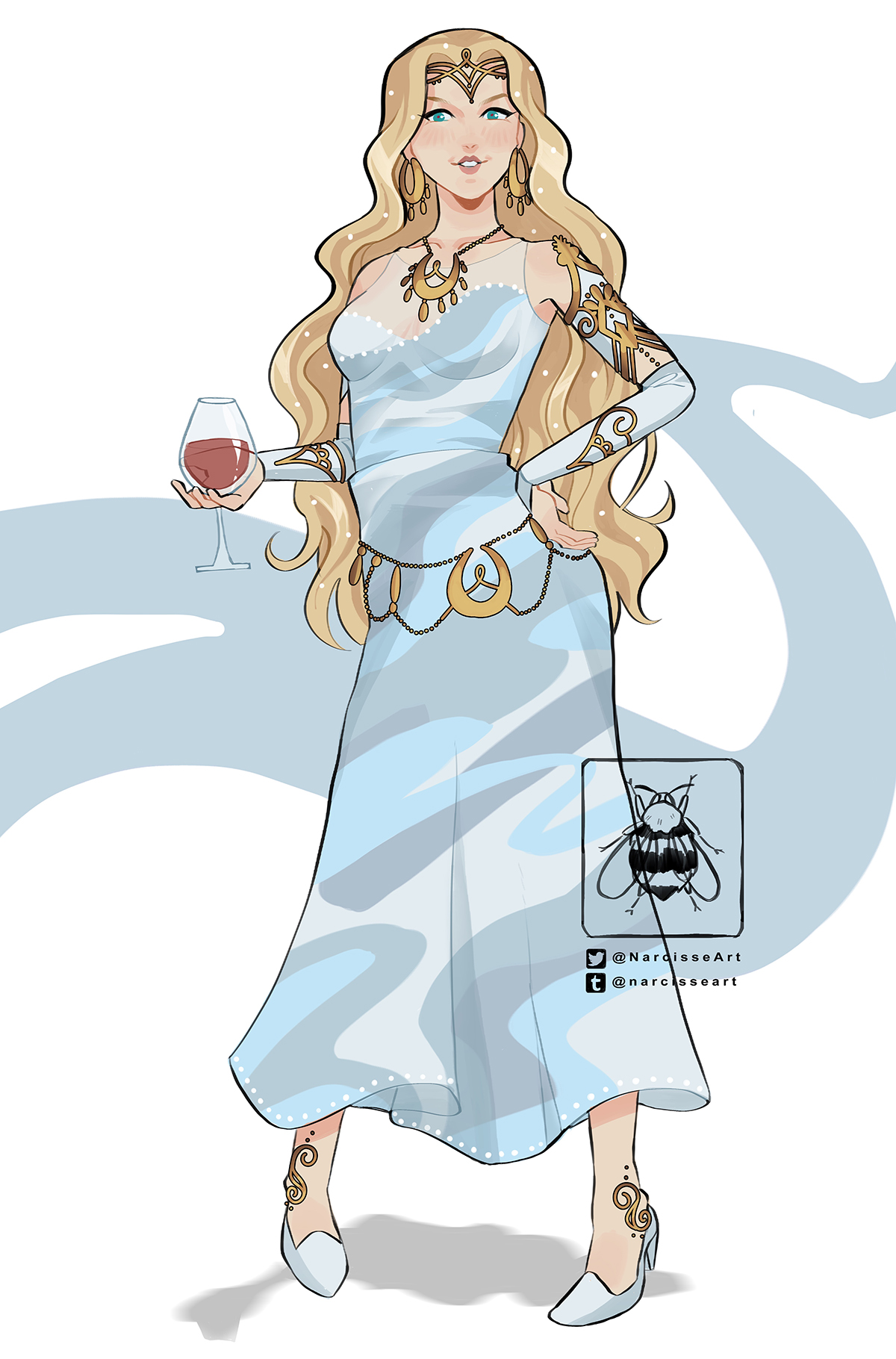
The illustration above was created by Doc Hollibee, who is on Twitter (here) and Tumblr (here). Doc drew me a picture of Princess Zelda with a sword (here), and I loved it so much that I asked her to draw Ceres with the same energy. Doc creates marvelous illustrations that depict the women of the Final Fantasy games as beautiful but still powerful and full of personality, and I’m thrilled and delighted to see the same artistic sensibility applied to my own original character.

The Demon King Reboot

Around this time last year, I finished an original fantasy novella called The Demon King. I serialized it on AO3, posting each chapter as I wrote it with a minimum of editing. This year I’ve been slowly editing the story into a legitimate novel. The process has been a lot of fun, but I’ve had to make some major changes.

I originally planned to serialize The Demon King in five arcs. The outline of the story was structured for each arc to focus on one character while providing the reader with one major revelation. I wanted there to be something resembling a punchline at the end of every scene, so I wrote the story as a comedy centered on character interactions. In other words, I saw The Demon King as something like an ongoing prose webcomic illuminated with occasional illustrations. AO3 isn’t a good platform for a project like this, however, and it was impossible to build an audience. I therefore closed the story at the end of the first arc.

In the original version of the story, I deliberately left room for the plot to spool out across later installments. In order to write a proper novel, however, I need to make the structure more streamlined and compact.

My strategy has been to simplify the plot in order to focus on the most important themes and character development arcs. The easiest way to go about this has been to remove half of the cast from the story. This was relatively painless, as I’m sure these characters will return in another project.

Another efficient way to simplify the story has been to make certain aspects of the plot clear from the beginning. A major component of this was to drop the conceit of the main characters going by multiple names. In the first draft, the eponymous demon king called himself “Balthazar” because he thought it sounded like a wizard name, and the characters closely associated with Balthazar humored him by using wizard names of their own. I decided to cut the plot points relevant to Balthazar using a fake name; so, in the current draft of the story, he goes by his real name, Ananth.

Ananth uses time magic, which needs to be clear from the beginning. The extent of the time travel will only be revealed gradually, but it will make my job infinitely easier if the reader sees Ananth using time magic in the very first chapter. Not only does this explain a number of aspects of his character that would otherwise be needlessly mysterious, but it also creates a compelling sense of mystery by providing opportunities for the reader to understand that Ananth is in fact very bad at using magic. Given that his only real talent is a basic ability to manipulate time, how did he become so powerful? Where (or when) did he come from, and what are his intentions?

While Ananth’s character has changed significantly, his foil Ceres hasn’t changed much at all. Ceres is her real name, and she’s not hiding anything by being catty and manipulative; that’s just her personality. The one significant edit I made is that Ceres is no longer a princess, but a queen. Then again, this isn’t much more than a matter of using the “find and replace” function to switch a few words, as Ceres was always a queen in my heart.

In any case, I’ve succeeded in compacting the story outline from fifty chapters into a solid thirty, and I’ve managed to finish the first ten. I enjoyed serializing fanfic novels on AO3 because of the constant stream of positive feedback and encouragement, so the major challenge of writing an original novel has been working in relative isolation. It was difficult to get started on revising this project, and it’s been slow going. Still, now that I know the shape of the story, I have a better sense of working toward an achievable goal.

The illustration above is by @Lunie_junk on Twitter, who also shares her work on DeviantArt (here) and on her Patreon page (here). I love Lunie’s Legend of Zelda and Final Fantasy art, and I’m a huge fan of her soft pastel style and colorful fantasy illustrations. She takes character commissions on a regular basis, and I recommend checking her out on her Carrd page (here) if you’re interested. I adore the story illustration Lunie created for me, and I really enjoyed working with her!

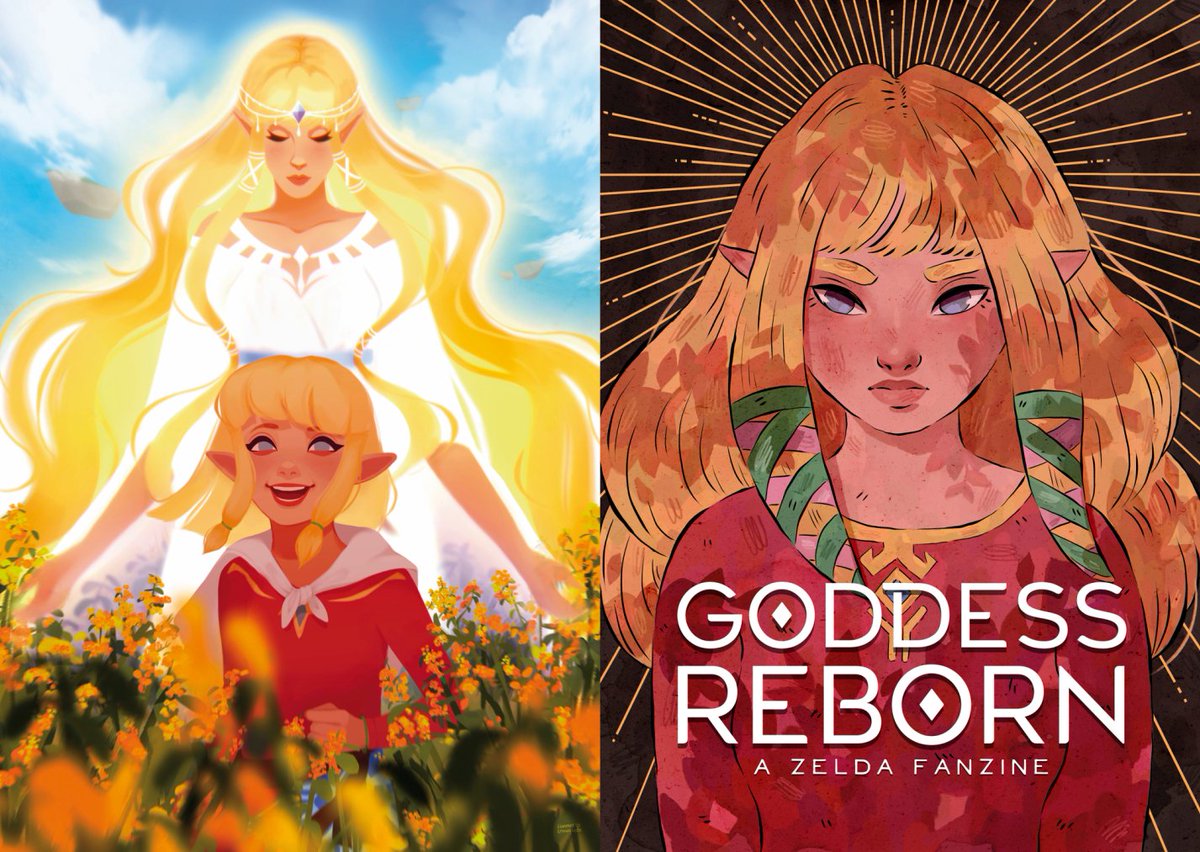
Goddess Reborn Zelda Fanzine

I’m excited to share a preview of the story I contributed to Goddess Reborn, a collection of art and fiction that celebrates the female characters of the Legend of Zelda series.

The zine is beautifully inclusive, and the amount of love that has gone into this project has been incredibly uplifting. I can’t wait for everyone to share their full pieces, but you can check out previews on Twitter (here) in the meantime. Preorders are open until May 31, and all proceeds go to international women’s charities.

goddessreborn.etsy.com

Red Trees

Red Trees by Caramel
https://caramel.itch.io/redtrees

Red Trees is a free nonviolent adventure story game made with RPG Maker in a style that emulates the Game Boy Color. It’s about a small village that might be haunted by ghosts in the woods, and it’s adorable.

The game is divided into three sections: the village’s residential area, its business center to the north, and the forest to the south. In order to progress from one area to another, you embark on an extended trading quest. For example, someone asks you to find their cat. To convince the cat to follow you, you need to feed it fish. In order to procure a fish, you need to give a can of worms to the person fishing at the local pond. The trading sequence isn’t strictly linear, but it’s not so complicated that you’d get lost or frustrated.

Red Trees isn’t a horror game by any means, but it gives me strong Omori vibes. (Although, having made that comparison, I should say that Red Trees was originally released in 2016, four years before Omori.) The music is relaxing, the character portraits are super cute, and the writing is wholesome with a touch of light humor reminiscent of Tumblr circa 2015. I especially love the menu screen’s character log, which collects short profiles of everyone you’ve met. The item portraits and descriptions are lovely as well.

Red Trees takes about an hour to complete, but this is mainly because of the game’s spatial layout. Your character can’t run, and the town is so spacious that it takes time to walk from place to place. This never becomes frustrating, but you may want to download the game so you can save your progress, step away, and come back later. Red Trees is extremely charming, and the experience of playing it is much more enjoyable if you take your time instead of rushing to finish it.

If you’re going to download Red Trees, you have the option of paying $2 to get an extra file folder of illustrations and a PDF booklet with annotated concept and development art. I highly recommend this extra material, but I’d also recommend not checking it out until you finish the game, as it spoils the ending. In fact, the bonus content functions almost like a separate postgame story, and it’s just as sweet and adorable as the game itself.

Deep Forest

Deep Forest by Small is Beautiful
https://small.itch.io/deep-forest

Deep Forest is a free GB Studio adventure game that takes about 45 minutes to play. There’s no combat, and the game is driven by puzzle-solving and exploration. You play as a forest witch tasked with helping three trees that have become mysteriously cursed. To purify a tree, you must first find it by exploring the forest. You then enter its nightmare, which functions as a dungeon. Once the tree’s curse is lifted, its thorny roots vanish, thereby allowing you to explore more of the forest.

This is the basic gameplay cycle of the Legend of Zelda series, and the simple puzzles of Deep Forest remind me of certain segments of Oracle of Seasons and Oracle of Ages wherein you:

(1) Use an animal to procure a seed.
(2) Find a patch of soil to plant the seed,
(3) which sprouts into a vine
(4) that allows you to climb a cliff.

If this similarity is intentional, it’s a lovely homage to the debut work of Hidemaro Fujibayashi, who went on to become the director of Breath of the Wild. In addition, I had a nice “Legend of Zelda” moment when I found a secret in Deep Forest. I was delighted when I realized that you can water the single square of roots in front of an otherwise unremarkable cave in order to discover a hidden spring. This moment of discovery lit a spark of excitement that reminded me of exploring Hyrule for the first time.

In terms of its visual style, Deep Forest is reminiscent of the Game Boy games that were released in the West under the “Final Fantasy” logo, which include the first Secret of Mana game and the first three games in the SaGa series. This style feels extremely nostalgic, and it’s cool to see it used to depict a thriving forest.

Deep Forest is fairly linear, and the gameplay mechanics are beautifully intuitive. I would have loved this game as a kid, and I’m extremely fond of it as an adult. It’s exactly the perfect length, and I enjoyed the exploration elements and wholesome story. As a unexpected bonus, the interactive postgame credits sequence is beautiful and genuinely feels like a reward for playing.

A Time for Giving

A Time for Giving by CobGoblin
https://cobgoblin.itch.io/a-time-for-giving

A Time for Giving is a free Game Boy “dark cottagecore” horror game about being a human sacrifice. It takes five to ten minutes to play, and it’s divided into three main areas: your protagonist’s cozy family cabin, an isolated village preparing for its winter festival, and the haunted snow-covered woods. The overworld graphics remind me of the cute rounded style of A Link to the Past, and the character artwork that appears during the dialog screens is delightfully eerie and upsetting. The dialog is well-written and communicates the themes of the game without pulling any punches.

A Time for Giving was created for a winter solstice-themed game jam, and the creator apologizes that there’s no sound because they ran out of time. I’m of the opinion that the lack of music is actually quite lovely, as it creates an environment reminiscent of a silent forest blanketed by snow so heavy that it muffles all sound.

A Time for Giving is very short and very simple, but the writing and visual style are exactly what I want from a handmade Game Boy game. It’s also a perfect combination of nostalgia and “what the fuck did I just play,” which is a major component of what makes these games so fun.

I played A Time for Giving a few times and made varying choices in an attempt to get a different ending, but alas. I wonder if there’s a way for this poor kid to make it out of the forest…?

Waking Nightmare

Waking Nightmare by Polyducks
https://polyducks.itch.io/waking-nightmare

Waking Nightmare is a free homebrew Game Boy horror game in which you navigate a short and simple maze. Every dead end presents you with a nightmare scenario and the notification that you’ve woken up, thus restarting the maze. The game moves very quickly, and each dead end is creative and worth the trouble of discovering. The game also marks every dead end that you’ve already seen twice in order to minimize frustration.

When you make it through the maze, you’re presented with a series of dialog choices that determine one of three endings. The maze layout doesn’t change, so it’s easy to finish the game and see all three endings in about fifteen minutes. The maze screens look like something a kid would build on a graphing calculator, and the gritty lo-fi pixel art is great, especially for the three closing screens. Apparently this is all text art, or “textmode” art, which the creator explains on their website (here). This website is just as interesting as the game itself, and I recommend checking it out if you’re interested in internet art history.

I was never a big fan of first-person maze games, but I’m glad I gave Waking Nightmare a chance. It’s visually distinctive, it makes excellent use of its medium, and the music will definitely get stuck in your head.

Capacity

Capacity by Renee Blair
https://heptad.itch.io/capacity

Capacity is a Game Boy style RPG Maker story game that uses generic pixel graphics and original character illustrations to tell a short fantasy-themed story about a bad relationship. The game describes this as “a toxic relationship,” but I don’t think it’s that complicated; it’s just a teenage girl who is hung up on a boy who clearly isn’t that into her. She doesn’t know how to let him go, so she embarks on a quest that she hopes will fix the relationship.

Capacity is extremely pretty and features a number of clever design elements. The monster art is great, and the final boss is a demon after my own heart. The game is driven by its narrative, and there’s no actual fighting. It takes about ten minutes to play, it’s totally free, and you can play it right in your browser window.

Capacity’s message is a bit heavy-handed and occasionally inappropriate to the situation. The game’s text drops mentions to “a cycle of abuse” and “generational trauma,” but really, it’s just a girl who’s hung up on a boy who isn’t that into her. Presumably because they’re both in their early teens. This isn’t to say that the boy isn’t a jerk and a coward, or that the protagonist isn’t a bit unhinged for pursuing him despite the clear “I don’t want to be involved with you” signals he’s broadcasting at every turn, but this is normal behavior for teenagers who are still figuring out how relationships work. It doesn’t make anyone a “toxic” person, especially not if they’re just a kid. We’ve all been there.

Putting the heavy-handed elements of Capacity’s story and writing aside, the game is really fun to play. In order to “save” your shitty “boyfriend” from his “curse,” you walk through a fantasy castle and interact with monsters, all of whom give you some variation of “he’s just not that into you.” At the top of the castle, the smoking hot Demon Lord tells you that a relationship doesn’t have to be like this, and that you deserve so much better. The fact that you refuse to listen to him proves that you still have some growing to do, and this is reflected in the game’s twist ending.

Capacity’s entire narrative structure emphasizes the point that sometimes your “demons” are right, and that you need to listen to what they’re trying to tell you about the situation that’s triggering your anxiety. It took me years to figure this out, and it’s a powerful message.