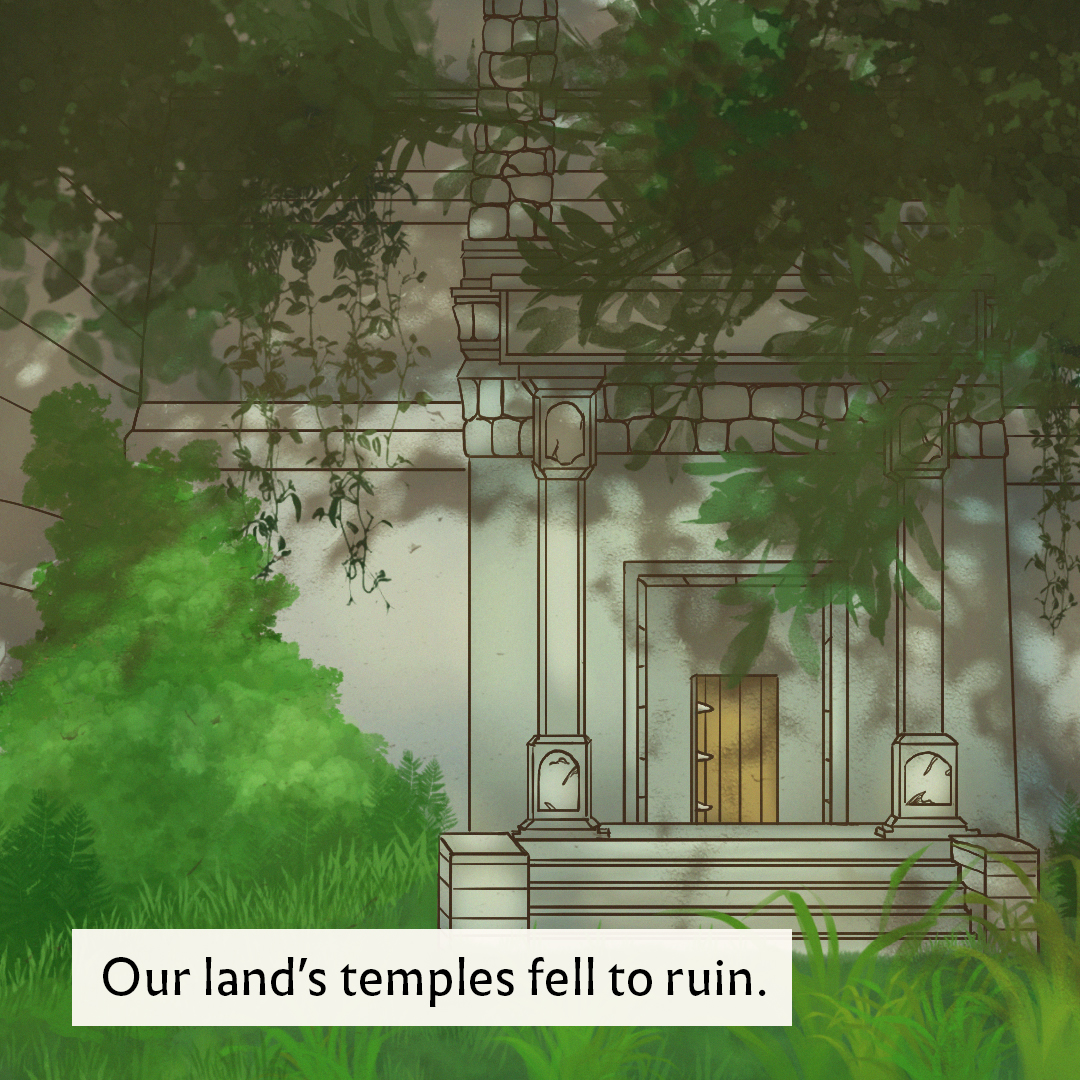
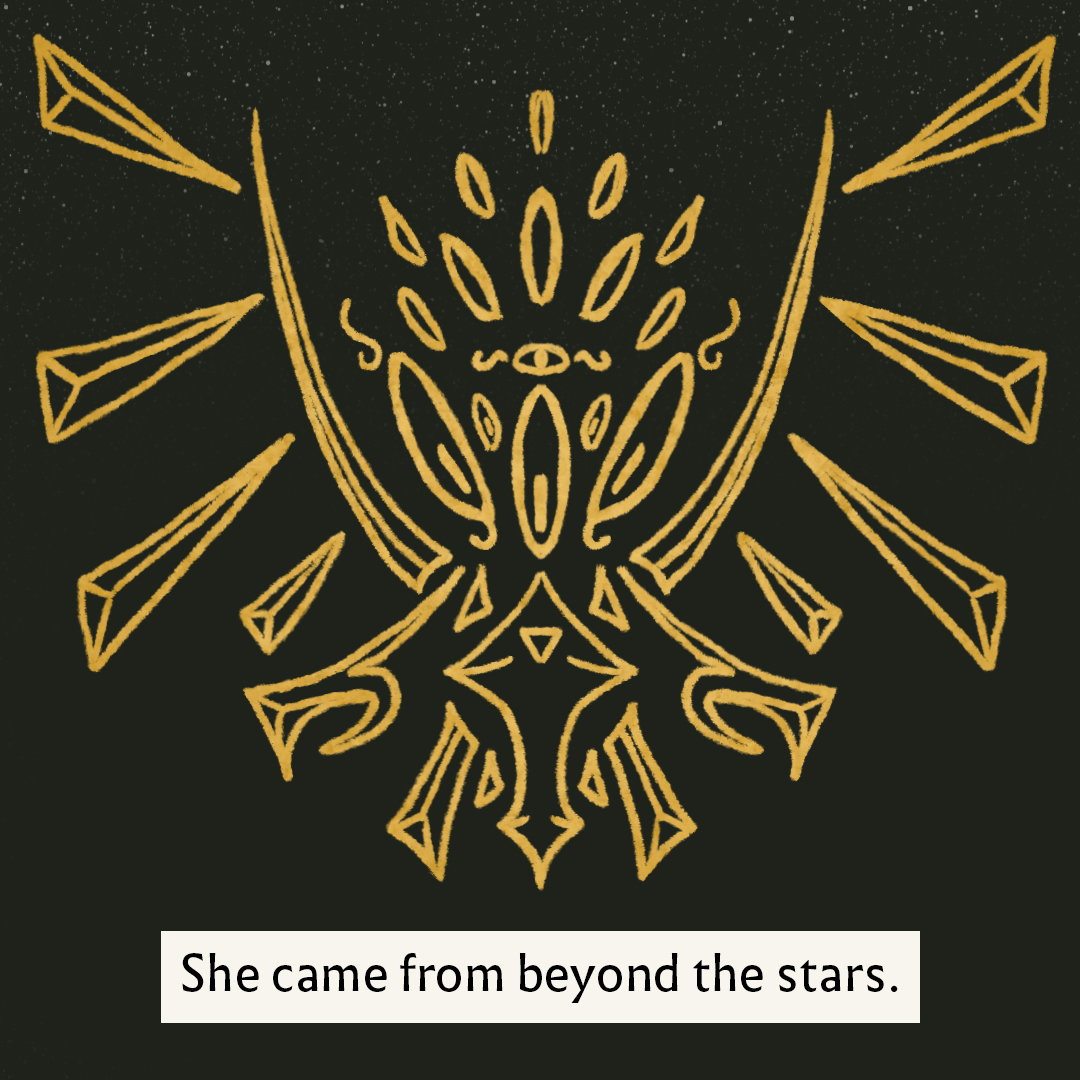
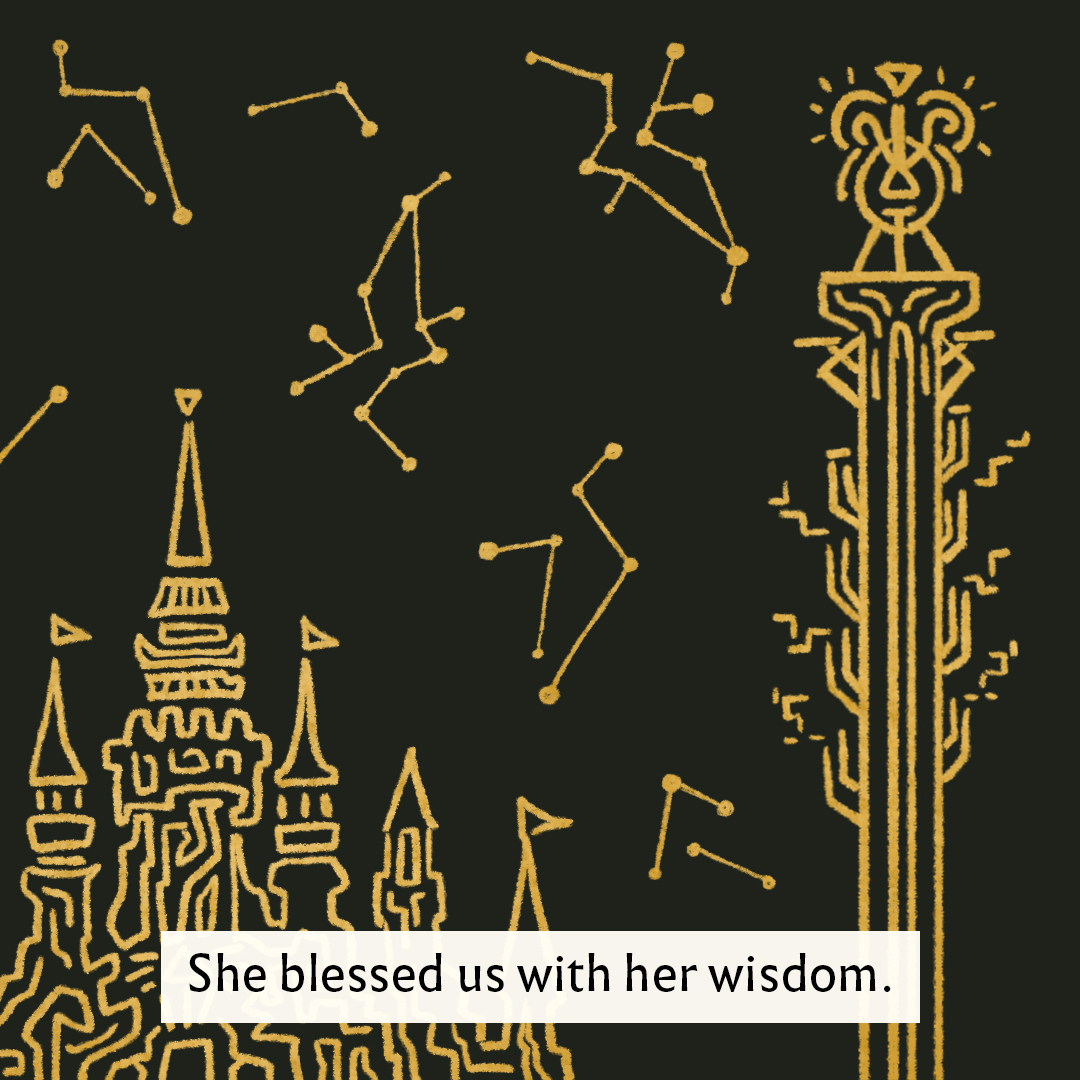
This is the second section of a speculative comic about gods and mortals in Legend of Zelda lore and mythology. It’s a continuation of the ideas I expressed in a short collaboration comic called Hylia’s Chosen Knight. The first part is (here), and the third and final part is (here).
A Legend of Shadows, Part One
This is the first section of a speculative comic about gods and mortals in Legend of Zelda lore and mythology. It’s a continuation of the ideas I expressed in a short collaboration comic called Hylia’s Chosen Knight. The second part is (here), and the third and final part is (here).
Watching from the Shadows
I contributed a story about Impa and Princess Zelda titled “Watching from the Shadows” to Goddess Reborn, a zine celebrating the female characters of the Legend of Zelda series. You can check out the zine’s Twitter account (here), and you can read my story on AO3 (here). Here’s a short description of the story…
Impa prepares to train Princess Zelda as a Sheikah warrior during the year following the fall of Hyrule Castle. Zelda is tired of hiding and eager to fight, so Impa shares stories from the past to demonstrate that there is wisdom in waiting for the right moment to strike.
This spot illustration was created by the magical and marvelously skilled Frankiesbugs, whose sharp and deadly work can be found on Tumblr, on Twitter, and on Instagram.
Infernax
Infernax is an 8-bit 2D Metroidvania style game with platforming elements and dark themes that feed into a morality system. The retro graphics, music, and gameplay remind me of Shovel Knight, save that Infernax is the opposite of Shovel Knight‘s brand of quirky and wholesome family fun. Infernax boasts buckets of blood and plenty of creatively disturbing imagery, but the uniquely upsetting aspect of this game is its sidequests, which force the player to make distinctly unpleasant choices.
You play as Alcedor, a duke who served as a knight in the Holy War and returns to his homeland only to find it overrun with the undead. Your job is to infiltrate the five demon strongholds and thereby break the magical seal on your own castle, which is occupied by the big boss demon. You navigate the 2D overworld with the various skills that you acquire in the five 2D dungeons, and along the way you accumulate experience points and money that you can use to upgrade your abilities and equipment.
Infernax bills itself as having a “tough-as-nails” level of difficulty. I found that it isn’t actually that hard until the final two levels, in which the platforming is a bit too precision-oriented for the game mechanics. If you prefer, you can get around this difficulty by using Game Genie style cheat codes (these ones right here) on a menu that’s available at every save point. Using this system to allow yourself infinite lives and access a double-jump ability can really help you out toward the end of the game, where failure at the platforming segments is unduly punished.
I think it’s important to be realistic and accurate about the difficulty level of a game like this, as not everyone is looking for a super hyper mega challenge. Maybe some people just want to stroll around a horror-themed digital theme park while fighting skeletons and zombies, and that’s cool. Infernax lets you turn the cheat codes on and off at any point you like and doesn’t penalize you for using them, and it offers a decent but not impossible challenge to anyone who wants to play the game straight.
The parts where you might need to use a walkthrough are when Infernax asks you to make a binary choice. This choice is usually between showing mercy to monsters or outright killing them. The key to these choices is presented to the player at the very beginning of the game, when you’re asked to make a decision regarding whether to spare someone who has been possessed by a demon. If you’re a decent person and choose to spare him, he kills several people and forces you to kill him anyway.
In order to get the “ultimate good” ending, the player has to continue to choose to kill monsters. This isn’t always easy. Later in the game, for example, a town under siege has trapped another possessed person in a cage. The townspeople claim that the possessed man has killed people, and that he needs to be put to death. Succumbing to the will of an angry mob with torches in order to enact violence on a seemingly defenseless person in a small cage isn’t great. If you let him go, however, he kills everyone. Should you allow the townspeople to set the possessed man on fire, it takes a long time for him to burn, and he screams and thrashes in pain the entire time.
This violence is somewhat mitigated by the 8-bit pixel graphics, which add a layer of campiness to the grimdark world. What Infernax celebrates isn’t just the visuals and gameplay of 8-bit games, but also their unironic and unapologetic violence. Infernax leans into this goriness by having its overworld enemies constantly attack and kill soldiers right in front of you. You can save some of these people, but most become zombie food. Sometimes you’re forced to kill other humans, which can be bloody business as well. If you like, you can aim for the “ultimate evil” ending and kill other humans by choice. This makes the game more difficult in terms of gameplay but also more interesting from a narrative perspective.
Infernax delights in violence for the sake of violence. It’s not actually that deep, but it’s quite fun. Even as they’ve created a dungeon whose theme is literally “piles of dead babies,” the developers are sensitive to the needs of a diversity of players and allow you to customize the level of difficulty to suit your preferences. In addition, there are multiple guides online that will help you unlock all the various silly bonuses the game has to offer, which include letting you run around with a machine gun and giving you free rein to zip through the overworld on a motorcycle.
If you’re bad at games like I am, Infernax might take about ten to fifteen hours to finish without cheat codes. If you’re good at games – or if you use cheat codes – it can be finished in under five hours, which makes the prospect of exploring multiple morality paths more intriguing. Overall, I spent about twenty hours in ultraviolent medieval zombie demon hell, and I regret nothing.
Your Journey Awaits! Pokémon Fanzine
I’ve spent the past several years in the Legend of Zelda fandom, but I have a deep and enduring love for the Pokémon series. Although I’ve taught classes and given conference lectures about Pokémon, I haven’t written fanfic about the series in years. When a few fandom friends announced that they were putting together a zine about the small towns where your avatar characters begin their journeys in the games, I was onboard.
The story I contributed to the Your Journey Awaits! Pokémon Fanzine is “The New Kid in Postwick,” which is about Sonia and Leon from Pokémon Sword and Shield. It’s about Sonia’s childhood in the small rural town of Wedgehurst, her friendship and rivalry with Leon, and the ambitions underlying her decision to set out as a young Pokémon trainer. Here’s a short description of the story…
Sonia has lived in Wedgehurst her entire life. Despite the beautiful nature and rich history of the area, she’s started to feel isolated from the wider world. Her anxieties are exacerbated by the boy who just moved into an old farmhouse in Postwick along with an exotic Charmander. Although he seems confident and carefree, Leon has problems of his own, and he’s ambivalent about moving to the country from Wyndon. Sonia and Leon gradually come to understand one another as they train together, and they seal their friendship by making a promise to venture out into the Wild Area together.
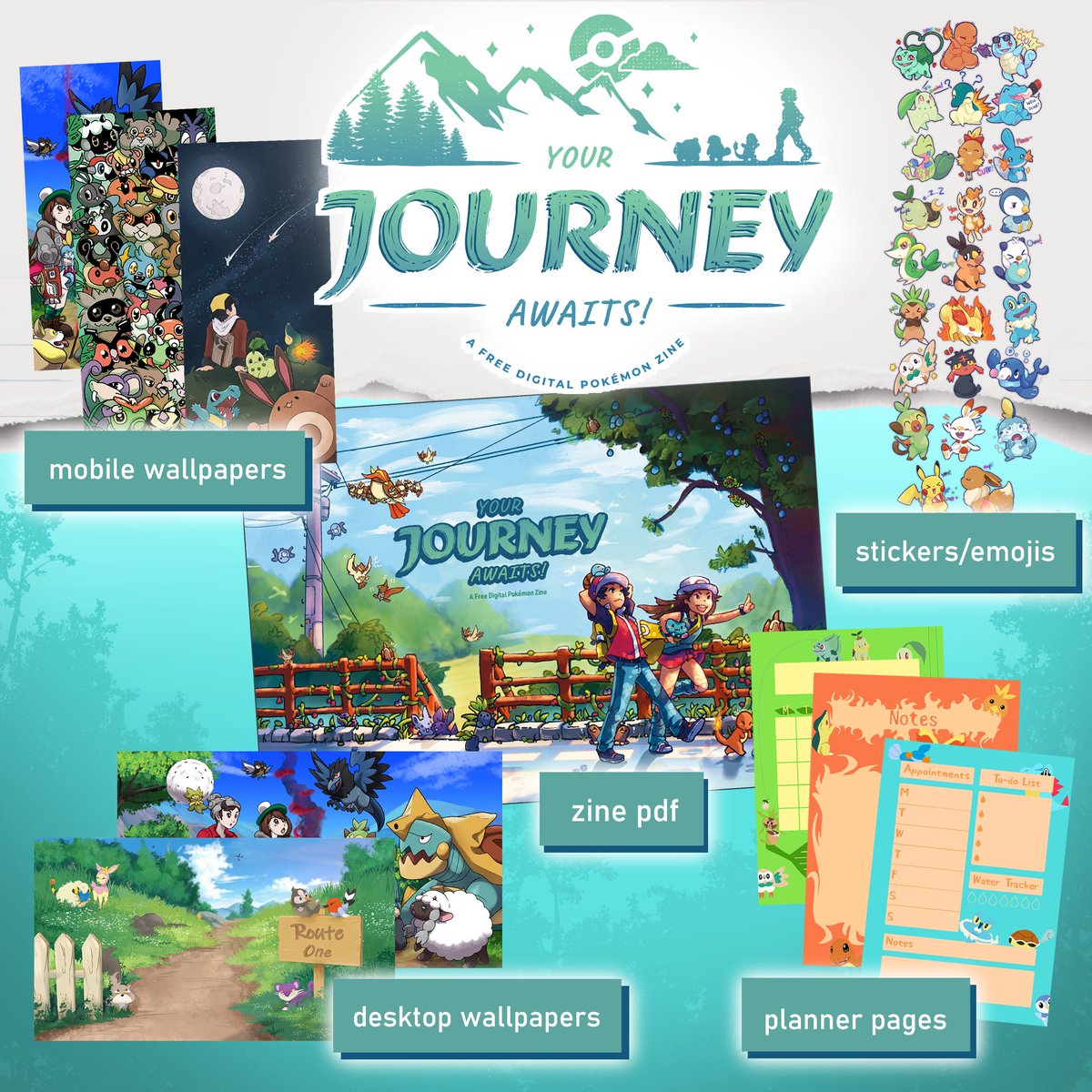
You can read my story on AO3 (here), and you can check out previews of the work appearing in the zine on its Twitter profile (here). The zine itself can be downloaded for free on Itchio (here). Along with a PDF of the zine, the download includes all sorts of fun digital extras like icons and wallpapers. The illustrations and stories are accessible to readers of all ages, so please feel free to share the zine with any younger Pokémon fans in your life!
The Role of Dōjinshi in Comic Fanzine Discourse
I’m looking forward to presenting at “Histories & Futures of Comics Communities,” the first academic symposium held in conjunction with the Toronto Comic Arts Festival. Here’s the abstract for my presentation…
In December 2021, a conversation concerning the definition of the term “zine” unfolded on Twitter. This conversation arose from anxieties surrounding the recent rise of fandom zines that, while organized by amateur editors and limited in distribution, are nevertheless professionally printed and highly selective. Many comic artists lamented what they perceive as a betrayal of the DIY ethos of North American zine culture, while others have used quote tweets as a platform to remind their followers that anyone can make a zine.
Surprisingly absent from this conversation is an examination of the largely separate zine cultures that have developed in parallel at comic festivals and anime conventions. Many exhibitors at local indie comic festivals continue to produce artistic but relatively low-budget personal zines. Meanwhile, exhibitors in the artist alleys of anime conventions have gravitated toward professional production methods for fanzines and associated merchandise, often taking advantage of the services of manufacturers based in East Asia.
I argue that contemporary North American anime fanzine culture has its roots in Japanese dōjinshi, which are typically created by aspiring and early-career creative professionals and tend to be manufactured by specialty presses that guarantee a high level of production quality. Dōjinshi-style fanzines spread to North America during the early 2010s via anime conventions hosted in cities on the western seaboard, particularly Los Angeles, Seattle, and Vancouver. While tracing this transcultural development, I will reflect critically on the tension between DIY zine counterculture and big-budget fanzines and address how neoliberal values have affected public conversations on amateur artistic production.
. . . . . . . . . .
The “Comics Communities” event takes place on June 17, the Friday before the TCAF. You can find the schedule (here). The main exhibit floor of the TCAF is completely free and open to the public, but registration for the academic symposium is limited and already completely sold out. Which is very exciting! The symposium organizer is a fellow contributor at Women Write About Comics, and I hope to be able to publish my paper there soon so that it’s accessible to anyone who’s interested.
ETA: My essay is now available on Women Write About Comics (here).
The Capra Demon Is for the Gays
While waiting for more news about the Breath of the Wild sequel, I started playing Dark Souls on my Nintendo Switch. I’m not into character customization, so my Chosen Undead is the basic male character. I named him Tulip. I am very bad at this game, and Tulip has been having a rough time of it. Yesterday evening, for example, Tulip fell down some stairs and died.
Tulip is currently spending a lot of time with someone called the Capra Demon. The Capra Demon infamously functions as a gatekeeper who blocks the player’s access to the majority of the game. It’s impossible to beat him without knowing exactly what you’re doing or getting help from real-life friends, and the game makes getting help difficult for reasons that are complicated to explain. Everything about this game is complicated to explain, so I hope you’ll forgive me if I leave it at “it’s just very hard to beat this boss.”
The Capra Demon exudes Pyramid Head energy in that he’s extremely fit, shirtless, and carrying two heavy meat-cleaver swords in such a way that his shoulders are pulled back, his chest is thrust forward, and the muscles of his arms are bulging. I made a stupid pastel-colored sketch of him and put it on Twitter, and I immediately lost five followers. I lost five more overnight.
When I say that I hate Pride Month – and sometimes I do hate Pride Month, kind of a lot – what I mean is that I hate the commodification of queer identity, and I hate how this commodification necessitates the sanitization of queer sexuality. Everyone is happy to see cute Disney animals dancing with hearts and rainbows, but nobody actually wants to see gay people being gay. And the Capra Demon is just about as gay as gay can be, which I think is charming and delightful.
I know the history of Pride Month, and I know why it’s important. Still, I wish people were able to accept difference not because it’s fun or attractive, but because… I don’t know, because it’s the right thing to do? Because we’re not animals? Because we’re capable of moral reasoning and extraordinary flexibility concerning what we’re able to accommodate into our worldview? And I just don’t feel that corporate rainbow merch and police-sponsored city pride parades are really helping people outside the community understand that being gay isn’t like Christmas, meaning that it isn’t a “special” thing that we collectively tolerate because it only happens once a year.
Like, being gay is being thirteen years old and playing Dark Souls because your friends are playing it, and then you get to this one boss, and you don’t know what’s going on but there’s just something about him, and the next thing you know you have your pants down and a wad of tissues in your hands, and then when you go to school the next day, maybe the way you talk about this video game character is a little weird, and your friends would never say that they’re homophobic, because of course they aren’t, but there’s just something about you that they don’t like, so they stop talking to you. You’ll make other friends as you find your community, but now you’ll have to live with the anxiety that there’s an element of who you are that a lot of people are always going to understand as being bad and wrong. Just like the Capra Demon is bad and wrong… but don’t his legs look fantastic in that cute little skirt?
I don’t really have a thing for the Capra Demon myself, to be honest, but as soon as I saw him I knew what was up. The Pride Month version of “this is for the gays” has become whatever sweet and wholesome child character is trending from whatever sweet and wholesome children’s cartoon is popular at the moment, but I don’t think that’s an accurate reflection of the reality of queer identity and sexuality. The Capra Demon is for the gays.
Hylia’s Chosen Knight
I had a horrible thought about the Legend of the Zelda mythology the other day. Demise’s curse supposedly follows the bloodline of the goddess Hylia, so all she needs to do to release Hyrule from an endless cycle of destruction is to stop reincarnating as a mortal. Why she insists on being reincarnated isn’t clear, but Skyward Sword strongly suggests that it’s because she loves Link so much. This is a little creepy…
…but I have nothing but unironic respect for ancient deities who behave like teenage girls!
Once I started thinking about Hylia being creepy, all sorts of interesting possibilities presented themselves. What if Hylia isn’t just a “goddess,” but also completely inhuman? What if she isn’t a sky goddess, but a being from beyond the sky? And what if it’s not necessarily Link she loved, but Hyrule? The idea of an eldritch cosmic entity who wants to become human because she loves the earth is beautiful. It’s also romantic, sort of like The Little Mermaid but endlessly apocalyptic.
Then I started thinking about the Sheikah, the group of people who have historically served Hyrule’s royal family from the shadows. In Breath of the Wild, the ancient Sheikah built incredibly sophisticated technology that is completely at odds with the otherwise medieval world of the game. In addition, their technology also features cosmic and sidereal motifs. What if the Sheikah always knew what Hylia was?
I was partially inspired by (this) comic about how potentially creepy Hylia is in Skyward Sword, and by (this) illustration of Zelda as subtly but undeniably monstrous. I’m fascinated by darker interpretations of the Legend of Zelda universe, and I would love to see more horror-themed Zelda art in the world. While I’m waiting for the sequel to Breath of the Wild to be released, I figured that I might as well create some myself.
Frankiesbugs is one of my all-time favorite horror artists, and I was beyond thrilled when she accepted my commission to draw this comic. She had the brilliant idea to model Hylia on Ebrietas from Bloodborne, who bears the sobriquet “Daughter of the Cosmos” and is theorized to have enabled the dystopian world of the game because of her desire to coexist with humans. Frankiesbugs also drew a connection between the iconic eye motif of the Sheikah and the possibility of Hylia having multiple eyes as someone who watches the earth from the skies – or as someone who always keeps watch over her chosen hero.
Frankiesbugs posts original horror art and video game fan art on Instagram, on Tumblr, and on Twitter, as well as on Teepublic and on Redbubble if you’re interested in wearing some creepy-cute graphic design.
Sumire
Sumire is a short nonviolent story game in which you play as the eponymous Sumire, a young girl who lives in a small town in rural Japan. Sumire’s grandmother recently died, and her father has left home. To make matters worse, Sumire’s childhood friend has progressed from ignoring her to outright bullying her. One morning, a magical talking flower (who is not evil, thank goodness) shows up at Sumire’s house and tells her that he has the power to help her experience one perfect day, at the end of which she might be able to see her grandmother again.
Sumire makes a checklist of what would constitute “a perfect day” and then sets out with her flower companion to achieve all of her goals, which include making peace with her former friend and confessing her feelings to a boy she likes. Along the way, you’re free to explore Sumire’s hometown, which is divided into about half a dozen small and manageable sections. The flower’s magic allows Sumire to speak with animals, plants, and a few inanimate objects, and each section of the town is filled with interesting characters and conversations.
At several points in the story, your character is asked to make a binary choice. One of these choices is always “be a decent human being,” while the other is “I wonder if this game has a genocide route.” Reviews of this game tend to make this seem far more complicated than it actually is, like…
Reviews: The game asks you to make difficult choices.
The game: A cute baby frog asks you to carry him to the river, which requires no effort on your part. Do you happily agree, or do you tell him that he’s disgusting and that you wouldn’t touch him even if he paid you? If you agree, you get a tangible reward and some extra dialog; and if you don’t, he doesn’t talk to you again.
Reviews: The game forces you to think about the consequences of your actions.
The game: Are you friendly to the slightly nerdy kid who’s friends with the boy you like, or do you tell him that he’s a fat fuck who deserves to be bullied? If you’re friendly, this unlocks a fun but entirely optional minigame; and if you’re not, he doesn’t talk to you again.
To me, it was always crystal clear what choices Sumire should make in order to achieve her goals, which are written in the form of a checklist on a piece of paper that you can access from the menu screen. For example, one of your goals is basically “tell Mom I love her.” So, when you trigger a scene in which you have an option to tell your mom you love her… You should probably do that!
The joy of this game is being able to roleplay what it feels like to be friendly and kind and have your kindness acknowledged and rewarded. There are no trick questions, and there are no decisions that don’t turn out the way you expect. For example, if you tell your mother that you love her, she doesn’t respond by accusing you of being emotionally manipulative for demanding attention when she clearly wants to be alone; this just isn’t that sort of game.
When I say “that sort of game,” I’m specifically thinking of Spiritfarer, which is written about adults for an intended audience of other adults. Spiritfarer is about as wholesome as a game can be, but it acknowledges that not everyone is going respond to kindness with gratitude. Meanwhile, I’m pretty sure that Sumire is intended for a younger audience, or at least an older audience that wants to feel nostalgia for a childhood that isn’t complicated by a more mature understanding of human behavior.
That being said, I’m curious about what would happen if you were to consistently choose the antisocial dialog options. Does the game get dark and creepy? Because that would be interesting. I couldn’t find anything about this online, so perhaps it might be worth experimenting with in the future.
Aside from the (probably?) limited satisfaction of trying out different dialog choices, I’m not sure if Sumire has any replay value in the traditional sense, as you can experience everything the game has to offer during a single two-hour playthrough. Regardless, the world of the game is so beautiful and charming that I’m already looking forward to returning to it in the future. Sumire is the video game equivalent of comfort food, and it’s perfect for a rainy afternoon when you need some flowers and sunshine in your life.
Blasphemous
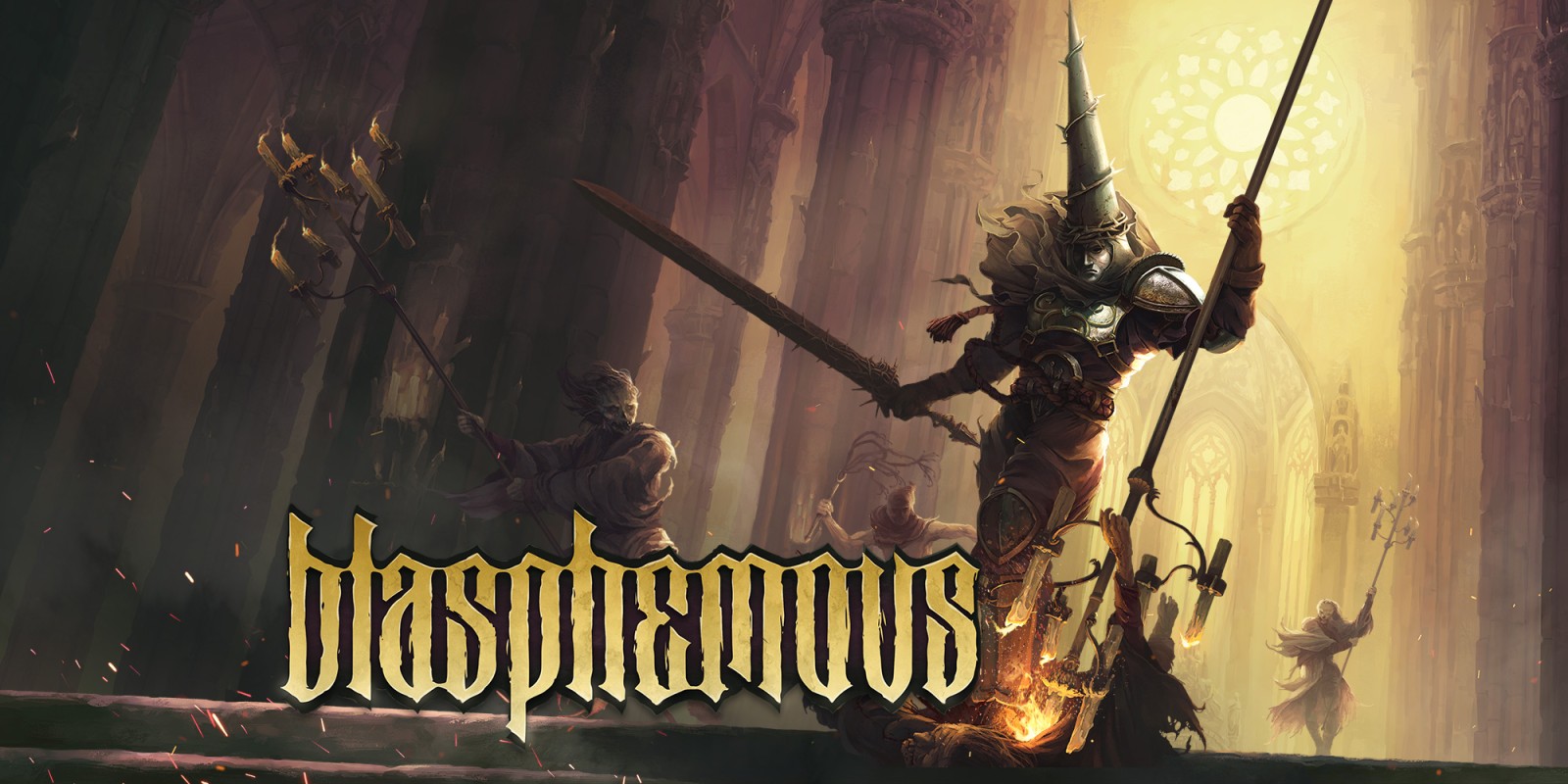
Blasphemous is an ultraviolent 2D Metroidvania with gorgeous 16-bit pixel art and limited but fluid animation. It describes itself as “fast-paced and punishing,” but it’s not really either of those things. The game’s focus is more on strategic combat than on platforming or quick reflexes, and your character moves at a fairly sedate speed. To me at least, the pace feels perfect, both from moment to moment and from one area of the map to the next. In terms of “punishing,” this is how I’d rate Blasphemous on a scale of “this game wants you to feel pain”:
6 – Guacamelee
7 – Blasphemous
8 – Shovel Knight
9 – Hollow Knight
10 – Rain World
In other words, Blasphemous is moderately punishing, but probably not at a level where you’ll give up at the beginning or rage quit in the middle. Granted, Blasphemous makes no attempt to be accessible, and it’s much easier if you use a walkthrough to access the health upgrades in the early part of the game, which are hidden so well (behind unmarked walls, under floors that only break if you jump on a specific spot from a great height, and so on) that you’d never find them unless you already knew where they were. Thankfully, once you get about two hours into the game, you start to understand how it works and don’t really need a walkthrough unless you’re a completionist.
Blasphemous has everything that I love about the Metroidvania genre, and it was worth my time just for the gameplay. The combat is engaging, the area-specific challenges are interesting, and the way in which the areas all eventually connect to each other is on par with Hollow Knight in terms of clever map design. If you enjoy indulging in a bit of exploration and backtracking, it will take about twenty hours to finish Blasphemous with near-perfect completion.
What really got me into Blasphemous is its atmosphere. Everything is compared to Dark Souls these days, but Blasphemous really is Dark Souls in 2D. The level of violence is incredible, and the game gets creative with its brutality. The architecture is similarly brutal and creative. Each area has its own unique character, and the background graphics are beyond fantastic. As for the story, it’s essentially this: You were dead, but now you’re undead for reasons that are unclear; and something bad happened to the world, but we’re not going to tell you what that was. Each collectible item has its own lore, all of which is disturbing.
I never felt as though Blasphemous is just trying to be awful for the sake of shock value, though. As you might guess from the title, it’s based on Spanish Catholicism, and it takes the themes and imagery of Catholicism to their logical extreme. If you’ve ever made a joke about how Catholicism is all about the fetishization of punishment and the worship of death, this game takes that joke seriously. At the same time, it’s so sincere and culturally specific that it never feels disrespectful. I was actually so impressed and curious about the lore and imagery that I looked up a few of the real-world cultural references online, and now I have a greater appreciation for Catholicism. No joke!
( I should say that this game probably isn’t for genuinely religious people, though. It is very literally blasphemous. It also contains all sorts of casual graphic and textual references to real-world torture and hate crimes committed by the church, which perhaps some people might not want to see. Honestly I can’t believe I played this game on a Nintendo console, what a time we live in. )
My favorite part of Blasphemous is its OST, which suits the tone and atmosphere of the game perfectly. About a third of the tracks suffer from dramatic moody bitch disorder, and I can’t remember where they play in the actual game, but most of the OST is mellow acoustic Spanish guitar. Que las Campanas me Doblen is a good representative track, and I really like Y Yo Fuego Te Daré, which manages to be both chill and epic at the same time. A track called Arpegios en Ocre plays in an area called “The Desecrated Cistern,” and it really makes you feel as though you’re exploring a cavernous underground space with a vaulted ceiling. I think the OST holds up well on its own as lo-fi Flamenco beats to chill to, but it’s also a gorgeous backdrop to the game and its ruined world.