Strange Tales and Modern Legends

My zine Strange Tales and Modern Legends collects three illustrated short stories based on demonic Japanese folklore.

When I was an undergrad, I had the honor of taking a class called “Demonic Women in Japanese Fiction” with a professor I truly admire. This course was a foundational experience, and I ended up writing a lengthy senior thesis with the same title. The project served as an introduction to literary theory and feminist thought; but, more than anything, I really enjoyed stories about women behaving badly.

I taught my own “Demonic Women” class at the University of Pennsylvania for the first time in Spring 2024, and it was a resounding success. Everyone in this class was just as fascinated by the stories as I was, which was a minor miracle. In all fairness – demonic women are a lot of fun.

Though I teach and publish (and blog) about Japanese literature, and though I’ve spent a significant amount of time living in and around Tokyo, I generally don’t write original fiction set in Japan. Still, I love demonic folklore so much that I couldn’t help but be inspired by the literature in my “Demonic Women” class. I therefore put together a short zine that collects two previously published stories and one original piece of flash fiction, and I commissioned a coven of talented artists to create illustrations.

In the zine’s opening story, “The Smile of a Mountain Demon,” a 21st century yamauba entraps a YouTube influencer with Buddhist pretensions by using Airbnb and the language of New Age spirituality. The young man is looking for a scenic “spiritual retreat” to use as a source of content, and the yamauba is looking for a tasty snack. I was inspired by the medieval Adachigahara folktales in which a cunning yamauba entraps a less-than-devout Buddhist priest, as well as Minako Ohba’s beautiful and heartbreaking short story “The Smile of a Mountain Witch.”

The zine’s main story, “The Kumo Diary,” is set in the Meiji period, the era of Japan’s industrial revolution. As Japan established itself as a nation that could compete with Western powers, its intelligentsia were motivated to create a unified sense of “Japanese culture.” Scholars were therefore tasked with making The Tale of Genji a respectable classic to be held in esteem by a modern nation. While I was studying the history of The Tale of Genji, I couldn’t help but wonder about all the apocryphal chapters that never made it into the canonical version, and I created a few fragments of a medieval text to be discovered by a reader who dwells in the shadows cast by the light of modernity.

The final story, “Hanahaki,” is about a neglected cat who vows revenge on the small child that has monopolized his beloved human’s attention. The title comes from a trope in underground manga and fancomics of the late 2000s and early 2010s. In these stories, someone suffering from unrequited love painfully coughs up (haki) delicate flower petals (hana) in lieu of the words they can’t say. The cat in this story is unable to communicate in human language, but he still finds a way to make his displeasure clear. If nothing else, the child must go.

Strange Tales and Modern Legends explores themes that have fascinated me for years, specifically the intersections of folklore, feminism, and the unruly joy of problematic characters. I hope readers find these stories as delightfully unsettling as I did when I wrote them.

If you’re interested, you can order a paper copy of the zine from Etsy or download a free digital version from Itch.io.

👹 https://digitalterrarium.itch.io/strange-tales
👹 https://www.etsy.com/listing/4299187840/strange-tales-horror-fiction-zine

The art at the top of this post, which is one of the illustrations featured in the zine, was created by Le Soldat Mort, a dark fantasy artist who shares their work on Bluesky (here) and on Instagram (here).

Green Dreams: Tales of Botanical Fantasy

I’m excited to announce that I published a new zine! Green Dreams: Tales of Botanical Fantasy collects six illustrated stories about our relationships with plants and nature.

“Each turn of the seasons brings an end to lives both large and small, but new seeds sprout joyously from the ruins” is the zine’s tagline, and disaster is a major theme of the collection. One of the opening stories is about the gradual effects of climate change; and, in the closing story, environmental catastrophes have become so severe that humans have disappeared completely. The zine also features stories about a medical tragedy narrowly averted, the aftermath of a devastating war, and a porous biological quarantine.

I considered subtitling the zine “Tales of Botanical Dark Fantasy,” but the truth is that none of the stories are actually that “dark.” In fact, I’d say the main theme of the collection is a persistent hope for the future. At this particular moment in history, the state of the world seems very bleak, so it’s good to remember that the environment that surrounds us is much larger – but also much more personal – than whatever horrors are currently unfolding.

Precisely because are so many fires burning in the world, I think it’s important to spend time in thriving green spaces that suggest futures of shifting and changing growth. I believe that a mindful contemplation of our natural environment can also be useful in the uncomfortable but necessary process of decentering normative humanity while challenging the artificial divisions we impose on ourselves and each other.

The incredible cover art by Frankiesbugs captures the mood of these stories perfectly.

Frankie creates bold and imaginative botanical fantasy art, and I asked them to illustrate the pagan archetypes of the flower maiden and the horned god, who together represent the endless natural cycle of death and rebirth. In this zine, I wanted to play with symbols that convey the beauty and mystery of the natural world, and Frankie embraced this theme, tinging the painting with potent Christian motifs and a powerful sense of fertility.

It’s an extremely impressive piece of art, and you to check out more of the artist’s work on Instagram (here), on Bluesky (here), and on Redbubble (here).

In this collection, I did my best to share a sense of fertile “green dreams” for the future. Mostly, though, I just really wanted to write some fun ecofiction about plants and mushrooms.

If you’re interested, you can read a free digital version of the zine on Itch.io or order a print copy from Etsy.

🌿 https://digitalterrarium.itch.io/green-dreams
🌿 https://www.etsy.com/listing/4351990958/green-dreams-fantasy-fiction-zine

The Wisdom of the Waiting Princess

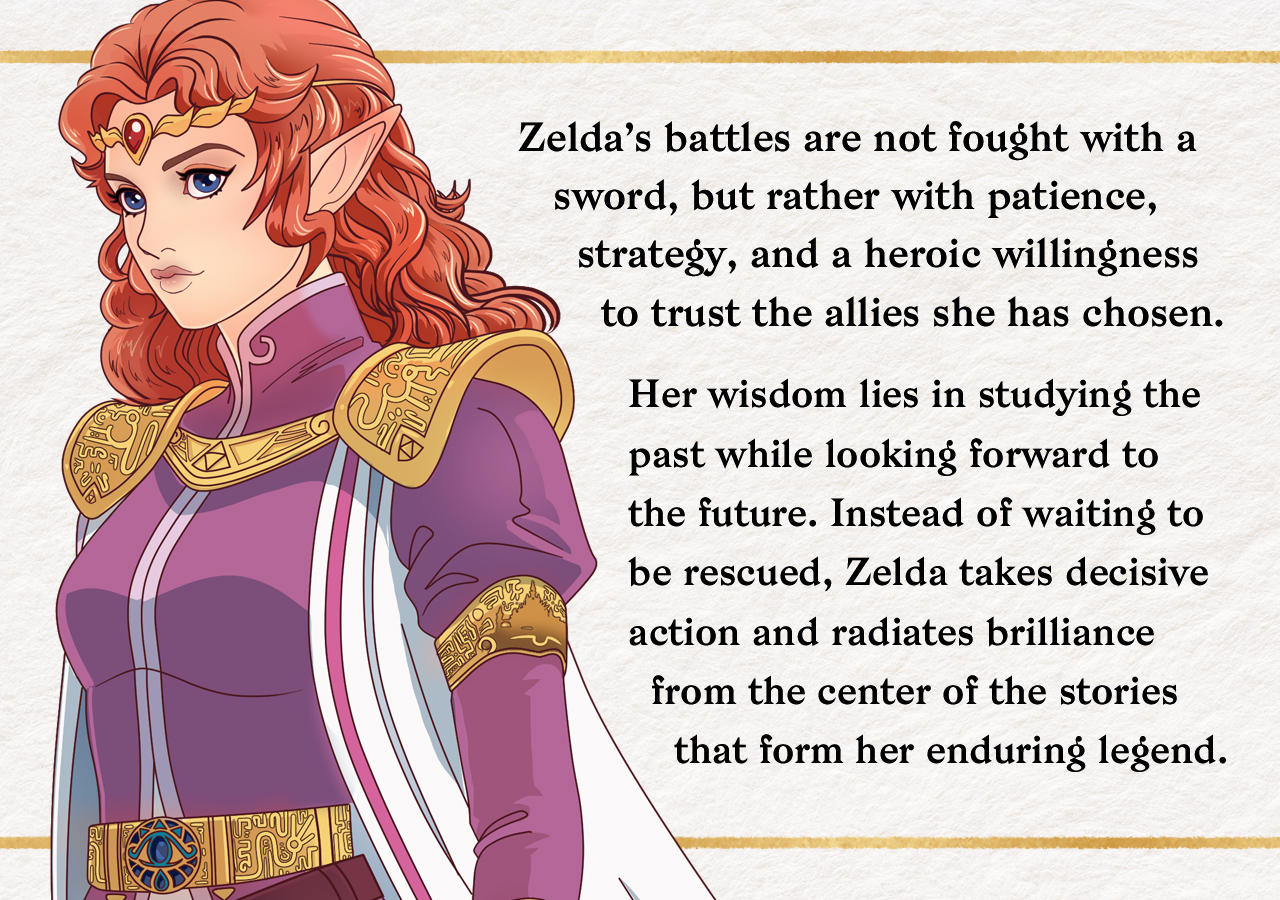
The Wisdom of the Waiting Princess is an empowering feminist reading of how the trope of the “captive princess” applies to the Zelda of the original 1986 game. While this Zelda is an action hero in her own right, her wisdom manifests in her remarkable ability to lay plans for the future.

You can read the essay on AO3 here:
https://archiveofourown.org/works/67410167

I had the honor of contributing this essay to Silent Princess: A Zelda Zine. The zine’s website is on Carrd (here), and you can check out the art and writing featured in the zine on its Tumblr site (here). Leftover sales of the zine merch are currently open (here), and you can still pick up a digital copy of the zine (here). All profits from zine sales will go to support Doctors Without Borders.

This original design for Princess Zelda was created by Hollarity, who put an incredible amount of love and care into portraying the character as a courageous young woman who is fully capable of going on her own adventures. You can find more of Holly’s gorgeous artwork on her website (here).

Kakariko Hills

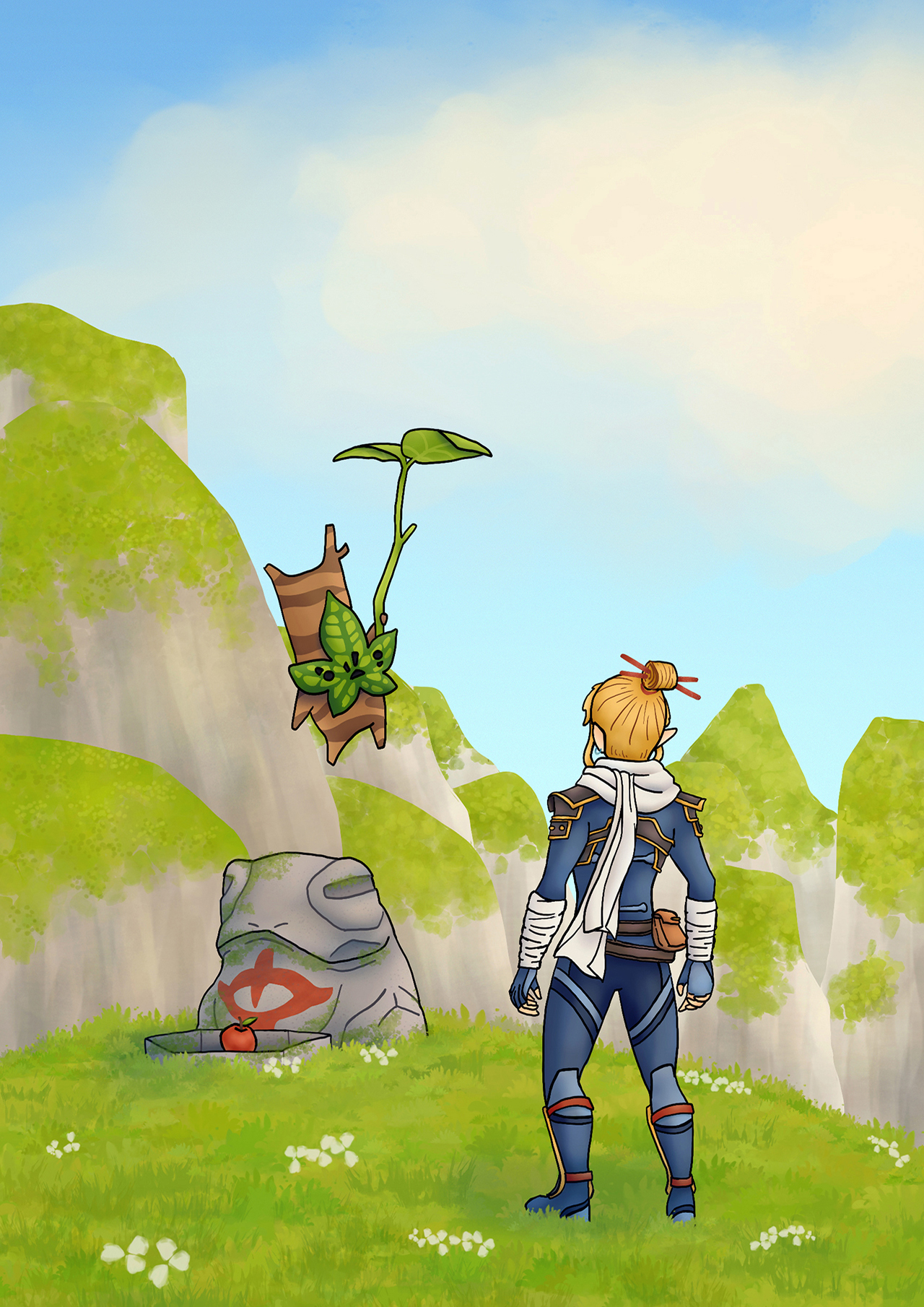
The mountains overlooking Kakariko Village are one of my favorite places in Breath of the Wild.

Most players will visit Kakariko Village early in the game, and it’s possible for a more experienced player to climb the surrounding hills and venture into the mountains. Link can find Koroks by solving little environmental puzzles (in this case, putting an apple in the offering plate in front of the frog statue), and the optional hunt for Koroks encourages the player to explore the hidden corners of the map. There’s no meaningful material reward for finding this Korok, but the scenery is impressive. This experience of discovery is a perfect example of what I love about video games – the joy of the journey.

It’s hard to say I have a favorite game, but I’m a big fan of Breath of the Wild. I live in a neighborhood of Philadelphia that has almost no plants or trees, and the beautiful landscapes in this game provide a much-needed immersion in green space while inspiring me to engage in urban gardening. I love open-world games in general, but Breath of the Wild is the first one I played and the one I keep returning to.

This illustration was my submission to the Videogames Zine published by Coin-Operated Press, a cool zine community based on Scotland that’s open to people from all over the world. You can follow them on Instagram (here), where they post news about events and upcoming calls for submissions.

In Praise of Moss Disability Zine

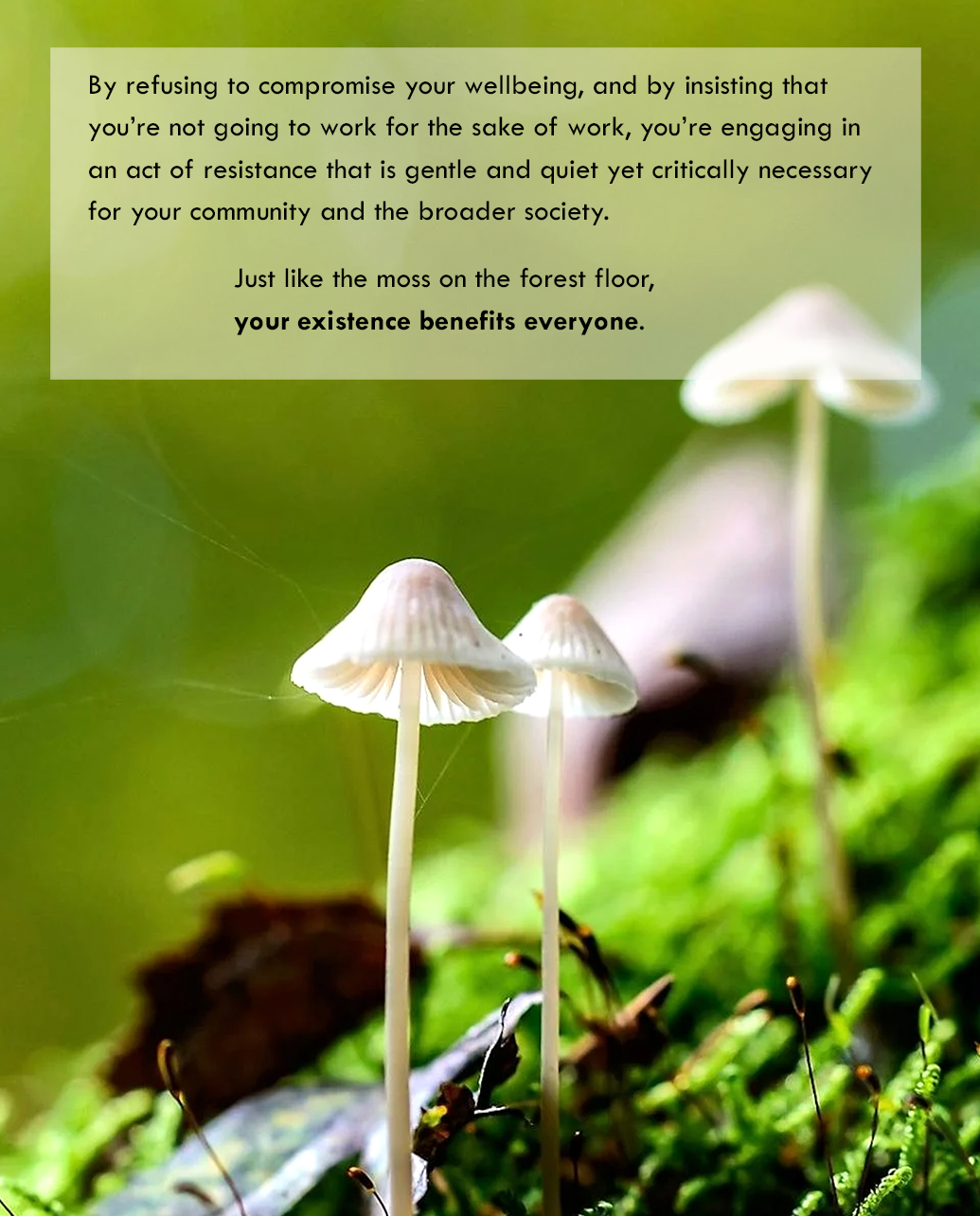
In Praise of Moss is a zine that argues against the myth of productivity while celebrating the value of a diversity of contributions to our culture and communities. Not everyone can be a tree, and that’s okay. Moss is an equally important part of an ecosystem.

I wrote this zine from a perspective that respects people of all abilities, but I think it’s important to acknowledge the more challenging aspects of disability. Disabled people are often expected to “pull their weight,” usually with the assumption that there’s only one way to measure success. In addition, people who live with invisible disabilities are often met with frustration and accusations of laziness when we’re unable to work or behave “normally.”

Moss is a useful metaphor for a recontextualization of what it means for disabled people to be useful to our communities and valued in our relationships. By exploring how moss can support an entire ecosystem, we can craft a model for how disability positivity can benefit society.

In addition, moss is remarkably adept at surviving disaster, which makes it an engaging analogy for resistance against the pressures of self-optimization exerted by neoliberal capitalism. While my focus is on disability, I believe that all readers can benefit from a shift in perspective that encourages us to grow naturally without worrying about productivity. 

When I write about “resisting productivity,” I’m speaking from the position of someone in academia who is directly affected by the myth that hard work will lead to prosperity. I hate the way this myth is weaponized against disabled people in the realm of higher education, and I want to destroy it. Very softly and quietly. Like moss.

While I love the lo-fi DIY aesthetic of many of the disability zines I’ve found on Etsy and in indie bookstores, it was important to me to create an attractively formatted physical object that feels good in my hands and accommodates my own disabilities by being easy to read. I want people who encounter this zine to feel that it’s valuable, and that they’re valuable too. I was fortunate to be able to work with Fireball Printing, a local Philadelphia service that creates gorgeous full-color publications.

If you’re interested, you can order a copy of the zine from Etsy, or you can download a free digital version on Itch.io.

🌿 https://digitalterrarium.itch.io/in-praise-of-moss
🌿 https://www.etsy.com/listing/1881401704/in-praise-of-moss-disability-zine

Legend of Zelda Forest Zine Preorders Open

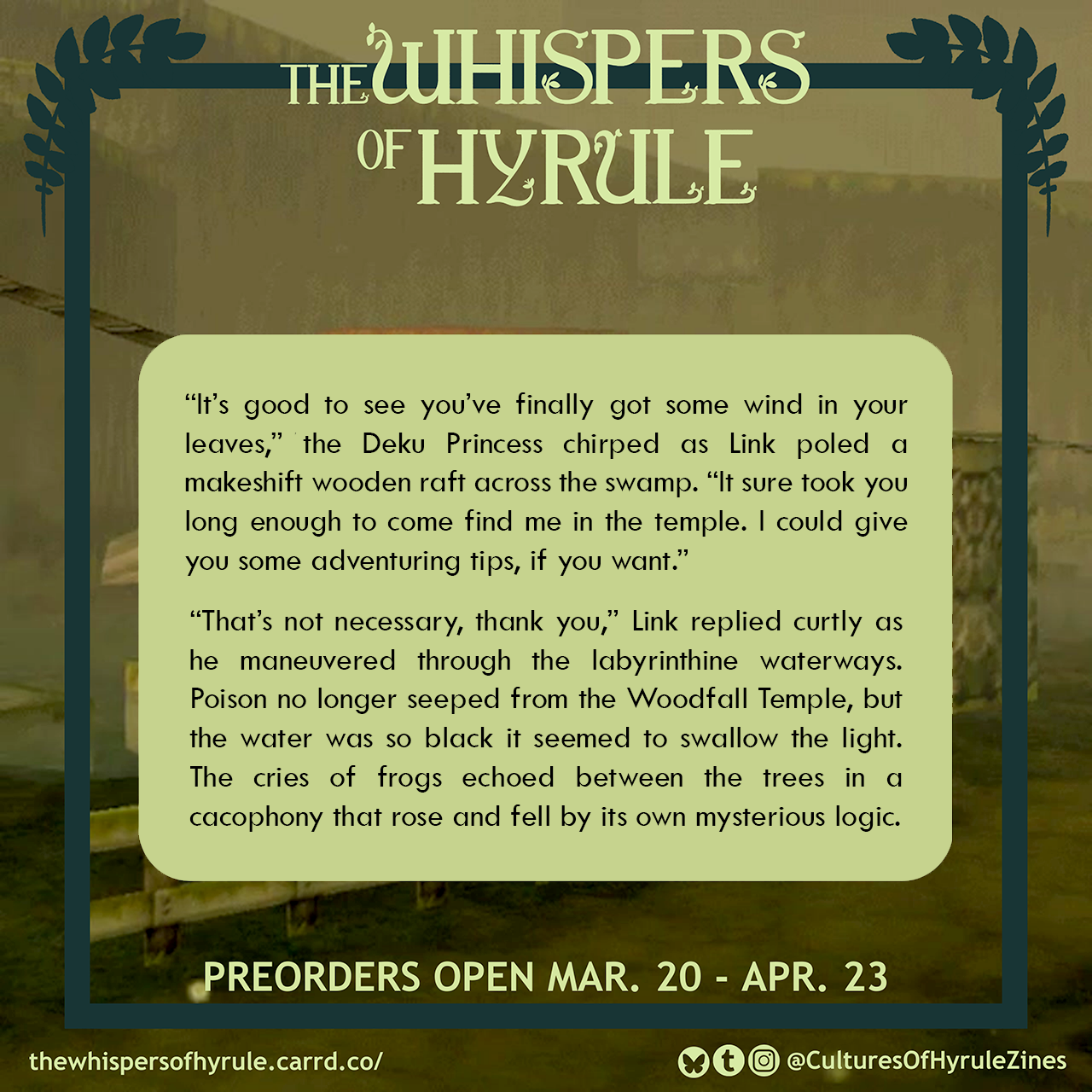
I’m excited to share the news that preorders are now open for The Whispers of Hyrule, a Legend of Zelda fanzine celebrating Hyrule’s beautiful green spaces and the creatures that make their homes in the trees.

I contributed a short story about Majora’s Mask titled “The Brave Tale of the Heroic Swamp Princess.” My story follows Link and the Deku Princess as they venture through the swamp on their way home from the Woodfall Temple. I did my best to capture the exuberant spirit of the Deku Princess, who helps Link work through the trauma he experienced in Ocarina of Time, as well as the warm atmosphere created by the vibrant plant growth in the swamp.

It’s been a privilege to see the drafts shared by the writers, artists, and musicians who have joined me on this journey. From sunlit meadows to deep forest shadows, everyone has worked hard to convey the wonder and mystery of getting lost in the woods. I know I say this about every fanzine, but this book is going to be gorgeous.

Preorders for the zine are open until April 23, and three stretch goals have already been exceeded. If you’re interested, you can check out the project at the following links:

🌿 https://thewhispersofhyrule.bigcartel.com/
🌿 https://culturesofhyrulezines.tumblr.com/
🌿 https://thewhispersofhyrule.carrd.co/

The Sleeping Princess

There is a legend in Hyrule that a sleeping princess lies behind the door of a locked room deep under the ruins of the North Castle. When the princess rises, so too will the ancient powers sealed within her dreams. Impa knows the legend is true, and she fears the fate that will befall the kingdom should the first Zelda wake. Yet when a shadow rises on the borders of Hyrule after the birth of a new princess, Impa must make a terrible choice.

I had the honor of contributing a story called “The Sleeping Princess” to Blood Moon Rising: A Zelda Horror Zine. I was interested in exploring the background of Princess Zelda in the original 1986 game, and I thought it might be fun to see her story through the eyes of Impa, who knew about the undead princess who was the first of Zelda’s line. In other words, I’m connecting some of the more disturbing threads between The Legend of Zelda and Zelda II: The Adventure of Link.

“The Sleeping Princess” is a story about maternal love, political sacrifice, and the dark secrets hidden within the labyrinthine dungeons of Hyrule. I was strongly inspired by H.P. Lovecraft’s novel At the Mountains of Madness, which dwells in the geometric terror of monumental architecture built by strange hands, and I did my best to create a sense of ruined grandeur similar to that of Dark Souls and Ico: Castle in the Mist.

For the story’s illustrations, I had the incredible pleasure of working with the devilishly talented Pumpkinsouppe, whose dark arts brought this ruined world to life.

You can find “The Sleeping Princess” on AO3 here:
https://archiveofourown.org/works/62492182

Leftover sales of the zine are open until February 24 on BigCartel (here).

Studio Ghibli Fanzine Preorders

.

.

I’m excited to share a preview of the short story I wrote for New Winds: A Studio Ghibli Fanzine.

My story, “The Record of the Last Heavenly Warrior,” is narrated from the perspective of one of the giant robots from Castle in the Sky who remained in Laputa Castle after all the humans fled. The log it creates across the years is an account of the actions it takes to help nature return to the abandoned structure. Through the care it offers the environment and its companions, the robot gradually begins to understand why humans abandoned the fortress, and it wonders what it will do should they ever return.

The editors and layout artists who’ve worked on New Winds put an extraordinary amount of love and attention into making the writing in this zine shine, and the comics and illustrations that fill the pages are equally beautiful. If you’re interested, preorders for the zine are open until February 6 on Bigcartel (here). You can check out more previews on the zine’s accounts on Twitter (here) and Tumblr (here).

🌿 https://studioghiblizine.bigcartel.com/
🌿 https://x.com/ghiblifanzine
🌿 https://ghiblifanzine.tumblr.com/

Silent Princess Zine Preorders Open

I’m proud to have contributed a nonfiction meta essay to Silent Princess, a fanzine celebrating Princess Zelda.

My essay, “The Wisdom of the Waiting Princess,” offers an empowering feminist reading of how the trope of the “captive princess” applies to the Zelda of the original 1986 game. My goal is to demonstrate that, while this Zelda is an action hero in her own right, her wisdom lies in patience, strategy, and the careful coordination of allies.

Silent Princess contains a sparkling treasure trove of essays, stories, comics, and illustrations, and I can’t wait for everyone to see the amazing work the team has created.

Preorders for the fanzine are open until January 6 on Bigcartel here:
🌟 https://silentprincesszine.bigcartel.com/

Residents of the Wild Fanzine

I’m honored to have a story about the adventures of the Gerudo archaeologist Rotana appearing in Residents of the Wild, a digital Legend of Zelda fanzine celebrating the NPCs of Breath of the Wild and Tears of the Kingdom. All proceeds from the zine will be donated to this year’s Zeldathon charity event. The zine is scheduled to be delivered on August 1, and preorders are open until July 28.

📚 rotwzine.carrd.co
📚 residents-of-the-wild-zine.square.site