Blackout is a Halloween-themed point-and-click adventure game that you can play in your browser or download for free.
You play as a teenage witch who falls from the roof of a house while trying to snatch a feather from a crow. She loses her memory during her tumble to a second-floor balcony, and she’s surprised to find that the house is filled with corpses. The electricity seems to have been cut, and it’s too dark to see anything clearly. Your job as the player is to guide the witch through the haunted house and get the lights on so she can figure out what happened.
Once the lights are back on, you’re free to explore the house a second time to see what’s actually going on. This is a super fun twist, and it’s what really sells the game for me. The tone completely shifts, and the ending is fantastic. I hope it doesn’t spoil the story to say that it’s just as much comedy as it is horror.
Even though your character is in the dark, the game’s 16-bit pixel art is bright and colorful. Each room of the house is a pleasure to explore. There are enough points of interest to provide flavor, but the graphics are designed to help the important puzzle pieces stand out. The puzzles are mostly self-explanatory – use the footstool to reach the key on the shelf, etc. – but some are silly and surprising. The writing in this game is just as charming as the art, and I really enjoyed the time I spent in this weird little house.
Blackout probably takes twenty minutes to play if you know what you’re doing. Since there’s not much guidance, I got stuck a few times, and it took me about 45 minutes to finish the game. I’m grateful to ( this ) short video walkthrough on YouTube for helping me figure out the endgame puzzle, which is very clever but only makes sense in retrospect once the lights are back on.
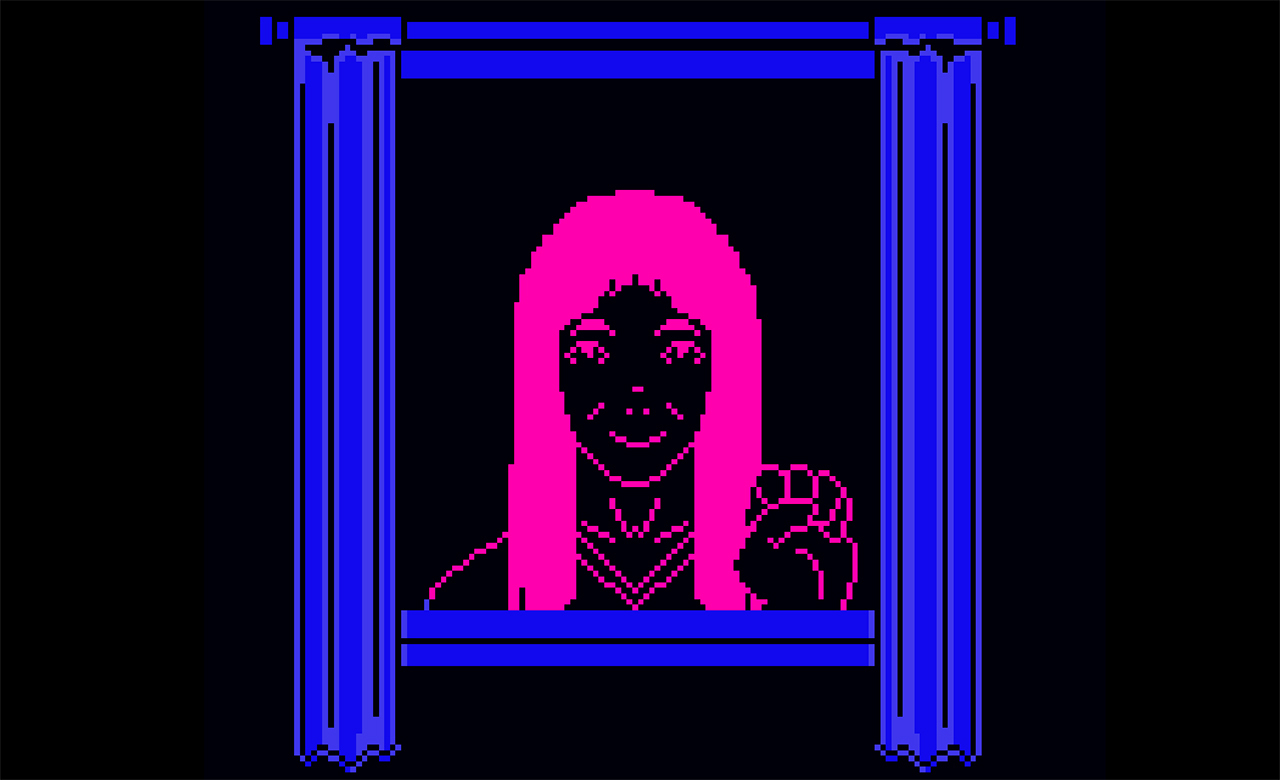
Don’t Let Her In is a free ten-minute horror game that you can play on a Game Boy Color emulator (such as mGBA) or directly in your browser on Itch.io.
You play as a teenager who hasn’t set foot outside the house in several weeks. Their father left a note on the kitchen table with a simple warning: Don’t let her in. As the player, you move through the house while interacting with various objects. You have one job, but you won’t be able to keep yourself safe forever.
Alternatively, you can ignore your father’s warning and invite the creepy woman inside the house as soon as she knocks on the kitchen window. This also leads to a satisfying story, although I’d recommend playing the game straight the first time around. The slow lead to the twist ending is wonderful, and having already experienced this twist makes the second ending much more satisfying.
The game’s graphics are simple but effective, and you might be surprised by how much body horror a few pixels can generate. The subtle worldbuilding is quite intriguing as well. There’s no good ending to this story, and its tone is bleak – there’s no irony or campiness, just horror. Don’t Let Her In may be short, but it’s remarkably effective at creating an atmosphere of loneliness and dread.
I Am Setsuna, which was published by Square Enix in 2016, is a twenty-hour JRPG set in a beautiful fantasy world blanketed by snow.
You play as a young man named Endir, a member of a secretive tribe of masked warriors. Endir has been hired by a mysterious third party to assassinate Setsuna, a young woman who has been chosen as the sacrifice whose death will hold back the tide of ice and monsters plaguing the world for another decade. When Endir finds and confronts Setsuna, she tells him that she is willing to die, but she requests that he accompany her on her journey to the sacrificial grounds so that her death will have meaning.
The structure of the game follows a standard JRPG progression. As he follows Setsuna on her pilgrimage, Endir travels between an alternating series of towns and dungeons. Each new town has slightly nicer weapons, and the money gained while fighting monsters allows these weapons to be purchased. The player can also purchase accessories that can be customized with various materials dropped by defeated monsters, thus granting characters new and improved battle abilities and magic spells.
I am Setsuna takes its inspiration in equal parts from Final Fantasy X and Chrono Trigger, meaning that its combat system is simple, easy to pick up, and fun to experiment with. Your characters gain levels quickly, so you’ll never have to worry about grinding. To help keep battles engaging, the combat employs an optional system of timed button presses that enable attack bonuses.
About ten hours in, the game becomes more challenging. Enemies take longer to defeat and often damage your characters before they die, while the dungeons become twisting labyrinths of indistinguishable corridors. It shames me to admit this, but I had to buy the Japanese strategy guide to find my way through an endgame dungeon filled with teleporter traps. In addition, I’d have to say that the game’s story begins to lose its threads well before the ending, which is remarkably unsatisfying.
As I’ve gotten older, I’ve found that I care far less about finishing any given video game. The moment a game stops being fun, I put it down and move on to something else. This is less about frustration and more about appreciation. Even if I never beat a game’s final boss, I can still be grateful for the parts of it that I enjoyed. Once I’ve seen everything I want to see, I can feel satisfied.
For me, I am Setsuna is a perfect example of a game that’s wonderful to play until it stops being fun. Although I’ve finished the story twice in the past, I was happy to enjoy about a dozen hours during my most recent playthrough. I suppose that I could keep going and power through the segments that necessitate a walkthrough, but I don’t particularly want to. And that’s okay.
Over the course of the first twelve hours of I am Setsuna, you’ll traverse snow-covered forests, venture into mountain villages beset by blizzards, and explore sparkling ice caves. Along the way, you’ll fight winter-themed creatures such as snow rabbits, arctic foxes, walruses, and bears. All of your characters are bundled up in warm and comfortable clothing, and it’s a pleasure to spend time in the villages chatting with NPCs by the fire while admiring the dried herbs and patterned quilts hanging from the walls.
I’m a fan of I am Setsuna, but I’d recommend it in the same way I’d recommend an actual retro game like Ocarina of Time. It’s absolutely worth playing I am Setsuna to experience its atmosphere and charm, but no one should feel bad about walking away when it becomes difficult and awkward.
Crow Country is a retro-styled 32-bit survival horror game that takes about four hours to play. What I love about Crow Country is its Story Mode, which removes all enemies and allows you to enjoy the game as an atmospheric adventure in an abandoned amusement park.
The year is 1990, and you (ostensibly) play as a police detective named Mara Forest. Mara is investigating the disappearance of Edward Crow, the owner of a small amusement park called Crow Country. Crow Country shut down and closed to the public two years ago after a girl named Elaine Marshall was severely injured in an accident.
Although Elaine’s family sued Edward Crow for the hospital fees, he never responded to court summons, and now the park sits boarded up and abandoned. Mara has reason to believe that Crow has holed up on the property, so she breaks in and begins searching for clues pertaining to his whereabouts.
Unfortunately for Mara, there are zombies about. Thankfully, she has a gun and a car trunk full of ammo. There’s also ample ammo scattered throughout the park, as well as various types of guns (and grenades) for Mara to pick up and experiment with. I’ve heard that the zombies aren’t particularly aggressive, and that shooting them isn’t particularly difficult, but I wouldn’t know. I didn’t bother with combat, and I have no regrets.
Even in Story Mode, Crow Country is a dense game with a lot to do. The map isn’t actually that big, but every “room” has multiple points of interaction. Most of this interaction provides atmosphere and flavor text, but Mara also needs to solve environmental puzzles in order to find the tools she needs to progress deeper into the park.
Mara can collect bits and pieces of brochures that she assembles into a map that proves to be extremely useful, as locked doors and unsolved puzzles are clearly marked. Although I did have to look up one or two solutions for optional challenge puzzles, I was never lost or confused about what I needed to do next. Unlike many puzzle-based adventure games, Crow Country is entirely possible to play without a guide.
In terms of its PlayStation-era retro graphics, Crow Country looks exactly like Final Fantasy VII. All of the character models are composed of charmingly blocky polygons, and the environments are pre-rendered and gradient shaded. Points of interaction are easy to distinguish, and you can rotate the camera a full 360 degrees. It’s a joy to move through this environment, especially once you begin to open Dark Souls style shortcuts.
Crow Country isn’t a cozy horror game; there’s no learning or friendship or beautiful autumn leaves. That being said, the horror elements are very mild, especially in Story Mode. Despite the atmospheric creepiness of its setting, Crow Country is less of a horror story about zombies and more of a speculative fiction story about how humans process the reality of climate change – or rather, how we will do anything to avoid processing this reality. The game’s conclusion is fantastic, as is the foreshadowing leading to its final reveals.
I wasn’t expecting Crow Country to be so fun to play, or for its environment to be so creatively designed, or for its story to hit so hard. I have zero patience for “intentionally inaccessible” retro game nonsense at this point in my life, but Crow Country wants to be experienced. Since it’s so short and accessible, I’d recommend the game to anyone who’s interested in the premise, even if you’re not typically a fan of survival horror.
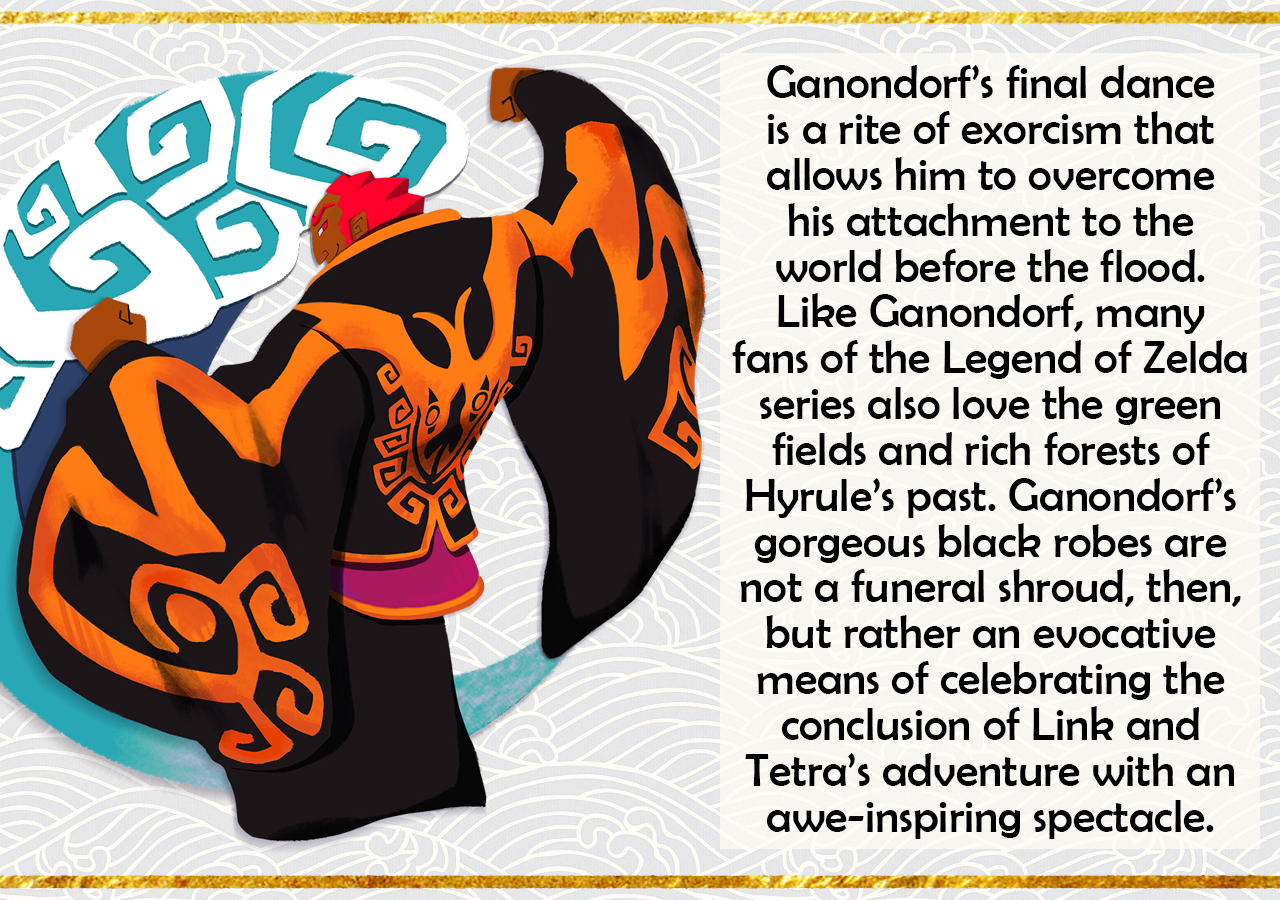
I’m excited to share my contribution to Hyrule Fashion Anthology, a fanzine celebrating the complex evolution of fashion history through the characters and setting of the Legend of Zelda series. Here’s a short description…
“A Wind-Grieved Ghost” discusses the influence of medieval Noh theater on the striking costume worn by Ganondorf in The Wind Waker. I provide a brief introduction of Noh drama and summarize how its character archetypes are enhanced by their clothing. I then explain the symbolism of Ganondorf’s gorgeously patterned robes and argue that the sartorial allusions to Noh theater serve to characterize Ganondorf as a frightening yet tragic ghost displaced from the beautiful vanished kingdom of Hyrule.
I consider myself extremely fortunate to have this essay illustrated by the dangerously stylish Astarsor, who shares bold and colorful character portraits on Instagram (here).
Leftover sales for Hyrule Fashion Anthology are open until November 15. This is a beautifully published zine filled with gorgeous artwork and fascinating articles inspired by the golden age of glossy fashion magazines, and it’s a stunning physical object. You can pick up a digital or paper copy along with a dazzling selection of merch via the zine’s storefront (here).
There’s a chill in the air as the twilight lingers and the moon glows bright in the autumn sky. What better time to crouch in front of your computer and scare yourself silly? For intrepid digital ghost hunters, Sidequest presents eight eerie games that are free to play on itch.io and short enough to occupy an intermission between deep dives into creepypasta wikis…
I was thrilled to have an opportunity to write another piece for Sidequest showcasing a curated collection of indie horror games. If you’re interested, you can check out the list here:
When calamity besets his home in the desert, the young prince Ganondorf is forced to journey abroad to seek answers in Hyrule’s ancient sanctuaries. Lost within the shadows of a temple deep in the forest, Ganondorf struggles with a burden he does not yet have the power to bear.
I wrote “A Legend of Shadows” for Hyrule Apocrypha, an illustrated storybook fanzine exploring the myths and lore of the Legend of Zelda series. I consider myself extremely lucky to have been be able to create a story illustration with Peregyr, whose green and magical art can be found on Twitter (here) and on DeviantArt (here). We had a great time imagining Ganondorf’s backstory as a failed hero. This is how the story opens…
What would you do if you weren’t the hero? What if the chosen one were someone else entirely? Would you curse the gods and lament your fate? Would you turn tail and go home? Would you try your luck elsewhere, in a distant land where no one knew your name? Or would you simply lay down your sword and give up? Ganondorf was beginning to suspect that he was no hero, but he was nothing if not stubborn. Giving up was not a choice he was willing to make.
You can read the full story on AO3 (here), and you can check out more of the work featured in the zine on Twitter (here) and on Tumblr (here). Leftover sales, which include some lovely Zelda-themed merch, are now open (here).
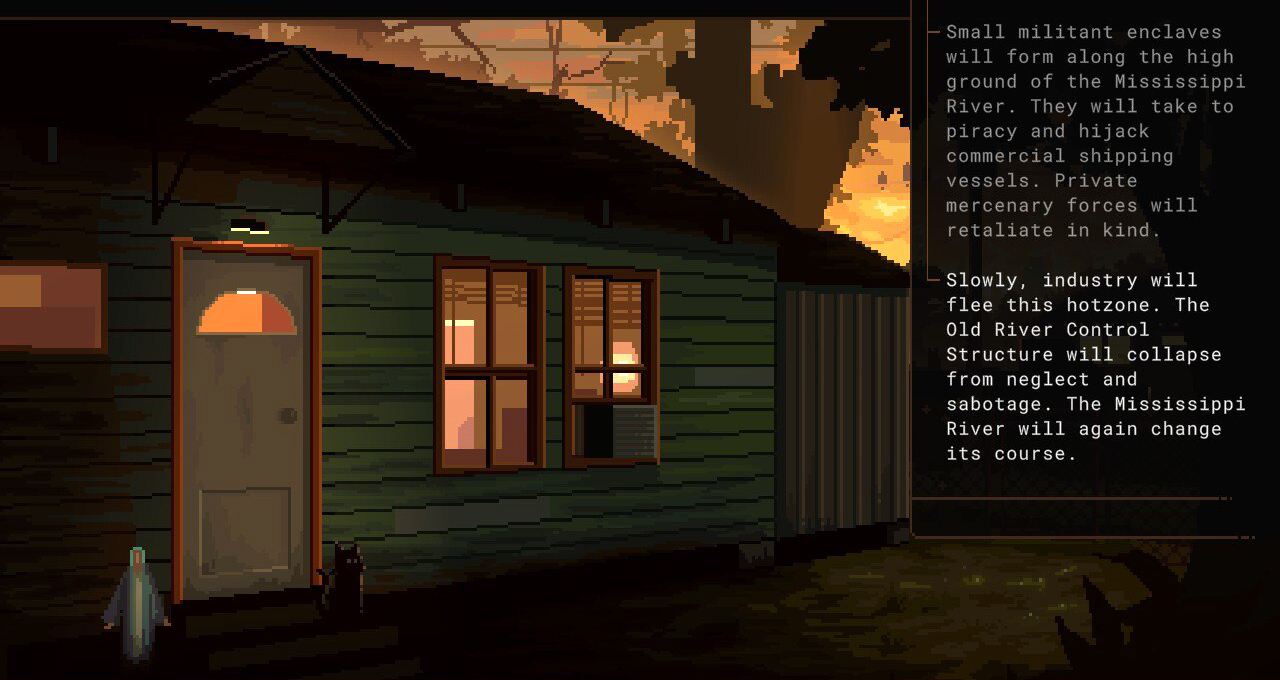
Norco is a cross between a visual novel and a point-and-click adventure game that takes seven hours to play. The game is set in a near-future version of New Orleans and its surrounding bayou. Despite its lowkey cyberpunk elements, the future envisioned by the game isn’t all that different from the present. Norco is gorgeously well-written and intriguingly grounded in the specificity of its setting, and the various small stories it encompasses are filled with fascinating characters and meaningful human drama.
I want to focus on what’s interesting about this game. That being said, Norco can be frustrating, so let me get this out of the way: most of the adventure game elements of Norco are bad. The puzzles (such as they are) are poorly executed and annoying. There’s at least one instance of turn-based combat per act, and it’s not great. Also, the game takes a weird turn toward cosmic horror in the third and final act; and, in order to unlock a slightly more satisfying ending, you have to do a minor random thing in the second act that’s extremely easy to miss.
None of this is a deal breaker. Rather, I think it’s good to set expectations. Specifically, you should expect to use a walkthrough at some point. I actually ended up using three walkthroughs, as I found some of the adventure game sequences to be difficult to piece together. They’re not complicated; they’re just opaque. Thankfully, the more frustrating puzzles are few and far between, and you can play the vast majority of the game just fine on your own.
You begin Norco as a woman named Kay who returns home after her mother dies of cancer and her brother Blake stops replying to texts. Although Blake is nowhere to be found in or around the house, Kay is greeted by the family robot Million, a fugitive from the skirmishes between armed militias that have broken out across the southwest. Million suggests that she and Kay talk to people in the neighborhood to figure out where Blake has run off to.
The search for Blake is interrupted by extended flashback sequences in which you play as Kay’s mother Catherine. While her cancer is in remission, Catherine takes odd jobs on a Fivver-like platform called Superduck in order to pay off loans so her kids can keep the house after she dies. These jobs take Catherine across New Orleans and eventually lead her to an abandoned mall colonized by the teenage disciples of an internet demagogue by the name of Kenner John.
We’re introduced to Catherine as she allows a blandly anonymous tech corporation to make a neural map of her brain. In theory, the experimental procedure is compensated by the generation of an AI personality intended to help Catherine’s family process her death. In reality, Catherine needs the money. Immediately after her brain imaging session, she’s out in the city after dark running errands via the Superduck app.
Oddly enough, Superduck ends up being a real “person,” a branch of an AI personality based on Catherine’s friend Duck. Based on a story Catherine once told Duck, Superduck has figured out that an alien entity resides in the estuary of Lake Pontchartrain, and that it was captured by Kenner John.
Although the cyberpunk elements of Norco’s plot are fun, they’re not the real story. As Catherine, you play as a tired and washed-up adult using a rideshare service to get around town while trying to gather information from other tired adults who are just trying to make a living. It’s through these conversations that the player gets a sense of what New Orleans is like as a city, as well as a sense of how not even wealthy people who seem to be major players have any control over the environment. There are going to be hurricanes, and there are going to be floods, and neither oil companies nor tech companies can do anything about it.
What I appreciate about Norco is how realistic and grounded it is. As someone dealing with cancer, Catherine gets winded climbing stairs during one of the adventure game segments, and she’s okay with telling people that no, actually, she’s not fine and she needs a minute. Kenner John’s cultists are dumb kids (affectionate) who just want to hang out in an abandoned mall and smoke weed while playing video games. Even the MAGA-style militia members who make a brief appearance in the last act are heroic in their own deranged way, and the poor harassed public official who stays late in City Hall dealing with paperwork delivers a monologue about how you can’t save everyone that’s worthy of Shakespeare.
Despite the gritty setting of a city on its last legs and Norco’s complete lack of sentimentality, all of the characters are intensely human and sympathetic. They’re also quite funny, even when they’re at their lowest and most morally dubious. There’s one story about a guy who eats a hotdog from a food cart in a downtown tourist area that made me laugh so hard I cried. Norco tackles challenging themes, but it also manages to be pitch-perfect comedy storytelling. I really can’t overemphasize how brilliant the writing is.
Also, this is worth saying: As someone who grew up in the Deep South, I’m truly and deeply grateful that the script of this game uses an accurate representation of Southern AAVE. My promise to myself about Norco was that I would put the game down and walk away the second anyone said “y’all” or pulled some sort of X-Men Gambit bullshit, but I didn’t need to worry. Everyone talks like a normal person.
The basic gameplay of Norco consists of conversation-based fetch quests. Someone will tell you to talk to someone else, and you have to go find them. You do this by driving (or ordering an off-brand Uber) to take you to a point on a map of New Orleans, and from there you’ll navigate between four or five screens by clicking on various points of interest. Your objective is always clear, but there’s a lot of non-essential content to interact with. And it’s good to talk with everyone! What you’ll get as a reward for being curious is some of the best stand-up comedy you’ll ever read.
The adventure game puzzles are so deeply embedded in the action of the story that they’re difficult to describe without extensive plot summary. What makes the worst of them annoying is that they expect you to leave the game and write something down in real life. One of the more obnoxious of these puzzles involves numerology. I understand that this is a play on the weird Christian-themed numerology cults that have sprung up on YouTube and Facebook – one of my aunts got really into this during the pandemic, true story, and it’s batshit insane – but it’s still a pain to put down the game and go get a piece of paper.
One of the interactive elements of the game that actually works well occupies a large portion of the third act. The Surprise Big Bad antagonist has gotten an offshoot of the Kenner John cult to build a spaceship on the bayou, and Kay needs to go out and find the site by navigating through the swamp in a small boat on a 4-bit pixelated sonar screen. There are all sorts of fun things to find out on the water, and this segment is enhanced by an atmospheric lead-up that includes an interesting lesson in natural history concerning why the topography of the bayou is so treacherous even though it looks like open water.
At the conclusion of the end credits, Norco provides a list of books and documentaries that the developers used as references. I was so drawn into the real-world history presented by Norco that I immediately screencapped this list. I got started on following up with these references by watching a documentary called Mossville: When the Great Trees Fall, and it’s almost painfully apparent that the creators of Norco were pulling inspiration from serious ongoing issues. It’s amazing that they were able to take such heavy material and transform it into something so gorgeously strange and entertaining.
Although Norco isn’t as mechanically robust as Disco Elysium, it’s easily in the same category of excellent writing and unique visual stylization. I somehow got the impression that this game would be all doom and gloom about poverty and injustice, but it’s actually a genuinely funny dark comedy about a cast of characters whom I grew to love despite (and often because of) their flaws and bad behavior.
I got to write my dream article for Sidequest about Ender Lilies, one of my favorite games! Here’s the opening paragraph:
In Binary Haze’s 2021 Soulslike Metroidvania Ender Lilies: Quietus of the Knights, a young girl named Lily navigates a hostile postapocalyptic world with the help of grotesquely mutated undead monsters. As the game progresses, Lily becomes increasingly reliant on her monstrous companions as she becomes more monstrous herself. Ender Lilies functions as an intriguing model of mutual aid, especially in relation to its gradual descent into fungal horror. As the world changes around us, Ender Lilies asks, is it really so horrific to develop radical new relationships with the environment?
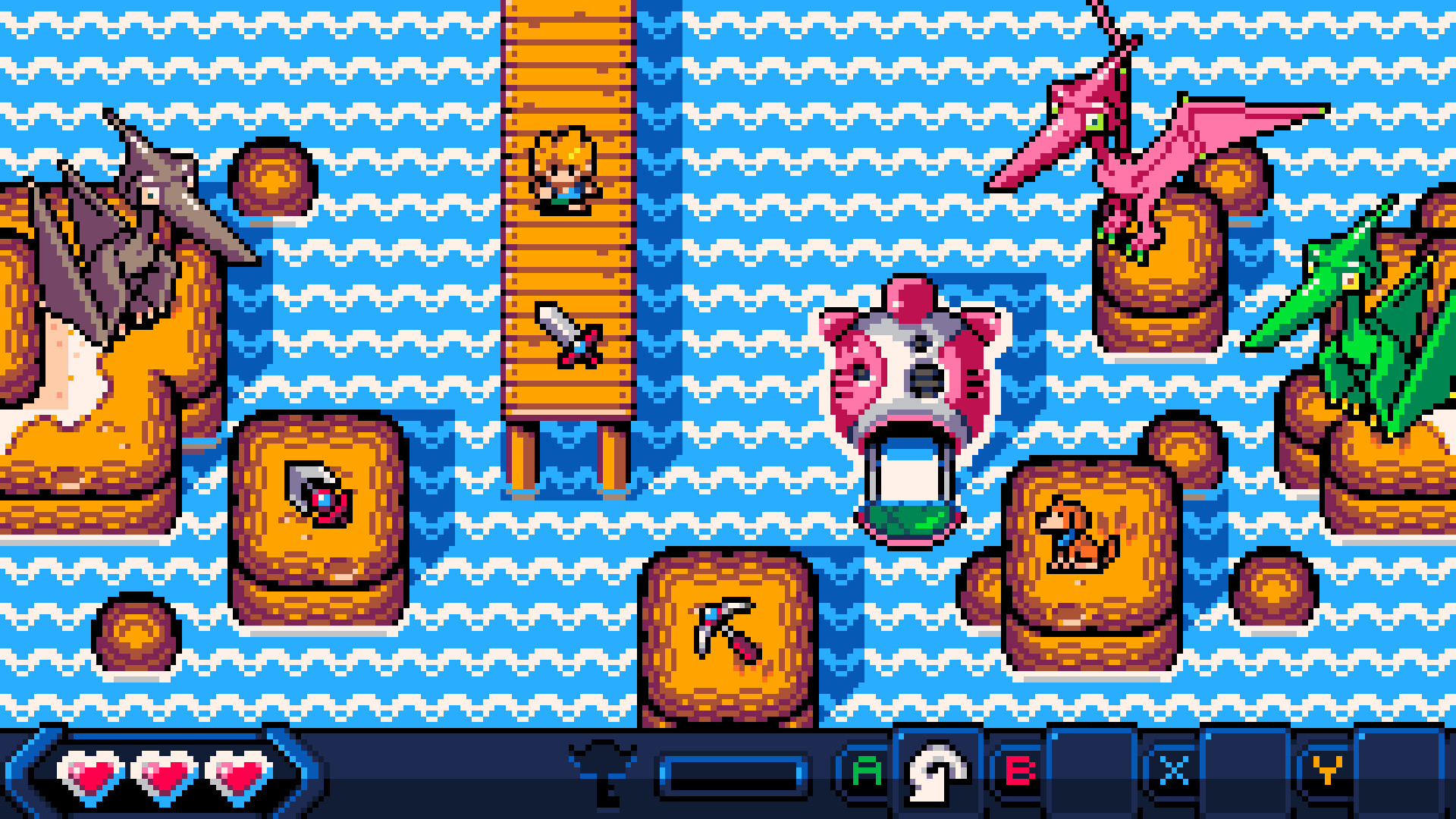
Castaway is a tribute to Link’s Awakening whose story campaign takes about 35 minutes to play. This campaign functions as a tutorial to the game’s Death Tower, in which you have one life to climb fifty simple and static floors with very few health drops and no permanent upgrades. The Death Tower is not for me, but the story campaign was a pocket of pure and unadulterated joy.
You play as a young boy whose escape pod lands on a deserted island after his spaceship blows up. After the crash, pterodactyls steal the boy’s survival tools and his dog, so it’s up to him to unsheathe his trusty sword and explore the island to get everything back.
The island is very small, as are each of the three dungeons. There’s no one to talk to, and there are only four types of enemies. The only aspects of the environment you can interact with are two types of rocks, so all of the puzzles involve sokoban-style block pushing. The two tools you find in the first two dungeons are a pickaxe that allows you to break rocks and a hookshot that allows you to latch onto rocks to cross gaps. If you use your tools to backtrack, you can collect three additional hearts to bolster your health.
The overworld map and dungeons are all tight and precise. More than a true imitation of a Zelda game, Castaway’s story campaign seems to be a stage for speedrunning, and there’s a special Speedrun Mode that allows you to see the clock onscreen. I tend not to care about such things, but the Speedrun Mode was a nice excuse to give the game a second playthrough with a bit more challenge.
The music and sound effects of Castaway are forgettable, but the graphics manage to achieve the trick of using modern technology to reproduce what you thought Game Boy Color games looked like when you were younger. The pixel art of the opening and closing animations is gorgeous, and the interstitial illustrations are lovely as well.
Whether this tiny game is worth $8 is debatable, especially if you’re not interested in speedruns or gauntlet survival challenges. I love Link’s Awakening beyond all reason, so I was happy to put down the money to support indie developers while spending an hour in nostalgia heaven. Still, it would have been nice if Castaway had more substance.
If you’re interested in the concept of Castaway but don’t want to spend money on something that feels like it should be a free demo of a larger game, please consider the alternative of Ocean’s Heart, a beautiful and robust Zeldalike game that’s honestly better than most actual Zelda games. If you’re interested, you can check out my review of Ocean’s Heart (here).