Spiritfarer

I caught the flu last week. I couldn’t eat or sleep for days. It was intense.

If you ever find yourself in a situation like this, Spiritfarer is the perfect game. The art and music are soothing and gentle, and the gameplay is simultaneously relaxing and addictive. It took me somewhere between 35 and 40 hours to get close to 100% completion, and I didn’t notice the passage of time at all while I was playing.

Spiritfarer describes itself as a “cozy management game about dying,” which is as good of a description as any. As Stella, the newly appointed Spiritfarer, it’s your job to ferry spirits to the great beyond on a giant boat. The twelve spirits you encounter take the forms of anthropomorphic animals, and each has a distinct personality and set of preferences. These spirits will need to spend time on your boat before they’re ready to move on, and you’re tasked with building each of them a small house and then keeping them fed and happy while they travel with you. You pick up cooking ingredients and building resources by visiting various points on the map, which you’ll gradually explore as you complete requests and meet new spirits. While sailing between locations on your boat, you can grow crops, care for livestock, cook food, and craft various materials.

Each spirit gives you an Obol as payment for their passage, and a spirit flower will bloom in their house after they move on. You use these tokens to upgrade your boat and expand your range of abilities, which grow include gliding and double jumping. This system of resource-based expansion allows you to open more of the game at your own pace while simultaneously limiting the number of tasks you need to worry about at any given time.

Spiritfarer has an excellent balance of exploration and crafting, as well as optional bits of Metroidvania-lite platforming. There’s no combat. Most of the challenge comes from effective in-game time management, although there are no time limits or negative consequences for just futzing around. Player movement is limited by a few artificial barriers at the beginning, but the world of Spiritfarer is relatively open, and there’s always a lot going on. The spirits’ requests nudge you in the direction of exploring new areas of the map organically, so you’ll never be at a loss for what to do next. Thankfully, your menu screen contains a list of requests and sidequests for your convenience.

The introduction to Spiritfarer’s story is a bit silly – you are a small child! here’s a giant boat! go out and ferry the dead! – but it becomes much more compelling as you progress. It might seem odd that a cute game about sailing around with talking animals has a “Teen” rating, but some of the spirits are carrying a lot of baggage. Their stories aren’t melodramas with happy endings, but instead involve real and complicated misbehavior, delusions, and regrets. To give an example, one of the souls is suffering from dementia. She’s kind and curious when she’s lucid, but she’s incredibly mean during her foggy periods, and she gradually gets worse instead of better.

There’s no graphic depiction of sex or violence, but some of the stories are surprisingly dark and specific. The first spirit you meet, Gwen, eventually admits that she struggled with suicidal ideation throughout her youth, and the compulsion to end her life returned with a vengeance as she was dying from lung cancer in her early forties. Gwen didn’t commit suicide, but she wasn’t able to survive cancer, and her blithely ironic attitude can’t quite conceal how bitter she is about having her life cut short.

Stella’s own story isn’t revealed until later in the game, but the way the spirits are connected to her is touching and beautiful. Spiritfarer celebrates the joy of being alive, but it’s ultimately about the sweetness and gentleness of death. Thankfully, it has a solid sense of humor, and also you can raise sheep.

Spiritfarer is a perfectly designed to be fun and engaging without being frustrating. I also appreciate that it wraps up in a satisfying thirty to forty hours. It’s exactly the sort of game I might recommend to adults who aren’t into gaming but are interested in how the medium can tell a complex story in an interesting and unique way.

Spiritfarer is also the perfect game to play if you find yourself stuck in bed with a prolonged illness. Even though I would happily recommend the game to anyone, it’s worth saving for when you need it.

The End of the Line for the Shinra Corporation

Over the course of its expansive story, Final Fantasy VII changes direction and shifts focus but holds fast to the goal of saving the world from a crisis created by Shinra. Even if there were no interstellar demons or mad scientists, the Planet would never have survived were it not for a small group of activists who dared to challenge the most powerful corporation in the world…

I contributed a meta essay titled “The End of the Line for the Shinra Corporation” to the Return to the Planet fanzine, which celebrates the 25th anniversary of the original 1997 release of Final Fantasy VII. My piece is about how the game references the corporate critique and real-world grassroots environmental activism in Japan during the 1990s. The zine is filled with gorgeous artwork, stories, and nonfiction, and it’s free to download. You can read my essay on my Japanese fiction blog (here), and I also posted it on AO3 (here). You can check out the zine via these links:

🌿 https://twitter.com/ff7ogzine
🌿 http://whitemateria.net/ff7ogzine/
🌿 https://archiveofourown.org/collections/FF7OGZine

Coffee Talk

Coffee Talk is a visual novel about an all-night coffee shop in Seattle. You play as the barista, and your job is to connect your customers to one another while improving their moods by serving warm drinks. Although the game tackles serious issues softened through the lens of fantasy, its tone is relatively lighthearted and gentle, and the pixel graphics are cute and cozy.  

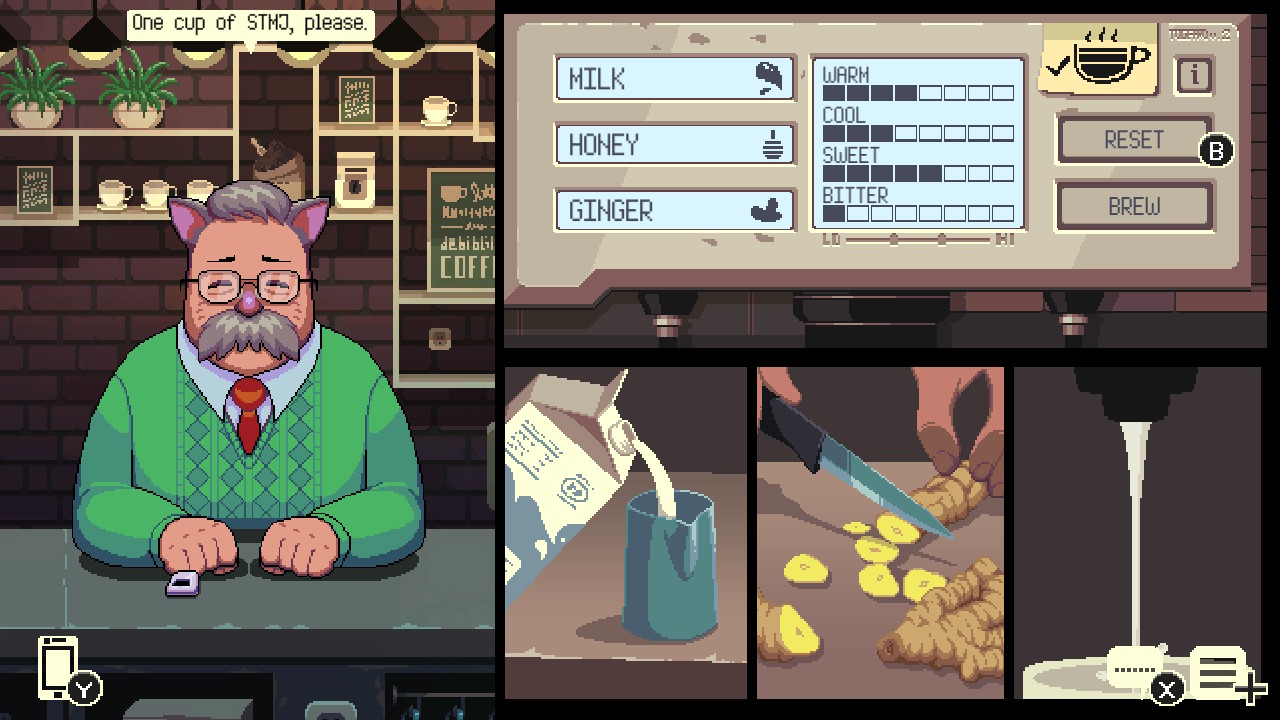
The game has three screens: your view of the shop from behind the counter as you chat with your customers, an ingredient selection screen for the drinks you make, and your cellphone, which contains an incomplete list of recipes, a music playlist, and an in-game social media app. The story takes place over fourteen nights, and there’s only one ending. There are no dialog choices, but some of your customers will open up to you more (and allow you greater access to their social media profiles) if you serve them drinks to match their moods. In other words, there isn’t much gameplay. Aside from brewing different types of coffee and tea, the player is mainly along for the ride.

Every review I’ve read of Coffee Talk complains about the drink brewing system, and rightly so. It’s counterintuitive and needlessly complicated. Each drink has a base – coffee, tea, green tea, chocolate, or milk – and you can add two additional ingredients, such as mint or cinnamon. The order in which you add the ingredients matters, meaning that tea with lemon and honey is a different recipe than tea with honey and lemon. On top of that, each drink has several different meters measuring qualities such as “sweet” or “cool,” and there’s no way to predict what combination of ingredients will result in the requested combination of qualities. Your customers will sometimes tell you how to brew a drink, but you mostly have to complete the recipe app on your phone yourself.

I can’t imagine that there’s any way to get everyone’s drink orders correct without either using a walkthrough or exploiting the save feature as you employ trial and error to go through a list of possible permutations. Thankfully, it doesn’t really matter, and most players will probably do just fine by paying attention to the dialog.

The main draw of Coffee Talk is its setting, a fantasy AU version of Seattle. The year is 2020, and everything is more or less the same except that fantasy races are real – elves, orcs, vampires, fish people, you name it. As far as I can tell, there’s no magic aside from the general characteristics associated with various fantasy races, meaning that elves have long lifespans, werewolves transform once a month, and so on. Each night at the coffee shop is prefaced by the front page of that day’s newspaper, and the fantasy world’s concerns seem to mirror those of our own: Orcs demand an end to workplace discrimination, the U.S. and Atlantis negotiate immigration reforms, Seattle plans to host this year’s Coachella music festival.  

The eleven characters who visit the coffee shop come from all walks of life. One of my favorites is the werewolf war veteran Gala, who works in medical administration. He seems to have a complicated past, but this is nowhere near as important as the mundane conversations he has with other characters, often contributing a sense of perspective to their problems. It’s refreshing that none of the characters care about the details of what it’s like to be a werewolf but are much more interested in what it means to work in medical admin. Gala is friends with a supermodel vampire named Hyde, who is characterized not as a “supermodel” or “vampire,” but rather someone who means well but is brutally honest – and perhaps romantically interested in Gala.

The setting of Coffee Talk has a lot of narrative potential, but I feel the worldbuilding is somewhat shallow. In addition, the lighthearted tone of the writing doesn’t match the complications of the issues under discussion. To give an example, one of the coffee shop’s patrons is an eighteen-year-old aspiring pop star whose manager seems to be setting her up to be sexually assaulted at a Coachella afterparty. Thankfully, the character is able to avoid this situation by not attending the party. How simple is that! When you’re confronted with sexual menace, you can just… walk away! It’s not like careers in the entertainment industry are based on the connections formed at these parties or anything.

Although this isn’t anywhere near as heavy as some of the other character arcs, I felt personally attacked by Freya, a green-haired human woman who works as a staff writer at a local Seattle newspaper. Freya receives a chance opportunity to submit a novel to a head editor at her newspaper’s parent company, with the caveat that she has to complete a draft in two weeks. Which she is 100% able to do, because she believes in herself. Writing a presentation-ready draft of a novel in two weeks is all about self-confidence, right? And of course her novel is accepted for publication, and it becomes a best seller right away, and all of this happens in less than a year. Because that’s all it takes to publish the first novel you’ve ever written: believing in yourself – and a lot of caffeine!!

Obviously I’m being ironic. Writing and publishing a novel in a few short months is just as much of a fantasy as the story arc of a game developer who solves the issue of crunch culture by… just taking a weekend vacation! Putting aside the work cultures of people in creative industries, I’m frustrated by the suggestion that a pleasant conversation all it takes to solve heavier problems ranging from systemic racism to needlessly high barriers to legal immigration, and that if your own life isn’t working out then you just aren’t drinking enough fancy coffee.

It should go without saying that this is nothing more than my personal response to the game. My frustration with Coffee Talk is my frustration with YA fiction in general, by which I mean that I find it difficult to become emotionally invested in characters who face genuine challenges but aren’t allowed to say “fuck.” Still, I understand that not everything has to be realistic and gritty, and that there’s value in seeing a happy ending for a character whose experience mirrors your own.   

On the whole, Coffee Talk is enjoyable and well-written, and it’s a nice lo-fi game to chill to. It takes about three to four hours to finish, and it has a fun postgame secret ending that adds a bit of replay value. A sequel is planned for release later this year, and I’m looking forward to reading more interactive stories set in this universe.

Reminiscence in the Night

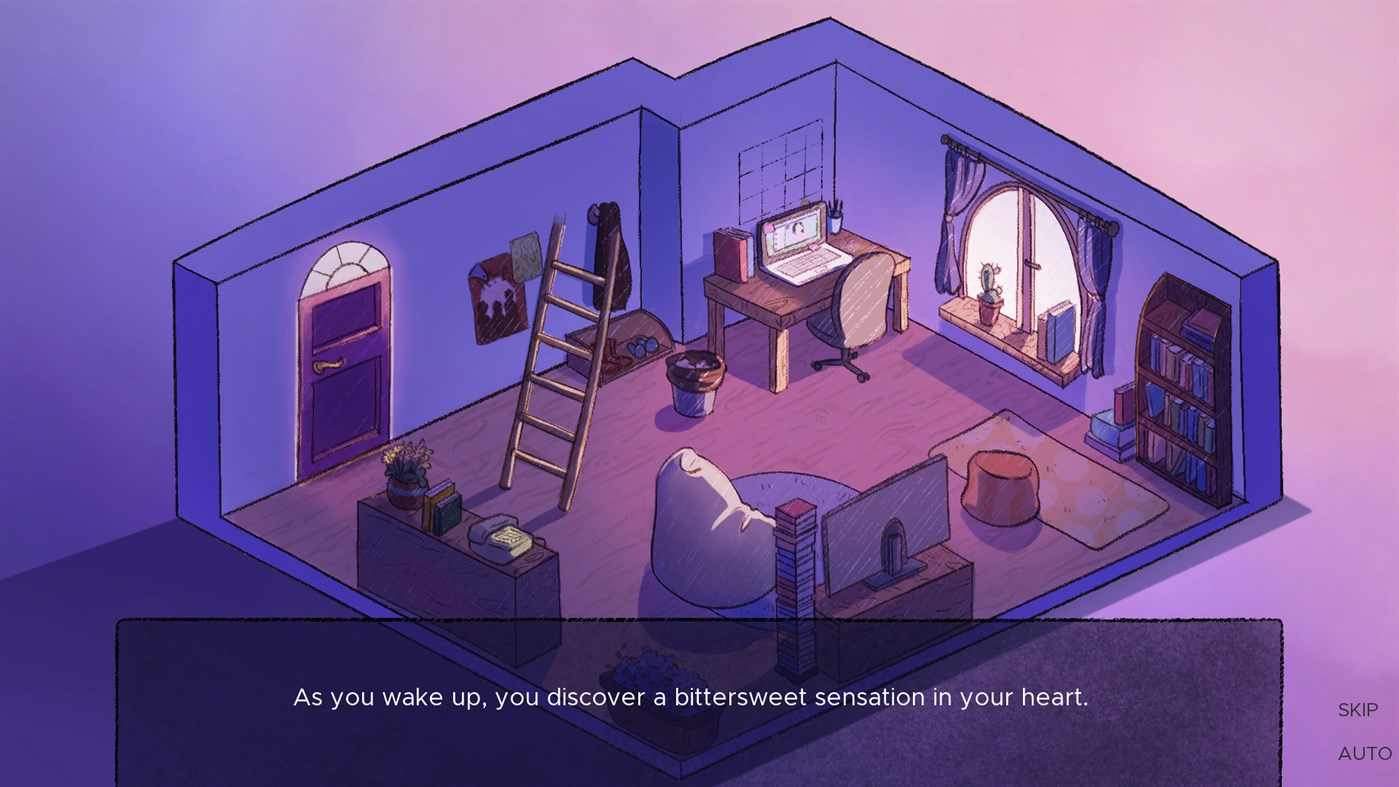
Reminiscence in the Night is a short point-and-click story game that takes place in the two-room apartment of someone with serious depression. It has multiple endings, and it takes about half an hour to play.

At the beginning of the game, your character wakes up in their apartment with no memories, and they can’t (or won’t) go outside. Their only clues to their identity are their mother, who calls on the phone, and their childhood friend Sofia, whom they can video chat with on their computer. Unfortunately, their mother is suffering from a memory disorder, and things are a bit awkward with Sofia.

The controls are simple and easy, but there isn’t much to interact with. The endings aren’t broadcast, and the dialog choices seem arbitrary. Unless you use a walkthrough, you’re probably not getting out of the apartment.

The game’s soft pastel graphics are cute, but its themes are very dark, and there are mild elements of horror. It’s difficult to understand exactly what happens if you get the bad ending, but either a ghost that lives in your mirror attacks and destroys you, or the ghost is metaphorical and you commit suicide.

The good endings are a bit more interesting, but you can only unlock them through an exact series of specific choices. If you happen to choose the “wrong” response to Sofia during your first conversation – which is, again, not broadcast at all – you’re almost certainly going to get the bad ending.

I’m not sure how well this arbitrariness works as a narrative device; but, if you’re willing to accept Reminiscence in the Night as a horror game with a dark ending, it’s an entertaining way to spend half an hour. It’s going for $3 on the Nintendo Switch store, and I’d say it’s worth it.

I’m intrigued by Team SolEtude, the studio that developed Reminiscence in the Night. They’ve got about half a dozen free games up on Itchio, and I’m definitely interested in playing more of their work.

Spirit Hunter: NG

Spirit Hunter: NG is a 2018 visual horror novel about the urban legends that come out after dark in a sleepy Tokyo suburb. You play as Akira Kijima, a 17-year-old delinquent whose young cousin has been captured by a spirit named Kakuya. Kakuya challenges Akira to a game, promising that she will return his cousin if he manages to confront a series of monsters local to the neighborhood of Kissouji.

The overarching story of Kakuya’s game is somewhat silly, as are the protagonist and supporting characters. The stars of the game are the urban legends that form the core of each of the seven chapters. As far as I can tell, these urban legends are all original, and it’s a lot of fun to slowly gather the details of the stories. The monster artwork is very creative and very gruesome, while the scenes depicting the monsters’ victims are horrible, explicit, and intense. There are no jump scares, but I was genuinely shocked by some of the deaths.

The gameplay is simple. You investigate your environment by shining your flashlight on objects embedded in the background artwork, and you collect various odds and ends that you use to solve simple puzzles. You’ll occasionally find yourself in life-or-death encounters with monsters who want to kill you, as well as overzealous police who will end your adventure early by arresting you. During these encounters, you’re presented with a timed series of dialog choices, and you’ll receive an instant “game over” if you select incorrectly.

Unfortunately, you can only save at certain points, meaning that you may have to replay an entire extended encounter sequence if you mess up. It’s possible to speed through previously read text, but I became so frustrated by an early-game confrontation that I started using a walkthrough to help make the gameplay a bit smoother. Although most of the puzzles and dialog choices are self-explanatory, others can feel entirely random. Still, if you don’t mind consulting a walkthrough before you play through the monster encounter sequences, the story flows smoothly, and the exploration elements are enjoyable and fairly intuitive.  

NG has “good,” “bad,” and “normal” endings based on whether you treat the monsters with violence or compassion. Other than that, there don’t seem to be any branching paths, and your choices don’t have anything more than minor cosmetic effects on the story. You can raise the level of affection that the named NPCs feel toward you, but this doesn’t seem to affect anything other than a few throwaway lines of dialog.

The game also includes a few sidequests that involve solving simple riddles to find D-Cards, trading cards that contain information on bonus urban legends with marginal connections to the main plot. These sidequests give the player an opportunity to explore the environment with a greater attention to detail, and the cards showcase some of the most interesting writing in the game. None of this card collecting is mandatory, but it’s nice to have an excuse to walk around the Tokyo suburbs late at night when all the sources of light are artificial and vaguely eerie by default. The atmospheric sound design is excellent as well, and it’s a pleasure to listen to your character’s footsteps echoing on concrete against a backdrop of city traffic, buzzing streetlights, and convenience store chimes.

If you use a walkthrough to progress smoothly through the confrontations with monsters, NG takes about fifteen hours to complete, and it’s easy to get sucked into the story. All of the urban legends are fascinating, and the game has a fairly progressive worldview on corporate violence, corrupt law enforcement, and the ways in which wealth and power facilitate the “othering” of people who are different. NG isn’t misogynistic or gross about its female characters, and there’s no sexual violence or lolicon.

All but one of the urban legend monsters are female, and NG is a treasure trove of themes and imagery to anyone interested in the intersections between gender and horror. The mystery at the core of the overarching story is tied both to real Shintō traditions and to real urban legends about (hopefully fictional) Shintō traditions, so there are a few extra layers of the narrative that players familiar with Japanese religion and folklore will be able to appreciate and enjoy.  

I definitely wouldn’t recommend NG to anyone who can’t handle graphic R-rated horror, but it’s visually striking and thematically satisfying. I respect and admire the game’s creepy demonic women, and I gradually came to sympathize with a few of the monstrous male characters as well. NG is so rich in narrative detail that it would be a fun game to write an in-depth academic research paper about… and who knows, I might even write this paper myself!

The Legend We Create

The courageous hero loves the wise princess, but they are bound by their fate and must put their feelings aside for the sake of a world floating above the ruins of an ancient kingdom.

…or so the legend goes, but some storytellers have a slightly different interpretation.

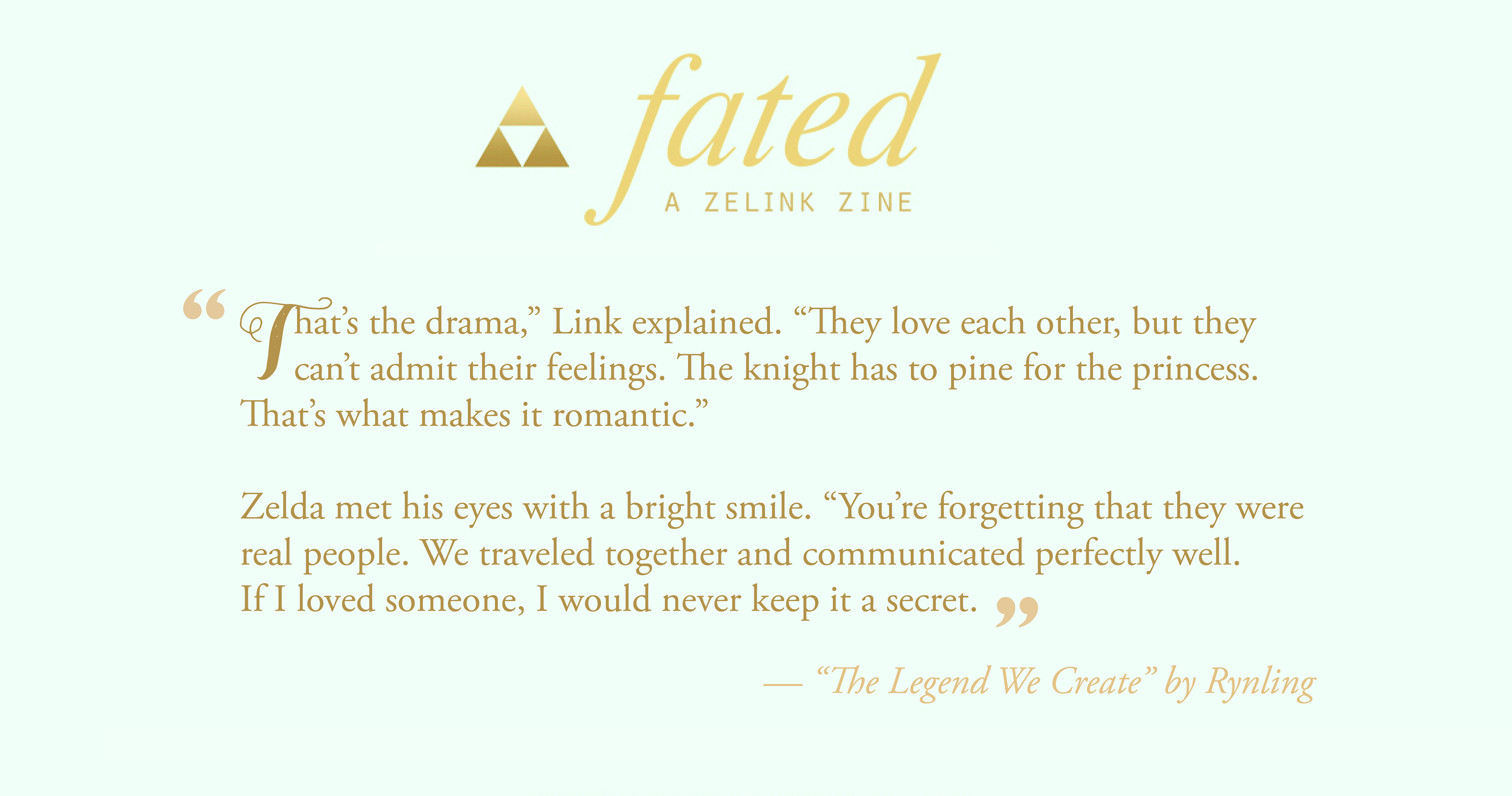
The Legend We Create is a tale of mutual pining and second-chance romance on the Great Sea, as well as a meditation on how each new generation heals the wounds of history by telling their own narratives about the past. You can read this short story on AO3 (here).

This story was published in Fated: A Zelink Zine. You check out the work of the other contributors on the zine’s Twitter account (here).

World End Syndrome

World End Syndrome is a visual novel about a small seaside town with dark secrets. It’s structured like a dating sim, and you have to romance each of the five datable characters if you want to unlock the “true ending” that answers all the questions about the overarching mystery. Thankfully, the dating sim elements are relatively undemanding. There aren’t a lot of dialog options, and the gameplay mainly involves choosing which location to visit on each day during the month of August.

I know this will be a deal-breaker for some people, so I should say at the beginning that there’s some mandatory incest in this game. But it’s sort of okay because of plot reasons? As far as dating sim incest goes, the relationships in World End Syndrome didn’t particularly creep me out. It’s honestly not that big of a deal, especially not in a game that would be PG-rated were it not for the occasional murder, but your mileage may vary.

As the nameless protagonist, you move to the small seaside town of Mihate to live with your cousin following the death of your sister in a car accident. You and your cousin are in the same class in high school, and your homeroom teacher is a folklore scholar who just published a bestselling YA romance novel. The novel is called World End Syndrome, and it’s based on the Mihate legend of the Yomibito, a dead person who returns to life but doesn’t know they’re dead.

There are strong “Bruce Willis at the end of Sixth Sense” vibes surrounding the protagonist at the beginning, but he turns out to be very much alive – at least until he gets murdered at the end of the prologue. This is the game’s official “worst ending,” and you have to start over from the beginning and make a different choice at a crucial point to progress. In order to avoid being murdered, you have to form an emotional bond one of the girls in your class. Successfully doing so for the first time leads you to an ending that, while satisfying in and of itself, does nothing to explain what the deal is with Mihate and its spooky legends.

It would be tedious to explain the details, but World End Syndrome has an interesting system of unlocking various scenes and dialog choices based on the number of previously completed interactions. Your cumulative progress carries over between saves, even when you’re hopping from one save file to another on the same romance route. What this means is that each playthrough is going to be different, even during repeated scenes. Your first full playthrough will tell a fairly straightforward story about a high school romance that’s sweet despite having hints of darkness, but on subsequent playthroughs you’ll begin to realize that there’s something very weird going on in Mihate. World End Syndrome isn’t really a horror game, as it’s not gruesome and doesn’t go out of its way to be upsetting, but it turns out to be an intriguing supernatural mystery.

The character art of the girls is very cute, the character art of the boys is very over-the-top silly, and the environmental art is absolutely gorgeous. Although there’s nothing special about the writing on a line-by-line basis, the translation is solid and pleasant to read.

What helps World End Syndrome stand out is the voice acting and sound design. I don’t have the vocabulary to describe what makes the audio elements of the game so appealing, save to say that the quality of the recording is excellent. There’s a lovely in-game radio broadcast that allowed me to finally understand the appeal of ASMR, and I think the sound quality is something you can appreciate even without knowledge of Japanese. The game gives you a lot of control over the sound channels, and you can turn down or even mute the voice acting if you prefer.

I was on the fence about World End Syndrome, as I was dubious about a game that wants you to play the same story six or seven times, but I’m glad I gave it a chance. If you’re only interested in one playthrough, that’s perfectly fine. It takes about ten to twelve hours to get from the beginning to the first character-specific “good ending,” which is a respectable length for a visual novel. Even if you don’t have the patience to solve the mysteries of Mihate, it’s a lot of fun to explore the town, attend club activities, and go on dates while there are dead people (and possibly a cult) wandering around and killing people in the background.

The Shadows of Hyrule

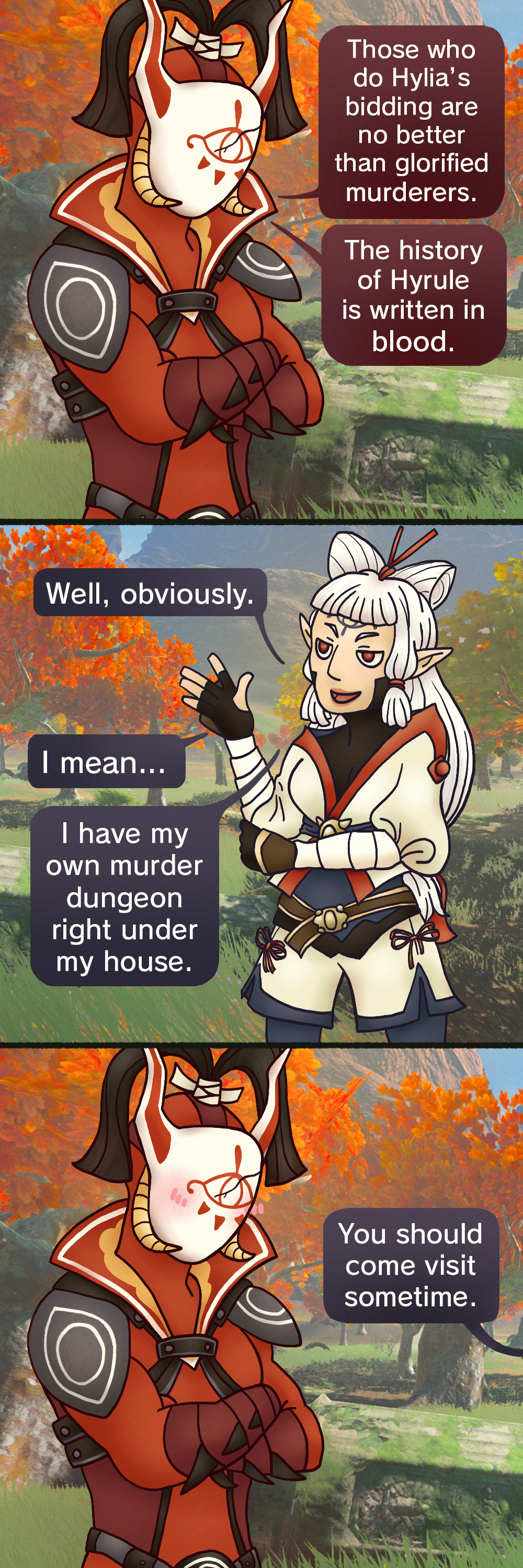
Honey, everyone has a murder dungeon in Kakariko Village.

The joke is that, while the “evil” Yiga Clan is characterized as violent and bloodthirsty in Breath of the Wild, the “good” Sheikah Clan is canonically just as disturbing. They’re all magical ninja assassins. What do you expect?

These two characters are Sooga and Impa from the Breath of the Wild AU melee fighting game Age of Calamity, and this is fan art of the four-part Sooga/Impa fancomic Shadow Folk by Frankiesbugs on Tumblr. You can read Shadow Folk on Tumblr starting (here), or you can donate 1€ to download a PDF version (here). I have to admit that I never considered any sort of relationship between Impa and Sooga until I read this comic, but the art is stylish and beautiful and the story is a lot of fun.

On the Internet, No One Knows You’re (Not) Kris

I recently participated in the annual Yuletide fic exchange for small fandoms. More than a thousand people contribute their work to this exchange, in which each participant is anonymously matched with someone who requests a story for one of the fandoms they’ve offered to write for. The person with whom I was matched asked for fic about Deltarune, and they requested “existential horror about free will and the ethics of a player guiding characters with self-awareness.” I’m always up for existential horror, and the recipient’s description of how they view the player-character Kris really vibed with me: “A Weird Kid who’s kinda lonely but not quite knowing how to make friends/not liking many of their options in town before the game starts.”

This prompt inspired me to write a story called “On the Internet No One Knows You’re (Not) Kris,” which is an exploration of Kris’s character within a narrative meta-analysis of the game. You can find it on AO3 (here).

The person who requested the story confessed that they’ve spent countless hours diving down the rabbit hole of Deltarune theories, so I took a plunge into the internet theory maze as well. The game subtly implies that Kris isn’t in full control of their body or personality, and that what’s manipulating them is their SOUL, the red heart that represents them during battle sequences. Many Deltarune theories try to answer the question of who (or what) is controlling Kris’s SOUL. There’s also the issue of what connection Deltarune might have to Undertale, as the two games share the same metaphysics and many of the same characters.

This ended up being my favorite Deltarune theory:
https://theamazingsallyhogan.tumblr.com/post/663249972697907200/great-big-massive-spoilers-under-the-cut-part-1

What this theory posits is that Kris has made a devil’s bargain with their SOUL, exchanging their free will for the power to rescue a childhood friend who mysteriously vanished a few years before the game begins. Although this theory doesn’t explain everything that’s going on in Deltarune – which, after all, has only released its first two chapters – the essay shines light on the characters’ backstory, which is only very briefly alluded to in the game itself.

This theory led me to create an illustration (here) based on the scene from Howl’s Moving Castle in which Howl makes a pact with the fallen star Calcifer, and I drew the comic above about how the ostensible villain of the second chapter of Deltarune might have a radically different view of the concept of free will. I also created an animated illustration (here) of the secondary villain Spamton, but I ultimately decided not to include it with the story. Spamton is bizarrely beloved in a certain corner of Deltarune fandom, but I think it’s probably safe to say that he’s an acquired taste. Still, I had a lot of fun writing Spamton’s dialog in my story. Despite spending far too long on the Deltarune wiki, I regret nothing.

Growing Up with The Legend of Zelda

The Legend of Zelda series has been criticized for its formulaic writing, but one of the strengths of its archetypal characters is that they allow room for multiple interpretations. I was born in the same year as the Zelda series, and my perspective on these characters and their stories has shifted as I’ve grown older.

When I was a kid, I loved Link. I had no innate skill as a gamer, but I enjoyed the thrill of running wild in Hyrule. I may not have fully understood the game mechanics, but this meant I was always discovering new things. Despite my many deaths, I reveled in the certainty that I was a force of good fighting for justice, and it was comforting to know that all I had to do in order to succeed was to follow the marks on my map.  

In my late teens, I began to identify more with Princess Zelda. As my view of the world became wider, I realized that it wasn’t always the best course of action to charge forward with an unsheathed sword. I also came to understand that it was impossible for me to be a lone hero. There were times when I would be at the mercy of forces beyond my control, and sometimes I would need to rely on the strength of other people to achieve my goals.  

Now that I’m an adult, I can’t help but sympathize with Ganondorf. The world is infinitely complicated and filled with impossible decisions. Even though you may have the best of intentions, it’s inevitable that some people will see you as a villain when you challenge the status quo. If you want the power to change the world, you have to forge your own path, and no one will give you a map marked with signposted quests to complete. Still, as long as you’re making your own rules, you might as well be stylish and have gorgeous hair.

The Legend of Zelda series has become a type of modern mythology. The games continue to be relevant not just because of the strength of their gameplay, but also because of the resonance of their archetypes in the lives of the people who grow up with their stories. Instead of growing out of the Zelda series, I’ve found that I’ve grown to appreciate it more now that I can relate to the characters through multiple levels of lived experience.

. . . . . . . . . . . . . . . . . . .

This essay and its accompanying illustration were originally published in Coin-Operated Press’s Nerd! Zine anthology. You can check out the zine on the press’s website (here).