Blasphemous

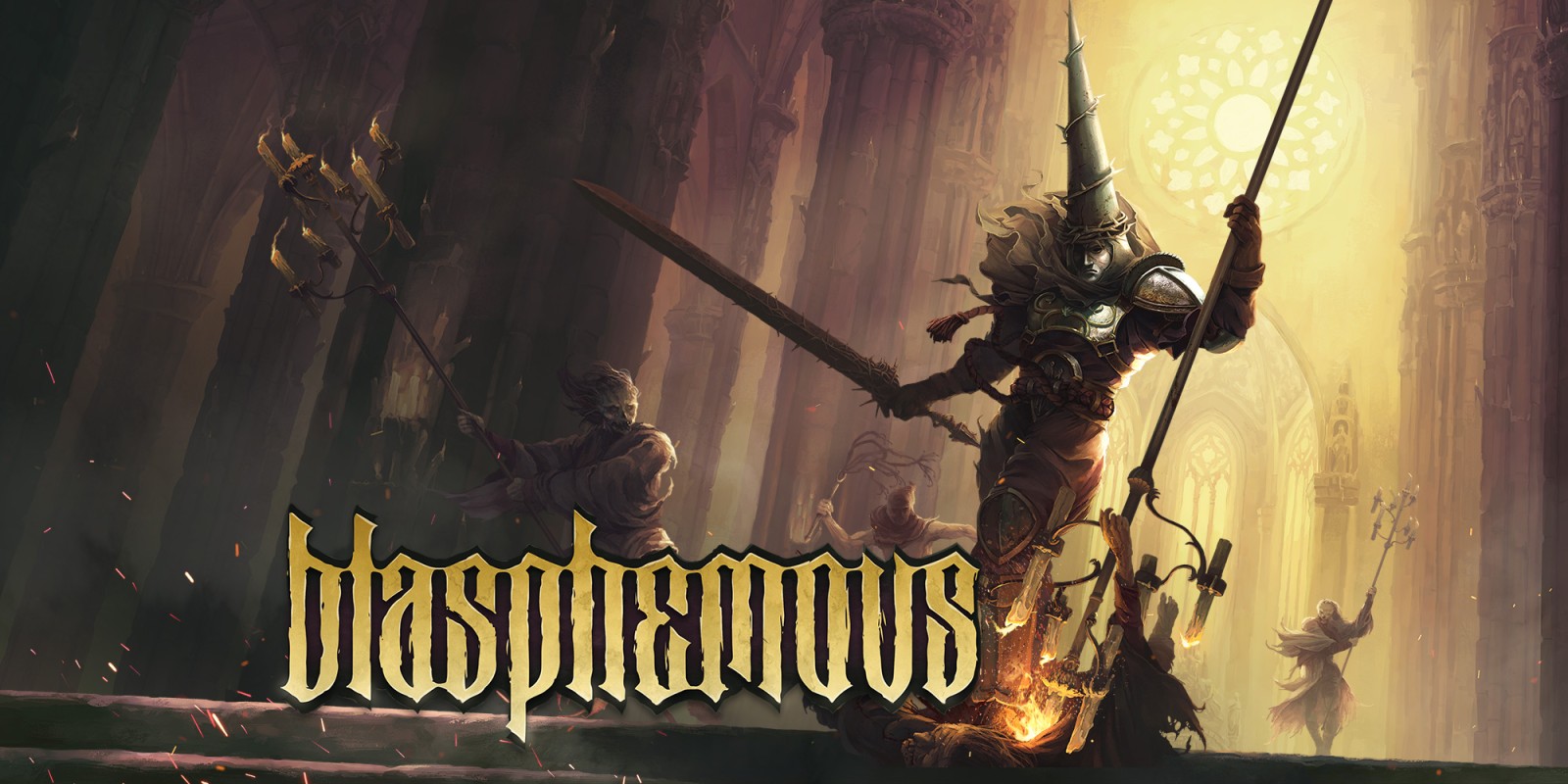
Blasphemous is an ultraviolent 2D Metroidvania with gorgeous 16-bit pixel art and limited but fluid animation. It describes itself as “fast-paced and punishing,” but it’s not really either of those things. The game’s focus is more on strategic combat than on platforming or quick reflexes, and your character moves at a fairly sedate speed. To me at least, the pace feels perfect, both from moment to moment and from one area of the map to the next. In terms of “punishing,” this is how I’d rate Blasphemous on a scale of “this game wants you to feel pain”:

6 – Guacamelee
7 – Blasphemous
8 – Shovel Knight
9 – Hollow Knight
10 – Rain World

In other words, Blasphemous is moderately punishing, but probably not at a level where you’ll give up at the beginning or rage quit in the middle. Granted, Blasphemous makes no attempt to be accessible, and it’s much easier if you use a walkthrough to access the health upgrades in the early part of the game, which are hidden so well (behind unmarked walls, under floors that only break if you jump on a specific spot from a great height, and so on) that you’d never find them unless you already knew where they were. Thankfully, once you get about two hours into the game, you start to understand how it works and don’t really need a walkthrough unless you’re a completionist.

Blasphemous has everything that I love about the Metroidvania genre, and it was worth my time just for the gameplay. The combat is engaging, the area-specific challenges are interesting, and the way in which the areas all eventually connect to each other is on par with Hollow Knight in terms of clever map design. If you enjoy indulging in a bit of exploration and backtracking, it will take about twenty hours to finish Blasphemous with near-perfect completion.

What really got me into Blasphemous is its atmosphere. Everything is compared to Dark Souls these days, but Blasphemous really is Dark Souls in 2D. The level of violence is incredible, and the game gets creative with its brutality. The architecture is similarly brutal and creative. Each area has its own unique character, and the background graphics are beyond fantastic. As for the story, it’s essentially this: You were dead, but now you’re undead for reasons that are unclear; and something bad happened to the world, but we’re not going to tell you what that was. Each collectible item has its own lore, all of which is disturbing.

I never felt as though Blasphemous is just trying to be awful for the sake of shock value, though. As you might guess from the title, it’s based on Spanish Catholicism, and it takes the themes and imagery of Catholicism to their logical extreme. If you’ve ever made a joke about how Catholicism is all about the fetishization of punishment and the worship of death, this game takes that joke seriously. At the same time, it’s so sincere and culturally specific that it never feels disrespectful. I was actually so impressed and curious about the lore and imagery that I looked up a few of the real-world cultural references online, and now I have a greater appreciation for Catholicism. No joke!

( I should say that this game probably isn’t for genuinely religious people, though. It is very literally blasphemous. It also contains all sorts of casual graphic and textual references to real-world torture and hate crimes committed by the church, which perhaps some people might not want to see. Honestly I can’t believe I played this game on a Nintendo console, what a time we live in. )

My favorite part of Blasphemous is its OST, which suits the tone and atmosphere of the game perfectly. About a third of the tracks suffer from dramatic moody bitch disorder, and I can’t remember where they play in the actual game, but most of the OST is mellow acoustic Spanish guitar. Que las Campanas me Doblen is a good representative track, and I really like Y Yo Fuego Te Daré, which manages to be both chill and epic at the same time. A track called Arpegios en Ocre plays in an area called “The Desecrated Cistern,” and it really makes you feel as though you’re exploring a cavernous underground space with a vaulted ceiling. I think the OST holds up well on its own as lo-fi Flamenco beats to chill to, but it’s also a gorgeous backdrop to the game and its ruined world.

Goddess Reborn Zelda Fanzine

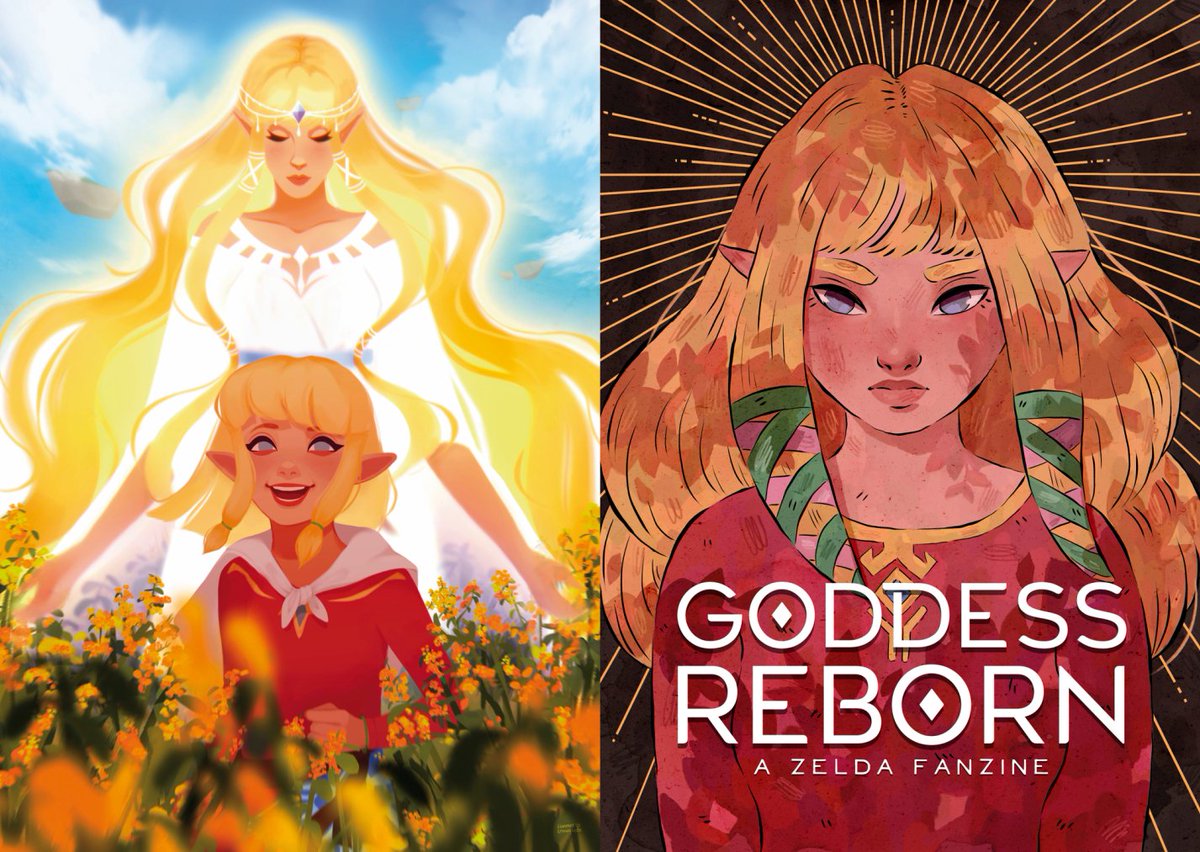
I’m excited to share a preview of the story I contributed to Goddess Reborn, a collection of art and fiction that celebrates the female characters of the Legend of Zelda series.

The zine is beautifully inclusive, and the amount of love that has gone into this project has been incredibly uplifting. I can’t wait for everyone to share their full pieces, but you can check out previews on Twitter (here) in the meantime. Preorders are open until May 31, and all proceeds go to international women’s charities.

goddessreborn.etsy.com

Red Trees

Red Trees by Caramel
https://caramel.itch.io/redtrees

Red Trees is a free nonviolent adventure story game made with RPG Maker in a style that emulates the Game Boy Color. It’s about a small village that might be haunted by ghosts in the woods, and it’s adorable.

The game is divided into three sections: the village’s residential area, its business center to the north, and the forest to the south. In order to progress from one area to another, you embark on an extended trading quest. For example, someone asks you to find their cat. To convince the cat to follow you, you need to feed it fish. In order to procure a fish, you need to give a can of worms to the person fishing at the local pond. The trading sequence isn’t strictly linear, but it’s not so complicated that you’d get lost or frustrated.

Red Trees isn’t a horror game by any means, but it gives me strong Omori vibes. (Although, having made that comparison, I should say that Red Trees was originally released in 2016, four years before Omori.) The music is relaxing, the character portraits are super cute, and the writing is wholesome with a touch of light humor reminiscent of Tumblr circa 2015. I especially love the menu screen’s character log, which collects short profiles of everyone you’ve met. The item portraits and descriptions are lovely as well.

Red Trees takes about an hour to complete, but this is mainly because of the game’s spatial layout. Your character can’t run, and the town is so spacious that it takes time to walk from place to place. This never becomes frustrating, but you may want to download the game so you can save your progress, step away, and come back later. Red Trees is extremely charming, and the experience of playing it is much more enjoyable if you take your time instead of rushing to finish it.

If you’re going to download Red Trees, you have the option of paying $2 to get an extra file folder of illustrations and a PDF booklet with annotated concept and development art. I highly recommend this extra material, but I’d also recommend not checking it out until you finish the game, as it spoils the ending. In fact, the bonus content functions almost like a separate postgame story, and it’s just as sweet and adorable as the game itself.

Deep Forest

Deep Forest by Small is Beautiful
https://small.itch.io/deep-forest

Deep Forest is a free GB Studio adventure game that takes about 45 minutes to play. There’s no combat, and the game is driven by puzzle-solving and exploration. You play as a forest witch tasked with helping three trees that have become mysteriously cursed. To purify a tree, you must first find it by exploring the forest. You then enter its nightmare, which functions as a dungeon. Once the tree’s curse is lifted, its thorny roots vanish, thereby allowing you to explore more of the forest.

This is the basic gameplay cycle of the Legend of Zelda series, and the simple puzzles of Deep Forest remind me of certain segments of Oracle of Seasons and Oracle of Ages wherein you:

(1) Use an animal to procure a seed.
(2) Find a patch of soil to plant the seed,
(3) which sprouts into a vine
(4) that allows you to climb a cliff.

If this similarity is intentional, it’s a lovely homage to the debut work of Hidemaro Fujibayashi, who went on to become the director of Breath of the Wild. In addition, I had a nice “Legend of Zelda” moment when I found a secret in Deep Forest. I was delighted when I realized that you can water the single square of roots in front of an otherwise unremarkable cave in order to discover a hidden spring. This moment of discovery lit a spark of excitement that reminded me of exploring Hyrule for the first time.

In terms of its visual style, Deep Forest is reminiscent of the Game Boy games that were released in the West under the “Final Fantasy” logo, which include the first Secret of Mana game and the first three games in the SaGa series. This style feels extremely nostalgic, and it’s cool to see it used to depict a thriving forest.

Deep Forest is fairly linear, and the gameplay mechanics are beautifully intuitive. I would have loved this game as a kid, and I’m extremely fond of it as an adult. It’s exactly the perfect length, and I enjoyed the exploration elements and wholesome story. As a unexpected bonus, the interactive postgame credits sequence is beautiful and genuinely feels like a reward for playing.

A Time for Giving

A Time for Giving by CobGoblin
https://cobgoblin.itch.io/a-time-for-giving

A Time for Giving is a free Game Boy “dark cottagecore” horror game about being a human sacrifice. It takes five to ten minutes to play, and it’s divided into three main areas: your protagonist’s cozy family cabin, an isolated village preparing for its winter festival, and the haunted snow-covered woods. The overworld graphics remind me of the cute rounded style of A Link to the Past, and the character artwork that appears during the dialog screens is delightfully eerie and upsetting. The dialog is well-written and communicates the themes of the game without pulling any punches.

A Time for Giving was created for a winter solstice-themed game jam, and the creator apologizes that there’s no sound because they ran out of time. I’m of the opinion that the lack of music is actually quite lovely, as it creates an environment reminiscent of a silent forest blanketed by snow so heavy that it muffles all sound.

A Time for Giving is very short and very simple, but the writing and visual style are exactly what I want from a handmade Game Boy game. It’s also a perfect combination of nostalgia and “what the fuck did I just play,” which is a major component of what makes these games so fun.

I played A Time for Giving a few times and made varying choices in an attempt to get a different ending, but alas. I wonder if there’s a way for this poor kid to make it out of the forest…?

Waking Nightmare

Waking Nightmare by Polyducks
https://polyducks.itch.io/waking-nightmare

Waking Nightmare is a free homebrew Game Boy horror game in which you navigate a short and simple maze. Every dead end presents you with a nightmare scenario and the notification that you’ve woken up, thus restarting the maze. The game moves very quickly, and each dead end is creative and worth the trouble of discovering. The game also marks every dead end that you’ve already seen twice in order to minimize frustration.

When you make it through the maze, you’re presented with a series of dialog choices that determine one of three endings. The maze layout doesn’t change, so it’s easy to finish the game and see all three endings in about fifteen minutes. The maze screens look like something a kid would build on a graphing calculator, and the gritty lo-fi pixel art is great, especially for the three closing screens. Apparently this is all text art, or “textmode” art, which the creator explains on their website (here). This website is just as interesting as the game itself, and I recommend checking it out if you’re interested in internet art history.

I was never a big fan of first-person maze games, but I’m glad I gave Waking Nightmare a chance. It’s visually distinctive, it makes excellent use of its medium, and the music will definitely get stuck in your head.

Capacity

Capacity by Renee Blair
https://heptad.itch.io/capacity

Capacity is a Game Boy style RPG Maker story game that uses generic pixel graphics and original character illustrations to tell a short fantasy-themed story about a bad relationship. The game describes this as “a toxic relationship,” but I don’t think it’s that complicated; it’s just a teenage girl who is hung up on a boy who clearly isn’t that into her. She doesn’t know how to let him go, so she embarks on a quest that she hopes will fix the relationship.

Capacity is extremely pretty and features a number of clever design elements. The monster art is great, and the final boss is a demon after my own heart. The game is driven by its narrative, and there’s no actual fighting. It takes about ten minutes to play, it’s totally free, and you can play it right in your browser window.

Capacity’s message is a bit heavy-handed and occasionally inappropriate to the situation. The game’s text drops mentions to “a cycle of abuse” and “generational trauma,” but really, it’s just a girl who’s hung up on a boy who isn’t that into her. Presumably because they’re both in their early teens. This isn’t to say that the boy isn’t a jerk and a coward, or that the protagonist isn’t a bit unhinged for pursuing him despite the clear “I don’t want to be involved with you” signals he’s broadcasting at every turn, but this is normal behavior for teenagers who are still figuring out how relationships work. It doesn’t make anyone a “toxic” person, especially not if they’re just a kid. We’ve all been there.

Putting the heavy-handed elements of Capacity’s story and writing aside, the game is really fun to play. In order to “save” your shitty “boyfriend” from his “curse,” you walk through a fantasy castle and interact with monsters, all of whom give you some variation of “he’s just not that into you.” At the top of the castle, the smoking hot Demon Lord tells you that a relationship doesn’t have to be like this, and that you deserve so much better. The fact that you refuse to listen to him proves that you still have some growing to do, and this is reflected in the game’s twist ending.

Capacity’s entire narrative structure emphasizes the point that sometimes your “demons” are right, and that you need to listen to what they’re trying to tell you about the situation that’s triggering your anxiety. It took me years to figure this out, and it’s a powerful message.

Opossum Country

Opossum Country by Ben Jelter
https://benjelter.itch.io/opossum-country

Opossum Country is a free ten-minute lo-fi horror game about a rural pizza delivery driver who finds himself stranded in an isolated trailer park where something isn’t quite right. If you’re worried that the game is poking fun at the sort of low-income and mentally unbalanced of people who might live in a trailer park, there’s definitely an element of that, but the story goes in a direction that I wasn’t expecting. In the end, the moral of Opossum Country is that you shouldn’t jump to conclusions about a community you don’t understand. I mean, if the game can be said to have a moral. Which it arguably doesn’t. Regardless, the ending is fantastic.

Ben Jelter also made another free ten-minute Game Boy game called The Last Employee, which definitely has a moral: fuck capitalism. This being the case, I’m guessing that Opossum Country was created from a place of deep sympathy for people on the margins of society. This narrative viewpoint is refreshing in its unapologetic portrayal of difference, but Jelter’s sympathy for these characters doesn’t stop the game from being creepy as fuck. The overworld pixel graphics are creative and unsettling, as are the more detailed character portraits.

Opossum Country was made with a program called GB Studio. Not only is it free, but there are also a ton of pay-what-you-want graphics asset packs floating around Itchio, as well as collections of free-to-use chiptunes music that’s compatible with the Game Boy engine. I also found a few pixel art resources for Clip Studio Paint in the form of brushes, templates, and filters. I’m not sure that “just anyone” can make a game as unique and interesting as Opossum Country, but it’s nice to know that there’s nothing stopping you from trying.

A Dark Winter Wander

A Dark Winter Wander by Red Skald
https://redskald.itch.io/a-dark-winter-wander

A Dark Winter Wander is a free horror-themed narrative adventure game created with GB Studio, a game creator that replicates the look and feel of retro handheld games. The game’s story is about a girl chasing her sister through a (mostly linear) maze of underground tunnels filled with monsters. Although it’s deliberately unclear what’s going on, I think the protagonist’s sister might have an eating disorder, while she herself is depressed. This isn’t important to the gameplay, but those elements are there from the beginning of the game if you’re sensitive and need to watch out for them.

In any case, you see your sister run off into the woods and decide to go after her. While chasing her, you fall into a hole filled with monsters. You talk to the monsters instead of fighting them, and the game is entirely driven by exploration and dialog. This invites a comparison to Undertale, but all of the monsters in A Dark Winter Wander absolutely wish you harm. The creature designs are great, and the lo-fi sound and graphics contribute to the unsettling atmosphere.

If you don’t follow your sister into the woods, you can actually finish the game in about ten minutes and watch a depressing indie game ending. I did this inadvertently, and it was a downer. I then reset the game, did what it wanted me to do, and played for about an hour. Exploring the monster tunnels is a lot of fun, and you can easily spend more than an hour poking around if you’re interested in seeing everything this game has to offer. The creator has offered free downloads, and I’d recommend downloading a Game Boy emulator so that you can play the game offline and create save states.

The unskippable cut scenes at the beginning of the game feel unnecessarily long, and the writing is a bit clunky at times. I also find the lack of specificity regarding what’s going on with the narrator’s family frustrating. You probably already know if a text-heavy Game Boy horror game that’s a metaphor for depression is for you, so I won’t try to sell it. Still, A Dark Winter Wander is one of the most interesting and engaging GB Studio projects that I’ve found on Itchio, and it’s inspired me to check out more work in this weird little subgenre.

Cross the Moon

Cross the Moon is a visual horror novel about a near-future dystopia in which a fraction of the moon has shattered, an event concomitant to the appearance of vampires. No one knows why people suddenly began displaying symptoms of vampirism, but those affected have become a disadvantaged underclass of society.

The game’s story follows two mixed-race vampire siblings and a Japanese detective through the streets of L’Amour, a French city that hosts the headquarters of a corporation called bloodFLOW, a leading producer of artificial blood and scientific research relating to vampires. Although Cross the Moon begins as a murder mystery, it gradually expands into the territory of cosmic horror.  

The beginning is standard vampire fare. The player is introduced to a high school student named Lux who is hanging out at a bar and fishing for someone who will consent to share their blood. Lux is essentially a good kid and thinks this is a bad idea, but he’s acting on behalf of his crush Apollon, who seems to be in thrall to his girlfriend, a manic pixie femme fatale named Corentine. Unfortunately for the trio, the man they seduce is found dead the next morning, and Apollon is charged with murder. In an attempt to clear his friend’s name, Lux ends up becoming involved with the vampire underworld, where he learns that Corentine is not an ordinary high school student – nor is Apollon.

This YA narrative is complicated by the interwoven story of Lux’s adult sister Aurore, who has managed to land an interview for a prestigious job at bloodFLOW. Her intake interview is weird, the job she’s asked to do is bizarre, and her coworkers are more than a little strange. She isn’t a big fan of the company itself, which she knows is exploiting the vampire population. Still, Aurore has grown up watching her working-class parents struggle, and she’s willing to do whatever it takes to give herself and her family a better life. Unfortunately, this leads her to sign a non-disclosure agreement regarding corporate secrets that turn out to be far beyond anything she imagined.

Meanwhile, Yoko has just transferred into L’Amour’s police force as part of an exchange program meant to facilitate cross-cultural communication regarding vampire-related policies and best practices. Due to the timing of her arrival, she’s immediately dropped into the investigation of the gruesome murder supposedly committed by Apollon. She strongly suspects Apollon is innocent, which convinces her to dig deeper into why a random teenage boy is being framed. This in turn leads her to the main mystery of Cross the Moon – what’s going on with bloodFLOW? What does the company have hidden under its corporate offices, and why does Yoko feel so compelled to pry into its secrets?

Cross the Moon is more of a graphic novel than a game. The only interactive element is the option to save your progress, and the story is completely linear. Although Cross the Moon is formatted as a visual novel, with long horizontal text boxes overlaid onto the bottom of a single full-screen image, it’s not a “game” in any meaningful sense. There are no branching paths, and there’s only one ending. There’s no animation or voice acting, and the character art assets are fairly limited. Cross the Moon is also quite long, promising at least seven or eight hours of reading.

The story starts off slow. I’m afraid this may put off many players used to flashy video game opening sequences, but it’s a pitch-perfect opening to a horror novel. This is how almost every Stephen King novel works, after all – the world needs to be built before it’s destroyed, and the reader needs to learn to care about the characters before they start to find themselves in serious trouble. Through the mundane details of the everyday lives of the characters, the player gradually builds an understanding of how the society of L’Amour operates, which makes the final horrific reveals all the more dramatic.

The author is sensitive to inequalities concerning race, class, and gender, but it’s worth mentioning that the game’s take on vampirism is its own thing and not analogous to any real-world identity. The minority status of vampires is informed by real-world politics, but Cross the Moon takes the concept in a creative and unexpected direction. I have to admit that I’m not a particular fan of vampires, but I found myself growing progressively more curious about how vampirism operates in the world of the game, as well as how it originated.

(By the way, if you’ve been reading between the lines of this review and have come to the conclusion that the ethically dubious corporation created vampires, that’s not what’s happening. This story has layers of progressively deepening strangeness, and it absolutely doesn’t go where you expect it to.)

The worldbuilding of Cross the Moon is enhanced by its visual style. The soft grayscale character art pops against the super-saturated backgrounds, which are composed of photographs overlaid with high-contrast color filters. I know this sounds like Baby’s First Photoshop, but it’s remarkably well done and extremely stylish. As I mentioned earlier, the character art assets are limited, so the player is occasionally asked to suspend disbelief while, for example, a character lies in a hospital bed in a full suit. For the most part, the graphics contribute a great deal of atmosphere to the story, as does the ambient music. The game contains some uncomfortably gory and deliciously creepy moments, and there’s a jump scare toward the end that really got me.

If reading a lengthy mature-audience horror story in the form of a visual novel sounds like a chore, then Cross the Moon probably isn’t for you. Speaking personally, I always find myself getting annoyed by extraneous gameplay elements in visual novels, so what Cross the Moon is doing is perfect for me. I read it on my Nintendo Switch between sessions with more action-oriented games, and I very much enjoyed myself. I’m intrigued by the potential of this hybrid medium of storytelling, and I’d love to see more “visual novels” that are in fact genuine novels intended for adult readers.