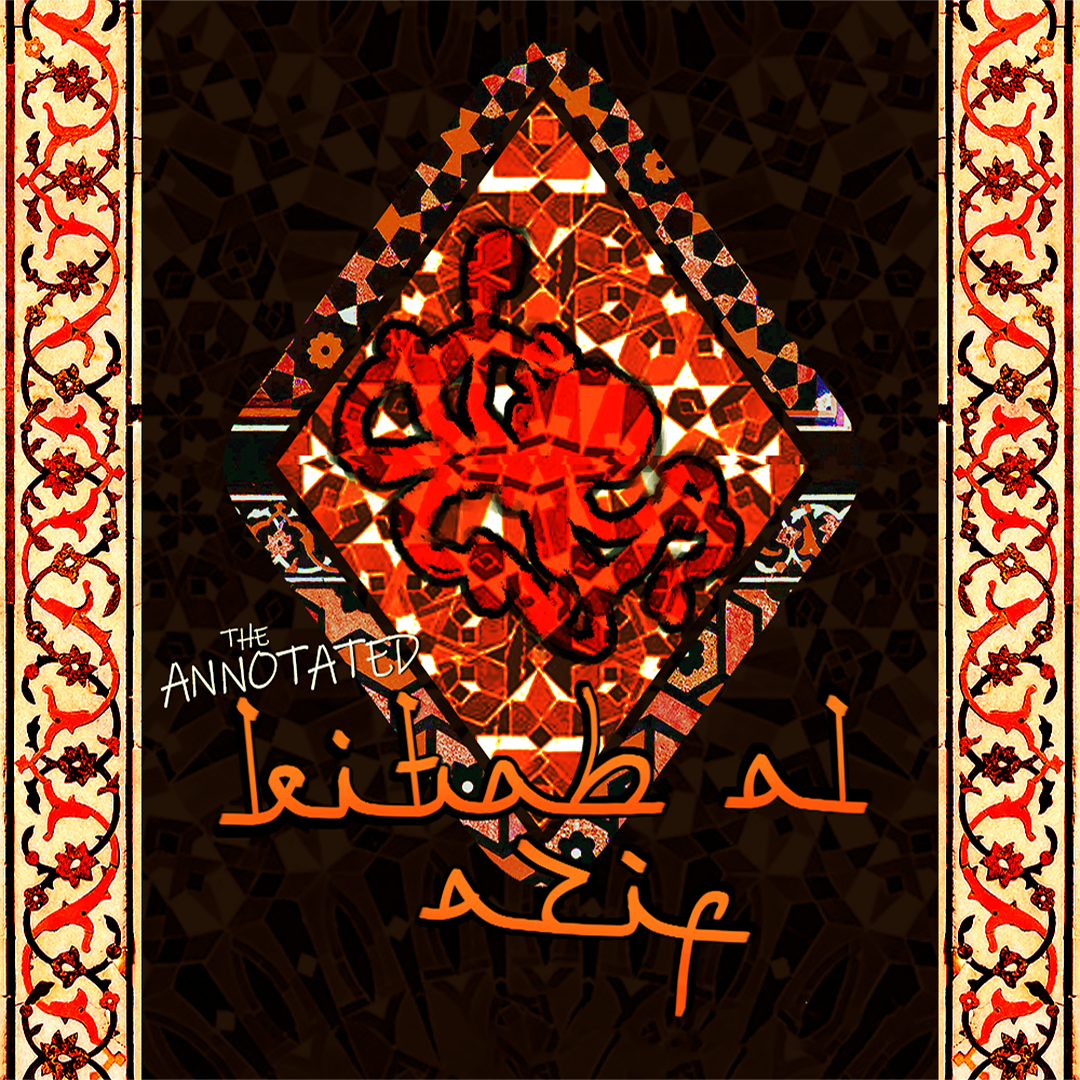
I’m excited to announce that my short story “The Annotated Kitab al-Azif” is free to read on The New Absurdist here:
📖 https://newabsurdist.com/editors-picks/the-annotated-kitab-al-azif/
“The Annotated Kitab al-Azif” is a queer Lovecraftian romance about the slow decline of American academia and the supernatural perils of translation. In this story, a burnt-out Millennial podcaster flees the high rent of Boston and accepts a position as a departmental admin assistant in the suburban Miskatonic University, which is suffering from budget cuts and declining enrollments. During the lull of his first summer on the job, the podcaster meets a grad student working on the Gnostic religious traditions of the southern Mediterranean while attempting a translation of the Kitab al-Azif, more popularly known as the Necronomicon.
As you might imagine, this area of study has consequences for the grad student. The podcaster isn’t too concerned, however. He’s already seen all manner of awful things while doing research online, and why let something as trivial as ageless extradimensional horrors get in the way of a budding relationship?
Though I’ve never accidentally summoned an eldritch abomination, the setting of “The Annotated Kitab al-Azif” is partially based on my own experience as a grad student at the University of Pennsylvania. The “horror” part of this experience is the constant scramble for funding, the awkward negotiations with libraries for access to research material, and the unspoken expectation that you’ll work in decaying buildings that haven’t been maintained since the early twentieth century.
Meanwhile, the “romance” part is the opportunity to share space with people from all over the world. When you use the same office (and the same refrigerator and bathroom) with other people, pre-existing differences in culture, language, and nationality quickly become secondary to the warmth of the personal relationships that form between you. Universities aren’t cultural melting pots by any means, but they’re as good of a place as any to realize that cultural differences really don’t matter all that much in the face of genuine friendship.
Though I’ve largely set aside my ambitions to become a translator, one of the reasons I got into academia was to model the positive change I wanted to see in the broader field of literary studies, especially with regards to de-mystifying stories written by authors from “non-Western” countries. Even when it’s done respectfully, the academic tendency to treat these stories as “subaltern” and “marginalized” is frustrating. To begin with, nobody thinks of their own language and culture as “other”; but, more importantly, people are just people.
The Necronomicon is an interesting base for an exploration of this theme. In my understanding of the lore of the Cthulhu mythos, the Necronomicon is essentially an expression of popular turn-of-the-century Spiritualism, which was in turn inspired by the various strands of medieval Gnostic thought that sprung up along the Silk Road.
Though this sort of spiritually inclusive worldview may have seemed “mystical” to people living in Christian-majority cultures in the late nineteenth century, it’s completely normal to someone coming from a Buddhist or a Hindu tradition. All things considered, the cyclical view of time and the multidimensional view of space suggested by the Necronomicon are completely normal for many people who weren’t raised as Christian, and it’s interesting to consider the real-world foundations of this infamous fictional text without the narrative trappings of Orientalism.
But also…… What if magic were genuinely real? What then?
I’m grateful to The New Absurdist for taking a chance on this odd piece of weird fiction. I also want to express my appreciation to the story’s cover artists, Katie Rejto and Wally Tigerland, for creating such a unique and intriguing illustration.
If your curiosity is piqued by the prospect of true-to-life dark academia haunted by a touch of cosmic horror, please check out my story on The New Absurdist (here).



 Digital Fantasy Diary