Self Care

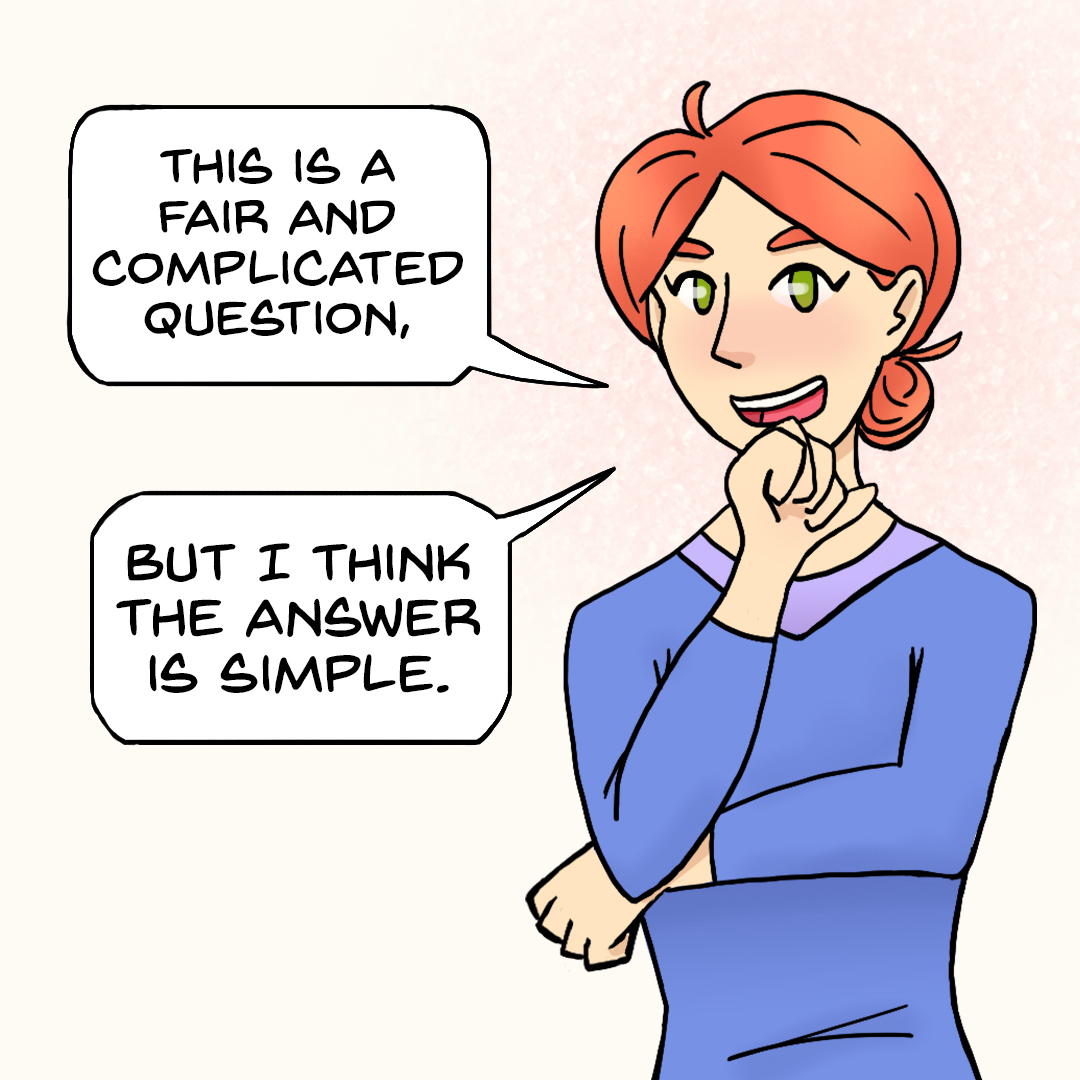
A modest proposal đź’– and a joke, of course!! Just a joke.

This was my submission to the 2025 edition of the anthology published by Philly Zine Fest, an event that gets cooler and livelier with each passing year. You can download a digital copy of the anthology from their website (here).

Essay about Final Fantasy VII’s Anti-Capitalist Critique

I’m excited to say that my essay “Final Fantasy VII Confronts Capitalism: Tifa Lockhart vs. Medical Debt” is now on Sidequest (here)! 👊🌟

I recently read the official Final Fantasy VII Remake prequel novel, Traces of Two Pasts. I was fascinated by Tifa’s backstory, especially how she was driven to the starting point of the game by medical debt. I hadn’t come across a serious discussion of this book in fandom or elsewhere, so I wanted to write a short but accurate summary with substantial analysis. My goal was to situate the book’s anti-capitalist themes in the context of the game’s story, Japan’s economic recession in the 1990s, and our current hellworld.

Here’s an excerpt from my article…

Tifa is twenty years old at the beginning of Final Fantasy VII. Despite her youth, she’s calm and level-headed, yet Tifa willingly becomes a member of Avalanche, an armed militia that conducts terrorist attacks on Midgar’s power grid. Though she questions the use of violence, Tifa understands that aggressive action is necessary.

The juxtaposition between Tifa’s personality and her involvement in an active terrorist organization begs the question of how such a kind and gentle woman could become so politically radicalized. The question Kazushige Nojima asks in Traces of Two Pasts is much sharper: under the circumstances, how could she not? If you had to walk in Tifa’s shoes, wouldn’t you become radicalized too?

You can read the full piece on Sidequest here:
https://sidequest.zone/2025/06/02/final-fantasy-vii-confronts-capitalism/

In Praise of Moss Disability Zine

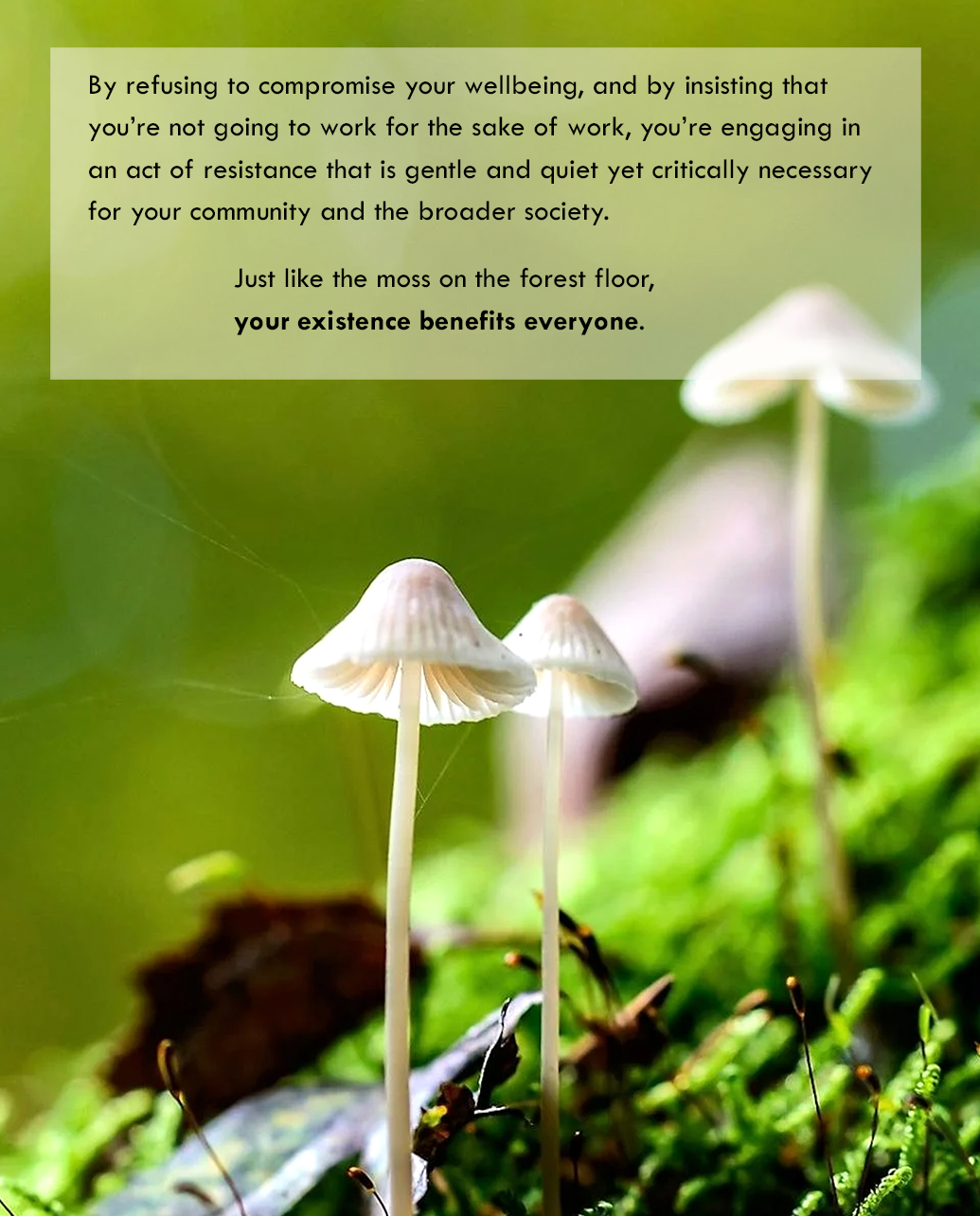
In Praise of Moss is a zine that argues against the myth of productivity while celebrating the value of a diversity of contributions to our culture and communities. Not everyone can be a tree, and that’s okay. Moss is an equally important part of an ecosystem.

I wrote this zine from a perspective that respects people of all abilities, but I think it’s important to acknowledge the more challenging aspects of disability. Disabled people are often expected to “pull their weight,” usually with the assumption that there’s only one way to measure success. In addition, people who live with invisible disabilities are often met with frustration and accusations of laziness when we’re unable to work or behave “normally.”

Moss is a useful metaphor for a recontextualization of what it means for disabled people to be useful to our communities and valued in our relationships. By exploring how moss can support an entire ecosystem, we can craft a model for how disability positivity can benefit society.

In addition, moss is remarkably adept at surviving disaster, which makes it an engaging analogy for resistance against the pressures of self-optimization exerted by neoliberal capitalism. While my focus is on disability, I believe that all readers can benefit from a shift in perspective that encourages us to grow naturally without worrying about productivity. 

When I write about “resisting productivity,” I’m speaking from the position of someone in academia who is directly affected by the myth that hard work will lead to prosperity. I hate the way this myth is weaponized against disabled people in the realm of higher education, and I want to destroy it. Very softly and quietly. Like moss.

While I love the lo-fi DIY aesthetic of many of the disability zines I’ve found on Etsy and in indie bookstores, it was important to me to create an attractively formatted physical object that feels good in my hands and accommodates my own disabilities by being easy to read. I want people who encounter this zine to feel that it’s valuable, and that they’re valuable too. I was fortunate to be able to work with Fireball Printing, a local Philadelphia service that creates gorgeous full-color publications.

If you’re interested, you can order a copy of the zine from Etsy, or you can download a free digital version on Itch.io.

🌿 https://digitalterrarium.itch.io/in-praise-of-moss
🌿 https://www.etsy.com/listing/1881401704/in-praise-of-moss-disability-zine

Seeded Ground

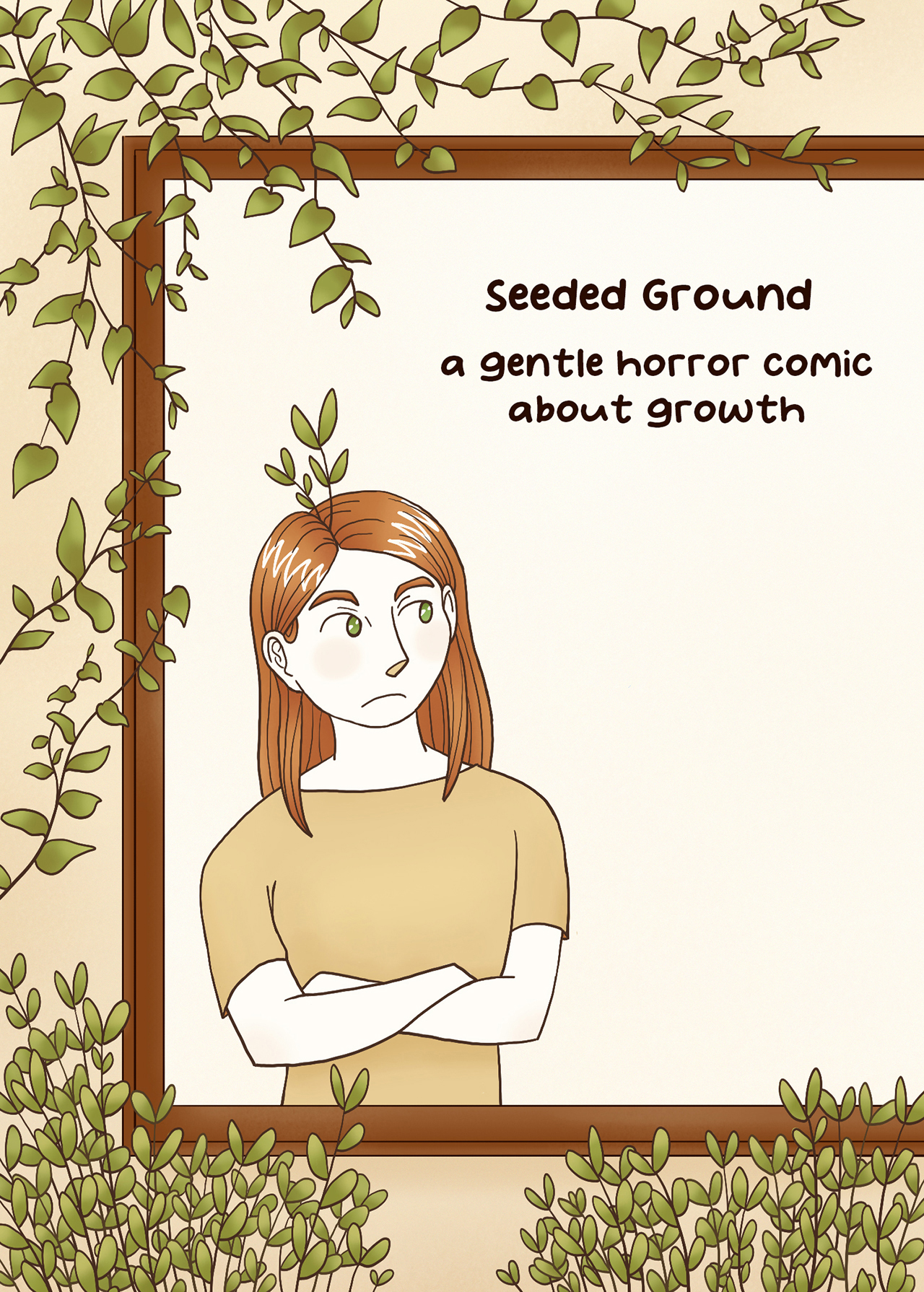
Seeded Ground is a twelve-page botanical horror comic about growth. It reads a bit like a supervillain origin story, but I created it as a statement of resistance against the oppressive ideologies of neoliberalism that have lured so many people in my generation into the trap of self-optimization.

You can download a free digital copy of the comic from Itch.io here:
https://digitalterrarium.itch.io/seeded-ground

I was inspired to draw this comic by a tweet written by a respected senior scholar. They argued that assigning at least five pages of writing every week is necessary to maintain “a certain standard of quality” in the undergraduate students who register for their classes.

This tweet inspired me to reflect on an unfortunate aspect of education in the United States. Namely, it’s an unstated but almost universally accepted goal of the formal education system to monopolize students’ time in order to train them to become the sort of adult workers who are willing to devote their lives to their career. An employee at a “good” job is expected to wake up early, commute, spend the entire day at work, and then go home and finish the tasks they didn’t have time to complete at the office. Meanwhile, freelance and part-time workers are expected to be available at any hour of the day, every day of the week, and at short notice. This is messed up, and I hate it.

My own experience as a professional working adult has essentially been the equivalent of that professor’s tweet. Namely, I’ve felt compelled to engage in meaningless work that no one will ever see in order to maintain the pretense of “a certain standard of quality.” Around the time of the pandemic, I got fed up. Was I really supposed to feel guilty about not replying to emails within 24 hours while I was sick with Covid? Fuck that.

These days I’m much more aggressive about enforcing boundaries concerning how much work I’m willing to do, and I can’t even begin to express how much the quality of my life has improved. I have no regrets.

As an epilogue to Seeded Ground, I illustrated a quote from the radical social theorist Herbert Marcuse’s 1964 book One-Dimensional Man: Studies in the Ideology of Advanced Industrial Society:

“If the individual were no longer compelled to prove himself on the market, as a free economic subject, the disappearance of this compulsion would be one of the greatest achievements of civilization.”

And he’s not wrong! I know it’s a twee Millennial stereotype to hate capitalism, but I really do believe that the point of life is not to optimize your performance as an employee. People need room to grow.

And if that growth is impeded? All sorts of bad things can happen. 🌿

WWAC Roundtable on LGBTQ+ Manga

Last week I had the opportunity to contribute to a Pride Month roundtable on LGBTQ+ manga organized by Women Write About Comics. In this roundtable, we share specific recommendations as well as more general thoughts on topics such as autobiographical essay manga, nonbinary manga characters, and debates surrounding BL and yuri manga.

The discussion was quite interesting, and you can read it here:
https://womenwriteaboutcomics.com/2023/06/roundtable-pride-month-manga-edition/

This conversation was very cathartic for me personally. It was a traumatic experience to publish my monograph on queer manga, as I encountered incredible resistance during every step of the project. I’ve also been surprised by the feedback I’ve received, with critics claiming that I didn’t write enough about “real” queer creators. My book feels more cursed than the Necronomicon, and I’ve been extremely hesitant to talk about it or the research that went into it. Still, it felt good to finally address the issue of who “gets to count” as queer, as well as why many queer people in Japan may not have chosen to identify as such in the past.

Thankfully, the situation in Japan is starting to change, and WWAC’s Pride Month manga roundtable captures the spirit of this social and cultural shift as it’s reflected in popular discourse, especially in creative work by and about openly queer people exploring and celebrating their identities.

Haunted Houses

I recently published a new edition of my horror fiction zine Haunted Houses!

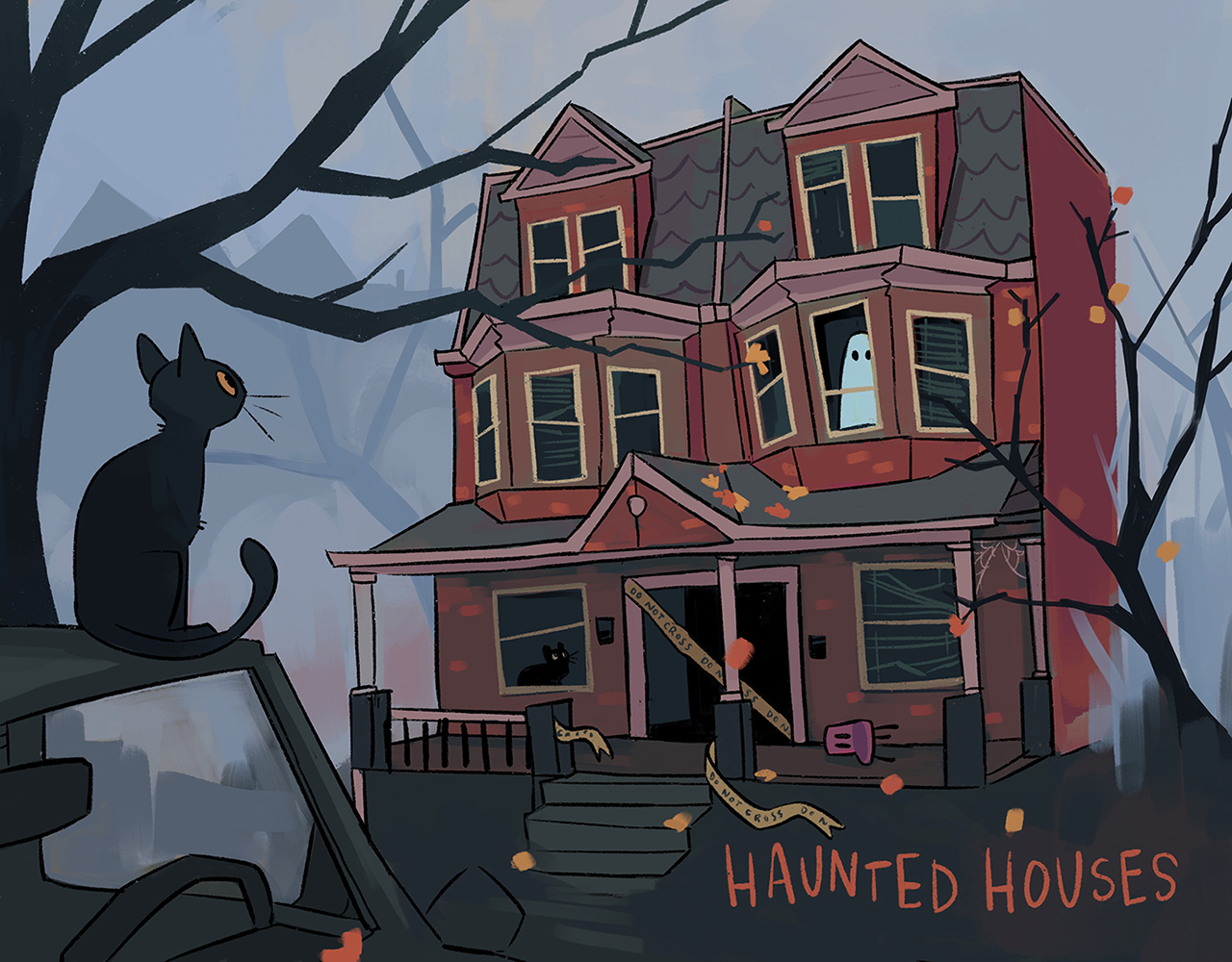
Haunted Houses collects seventeen pieces of surreal flash fiction about haunted spaces and the terrible people who inhabit them. This edition of the zine includes several new stories and illustrations, as well as a gorgeous cover illustration by Megan Crow, who was able to channel the everyday spookiness of West Philadelphia. Although the stories in this zine fit firmly into the mode of magical realism, I wanted to use the medium of fiction to explore a truly terrifying set of real-life themes relating to housing, from gentrification to rent spikes to urban depopulation.

If you’re interested, physical copies of the zine are available on Etsy:
https://www.etsy.com/listing/890744799/haunted-houses-fiction-zine

I’ve also started to host free digital editions of my older zines on Itchio:
https://digitalterrarium.itch.io/

A Monstrous Little Mermaid Story

I’m honored to have an essay in one of my favorite online magazines, Cosmic Double. “A Monstrous Little Mermaid Story” is about how I discovered the joy of queer transformations in HP Lovecraft’s “The Shadow over Innsmouth.”

“A Monstrous Little Mermaid Story” is free to read on the Cosmic Double website here:
https://cosmicdouble.com/2023/01/08/a-monstrous-little-mermaid-story/

I originally created this essay as something of a writer’s statement for a short story called “Don’t Eat the Fish.” The story is about the uncanny space at the intersection of queerness, disability, and economic precarity, but I also think it stands on its own as an unsettling work of body horror. I workshopped this story for years as I slowly developed my skills, and I worked hard to polish the narrative voice and sharpen the genre effectiveness while also being as honest as I could about the nuances of my own personal experience.

I generally try to keep overt identity politics out of my writing, which isn’t a value statement as much as it is a personal preference. It’s not as though my stories aren’t informed by my identity or social environment. Rather, both my identity and my environment constantly shift and change, and my stories generally aren’t about myself to begin with. Still, because this particular story was so strongly informed by my positionality, I spent more than a year submitting it a series of literary magazines dedicated to raising the voices of queer, disabled, and economically precarious writers.

Unfortunately, every single magazine I submitted the story to was like, “Oh damn, that’s truly upsetting, and this story is not Positive Queer Representation™ enough.” Usually, when I have a story rejected, I’m lucky enough to get a personal note from an editor along the lines of, “This isn’t a good fit for us right now, but we all enjoyed this piece and would love to see more work from you in the future.” With this story, the response was inevitably: NO.

I therefore wrote this essay as a way of processing what my story and its literary influences meant to me. I’ve long since accepted that the story itself will never be published, but I’m truly grateful to Cosmic Double for being willing to publish an essay that may not be Positive Queer Representation™ but still attempts to represent what I believe is a very real aspect of nonbinary (and trans!) queer identity. That takes courage, and the essays I’ve been reading on the site led me to believe that the editors are open to an earnest investigation of what it means to feel “monstrous.” If you’re interested in well-crafted essays from unexpected points of view, please check them out!

Cosmic Horror and the Ruins of Capitalism in Night in the Woods

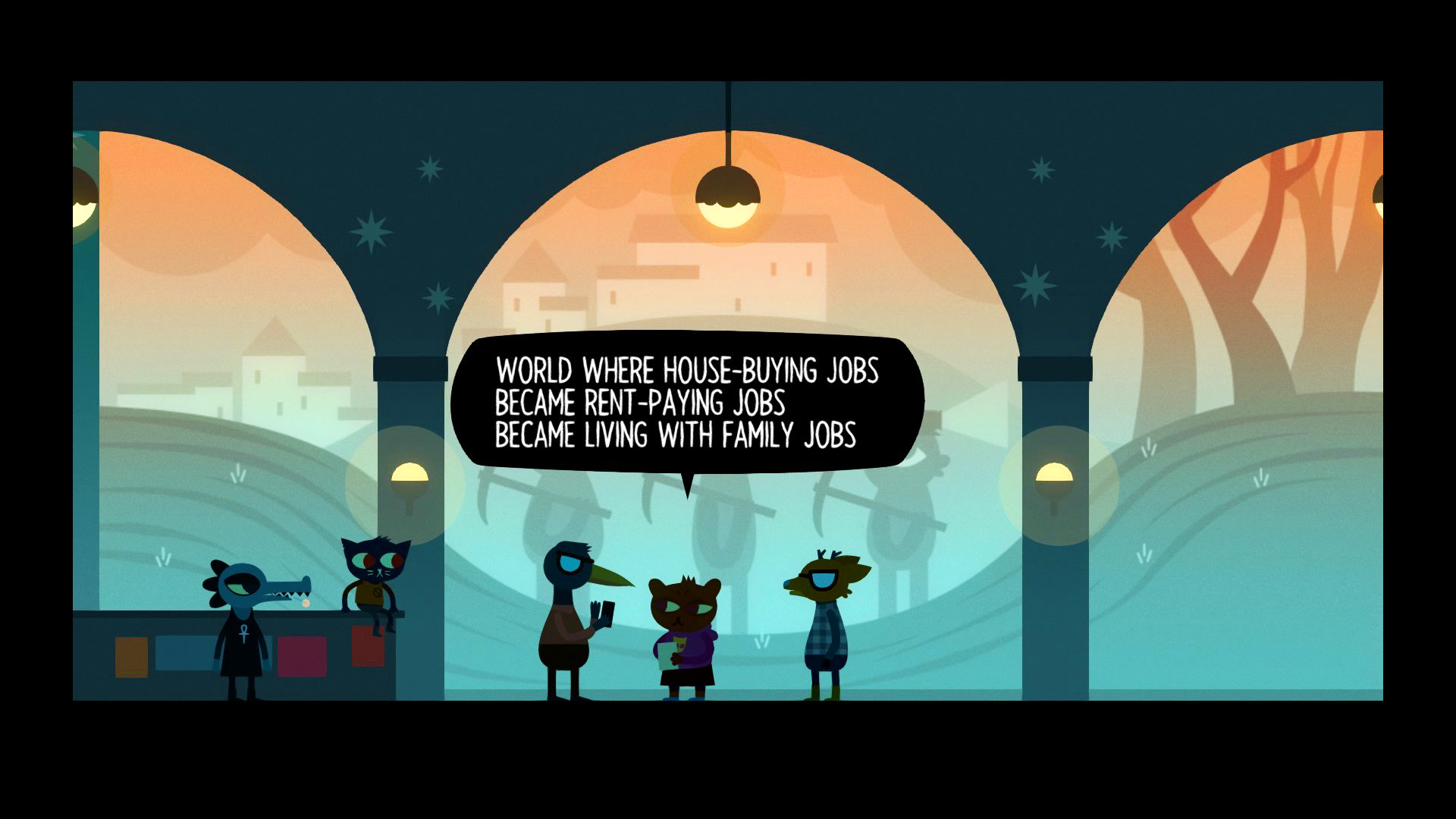
I maintained my sanity during the pandemic by spending time outdoors in abandoned places. Some of these places exist in the real world, but most were virtual. One of my favorite haunts has been Possum Springs, a depopulated town in western Pennsylvania that serves the setting of the 2017 story exploration game Night in the Woods.

In Night in the Woods, you play as Mae, an anthropomorphic cat who has dropped out of college and moved back to Possum Springs to live with her parents. With no job and nothing better to do, Mae decides to investigate the disappearance of several local children. It turns out that there is a monster living in the abandoned mine tunnels under Possum Springs, and a cult of town residents has been feeding young people to this creature in return for a promise that it will prevent the town’s economic decline. When Mae and her friends catch the cult in the act of sacrificing one of its own members, its leader tells the group of teenagers that these rituals aren’t easy for them, especially now that they’re getting older. It’s time for a new generation to take over and ensure the prosperity of Possum Springs, however modest this prosperity might be.

Mae and her friends don’t join the death cult, of course. They escape from the monster, and the mine tunnels collapse and trap the remaining cult members underground. At the end of the game, Mae reflects that what she’s taken away from this experience is the conviction that, if there is no benevolent higher power in a hostile universe, then she and her friends will have to help each other while doing the best they can for themselves and their community.

The elements of cosmic horror in Night in the Woods are genuinely creepy, especially during Mae’s interactive nightmare sequences, but the purpose of the cult is to serve as a thematic juxtaposition to the true terror of Possum Springs, a large and impersonal set of interlocking systems that collectively exploit hardworking but vulnerable people – namely, capitalism.

Mae’s parents are afraid of losing their house to the bank because of an usurious mortgage they took out to finance Mae’s college tuition, and entire neighborhoods in Possum Springs are filled with repossessed, unsold, and subsequently abandoned buildings. The pastor of the local church wants to open a shelter for the newly homeless and the railroad drifters who camp out in the forest next to town, but she fails to obtain a permit from the city council due to concerns that lowering the property values in the neighborhood will fatally disrupt an already struggling real estate market.

The horror of an absurd and uncaring universe in Night in the Woods has very little to do with the unfathomable monster lurking in the mine tunnels, although the cult of older people who sacrifice members of younger generations for the vague promise of being able to sustain an imagined standard of living comes uncomfortably close to allegory in the wake of the 2016 American presidential election. Forces beyond our control and comprehension are indeed destroying individual lives and modestly thriving communities, but these forces are nothing as quaint as a stygian tentacle beast that eats children.

According to Scott Benson, the lead writer and artist of Night in the Woods, Possum Springs is located in western Pennsylvania just outside of Pittsburgh. This situates the town in the Rust Belt, an economically depressed region stretching around the Great Lakes from Buffalo to Detroit. The cities in the Rust Belt were centers of American manufacturing until the 1980s, when international free trade agreements incentivized companies in sectors like natural resource extraction and the automotive industry to outsource materials and labor. Formerly bustling mines and factories closed, resulting in a dramatic decline in population that in turn resulted in the bankruptcy of many smaller businesses.

It’s currently possible to accrue a sizeable following on social media by posting urban exploration photos of shuttered factories and other ghostly relics of infrastructure, such as empty schools, hospitals, movie theaters, and shopping malls. There’s a certain poetic charm in high-contrast photos of healthy green weeds stretching up through the cracks of ash-gray concrete and leafy vines twining around rusted iron support pillars. Images of the remains of modern civilization devoid of human presence provide fertile ground for the imagination to run wild.

Night in the Woods denies its players the solitary pleasures of urban exploration, however. As a dialog-driven game, its story can’t be advanced unless the player participates in conversations with various people around Possum Springs. As the you learn more about the town, you begin to understand the problems experienced by its inhabitants, which range from poverty to alcoholism to severe depression. At the same time, you come to appreciate the people who care about each other and want to do right by their community even despite the financial and emotional burdens they carry.

Night in the Woods suggests that the fractures in the community cannot be repaired by any given individual action, like “going to college” or “owning a home.” Rather, the problem lies in the larger economic forces that steamroller over working-class people in small towns. None of the characters Mae interacts with are stupid or unaware of what’s happening, but most of them don’t have the agency to make any real choices about their lives.

Night in the Woods features a number of optional sidequests that tell an ongoing story about the historical tension between the former mine owners and the labor unions in Possum Springs, and it’s clear that the working conditions for miners were deplorable. The mines closed at least a decade before the story begins, but the labor of the workers in Possum Springs is still exploited. Mae’s father, who was laid off from his job at a small factory, now works at a large supermarket by the highway that forced the local grocery store in Possum Springs to be shut down. At the end of the game, Mae’s father considers starting a labor union at his workplace, which pulls money out of the local economy without benefiting the town or its people.

The game’s presentation of unions isn’t entirely positive, however. As Mae’s friend Bea explains, the unions are male-dominated, and homosocial labor solidarity lends itself to an atmosphere in which overt sexual harassment is swept under the rug. Mae’s friend Selmers, who started writing poetry for the rehab program she entered after becoming addicted to pain pills while working at the local pharmacy, performs a reading of an incredible piece about how even unionized jobs are becoming unsustainable in the face of global capitalism.

Night in the Woods is ultimately about accepting uncomfortable realities while moving forward and finding friendship and community in difficult times and circumstances. The game isn’t just a protest against the violence of the global neoliberal capitalism that destroys local economies; it’s a model of resistance on a small and personal scale, as well as an argument for the quiet beauty of allowing outdated structures to fall gently to ruin.

Small town life isn’t for everyone, but neither is building a community from scratch in a big city. If nothing else, it’s good to have choices. The gameplay of Night in the Woods is centered around making choices, and the choice Mae and her friends make is to bury the monster in the mine, sacrificing short-term gains for long-term stability.

Although Night in the Woods is set in the days leading to and following Halloween, its advocacy for regrowth and positive change is a welcome message as society gradually begins to recover from the effects of the pandemic. If nothing else, Possum Springs is a great place to find surreal and spooky chills, and Mae’s homecoming is a crash course on how to make conversation with other people in real-world places that will be hopefully be not so abandoned in the future.

. . . . . . . . . . . . . . .

This essay was originally published on May 18, 2021 in Entropy, a digital magazine about the fringes of art and culture. Entropy closed its website in late 2022, and I am reproducing this publication with the kind permission of the editors.

League of Enthusiastic Losers

League of Enthusiastic Losers is a chill and beautiful visual novel set in Moscow in the 1990s. You play as Vitya, a handyman, who is often accompanied by his friend and roommate Volodya, a copywriter who’s working on a novel. It’s not clear whether the two men are in a romantic relationship; but regardless, they’re close friends who love and support one another. Unfortunately, while all of their friends from high school are off being successful and moving up in the world during the boom economy, the two of them can barely pay rent.

As the player, your task is to follow Vitya and Volodya as they try to figure out how to pay their landlord a portion of the rent they owe. Both men are extremely sweet and gentle, and they keep getting sidetracked as they do things like adopting a stray dog and helping their landlord’s son fix his toy airplane. Their grand plan is to dig up a “buried treasure” in the local public park that ends up consisting of several small tokens of Soviet life. Thankfully there are no antagonists in this game, and everything turns out okay. The men’s landlord is just as much of a sweetheart as they are, and their friends are happy to help support them.

The player can control Vitya and Volodya’s movement through linear 2D spaces, make a few dialog choices, and enjoy a few simple flash games like “glue the wings on the toy airplane” and “use the metal detector in the park.” There’s no stress and no point of failure, just two soft but handsome men and their adorable dog navigating a beautiful city depicted in a colorful painterly art style.

There are two things I love about the character Volodya in particular. First, he walks with a pronounced limp. It’s never explained, and no one ever comments on it, but people slow down their own pace when they walk with him. I don’t think Volodya has a “disability,” necessarily, but the game does a good job of depicting that sort of human difference.

Second, everyone around Volodya understands and accepts the fact that it takes time to write a novel, and that it probably won’t be picked up by a publisher right away. In fact, the first press he submits the manuscript to rejects it. When I compare this to the writer plot in the game Coffee Talk, in which Freya takes five days to write a novel that’s immediately accepted by a publisher with no agent necessary, I appreciate this game’s honesty about the fact that no one is immaculately conceived as a literary genius.

Everything about League of Enthusiastic Losers is honest, and the honest truth about life is that sometimes everything really is going to be okay. More than anything, League of Enthusiastic Losers is a game about being in your late twenties and gradually finding your place in the world. None of the characters is “good” or “bad,” but all of them are human, and it’s a joy to follow them through their everyday lives.

League of Enthusiastic Losers takes about half an hour to play, and you can pet the dog anytime you want.