Oxenfree

Oxenfree is a horror-themed teenage friendship drama conversation simulator set on a haunted island in the Pacific Northwest. Originally released in 2016, Oxenfree is available on all consoles, and it takes about four and a half hours to finish the story.

You play as a teenage girl named Alex who takes the last ferry out to Edwards Island with her pothead friend Ren and her edgy stepbrother Jonas. They plan to spend the night on the beach, where two girls named Clarissa and Nona are waiting for them with a cooler of beer. There’s an urban legend that old-fashioned transistor radios can pick up strange signals on the island, and Ren leads Alex and Jonas to a sea cave where the signal distortions are rumored to be strong. By tuning into the radio transmissions, Alex ends up opening a portal to a parallel dimension.

I really enjoyed Oxenfree, both when I first played it and when I revisited it earlier this year. The graphic design is gorgeous, the OST is ambient and chill, and the elements of horror are genuinely creepy. The story of Oxenfree is intriguing, and walking across the island while navigating Alex’s relationships with the other characters is a fun and interesting experience.

Still, as a game, Oxenfree suffers from two major problems.

The first of these problems is that Alex walks very slowly. This makes sense, as a major element of gameplay is choosing Alex’s response in real time during ongoing conversations. The relaxed speed of travel also encourages the player to enjoy the scenery and the ambiance. Unfortunately, backtracking is a slog. The frustration engendered by Alex’s sluggish walking speed is exacerbated by the fact that the load times between screens are obscene, usually exceeding sixty seconds. As a result, I felt strongly discouraged against unguided exploration.

In order to uncover the full story of what’s happening, the player needs to embark on a scavenger hunt to collect a dozen letters scattered across the island. Because of the slow character movement and unbearable loading times, I had to give up on finding the letters myself. I was reduced to searching for spoilers online, which isn’t ideal.

As far as I can tell, a Cold War era submarine somehow managed to get itself caught in a dimensional paradox just offshore, and the Edward Island’s “ghosts” are the manifestations of the sailors trying to free themselves. These ghosts are secondary to the main story of Oxenfree, which is about the relationships between the teenage characters.

Although I think the friendship drama might have been more compelling if I had encountered the game at a younger age, Oxenfree’s second major problem is that its writing feels strange and awkward, at least to me.

I really wanted Alex to spend time with the two other teenage girls on the island. I like Nona and Clarissa a lot. I found them to be interesting characters, and I wanted to know more about them. Unfortunately, Oxenfree doesn’t give Alex many dialogue options to interact with either girl that aren’t petty, condescending, or downright bitchy. This isn’t the way that normal people talk to one another, even if they’re teenagers.
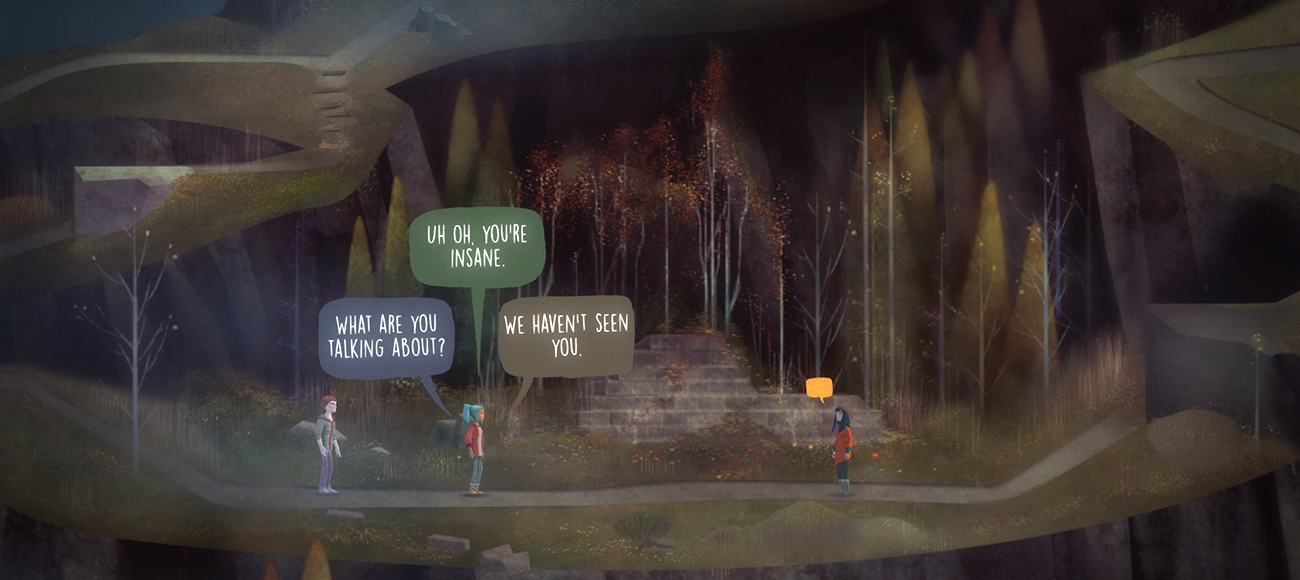
It’s clear that Oxenfree expects Alex to spend the majority of its playtime with Jonas and Ren, both of whom tend to respond poorly if the player chooses conversation options that don’t read as stereotypically “masculine.”

To give an example, after something terrible and upsetting happens, Jonas tells Alex that he’s scared. If she demonstrates sympathy or empathy by responding with “Are you okay?” or “I’m scared too,” Jonas will become annoyed or openly hostile. Meanwhile, the uncomfortably callous response of “You’re fine, let’s keep going” is configured as “correct” and doesn’t result in a string of passive-aggressive insults.

There are several different variations on Alex’s personality that the player can choose to express, but Oxenfree doesn’t give the player many opportunities to be chill, or friendly, or sincere, or emotionally vulnerable, or just curious about what’s going on. Each conversation choice generally has three options, but there’s always an additional option of not saying anything. As I played, I gradually found myself “choosing” not to say anything, especially not to the boys.

In other words, the opportunities for roleplaying the character of Alex are limited. I don’t think Alex is supposed to be unsympathetic, but the writer/director’s understanding of how interpersonal communication works feels very specific to a personality and worldview that I don’t understand. The portrayal of these teenagers – especially the teenage girls – is just so mean. The voice actors all give wonderful performances that help the player better understand the characters, but I wish the writing were as nuanced as the acting.

Granted, Alex ends up being the villain of Oxenfree II, so another interpretation might be that she is in fact a bad and selfish person who doesn’t care if she hurts people. If this is indeed the case, though, I wish that the writing had signposted her personality more clearly, or at least given more concrete hints regarding how the true nature of the situation on Edwards Island has affected her character.

Oxenfree has been universally praised, and I’ve even seen people refer to it as a “cozy game,” meaning that it presumably creates a sense of warmth in the player by being unchallenging to play while focusing on a story with themes of friendship and personal growth. I can understand the affective positivity of this reaction, but I also think it’s important to explain why Oxenfree can be difficult and frustrating, especially to someone playing the game in 2024.

Oxenfree is gorgeous to look at and features engaging conversation-based gameplay mechanics, but this is a horror game with slow movement speed and long loading times in which characters are often seriously unpleasant to one another. I maintain that Oxenfree is a unique and interesting game that’s well worth checking out – especially given its relatively short length – but it’s always good to have an accurate understanding of what you’re getting into.

While doing some research about the game’s reception, I learned that Netflix acquired the Oxenfree development team, Night School Studio, in 2021. Netflix produced Oxenfree II, and I read that there’s a live-action series adaptation of Oxenfree in production. This sounds nice, to be honest. Crossmedia adaptations don’t always succeed, but I get the impression that Oxenfree might actually work much better if it weren’t an interactive video game.

Giraffe and Annika

Giraffe and Annika is an extremely chill 3D adventure story game with anime-style character designs and panel-by-panel manga cutscenes. The game takes about four hours to finish, and I suppose that whether it’s worth $30 depends on how much you value this type of experience. I played Giraffe and Annika in short stretches during the day to get a bit of emotional sunshine, and it was lovely.

You play as Annika, a ten-year-old catgirl who mysteriously finds herself on a beautiful forested island. There’s a bit of an Alice in Wonderland flavor to the scenario, as Annika doesn’t worry too much about where she is or how she got there, and she begins the story as something of a blank slate. After investigating an empty house belonging to someone named Lisa, Annika goes back outside to find a blue-haired catboy named Giraffe waiting for her. Giraffe tells Annika that she has special powers, and he asks her to visit three dungeons on the island in order to restore starlight to a magical pendant.

The dungeons are themed open-air environments inhabited by roaming ghosts that will drain Annika’s health meter if they get too close. Thankfully, the dungeons are also filled with numerous health-restoring crystals. At the end of each dungeon is a boss battle that takes the form of a simple rhythm game. It’s possible to die from ghost attacks and other environmental hazards in the dungeons; and, in fact, I died a lot. Thankfully, save points and respawn points are so frequent that this isn’t an issue. There is zero stress in this game.

By clearing the dungeons, Annika will unlock exploration abilities such as a floaty space jump and the ability to swim underwater. She’ll also perform small fetch-quest tasks for NPCs who will help her bypass other obstacles. There are various objects that Annika can interact with across the island, but the optional collectibles are just for fun. Objectives are clearly marked, and you’ll never be in danger of getting lost or going off-track from the main quest.

The island is very lush and green and beautiful, and there’s a short day-night cycle that adds a touch of visual flair. I also appreciate the cuteness of the designs of the game’s sizeable cast of NPCs. In order to access the second dungeon, for example, you need to feed carrots to a sea turtle; and, to get the carrots, you have to round up a family of rabbits. The rabbits look like a Studio Ghibli adaptation of Beatrix Potter, and they’re adorable. Meanwhile, the sea turtle is completely photorealistic, which is a good illustration of the game’s gentle sense of humor.

It’s always a pleasure to encounter and interact with new characters, and I really enjoyed the manga-style cutscenes, which play out panel by panel. The character art is comically expressive, and the bright pastel colors are lovely.

It’s difficult to critique Giraffe and Annika, as it’s very sweet and competently constructed. Still, the main 3D playspace of the game can feel a bit textureless, and I also felt that the game wears out its welcome when it starts trying to challenge the player at the very end. I actually appreciate the occasionally amateurish design, as it fills me with a sense of nostalgia for the early 3D adventure games of the PlayStation era. Even though Giraffe and Annika sometimes looks as though it was built with out-of-the-box 3D graphic assets, it’s clear that the creators put a lot of effort into creating unique environments with a distinct sense of character.

Giraffe and Annika probably won’t appeal to someone looking for a deep story or challenging gameplay, but I can imagine that it would be a perfect starter game for its target audience of younger players. As for me, it provided a pleasant and much-needed mood boost during a dismal week in February. Giraffe and Annika is a bright and simple fantasy adventure with cute characters and no unnecessary cooking or crafting elements, and sometimes that’s exactly what you need in your life.

Melissa

Melissa
https://cattrigger.itch.io/melissa-heart

Melissa is a free-to-play retro horror visual novel about a rudimentary dating game on an old library computer. If you’re okay with dying quickly, it takes about seven minutes to play, but you can add a few more minutes by trying to stay alive for longer. The game has an easily accessible save system, so you can restart at every dialogue choice to see what happens when you beg for mercy. Good luck!

Melissa reminds me of the best parts of Doki Doki Literature Club without the need to scroll through an hour of cutesy school shenanigans. The initial dating game is exactly the sort of thing you’d find on a floppy disc next to Oregon Trail, and both the graphics and the sound design feel nicely textured and deliciously crunchy. The writing gets in and gets the job done, and the twist is a lot of fun.

The developer made a sequel called Morris
https://cattrigger.itch.io/morris-heart

…that is significantly longer (about 25-30 minutes) and also very good. The retro nostalgia appeal is amplified by the occasional internet dial-up sounds, and at certain points the game asks you to print things out on the library’s public printer, which makes adorable dinosaur noises. Aside from the eponymous Morris, the story featured two additional characters, both of whom are delightfully unhinged. In the comments on the game’s page on Itch.io, a few people said that they’d happily date the evil older woman, and honestly? Same.

It amuses me that Melissa and Morris are both named after famous computer viruses. If you’re interested, I recommend checking out these two bizarre FBI pages, if only for their top-notch banner graphics:

The Melissa Virus
https://www.fbi.gov/news/stories/melissa-virus-20th-anniversary-032519

The Morris Worm
https://www.fbi.gov/news/stories/morris-worm-30-years-since-first-major-attack-on-internet-110218

Anyway, it seems like the developer is making a full Date Time trilogy for release on Steam, and I’m intrigued by the work they’ve posted so far. It’s interesting to think that this universe of cursed retro dating games is informed by its own system of deep lore, and I’m always here for monster computer viruses who are down to smooch.

Fishy

Fishy
https://i-choose-paradise.itch.io/fishy

Fishy is a horror-themed “wholesome” visual novel that takes about twenty minutes to finish. You play as a sweet middle school girl who’s spending the night at an aquarium for a friend’s birthday party. The problem is that she’s deathly afraid of the ocean, and it doesn’t help that there’s mild friendship drama afoot. She gets separated from the group and wanders into a restricted area, where she encounters fish that aquarium guests are never meant to see.

The art of Fishy is fantastic and alternates between genuinely gorgeous and genuinely creepy. Putting the spooky fish aside, the environmental illustrations perfectly capture the magical atmosphere of what it might be like to spend the night in an aquarium. The character designs are lovely as well.

The writing is competent, but the game seems to be aimed at the same audience as its preteen characters. In its determination to be wholesome and teach the player a positive life lesson, the story hesitates to create a sense of tension, dread, or even character development.  

Fishy’s message is that having a prosthetic limb is cool, actually. And that’s great! Prosthetic limbs are in fact cool as hell. Still, the twenty minutes that most players will spend with the game isn’t quite enough time to tie all the various thematic threads together. There’s the player-character’s anxiety + her relationship with her friends + her fear of the ocean + the potentially haunted aquarium; and then, on top of that, there’s the positive message about disability positivity. It’s a lot!

The lack of any real darkness or specificity makes the experience of the player-character somewhat confusing, at least to my adult sensibilities. Like, what exactly is the source of the friendship drama? Why is the player-character afraid of the ocean? Is there something going on in her life that makes her prone to attacks of social anxiety? Why does she react to this situation in such an extreme way? Is she having a legitimate psychotic break?

I always appreciate stories that reach for big goals, of course, and the writing is quite compelling. If nothing else, the characters all seem like real people, and I was interested in learning more about them.  

Also, I have a bit of a crush on the girl in the friend group who knows all sorts of disturbing facts about the ocean and doesn’t mind bringing them up at (in)appropriate moments. I want a whole game about Weird Fish Girl and whatever her damage is. She’s wonderful, and I love her.

All in all, Fishy is a fun story with a few spooky scenes, and it feels like a good visual novel to share with younger children. The hand-drawn art is appealing, and the story goes to some interesting places in a relatively short amount of time. In any case, it’s free to play, so no complaints there. Even if you’re not into preteen friendship drama, it’s always good to spend quality time with the terrors of the deep.

Hypnospace Outlaw

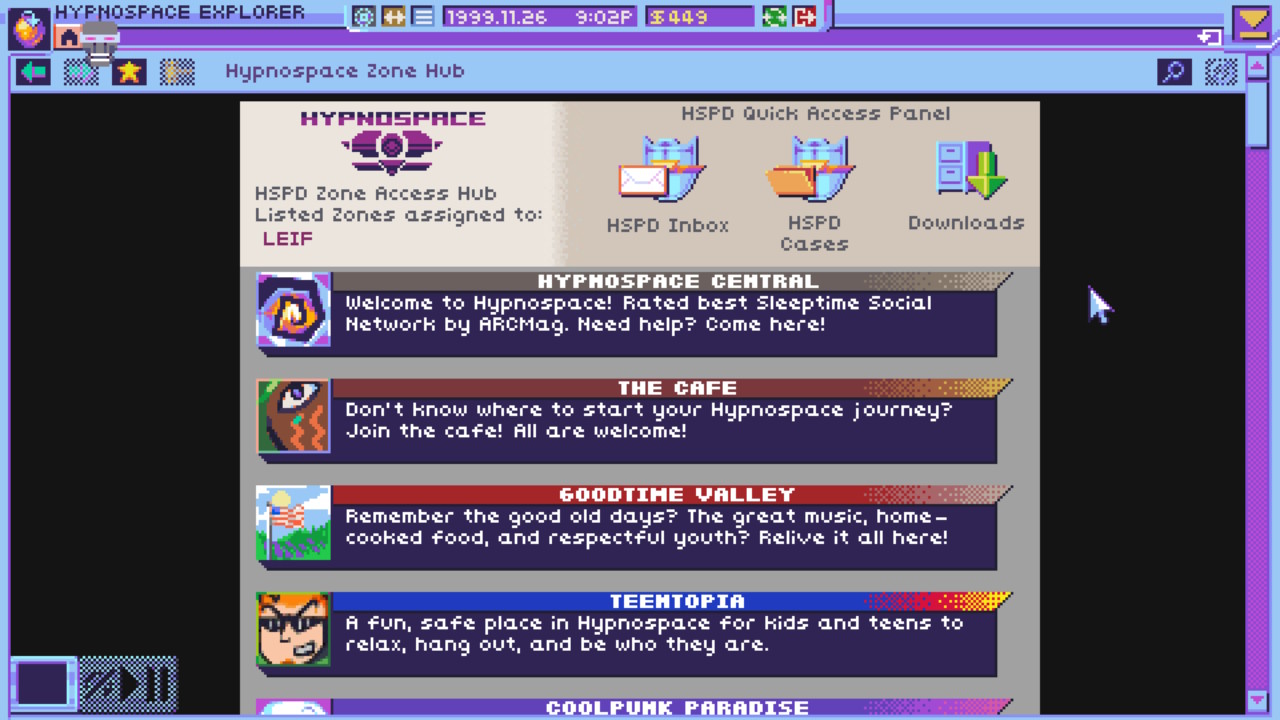
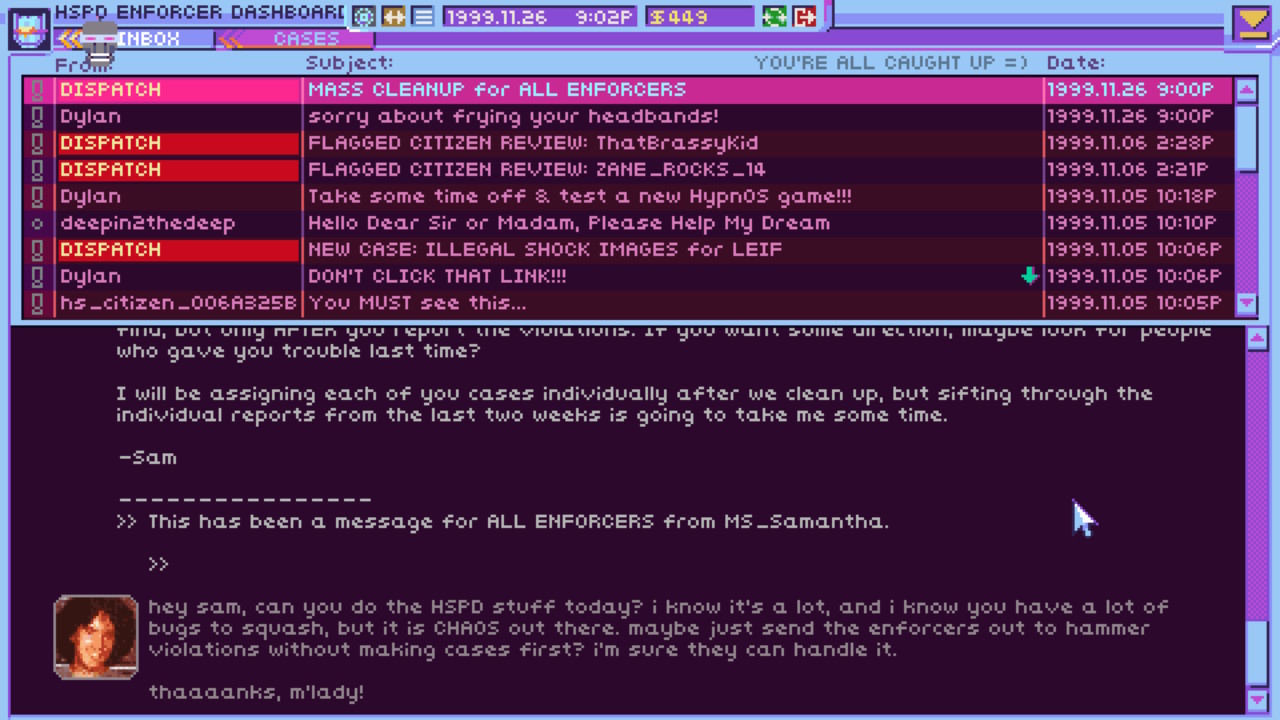
Hypnospace Outlaw is an internet detective game set in a parallel universe in 1999. You play as a volunteer moderator who’s tasked with flagging content violations, and the gamespace consists of your desktop, your email inbox, and a web browser that connects you to Hypnospace, a Geocities-style database of websites.

The Hypnospace admins send you a series of cases, and the first one is easy enough to solve. A representative of the estate of an artist who created a popular cartoon character has reported a page displaying unauthorized reproductions. You can find the page easily enough by searching for the character’s name in your web browser, where you see that a first grade teacher has shared scans of her students’ artwork of the character. You can click on each image and use a special tool in your browser to report it, thus removing the artwork from the woman’s page. Once you’ve removed all images recognizable as the character, you’ll get an email telling you that the case is resolved.

Obviously this is a shitty thing to have done, but the game doesn’t give you any ability to do otherwise. If you want to keep playing, you have to “solve” these cases in the only manner provided. Unfortunately, it’s not possible to make choices.

This lack of agency can be upsetting, especially when the game forces you to slap violation penalties on a teenage girl experiencing sexual harassment through DMs. She sent a support request to Hypnospace asking them to address the harassment, and she’s posted screenshots of the chats on her page. When you report these images as harassment, the girl is the one who’s penalized, as the images are hosted on her page.

A female member of the admin staff carbon-copies you on an email that she sends to her boss, asking him if this misattribution can be corrected. Unfortunately, he’s a piece of shit and brushes her off, saying that it’s not his problem. M’lady.

The point of being able to see the internal workings of content moderation is to give the player a sense of how wild and woolly the early public internet used to be. The administrators and moderators managing online communities were young and didn’t really know what they were doing, and there was a complete disconnect between corporate software developers and the end users, many of whom were just kids. In addition to teen drama, Hypnospace also hosts retirees with time on their hands, people who are deeply emotionally invested in the music they enjoy, small businesses doing their best, and a healthy cohort of amateur artists and poets.  

Hypnospace Outlaw has a strong Windows 95/98 aesthetic, and the Geocities/Angelfire style of page design is well-observed, with ample crunchy backgrounds and neon colors and spinning GIFs. What’s less well-observed is the quality of the writing people put on their pages. Even in college in the mid-2000s, I remember finding this exact style of personal webpage and being impressed by how knowledgeable and competently written they were. In Hypnospace Outlaw, however, the writing is uniformly bad. It’s bad on purpose, which has its charm, but I still got the feeling that the in-game webpages are more to look at than to read.  

If you can tolerate the bad-on-purpose writing, however, all sorts of intriguing worldbuilding details begin to emerge. You never learn much, however, only bits and pieces of trivia that are incorporated into people’s discussions of their special interests. The main “alternate” aspect of this universe, which is that people access the internet by wearing a headband while they sleep, is never explained. It’s also not particularly important… until it is. Still, I wouldn’t say that Hypnospace Outlaw has anything as structured as a plot. You’re mainly just here for the vibes.

After the first case, the game becomes infinitely more difficult and complicated, and I had to make constant use of a walkthrough (this one here). I have no idea how I would have figured out many of the cases otherwise. The problem is that there are dozens of public pages, not to mention hidden pages and directories and search terms and tagging systems, and the “clues” you receive are all extremely cryptic. There’s a lot of noise and not much clarity.

In the end, I’d estimate that it’s completely unnecessary to engage with about 70% of the game. There’s no real incentive to sort through the chaff unless you’re simply curious and don’t mind spending time clicking on links and reading through the webpages collected in the various themed directories. I ended up ignoring a lot of the game’s content, but I really enjoyed the pages that focus on urban legends and conspiracy theories. There’s also a page devoted to a kind of lo-fi, found-noise techno called Fungus Scene that I would very much like to exist in our own universe. Personally speaking, I would have preferred more of this sort of “weird but brilliant” creativity and less “kids being immature” cringe humor.

If you beeline through the cases with a walkthrough, Hypnospace Outlaw takes about three to four hours to finish, and how much time you’re willing to spend exploring outside the main objectives will depend on your tolerance for this subjective version of what the internet looked like in the late 1990s. For me, Hypnospace Outlaw is interesting in theory but somewhat frustrating to engage with, and the ultimate message that incompetent techbros can get away with everything from harassment to manslaughter didn’t really resonate as a meaningful story.

Still, despite routinely subjecting myself to some of the strangest titles Itch.io has to offer, I’ve never seen anything like Hypnospace Outlaw, and I’m happy it exists. If you’re at all curious, I’d recommend checking out the free demo. It’s available for the Nintendo Switch, so you can play the game while smoking weed in the bath, which is probably the best way to experience it to be honest.

Corpse Party

Corpse Party is a 16-bit RPG Maker horror adventure game from 1996 that was released on multiple platforms before finally finding its way, in a substantially updated form, to the Nintendo Switch. It shows its age, but it’s definitely worth playing if you’re into retro-styled horror adventure games.

Corpse Party is divided into five chapters, each of which stands as a discrete unit accompanied by its own set of save files that can be selected from the main menu. Every chapter has a number of optional bad endings, but you need to achieve the good ending in order to unlock access to the next chapter. If you’re using a walkthrough, each chapter takes roughly an hour to complete.

You play as various members of a group of high school students who stayed late after school one evening to tell ghost stories. They unfortunately trigger a curse that transports them to an abandoned elementary school building that was shut down in the 1970s after a grisly series of abductions and murders. Different students occupy different pocket dimensions of the school, which is almost entirely cut off from reality. To make matters worse, your group of students isn’t the first batch of kids to be spirited away to the school, which is littered with corpses and haunted by vengeful ghosts. Your goal is to help the kids escape the school… if that’s even possible.  

Corpse Party is extremely gory, and not all the kids are going to make it. The game contains intense depictions of mutilation and self-harm accompanied by vivid textual descriptions and occasional environmental illustrations of an uncomfortably graphic nature. The violence occupies an intersection between disturbing, gross, and campy, and I thought it was a lot of fun.

The main challenges of Corpse Party are of the standard “find a key to unlock the door” adventure game variety. The layout of the school changes from scene to scene, but it’s not large enough to get lost in. Aside from avoiding the occasional wandering ghost, there are no reflex challenges, and your characters are very rarely in any immediate danger. If there were jump scares, they didn’t register with me. The 16-bit character sprites are very cute, even when they’re depicting corpses.

As far as horror games go, Corpse Party is relatively chill, but with one caveat:

Corpse Party is completely linear and frustratingly opaque about what you need to do to trigger the next event in any given sequence. Unless you want to walk through endless dark hallways searching every square of the map, you’re going to need a walkthrough to get through the game. The walkthrough people use is (this one), but the walkthrough can sometimes be just as opaque as the game itself.

Personally speaking, I’m not the sharpest tool in the shed, but I managed to get through the first two chapters of Corpse Party without using a walkthrough. These initial two chapters stand on their own as a story, and I felt that they were actually the best part of the game. I think it’s probably safe to say that the opening of Corpse Party is more than enough to satisfy someone with a casual interest and playstyle.

The characters are usually divided into interesting pairs, and most of what you’ll do in the game consists of walking around inside the ruins of the school building while having conversations. The kids are very good about following horror movie rules – they don’t split up or do anything stupid – but they’re at the complete mercy of the ghosts of the original murder victims, who will change the layout of the school or create traps just to mess with them. For the most part, the kids are good and gentle and kind to one another, which makes it all the more upsetting when something bad happens.

The characterization and conversations aren’t that deep, however, so you never get so attached to any character that you don’t want to see them die. My favorite death is when one of the kids gets slammed against a wall so hard that his body explodes into red pulp, which all the rest of the kids have to walk through for the remainder of the game while navigating that particular hallway intersection.

Through disjointed and disconnected teamwork, your characters learn what actually happened to the ghosts haunting the school. For curious lore hunters, there are various bits of text scattered around, from newspaper clippings to messages left by other victims of the curse. These textual passages start off as grim and gradually grow more disturbing, and it’s always a pleasure to find something new to read. There’s also an optional collection quest that encourages you to find and interact with all the corpses in each chapter; and, if you like, you can return to the main menu and read about all the horrible ways these kids died.

It’s probably more accurate to call Corpse Party a “visual novel” as opposed to an “adventure game,” but it’s fun to explore the school while interacting with various objects in the environment. It’s also fun to gain access to new areas, both to learn more about the story and to see more of the game’s pixel art. One of my favorite areas is the outdoor pool in Chapter 4, which is filled with waterlogged corpses and preceded by a hellishly filthy locker room. Good times.

Despite its frustrations, I really enjoyed Corpse Party, and the English translation created by XSeed is fantastic. While reading the game’s Wikipedia page (here), I learned that there’s a manga adaptation (here), and I had so much fun exploring this horrible haunted school that I started reading it. It’s just as ridiculous and over the top as you’d expect from a manga adaptation of a horror game, but each chapter has one or two really great horror scenes enhanced by lovingly detailed and disturbingly gruesome artwork.

Review of A Guest in the House on WWAC

I had the pleasure of writing a review of Emily Carroll’s darkly brilliant graphic novel, A Guest in the House, for Women Write About Comics. The story gazes into the moonlit shadows of “traditional” families, and it’s gothic horror at its sexiest and most subversive. Here’s an excerpt from my review:

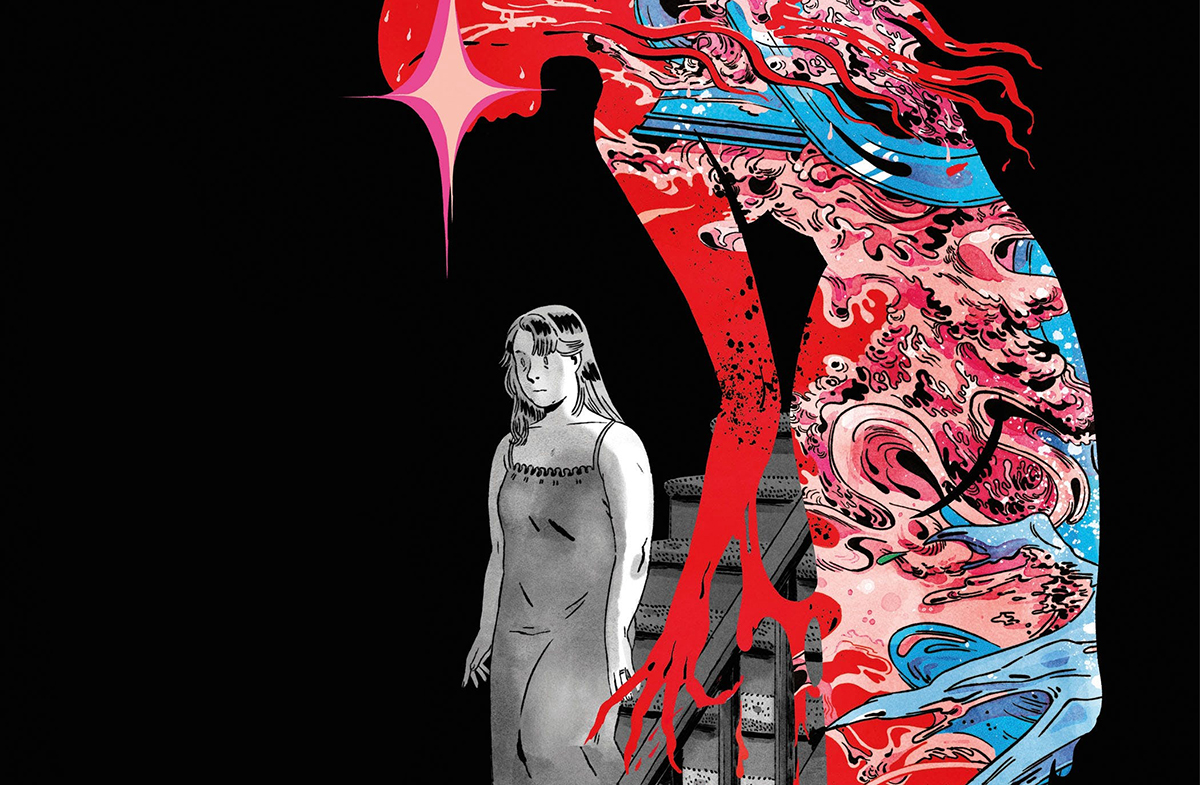
Carroll’s visual representation of Abby’s inner world is brilliantly strange and gorgeously queer. In her more introspective moments, Abby indulges in a fantasy of herself as a heroic knight fighting dragons, who lay waiting for her, hot and wet in their dark caves. Having slain a dragon while remaining protected and genderless inside her full-body armor, Abby seeks comfort in the arms of the beautiful ladies that await her arrival. While the majority of the artwork in A Guest in the House is painted in black ink with gradations of gray, Abby’s fantasies practically scream from the page in lurid full color that slowly begins to bleed into Abby’s waking life.

You can read the full review here:
https://womenwriteaboutcomics.com/2023/10/a-guest-in-the-house-review/

If you’re interested, I also recommend checking out Emily Carroll’s website (here) for a curated selection of horror art and short comics. It’s not for the faint of heart, but it’s one of the best sites on the internet.

While I was writing this review, I told a friend that A Guest in the House is like Dark Souls, but if Dark Souls were about a housewife in rural Canada in the 1990s. I stand by this evaluation, and I think it makes sense given the artist’s love of FromSoft games. Carroll recently released a short fancomic about Bloodborne, and you can download it for free from Itchio (here). As with A Guest in the House, I might offer a content warning for body horror and violence, but the art and writing are gorgeous.

Review of The Hills of Estrella Roja on WWAC

I recently had the immense honor of being able to review emerging artist Ashley Robin Franklin’s brilliant Southwest Gothic graphic novel, The Hills of Estrella Roja, for Women Write About Comics.

Here’s an excerpt:

Even as Kat and Mari enjoy queer teen solidarity, they’re inducted into an adult world of queerness that was previously denied to them. Mari’s side of the story is especially interesting in this regard, as she gradually comes to understand that her identity isn’t just a matter of her own lived experiences, but also a product of the heritage shaped by the experiences of her extended family. The art of The Hills of Estrella Roja cleverly suggests connections between generations in subtle allusions and callbacks while immersing the characters in a gorgeous world that constantly reaches out (sometimes literally!) to pull Mari and Kat deeper into the natural environment that surrounds them.

You can read the full review here:
https://womenwriteaboutcomics.com/2023/08/the-hills-of-estrella-roja-review/

As always, I have nothing but gratitude for my editor, Kat Overland. Kat gave me the go-ahead to write a review of Franklin’s minicomic Fruiting Bodies and then helped me get in touch with Clarion Books to request an advance review copy of The Hills of Estrella Roja. I’m not used to playing in the big leagues, so Kat’s support was invaluable, as were their notes as a native Texan. For excellent taste and good-sense takes on comics, politics, and pop culture, you can follow Kat on Twitter (here) and on Bluesky (here).

You can follow Ashley Robin Franklin on Instagram (here), where she posts cute and colorful botanical studies and shorter autobiographical comics that are touching, relatable, and well worth reading.

Review of Soul Void on Sidequest

I recently had the pleasure of writing a review of the Game Boy horror adventure game Soul Void for the online gaming magazine Sidequest. I love Soul Void, and I’d describe it as Undertale for people who love quirky adventures with elements of horror but hate bullet hell. Although the horror elements of Soul Void are quite gruesome, it’s accessible to players of all skill levels. The game is free to play on Itchio (here), but I’d recommend playing it on a Game Boy emulator like mGBA, which you can download (here). Here’s an excerpt from my review:

Soul Void is a dark fantasy Game Boy adventure game that takes about three hours to finish. Its story of a young woman navigating the perils of the underworld is intriguing and cathartic, and its art design makes incredible use of the eeriness of its retro pixel graphics. For anyone who enjoyed the characters and worldbuilding of Undertale, Soul Void offers a similarly offbeat odyssey of mystery and friendship illustrated with disturbing but brilliantly creative horror art.

You can read the full review here:
https://sidequest.zone/2023/08/21/review-soul-void-dives-deep-into-retro-body-horror/

I want to give a big shout-out to my editor, Maddi Butler, for helping me get my thoughts in order and work through some of the more interesting themes of this game. I’d also like to thank the Sidequest Editor in Chief, Melissa Brinks, for giving me an opportunity to write about Soul Void, and for allowing me to expand on my thoughts about this amazing game. For excellent writing and commentary on video games, you can follow Maddi on Bluesky (here) + Melissa on Twitter (here). If you’re in the mood for gorgeous horror art, you can follow Soul Void’s creator, Kabadura, on Twitter (here) and on Instagram (here).

Review of River’s Edge on WWAC

I recently had the opportunity to review Kodasha USA’s release of Kyoko Okazaki’s 1994 graphic novel River’s Edge for Women Write About Comics.

River’s Edge is like an anti-shōjo manga about teenagers at the margins of society being evil to one another. This is the sort of gritty “all the trigger warnings” graphic novel that I wouldn’t recommend to everyone, but I really enjoyed it. I think it’s an important piece of art, and I’m grateful that it’s available in English. Here’s an excerpt from my review:

Even to readers not interested in manga classics or sociopolitical critiques of millennial Japan, River’s Edge tells an engrossing tale of teenagers precariously close to falling out of mainstream society. Characters who initially seem to be stereotypes gain fascinating depth and complexity as their lives spiral out of control over the course of a story that rapidly gains momentum. River’s Edge isn’t entirely bleak, however. The footholds the characters find in the landslide are meaningful, and their small moments of genuine friendship and connection are all the more valuable in the cultural wasteland they inhabit.

You can read the full review here:
https://womenwriteaboutcomics.com/2023/08/review-rivers-edge-reflects-gritty-millennial-malaise/