I recently had the immense pleasure of writing an article about the latest chapters of Deltarune for Sidequest. This piece features some story analysis and theorizing, as well as a personal anecdote about an extremely awkward moment during my job search in my last year of grad school, but it’s mostly about the joys of retro media and the lost art of having fun. Here’s an excerpt…
Nostalgia is a difficult subject to approach. Cultural nostalgia, which often takes the form of a glorified version of an earlier decade, is a hallmark strategy of conservative political movements that attract sympathy by engendering a fantasy of a time when, supposedly, things were better. Nostalgia for childhood media can be fraught as well, especially when we view the more problematic aspects of this media from an adult perspective.
Still, nostalgia has its uses. When approached with care and attention, indulging in nostalgia can be an exercise that facilitates a rediscovery of play. In its celebration of the television and video games of an earlier era, Chapter 3 of Deltarune invites introspection into the aspects of play that a younger version of yourself understood to be “fun.”
As an aside, my corner of video game fandom spent the month of July going wild for the character Tenna, an anthropomorphic personification of a CRT television who plays a central role in Chapter 3 of Deltarune. Tenna’s status as the Summer 2025 Tumblr Sexyman is partially due to his eye-catching visual design and flashy personality, but I also get the feeling that his near-instant popularity was due to the way he speaks to a particular type of cultural malaise.
As a consequence of the concomitant collapse of social media platforms and the proliferation of AI-generated “content,” everyone is exhausted by the effort it takes to wade through (and compete with) soul-numbing machine slop. What Tenna represents is an era of media that, though it might not have been “good,” was at least intentional. My essay doesn’t touch on specific issues relating to gen-AI, but I was directly inspired to write this piece by the very enthusiastic reception of the recent chapters Deltarune in online creative communities. There’s definitely something interesting going on there culturally, I think.
“The Softer Side of Dark Souls Fandom,” my essay about a major shift in internet culture, was published on Sidequest. Everybody loves Bloodborne and Elden Ring now; but, ten years ago, FromSoft fans were a fairly isolated group, not to mention some of the most hateful people I’d ever encountered online. At about 1,400 words, this piece is far shorter than it should be, but I still had a fun time writing about how FromSoft fandom has become much more welcoming and inclusive over the past decade. Here’s an excerpt:
I’ve put untold hundreds of hours into Dark Souls and its sequels. When the game first came out almost fifteen years ago, however, there was nothing I hated more than Dark Souls. I refused to play it. I associated the game with the worst people on the internet, who spewed hate while using Dark Souls memes to shame and attack anyone they felt challenged the hegemony of their male-dominated subculture of video game fandom.
I therefore feel an ironic pleasure in the fact that, these days, Dark Souls and the other FromSoft games have been embraced by women and the queer community, the exact people these angry online gaming communities loved to hate. In a strange twist of fate, the games weaponized to mock diversity have become a sanctuary for many of the people who were once excluded.
An earlier version of this essay was published in Act Your Age, Vol. 2: Dark, a fandom memoir anthology zine that you can check out (here).
I decided to publish this piece online when the host of one of my favorite video game podcasts, Bonfireside Chat, came out as transgender. Since she’s not really a public figure, I don’t mention her in the essay itself, but her announcement made me incredibly happy. Regardless of gender and sexuality, I hope everyone can find a place where they feel accepted and supported in their interests… even if their interest is in dark fantasy games about dying in all sorts of grisly and horrifying ways!
I was honored to write a review for Pacific Affairs of Daniel Johnson’s 2023 monograph Textual Cacophony, a critical analysis of Japanese internet culture between roughly 2006 and 2014. Johnson is especially interested in the anonymous message board 2channel and the video sharing site Niconico, and my review highlights why the online subcultures associated with these sites are still relevant and worth studying. Here’s the opening paragraph:
It’s no secret that a great deal of twenty-first century media has been influenced by internet subcultures; unfortunately, much of this culture has been lost to time. Many emergent online cultures of the 2000s have proved tragically ephemeral, with the scarce documentation that exists often falling into the trappings of cultural nostalgia. Thankfully, Daniel Johnson’s Textual Cacophony: Online Video and Anonymity in Japan functions as a critical analysis that documents and preserves an important moment in Japanese media history that continues to resonate across national borders.
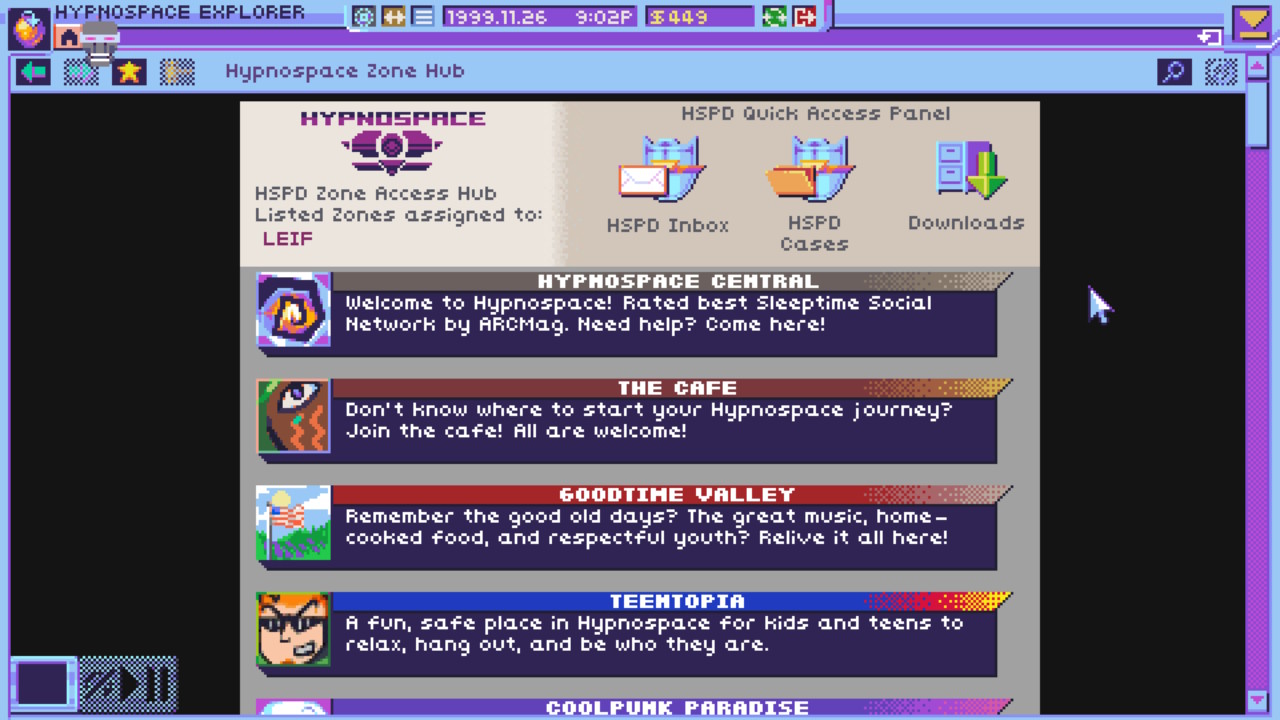
Hypnospace Outlaw is an internet detective game set in a parallel universe in 1999. You play as a volunteer moderator who’s tasked with flagging content violations, and the gamespace consists of your desktop, your email inbox, and a web browser that connects you to Hypnospace, a Geocities-style database of websites.
The Hypnospace admins send you a series of cases, and the first one is easy enough to solve. A representative of the estate of an artist who created a popular cartoon character has reported a page displaying unauthorized reproductions. You can find the page easily enough by searching for the character’s name in your web browser, where you see that a first grade teacher has shared scans of her students’ artwork of the character. You can click on each image and use a special tool in your browser to report it, thus removing the artwork from the woman’s page. Once you’ve removed all images recognizable as the character, you’ll get an email telling you that the case is resolved.
Obviously this is a shitty thing to have done, but the game doesn’t give you any ability to do otherwise. If you want to keep playing, you have to “solve” these cases in the only manner provided. Unfortunately, it’s not possible to make choices.
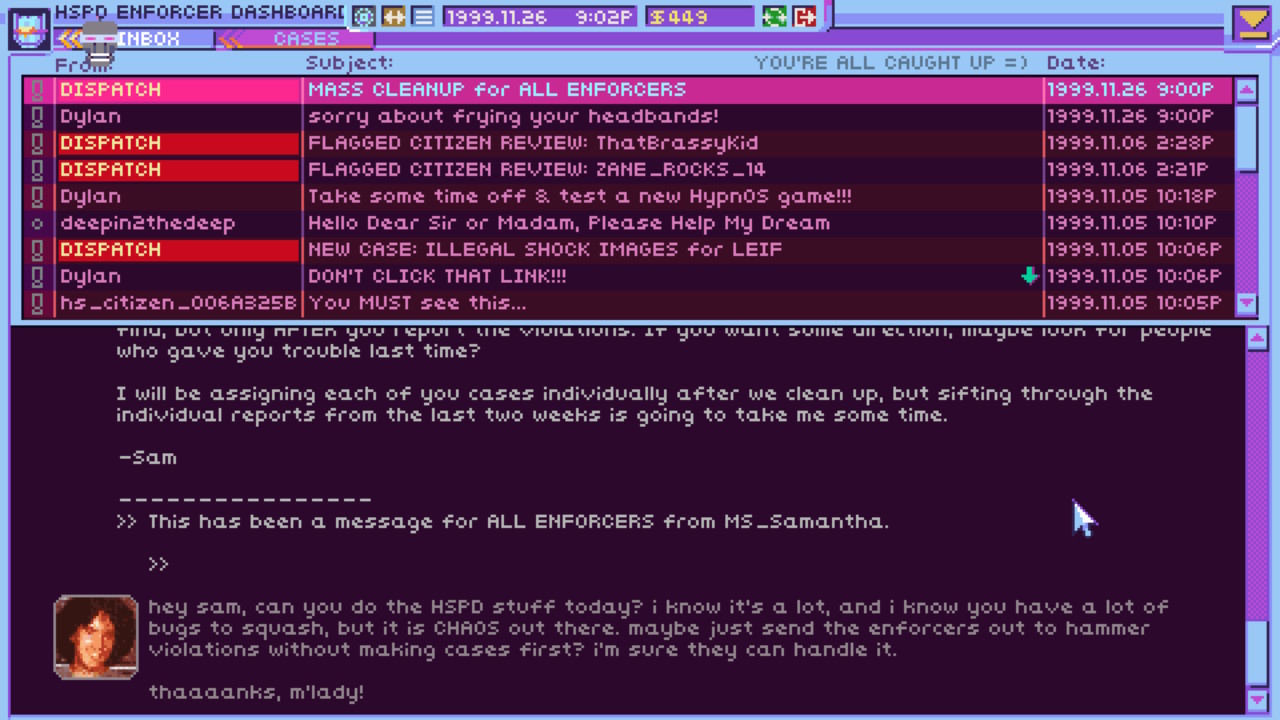
This lack of agency can be upsetting, especially when the game forces you to slap violation penalties on a teenage girl experiencing sexual harassment through DMs. She sent a support request to Hypnospace asking them to address the harassment, and she’s posted screenshots of the chats on her page. When you report these images as harassment, the girl is the one who’s penalized, as the images are hosted on her page.
A female member of the admin staff carbon-copies you on an email that she sends to her boss, asking him if this misattribution can be corrected. Unfortunately, he’s a piece of shit and brushes her off, saying that it’s not his problem. M’lady.
The point of being able to see the internal workings of content moderation is to give the player a sense of how wild and woolly the early public internet used to be. The administrators and moderators managing online communities were young and didn’t really know what they were doing, and there was a complete disconnect between corporate software developers and the end users, many of whom were just kids. In addition to teen drama, Hypnospace also hosts retirees with time on their hands, people who are deeply emotionally invested in the music they enjoy, small businesses doing their best, and a healthy cohort of amateur artists and poets.
Hypnospace Outlaw has a strong Windows 95/98 aesthetic, and the Geocities/Angelfire style of page design is well-observed, with ample crunchy backgrounds and neon colors and spinning GIFs. What’s less well-observed is the quality of the writing people put on their pages. Even in college in the mid-2000s, I remember finding this exact style of personal webpage and being impressed by how knowledgeable and competently written they were. In Hypnospace Outlaw, however, the writing is uniformly bad. It’s bad on purpose, which has its charm, but I still got the feeling that the in-game webpages are more to look at than to read.
If you can tolerate the bad-on-purpose writing, however, all sorts of intriguing worldbuilding details begin to emerge. You never learn much, however, only bits and pieces of trivia that are incorporated into people’s discussions of their special interests. The main “alternate” aspect of this universe, which is that people access the internet by wearing a headband while they sleep, is never explained. It’s also not particularly important… until it is. Still, I wouldn’t say that Hypnospace Outlaw has anything as structured as a plot. You’re mainly just here for the vibes.
After the first case, the game becomes infinitely more difficult and complicated, and I had to make constant use of a walkthrough (this one here). I have no idea how I would have figured out many of the cases otherwise. The problem is that there are dozens of public pages, not to mention hidden pages and directories and search terms and tagging systems, and the “clues” you receive are all extremely cryptic. There’s a lot of noise and not much clarity.
In the end, I’d estimate that it’s completely unnecessary to engage with about 70% of the game. There’s no real incentive to sort through the chaff unless you’re simply curious and don’t mind spending time clicking on links and reading through the webpages collected in the various themed directories. I ended up ignoring a lot of the game’s content, but I really enjoyed the pages that focus on urban legends and conspiracy theories. There’s also a page devoted to a kind of lo-fi, found-noise techno called Fungus Scene that I would very much like to exist in our own universe. Personally speaking, I would have preferred more of this sort of “weird but brilliant” creativity and less “kids being immature” cringe humor.
If you beeline through the cases with a walkthrough, Hypnospace Outlaw takes about three to four hours to finish, and how much time you’re willing to spend exploring outside the main objectives will depend on your tolerance for this subjective version of what the internet looked like in the late 1990s. For me, Hypnospace Outlaw is interesting in theory but somewhat frustrating to engage with, and the ultimate message that incompetent techbros can get away with everything from harassment to manslaughter didn’t really resonate as a meaningful story.
Still, despite routinely subjecting myself to some of the strangest titles Itch.io has to offer, I’ve never seen anything like Hypnospace Outlaw, and I’m happy it exists. If you’re at all curious, I’d recommend checking out the free demo. It’s available for the Nintendo Switch, so you can play the game while smoking weed in the bath, which is probably the best way to experience it to be honest.
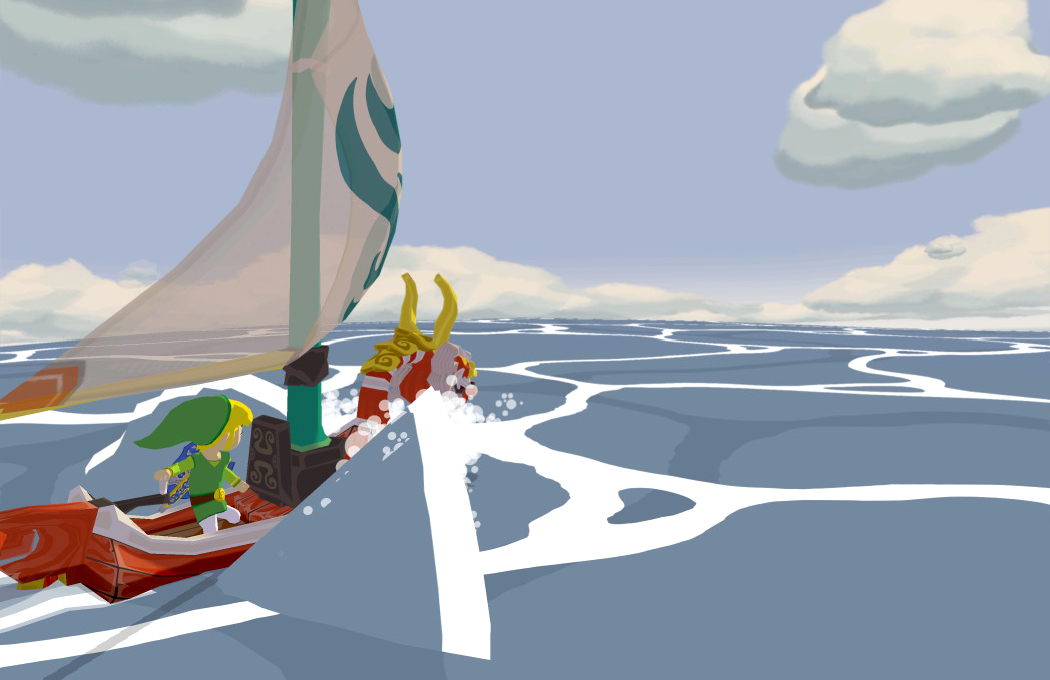
I’m excited to have published an essay titled “How Legend of Zelda: The Wind Waker Navigated Fan Expectations” on one of my favorite video game sites, Sidequest.
I’ve been studying fan interpretations of the Legend of Zelda games for about five years, but I’ve mainly focused on fancomics. In this essay, I finally ventured into the stormy territory of IGN forums in an attempt to understand why people disliked The Wind Waker when it came out twenty years ago. Here’s an excerpt from my essay:
For better or worse, gamers have grown up, and video games have developed as an artistic medium alongside us. In the case of The Wind Waker, the Legend of Zelda fandom has matured enough to appreciate the depth of the game’s story and design, as well as the unique character of its graphic style. Meanwhile, the challenge Tears of the Kingdom will face is that many of the younger players who embraced Breath of the Wild are now seven years older, and they expect the game’s sequel to reflect the seven years of cultural progression they experienced alongside gaming fandom on social media.
This past Sunday, someone on Reddit posted a link to a page-by-page series of photos of the (original Japanese) artbook that comes included with the special edition of Tears of the Kingdom. Since then, a lot of big-name fandom artists have been sharing public pledges that they won’t post any art that contains spoilers. I appreciate their stance, but I’d like to offer my own take – not on the spoilers themselves, but on the culture of corporate secrecy surrounding “spoilers.”
Before anything, I should admit that I looked at the leaked pages. They’re neat! There are a few new interesting character designs, but no story spoilers. The text is little more than design notes. “This clasp connects the two sides of her hairband,” that sort of thing.
I actually wasn’t all that impressed by the Tears of the Kingdom trailers, which make the game seem like a hot mess of heterogeneous elements that don’t fit together. That being said, some of the new character designs are really exciting! I’m not a fan of video game trailers to begin with, as they tend to target action-oriented fourteen-year-old boys. Meanwhile, the Tears of the Kingdom concept artwork is much more specific and interesting, and I think it invites a much broader and more diverse range of people who play games.
To put it bluntly: I didn’t like the trailers, but the leaked concept art sold me on this game.
I think it’s important to keep in mind that the refusal of media companies to put out nothing more than one or two teaser trailers in advance of a big release is a relatively recent practice. Before Disney bought Marvel in 2009, it was common to share all sorts of concept art, cast interviews, behind-the-scenes set photos, and so on. One of the most enjoyable aspects of being a video game fan in the 1990s and 2000s was checking out all the cool pre-release content in magazines and on official websites. In my experience, these little teaser “spoilers” aren’t going to diminish anyone’s enjoyment. Quite the opposite, in fact!
In addition, I think it’s important to put this leak into the context of Nintendo posting a major Direct video saying that they would open preorders for a special edition, only for the extremely limited stock to be almost instantaneously bought out by scalper bots, as Nintendo’s marketing people must have known it would be. Putting the $130 special edition aside, just a regular download of Tears of the Kingdom costs $70, which is quite hefty. I’m not inclined to take Nintendo’s side in any of this, nor am I amused by their weird Disneyesque attempts to create a kind of sacred space around a video game release to inspire “fear of missing out” anxieties.
Of course, I can understand the mindset of someone who wants to go into a game completely “unspoiled,” but you have to wonder. How good can a game (or movie) be if the entire experience of enjoying it would be ruined by knowing more about it?
My final reaction to the conversation surrounding this leak is rooted in my frustration with the prevailing culture of image-based social media. It makes sense for big-name professional artists with large followings to say that they’re not going to post “spoilers.” I understand that having an active online audience of tens of thousands of people necessitates certain precautions against discourse and harassment! Still, that experience is limited to a relatively tiny percentage of creatives.
The tail of social media interest in any given media release is a week at most. If you’re an artist with a low-to-mid-range following, and you can post your work within the first three to five days of a release, this translates to a difference between your post getting 3,000 notes and it getting maybe 300 if you’re lucky. If you’re an absolute amateur like me, this is a difference between getting 3,000 notes and maybe getting 30.
I can’t even begin to explain how intense the pressure to drop everything and produce work quickly is. Intense, and unpleasant. It’s disheartening to see work that was posted maybe two days earlier get an exponentially higher amount of positive feedback simply because of the timing of the post. Essentially: if you’re unable to produce quality work within a magic window, it can feel as though your work doesn’t matter.
( By the way, if your response is “you should create art for yourself,” please go sit in the corner and think about why an aspiring or early-career artist might need or appreciate support. )
Meanwhile, if an artist has more concept art and other development material to work with, they can take their time and create good work on their own schedule so that it’s ready to go when the magic window opens. Personally speaking, I think being able to enjoy the process of making art instead of operating on an unhinged crunch schedule is much healthier, much more sustainable, and a lot more fun.
So, all things considered, maybe being able to access a wider range of information about a game before it releases is kind of nice, actually.
I’m looking forward to presenting at “Histories & Futures of Comics Communities,” the first academic symposium held in conjunction with the Toronto Comic Arts Festival. Here’s the abstract for my presentation…
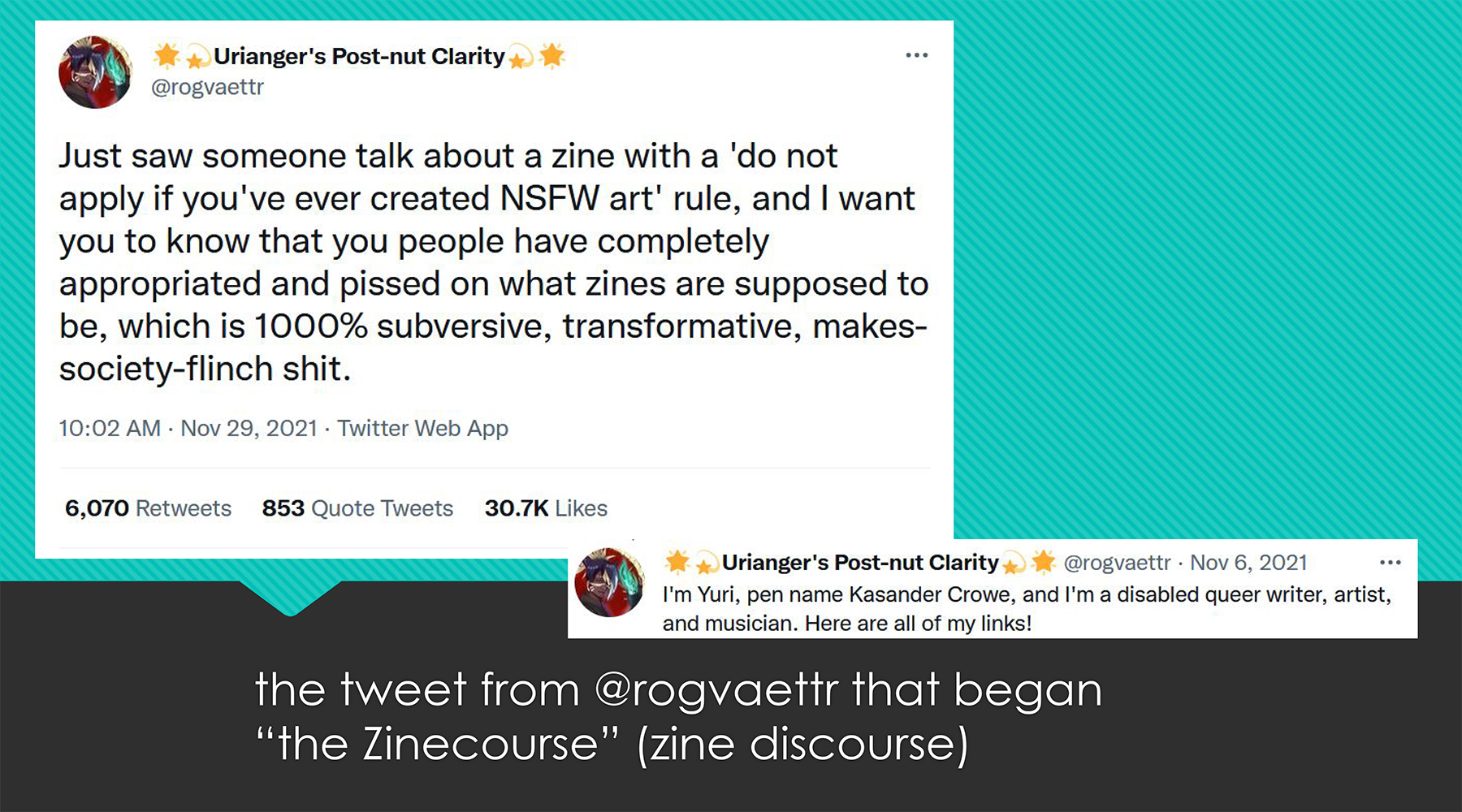
In December 2021, a conversation concerning the definition of the term “zine” unfolded on Twitter. This conversation arose from anxieties surrounding the recent rise of fandom zines that, while organized by amateur editors and limited in distribution, are nevertheless professionally printed and highly selective. Many comic artists lamented what they perceive as a betrayal of the DIY ethos of North American zine culture, while others have used quote tweets as a platform to remind their followers that anyone can make a zine.
Surprisingly absent from this conversation is an examination of the largely separate zine cultures that have developed in parallel at comic festivals and anime conventions. Many exhibitors at local indie comic festivals continue to produce artistic but relatively low-budget personal zines. Meanwhile, exhibitors in the artist alleys of anime conventions have gravitated toward professional production methods for fanzines and associated merchandise, often taking advantage of the services of manufacturers based in East Asia.
I argue that contemporary North American anime fanzine culture has its roots in Japanese dōjinshi, which are typically created by aspiring and early-career creative professionals and tend to be manufactured by specialty presses that guarantee a high level of production quality. Dōjinshi-style fanzines spread to North America during the early 2010s via anime conventions hosted in cities on the western seaboard, particularly Los Angeles, Seattle, and Vancouver. While tracing this transcultural development, I will reflect critically on the tension between DIY zine counterculture and big-budget fanzines and address how neoliberal values have affected public conversations on amateur artistic production.
. . . . . . . . . .
The “Comics Communities” event takes place on June 17, the Friday before the TCAF. You can find the schedule (here). The main exhibit floor of the TCAF is completely free and open to the public, but registration for the academic symposium is limited and already completely sold out. Which is very exciting! The symposium organizer is a fellow contributor at Women Write About Comics, and I hope to be able to publish my paper there soon so that it’s accessible to anyone who’s interested.
ETA: My essay is now available on Women Write About Comics (here).
While waiting for more news about the Breath of the Wild sequel, I started playing Dark Souls on my Nintendo Switch. I’m not into character customization, so my Chosen Undead is the basic male character. I named him Tulip. I am very bad at this game, and Tulip has been having a rough time of it. Yesterday evening, for example, Tulip fell down some stairs and died.
Tulip is currently spending a lot of time with someone called the Capra Demon. The Capra Demon infamously functions as a gatekeeper who blocks the player’s access to the majority of the game. It’s impossible to beat him without knowing exactly what you’re doing or getting help from real-life friends, and the game makes getting help difficult for reasons that are complicated to explain. Everything about this game is complicated to explain, so I hope you’ll forgive me if I leave it at “it’s just very hard to beat this boss.”
The Capra Demon exudes Pyramid Head energy in that he’s extremely fit, shirtless, and carrying two heavy meat-cleaver swords in such a way that his shoulders are pulled back, his chest is thrust forward, and the muscles of his arms are bulging. I made a stupid pastel-colored sketch of him and put it on Twitter, and I immediately lost five followers. I lost five more overnight.
When I say that I hate Pride Month – and sometimes I do hate Pride Month, kind of a lot – what I mean is that I hate the commodification of queer identity, and I hate how this commodification necessitates the sanitization of queer sexuality. Everyone is happy to see cute Disney animals dancing with hearts and rainbows, but nobody actually wants to see gay people being gay. And the Capra Demon is just about as gay as gay can be, which I think is charming and delightful.
I know the history of Pride Month, and I know why it’s important. Still, I wish people were able to accept difference not because it’s fun or attractive, but because… I don’t know, because it’s the right thing to do? Because we’re not animals? Because we’re capable of moral reasoning and extraordinary flexibility concerning what we’re able to accommodate into our worldview? And I just don’t feel that corporate rainbow merch and police-sponsored city pride parades are really helping people outside the community understand that being gay isn’t like Christmas, meaning that it isn’t a “special” thing that we collectively tolerate because it only happens once a year.
Like, being gay is being thirteen years old and playing Dark Souls because your friends are playing it, and then you get to this one boss, and you don’t know what’s going on but there’s just something about him, and the next thing you know you have your pants down and a wad of tissues in your hands, and then when you go to school the next day, maybe the way you talk about this video game character is a little weird, and your friends would never say that they’re homophobic, because of course they aren’t, but there’s just something about you that they don’t like, so they stop talking to you. You’ll make other friends as you find your community, but now you’ll have to live with the anxiety that there’s an element of who you are that a lot of people are always going to understand as being bad and wrong. Just like the Capra Demon is bad and wrong… but don’t his legs look fantastic in that cute little skirt?
I don’t really have a thing for the Capra Demon myself, to be honest, but as soon as I saw him I knew what was up. The Pride Month version of “this is for the gays” has become whatever sweet and wholesome child character is trending from whatever sweet and wholesome children’s cartoon is popular at the moment, but I don’t think that’s an accurate reflection of the reality of queer identity and sexuality. The Capra Demon is for the gays.
The Etsy Strike isn’t just about the platform increasing its fees for sellers, although that’s a wild move for the company to make after bringing in record profits for two years straight. Rather, it’s about how these fees are structured to hurt small businesses.
In essence, Etsy is forcing independent artists to operate according to the same business model and practices as Amazon. The most egregious instance of this is the platform’s insistence that we offer free tracked shipping.
Shipping costs rose steeply during the past two years. The pandemic also resulted in significant delays, and the new regulations regarding shipping packages to and from the UK haven’t helped. To ensure “customer satisfaction,” Etsy now penalizes sellers who don’t include tracking on every order, even if it’s just a single sticker. In addition, Etsy is aggressive about its policy of burying the listings of sellers who don’t offer free shipping.
What this means is that sellers are expected to absorb the rising costs of shipping. We are encouraged to purchase mailing labels through Etsy, which generally overcharges and also levies additional shipping fees on the seller. To give an example of what this looks like in practice, an artist would be expected to pay about $4 in order to mail a $3 vinyl sticker. This is exponentially worse when it comes to international shipping.
In other words, this protest isn’t about paying a few more dimes to Etsy for storefront rent. Rather, it’s about how Etsy is forcing small businesses to choose between losing money or raising their prices to levels that would substantially decrease sales. Artificially inflated prices also effectively shut out artists and crafters who don’t already have substantial online followings.
This is only one of many instances of how Etsy’s recent policies and fee structures hurt small businesses and independent artists. The situation is especially upsetting because it doesn’t have to be like this. Although Etsy was never without its flaws, the platform was relatively welcoming to part-time and amateur sellers, and this inclusive environment resulted in record-breaking profits for the company.
Unfortunately, this profit has led Etsy to consider licensing itself as a storefront for large international distributors such as AliExpress and Rakuten, who are already operating on the same scale as Amazon. This is especially unfortunate because Etsy forbids independent sellers from reselling professionally manufactured goods, thus creating a double standard that puts actual artists at a distinct disadvantage.
Etsy is a major platform for independent creators, especially as competition to table at in-person conventions is at an all-time high and platforms like Gumroad and Kickstarter are quickly losing their viability. Even if you doubt the efficacy of a grassroots strike against a giant multinational corporation, I think it’s still important to stand in solidarity with the artists, crafters, and other creators who are taking a stand against the entire online marketplace becoming like Amazon.
ETA: I want to acknowledge that it is in fact possible to send tracked first-class letters through Pitney Bowes, which has partnered with Etsy to offer tracked shipping directly through the seller interface.
That being said, there are two problems with using the Pitney Bowes letter tracking offered by Etsy, both of which have been well documented, even on Etsy’s own forums. The first is that this option is difficult for many sellers to access, and Etsy Support doesn’t help with troubleshooting. The second is that letters mailed via Pitney Bowes aren’t directly trackable via USPS (or via the Pitney Bowes site) and seem to have a higher instance of becoming lost, thus resulting in sellers having to refund orders.
The Reddit group for Etsy is constantly filled with variations on this second issue. One of the more common of these variations is that tracking never updates beyond “pre-transit,” making it seem as though the order was never mailed. Another common variation is that first-class letters aren’t actually tracked, with the “tracking” being more of a delivery estimate. This means that letters and packages are frequently marked as “delivered” even though they haven’t been. Because sellers are penalized for not responding to complaints within 24 hours, the easiest course of action is to apologize, refund the order, and hope that the buyer doesn’t leave feedback saying that there was a problem.
In addition, the Pitney Bowes labels are larger than regular first-class envelopes. More “professional” sellers therefore use stiff cardboard mailers even for first-class shipping, which is an additional expense, as is a label printer. What I wanted to argue is that sellers shouldn’t be penalized for simply using a stamp and an envelope to mail small paper goods, and that we weren’t penalized for this until very recently.
I understand that this may look different from the perspective of a store with thousands of sales and a smooth workflow, but my sympathies lie with artists and other creators who aren’t operating on a large scale and don’t yet have the experience (or personal connections within the community) to be able to understand things that are easy for more established sellers.
There are a lot of nuances to this argument that I simplified in order to provide an accessible summary for why so many smaller storefronts went on strike. The point I want to emphasize is that there’s no need for Etsy to be so hostile to amateurs.
This is my take on the viral Matt Bors comic. Though Bors is depicting a caricature of obnoxious reply guys on Twitter, a surprisingly large collection of random people on Tumblr actually said this to me recently in response to an offhand post that the world wouldn’t end any faster if I didn’t reply to work emails on Saturday evening. Their reasoning seemed to be that it was hypocritical of me to push back against the neoliberal demands of constant work from the “privileged” position of someone who actually has a job.
Since then, their comments have been living in my head rent-free. With this comic I hereby evict that unpleasantness and release it back into the wild.
As I drew this comic, however, I made a decision to limit the negativity I post on social media, which includes this very comic itself. To be honest, most of the experiences that have had a major impact on my life during the pandemic have been negative, but I’m not sure there’s any real use or meaning in representing them directly through autobiographical essays and comics. Instead, I’ve found much more satisfaction in constructing analogies through the medium of fiction.
In addition, I get the feeling that there are many people in the world (including the “yet you participate in society” commenters I encountered on Tumblr) who will aggressively seek out and latch onto negativity specifically in order to make bad-faith arguments about topics that could benefit from more nuance. Now that I’m at a stage of my life where I’ve started to work on more collaborative creative projects, I’d prefer to keep that sort of socially networked negativity out of my space.
Still, even though I do in fact have a job, I’m not wrong. Fuck capitalism.






 Digital Fantasy Diary