Misao

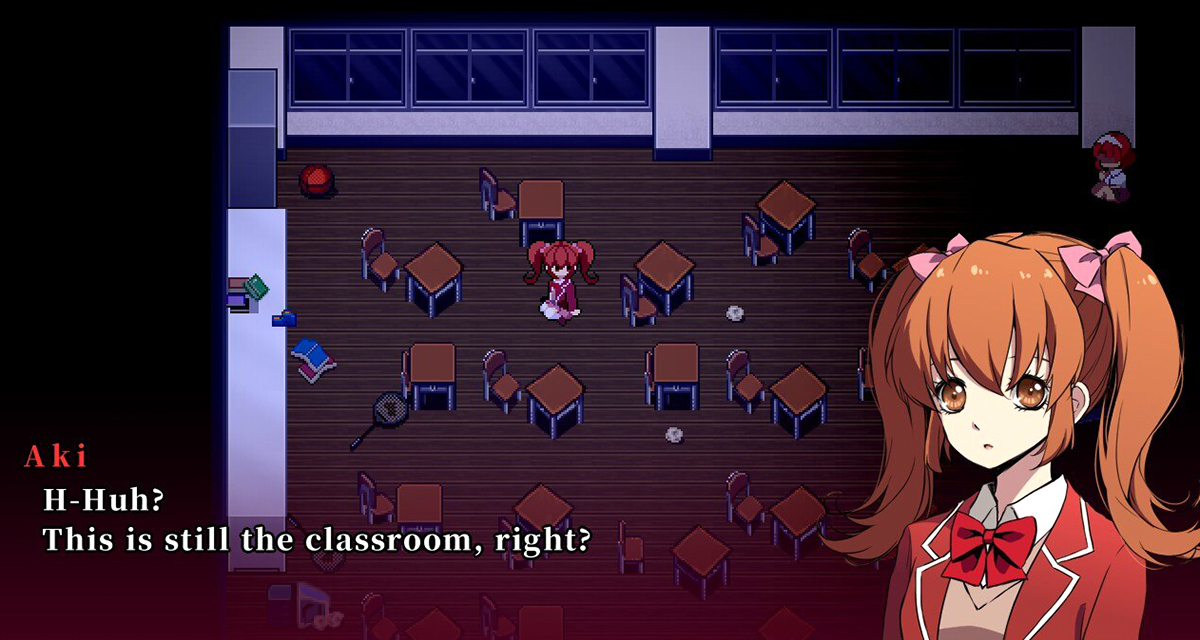
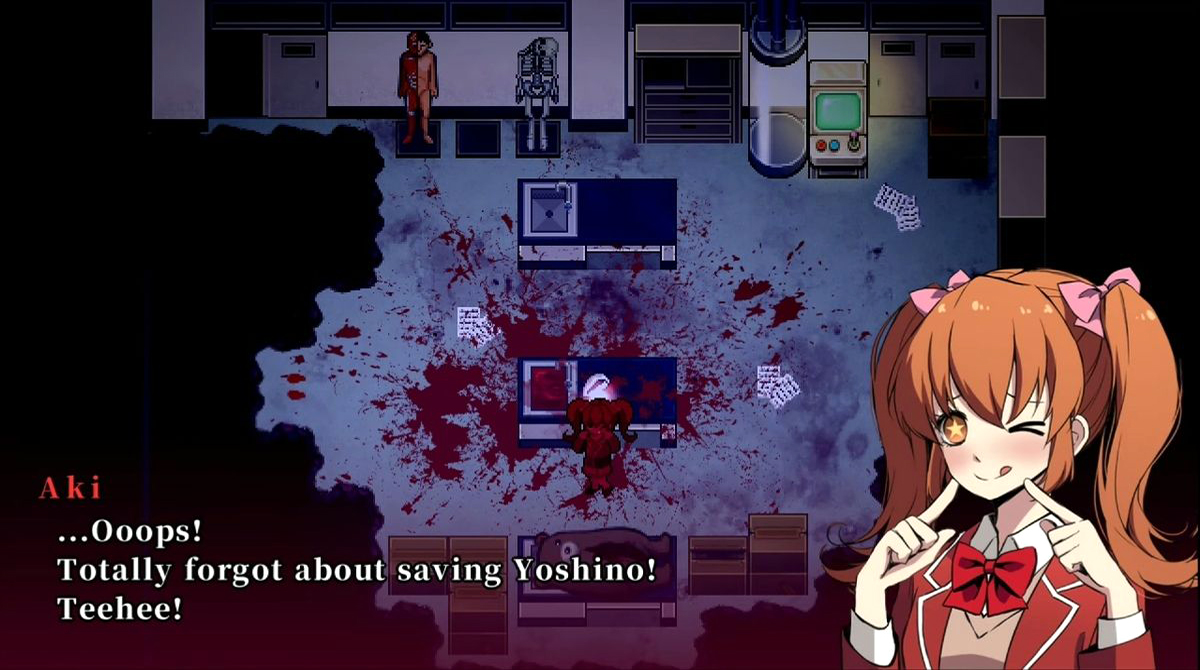
Misao is a short 16-bit indie survival horror game originally released in 2011 and then published on Steam (here) as a remastered edition in 2024. The game is set in a high school that’s been transported to a demonic realm by the vengeful spirit of the eponymous Misao, a beautiful but quiet girl who mysteriously disappeared three months prior to the opening of the story. 

You play as a girl (or optionally as a boy, in the HD version) named Aki who suddenly hears Misao’s voice in the middle of class, asking someone to “find me.” The classroom is cloaked in darkness, an earthquake hits, and the school begins to fall apart in the aftershocks. As Aki explores the mostly abandoned building, she learns that four of her classmates were bullying Misao with the compliance of their homeroom teacher. Despite the intensity of the bullying, Misao didn’t kill herself – but someone else did.

The gameplay consists of navigating the school while collecting six objects necessary to piece together Misao’s story. There’s no set order to acquiring these items, meaning that the game starts off as somewhat confounding but gradually comes to make more sense. Once you get your bearings, what you need to do becomes fairly self-evident, but a walkthrough is recommended for players (such as myself) who might find themselves overwhelmed at first. There are several excellent guides posted to Steam, but I recommend (this one) on account of its helpful division into sections.

Like Mad Father (reviewed here), which was also published by Miscreant’s Room, Misao is essentially a haunted house simulator in which your player-character can die in dozens of delightfully gruesome ways. Thanks to a handy quicksave function, there’s no penalty for dying, and the player is encouraged to get into all sorts of trouble for the sole purpose of seeing what will happen. Aside from two short chase sequences, very little skill is needed to survive, just a bit of trial and error.
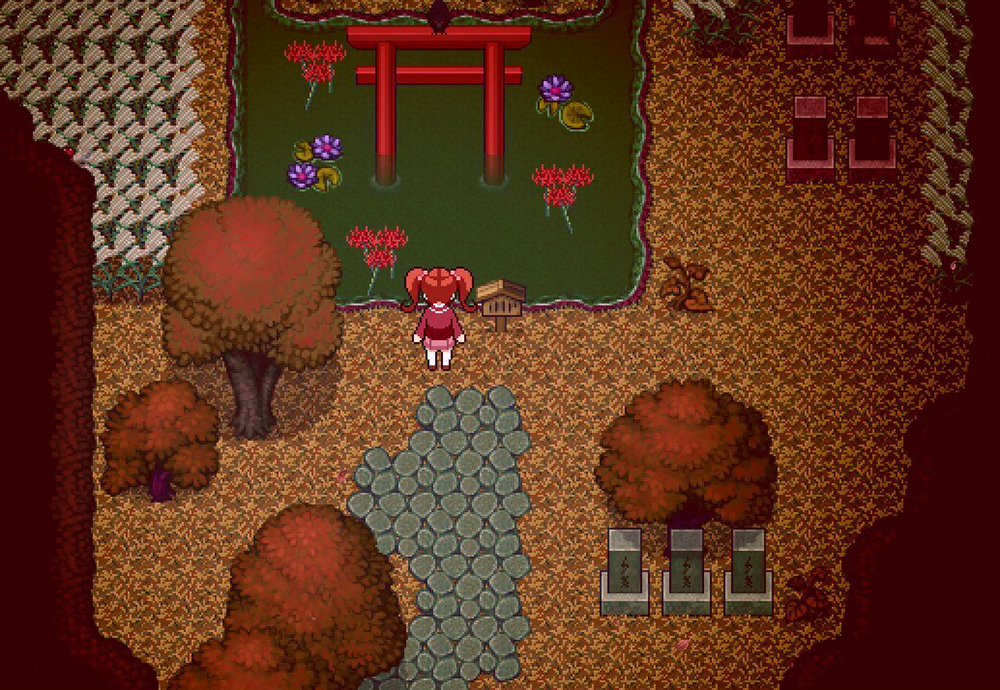
What I love about Misao is how much fun this game has with the tropes and imagery of a haunted high school. The laboratory is staffed by a mad scientist who has a chainsaw and will take advantage of any excuse to use it. The hamburgers in the cafeteria are made of unspeakable meat, and the seating area in front of the open kitchen is filthy with blood and entrails. The toilets haven’t been cleaned for a very long time, nor has the secret zombie cave under the school. The Shinto shrine in the courtyard is beautiful, but the rituals performed there are anything but.

Misao’s story mixes high school bullying and friendship drama with a mystery surrounding a twisted serial killer, and everyone gets exactly what they deserve. Still, for players who think high school kids shouldn’t be condemned to eternal damnation, Aki can rescue her classmates from their personal hells in a short epilogue. A few of the characters Aki encounters are native to the demon realm, and they’re all having the time of their lives. My favorite is the student librarian, who’s fully aware of the bloodshed surrounding her but just wants to make friends. She is a treasure.

If you’re not a completionist, Misao takes about two hours to finish, allowing the story to make an impact without testing the player’s patience through needless puzzles or gameplay challenges. The haunted high school setting is creatively rendered and a lot of fun to explore, even if the open-world structure is a bit overwhelming at the beginning.

The deaths are all creative and disturbing, but the retro graphics allow the game to feel campy instead of creepy, so much so that Misao sometimes feels more like a comedy than a horror story. I grew to feel a begrudging sort of affection for the characters, but I can’t deny that I had a huge smile on my face as I watched them get picked off – and really, good for Misao. I support her.
Dreamcore Limited

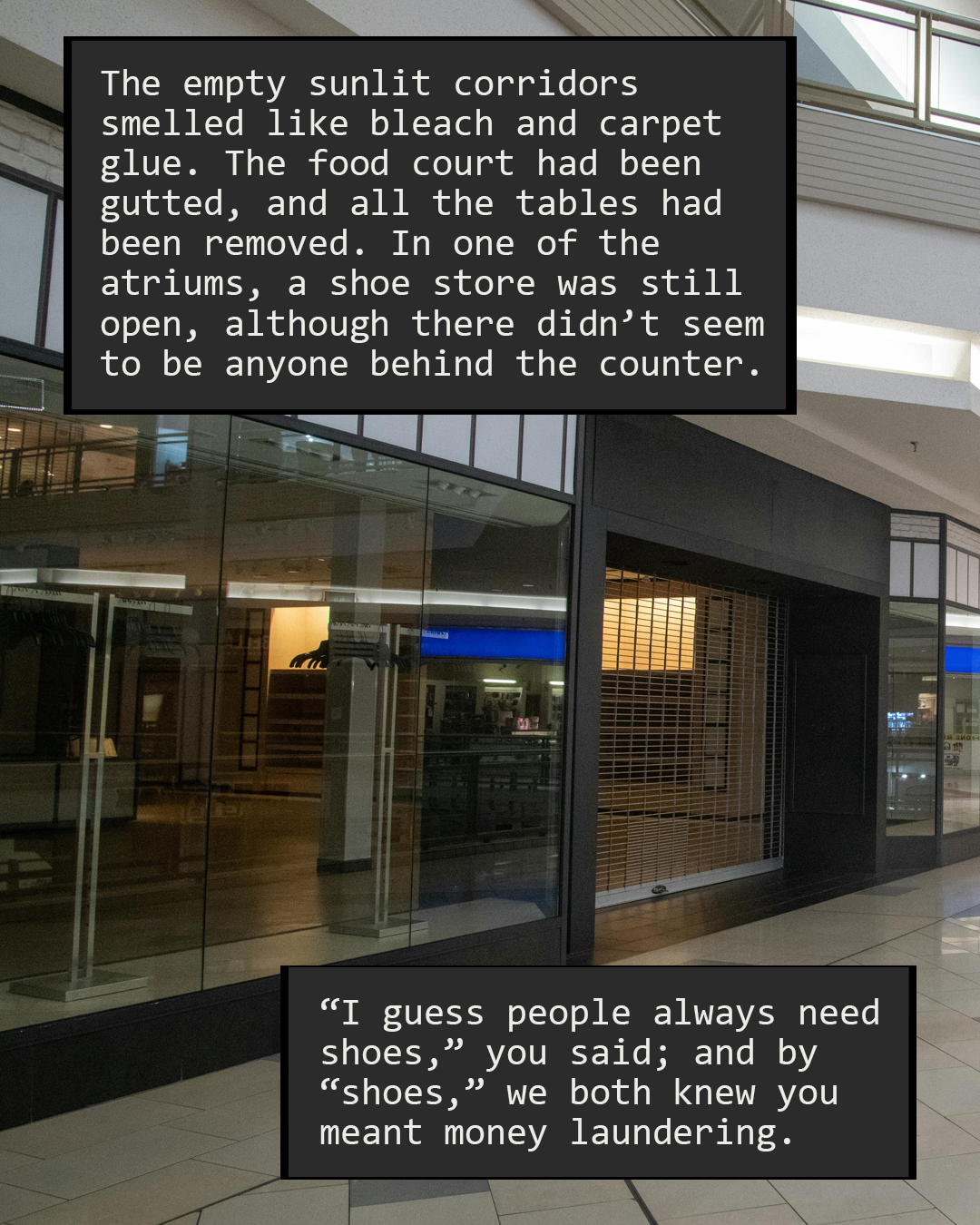
“Dreamcore Limited” was my submission to the Halloween flash fiction contest hosted by Bloodletter Magazine. This piece was selected as one of the three winners, and it was awarded a cover illustration by the horror artist Rialin Jose! You can read the stories and bask in the spookiness of their illustrations on Bloodletter’s account on Instagram (here).

The theme of this contest was “liminality,” and what better setting than a dead mall? Nostalgia is creepy, and the horror of dead malls is the uncanniness of feeling your history collapse into a marketing demographic that no longer fits.

I was inspired by Maria-Gemma Brown’s academic article “Ghost in the Mall: The Affective and Hauntological Potential of Dead Mall Ruins,” which is a fantastic piece of scholarship that’s interesting and accessible to a broad general audience. The article is open-access, and you can read it or download a PDF copy on the website of Capacious: Journal for Emerging Affect Inquiry (here).

Essay about Analog Nostalgia on Shelfdust

I’m honored to have published an essay on Shelfdust about the gentle anti-capitalist use of cultural nostalgia in the French graphic novel Onibi: Diary of a Yokai Ghost Hunter, which is an autobiographical account of a summer the artists spent in rural northern Japan. When I used this book as a course text in my “Japanese Ghost Stories” class last fall, I was surprised by the warmth of the students’ response, which I suspect is tied to the trend of “analog nostalgia” that seems to be big on social media at the moment. I’d always thought of nostalgia as a reactionary cultural movement, but I have to admit that Onibi presents a welcome challenge to this assumption.

Here’s an excerpt from the beginning of my essay:

Onibi demonstrates a fascination with retro objects and aesthetics, which are presented as a refuge from hustle and productivity. As concerns regarding pressing issues such as unemployment and climate change grow ever more pressing, so too do anxieties concerning the speed and waste demanded by capitalism. I believe that the recent fascination with retro and analog technologies is partially a response to these anxieties. Given that comics have emerged as an increasingly visible and viable space for public discourse, I’d like to take a look at how Brun and Pichard use analog nostalgia to translate local culture into an argument for a break with contemporary capitalism’s insistence on constant growth. 

You can read the full piece here:
https://shelfdust.com/2025/10/15/analog-nostalgia-and-gentle-degrowth-in-onibi-diary-of-a-yokai-ghost-hunter/

Strange Tales and Modern Legends

My zine Strange Tales and Modern Legends collects three illustrated short stories based on demonic Japanese folklore.

When I was an undergrad, I had the honor of taking a class called “Demonic Women in Japanese Fiction” with a professor I truly admire. This course was a foundational experience, and I ended up writing a lengthy senior thesis with the same title. The project served as an introduction to literary theory and feminist thought; but, more than anything, I really enjoyed stories about women behaving badly.

I taught my own “Demonic Women” class at the University of Pennsylvania for the first time in Spring 2024, and it was a resounding success. Everyone in this class was just as fascinated by the stories as I was, which was a minor miracle. In all fairness – demonic women are a lot of fun.

Though I teach and publish (and blog) about Japanese literature, and though I’ve spent a significant amount of time living in and around Tokyo, I generally don’t write original fiction set in Japan. Still, I love demonic folklore so much that I couldn’t help but be inspired by the literature in my “Demonic Women” class. I therefore put together a short zine that collects two previously published stories and one original piece of flash fiction, and I commissioned a coven of talented artists to create illustrations.

In the zine’s opening story, “The Smile of a Mountain Demon,” a 21st century yamauba entraps a YouTube influencer with Buddhist pretensions by using Airbnb and the language of New Age spirituality. The young man is looking for a scenic “spiritual retreat” to use as a source of content, and the yamauba is looking for a tasty snack. I was inspired by the medieval Adachigahara folktales in which a cunning yamauba entraps a less-than-devout Buddhist priest, as well as Minako Ohba’s beautiful and heartbreaking short story “The Smile of a Mountain Witch.”

The zine’s main story, “The Kumo Diary,” is set in the Meiji period, the era of Japan’s industrial revolution. As Japan established itself as a nation that could compete with Western powers, its intelligentsia were motivated to create a unified sense of “Japanese culture.” Scholars were therefore tasked with making The Tale of Genji a respectable classic to be held in esteem by a modern nation. While I was studying the history of The Tale of Genji, I couldn’t help but wonder about all the apocryphal chapters that never made it into the canonical version, and I created a few fragments of a medieval text to be discovered by a reader who dwells in the shadows cast by the light of modernity.

The final story, “Hanahaki,” is about a neglected cat who vows revenge on the small child that has monopolized his beloved human’s attention. The title comes from a trope in underground manga and fancomics of the late 2000s and early 2010s. In these stories, someone suffering from unrequited love painfully coughs up (haki) delicate flower petals (hana) in lieu of the words they can’t say. The cat in this story is unable to communicate in human language, but he still finds a way to make his displeasure clear. If nothing else, the child must go.

Strange Tales and Modern Legends explores themes that have fascinated me for years, specifically the intersections of folklore, feminism, and the unruly joy of problematic characters. I hope readers find these stories as delightfully unsettling as I did when I wrote them.

If you’re interested, you can order a paper copy of the zine from Etsy or download a free digital version from Itch.io.

👹 https://digitalterrarium.itch.io/strange-tales
👹 https://www.etsy.com/listing/4299187840/strange-tales-horror-fiction-zine

The art at the top of this post, which is one of the illustrations featured in the zine, was created by Le Soldat Mort, a dark fantasy artist who shares their work on Bluesky (here) and on Instagram (here).

The Sleeping Princess

There is a legend in Hyrule that a sleeping princess lies behind the door of a locked room deep under the ruins of the North Castle. When the princess rises, so too will the ancient powers sealed within her dreams. Impa knows the legend is true, and she fears the fate that will befall the kingdom should the first Zelda wake. Yet when a shadow rises on the borders of Hyrule after the birth of a new princess, Impa must make a terrible choice.

I had the honor of contributing a story called “The Sleeping Princess” to Blood Moon Rising: A Zelda Horror Zine. I was interested in exploring the background of Princess Zelda in the original 1986 game, and I thought it might be fun to see her story through the eyes of Impa, who knew about the undead princess who was the first of Zelda’s line. In other words, I’m connecting some of the more disturbing threads between The Legend of Zelda and Zelda II: The Adventure of Link.

“The Sleeping Princess” is a story about maternal love, political sacrifice, and the dark secrets hidden within the labyrinthine dungeons of Hyrule. I was strongly inspired by H.P. Lovecraft’s novel At the Mountains of Madness, which dwells in the geometric terror of monumental architecture built by strange hands, and I did my best to create a sense of ruined grandeur similar to that of Dark Souls and Ico: Castle in the Mist.

For the story’s illustrations, I had the incredible pleasure of working with the devilishly talented Pumpkinsouppe, whose dark arts brought this ruined world to life.

You can find “The Sleeping Princess” on AO3 here:
https://archiveofourown.org/works/62492182

Leftover sales of the zine are open until February 24 on BigCartel (here).

Vacant

Vacant
https://doublecrow.itch.io/vacant

Vacant is a free-to-play 2D narrative adventure game that takes about 35 minutes to finish. You play as a camerawoman named Elena who accompanies her friend Priya to a hotel that was abandoned shortly after it was built. Priya runs a ghost hunting video channel, and she wants to make it big by solving the mystery of the unexplained disappearances of Masthill Lodge.

Following a short hike through the woods, Elena and Priya enter the abandoned hotel, which has two floors and a basement. There’s a kitchen and a few staff rooms on the first floor, and the guestrooms are on the second floor. The space is large enough to be fun to explore but small enough to be manageable. All points of interaction are clearly marked, and there are no puzzles. The occasional dialogue choices are fun but don’t seem to affect the story, which is fairly linear.

After you poke around a bit, Elena and Priya have a heart-to-heart talk about why Priya makes these videos despite her firm belief that ghosts don’t exist. Her work is about the craft and the connection with her audience, she says, giving a perfectly reasonable explanation for why so many people enjoy ghost hunting videos.

Regardless, there’s something not quite right about Masthill Lodge. How did 54 people disappear here, exactly? And why has no information about any of them turned up in the ten years since?

The tension comes to a head when a man suddenly appears outside the lodge. “Don’t make a sound,” Priya says, and this is when the strength of the medium comes into play. As the player, you have to move forward, and your choices are limited for the worst possible reasons. I don’t generally get creeped out by horror games, but let me be honest – this one got me.

The writing in Vacant is excellent, and the characters are human and believable. The pixel graphics and sound design contribute to the subtly creepy atmosphere. The pacing is perfect, with a good balance of character drama, humor, mystery, and horror. The ending is fantastic.

There’s no way to save your progress, so you’ll need to sit down and play the whole story in one go. I didn’t mind, as the game is so well crafted that it’s easy to become immersed in the fiction. If you’re a fan of the character writing of Night in the Woods or the magical realism of The Magnus Archives, I’d definitely recommend checking out Vacant.

Best Horror Comics on How to Love Comics

I had the immense honor of being able to contribute to a list of “The 45 Best Horror Comics You Should Read” on the website How To Love Comics. Here’s how I pitched the eight titles I recommended…

Betwixt: A Manga Horror Anthology, edited by Fawn Lau and Mayuko Hirao
A diverse collection of big-name creators showcasing manga-style stories that focus on urban legends and folk horror.

Bloodborne: The Healing Thirst, by Ales Kot and Piotr Kowalski
A stand-alone story that captures the oppressive gothic atmosphere of Bloodborne while being accessible to readers with no knowledge of the game.

The Crossroads at Midnight, by Abby Howard
A single-artist collection of queer short stories with distinctive monochromatic art and intensely disturbing imagery. 

The Hills of Estrella Roja, by Ashley Robin Franklin
A lushly illustrated graphic novel about a college student on the hunt for cryptids in the beautiful but eerie Texas desert.

Loving, Ohio, by Matthew Erman and Sam Beck
A suburban gothic horror story about a small town quietly controlled by an all-too-realistic cult. 

Not Drunk Enough, by Tess Stone
A colorful and stylish horror comedy about being trapped in a mad science corporation after dark.

PTSD Radio, by Masaaki Nakayama
A quiet but intensely creepy collection of Japanese urban legends loosely connected by an overarching narrative.

The Shadow over Innsmouth, by Gou Tanabe
A painstakingly faithful Lovecraft adaptation with meticulously drafted art and a well-researched translation. 

You can check out the fully annotated list (here). There are a lot of famous heavy hitters on this list, and it was a pleasure to be able to include a few lesser-known manga and indie graphic novels.

A Legend of Shadows

When calamity besets his home in the desert, the young prince Ganondorf is forced to journey abroad to seek answers in Hyrule’s ancient sanctuaries. Lost within the shadows of a temple deep in the forest, Ganondorf struggles with a burden he does not yet have the power to bear.

I wrote “A Legend of Shadows” for Hyrule Apocrypha, an illustrated storybook fanzine exploring the myths and lore of the Legend of Zelda series. I consider myself extremely lucky to have been be able to create a story illustration with Peregyr, whose green and magical art can be found on Twitter (here) and on DeviantArt (here). We had a great time imagining Ganondorf’s backstory as a failed hero. This is how the story opens…

What would you do if you weren’t the hero? What if the chosen one were someone else entirely? Would you curse the gods and lament your fate? Would you turn tail and go home? Would you try your luck elsewhere, in a distant land where no one knew your name? Or would you simply lay down your sword and give up? Ganondorf was beginning to suspect that he was no hero, but he was nothing if not stubborn. Giving up was not a choice he was willing to make.

You can read the full story on AO3 (here), and you can check out more of the work featured in the zine on Twitter (here) and on Tumblr (here). Leftover sales, which include some lovely Zelda-themed merch, are now open (here).

Ms. Weaver’s Halloween Candy

I’m proud to see my story “Ms. Weaver’s Halloween Candy” in the newest issue of Suburban Witchcraft.

“Ms. Weaver’s Halloween Candy” is a magical realist suburban gothic fantasy about love, creativity, and the (human) sacrifices necessary to survive as an outsider in academia. The piece begins as a Stephen King style story about a kid on a bike investigating a local legend in a small college town, but it gradually unravels into a veiled reworking of the Ariadne myth as the protagonist learns that the ambitions of her mother extend far beyond the confines of her family.

Suburban Witchcraft Magazine is a gorgeous digital repository of weird writing with a literary bent, and each issue is free to read online. You can check out the issue with my story here:

📚 https://suburbanwitchcraft.com/issue6

Strange Things Happen in Philadelphia

Strange Things Happen in Philadelphia collects six short pieces of weird fiction about the past, present, and near future of a city where anything can happen. Philadelphia is simultaneously filled with decaying ruins and vibrant cultures, and I see the stories in this zine as a celebration of those of us surviving and thriving during the slow collapse of the American empire. Nothing in these stories is real, of course, but I’ve drawn them from a deep well of local folklore and hearsay.

To tell the truth, I don’t actually know that many people in Philadelphia. I lived here for most of grad school but then moved away to chase various academic jobs. I returned during the pandemic, which wasn’t a great time to meet new people or reconnect with old friends. I’ve tried to apply to local writing groups and workshops but haven’t gotten anywhere (yet).

Don’t get me wrong – I’m fortunate to enjoy the support of various writing communities online. Still, my personal experience of Philadelphia has been mediated by long solitary walks through parts of the city that have a lot of abandoned buildings, many of which have fallen to ruin.

One of these areas is my own neighborhood of Point Breeze, which is a lovely place to live but also filled with decrepit warehouses and other abandoned properties. I myself live next door to a derelict funeral home, and I’m constantly reading threads on various Philadelphia reddit boards about the struggles of homeowners whose townhouses adjoin similarly abandoned buildings.

It’s worth emphasizing that Philadelphia is densely populated. In fact, one of the reasons I love living here is that there are always people on the street at all times of the day and night. In a lot of ways, Philadelphia reminds me of Tokyo. It’s an affordable city with a lot of history, culture, and potential…

…but that’s not really what these stories are about. As I edited this zine, I realized that it’s pervaded by a sense of loneliness. Not an unpleasant loneliness, but rather the unique perspective afforded to a stranger. When you’re alone, you end up seeing things that perhaps other people might miss, and that sense of strangeness is what I wanted to capture in this collection.

I was fortunate to be able to work with Kaylee Rowena, an architectural wizard of the highest order, to create the art for the zine cover. The zine also features a spooky illustration of Mothman by an artist of the odd and surreal who goes by Gravemud on Tumblr, as well as a gorgeously aesthetic illustration of two elegant monsters by the brilliant and stylish Critter Crafter Ally. I’ve also included a half dozen of my own illustrations.

Unlike my previous short fiction zines, Strange Things Happen in Philadelphia is printed in full color, and I’d like to think it’s an attractive little book. If you’re interested, you can download a free digital copy from Itch.io or order a physical copy from Etsy.  

🌇 https://digitalterrarium.itch.io/strange-philly-zine
🌇 https://www.etsy.com/listing/1761448527/strange-philadelphia-fiction-zine