We Should Improve Society Somewhat

This is my take on the viral Matt Bors comic. Though Bors is depicting a caricature of obnoxious reply guys on Twitter, a surprisingly large collection of random people on Tumblr actually said this to me recently in response to an offhand post that the world wouldn’t end any faster if I didn’t reply to work emails on Saturday evening. Their reasoning seemed to be that it was hypocritical of me to push back against the neoliberal demands of constant work from the “privileged” position of someone who actually has a job.

Since then, their comments have been living in my head rent-free. With this comic I hereby evict that unpleasantness and release it back into the wild.

As I drew this comic, however, I made a decision to limit the negativity I post on social media, which includes this very comic itself. To be honest, most of the experiences that have had a major impact on my life during the pandemic have been negative, but I’m not sure there’s any real use or meaning in representing them directly through autobiographical essays and comics. Instead, I’ve found much more satisfaction in constructing analogies through the medium of fiction.

In addition, I get the feeling that there are many people in the world (including the “yet you participate in society” commenters I encountered on Tumblr) who will aggressively seek out and latch onto negativity specifically in order to make bad-faith arguments about topics that could benefit from more nuance. Now that I’m at a stage of my life where I’ve started to work on more collaborative creative projects, I’d prefer to keep that sort of socially networked negativity out of my space.

Still, even though I do in fact have a job, I’m not wrong. Fuck capitalism.

Political Art

I’m about as “indie” as someone can be, but I’ve had trouble finding a place in various indie creative communities during the past year. This is partially because I can’t meet or talk with anyone face to face, but I think it might also be because the sort of work I do isn’t considered to be political. I’m not punk enough, basically.

I don’t see my work as apolitical, though. For example, the full title of this illustration is:

“In higher education, you can’t ask for help because people will think you’re damaged, and you won’t receive help because no one wants to waste resources on the sort of person who has to ask for help. I tried to change the system from the inside by becoming a professor and being kind and supportive to my students and colleagues, and I was remarkably successful. In the end, however, I’m still the sort of person who needs to ask for help every once in a while, so I was denied tenure. The ideology of neoliberal capitalism has all but destroyed the values of higher education, and the pandemic has only exacerbated the damage. Because the problem is systemic, there’s very little any one individual can do, so here, have some plants. They represent diversity, but only in a superficial and visually pleasing way.”

This botanical study was inspired by the point-and-click game When the Past Was Around, which tells a story about burning out and rediscovering joy. Through its gameplay and visual design, the game encourages the player to nurture a more forgiving worldview and advocates for adjusting your goals to reflect your passions instead of your limitations. It’s a short game, but it really spoke to me.

A lot of people are very angry right now, and I understand that. I’m angry too, but I express it in my own way. To me, the opposite of neoliberalism isn’t “productive” anger, but rather “laziness” and an embrace of the sort of gentleness and beauty that exists for its own sake. I like video games precisely because they’re a “waste” of time. I like fan art because it’s “worthless” in creative economies, and I like plants because they exist in their own “imperfect” and “limited” ways without requiring “work” or “effort.”

In any case, aggressively ignoring the bourgeois dichotomy between high art and pop art feels very punk to me.

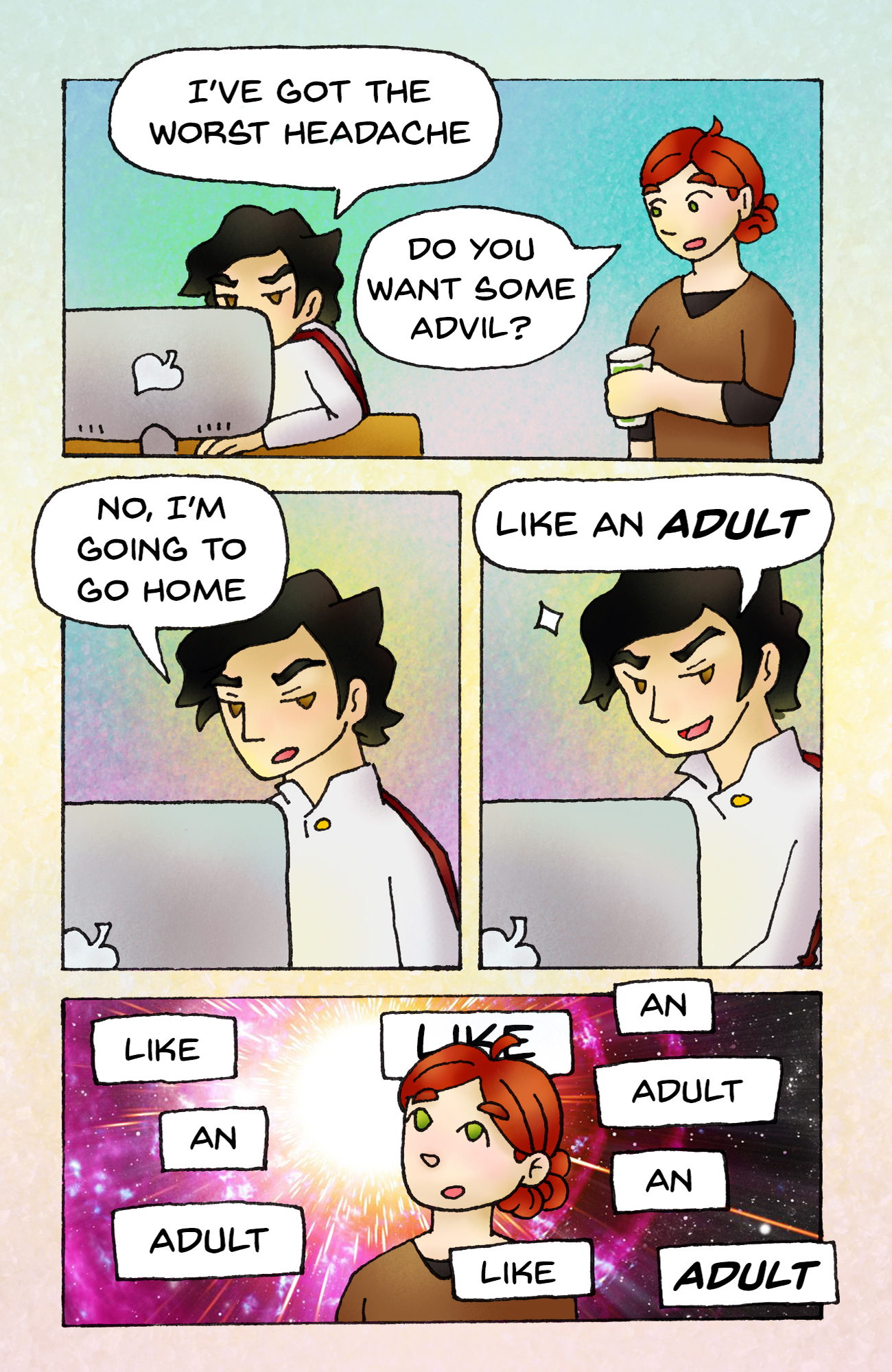
Like An Adult

A conversation with a friend reminded me that “self-care” means actually taking care of yourself at work. “Working through the pain” is sometimes necessary in special circumstances, but it shouldn’t be expected, and it definitely shouldn’t be the default.