Self Care

A modest proposal đź’– and a joke, of course!! Just a joke.

This was my submission to the 2025 edition of the anthology published by Philly Zine Fest, an event that gets cooler and livelier with each passing year. You can download a digital copy of the anthology from their website (here).

Essay about Analog Nostalgia on Shelfdust

I’m honored to have published an essay on Shelfdust about the gentle anti-capitalist use of cultural nostalgia in the French graphic novel Onibi: Diary of a Yokai Ghost Hunter, which is an autobiographical account of a summer the artists spent in rural northern Japan. When I used this book as a course text in my “Japanese Ghost Stories” class last fall, I was surprised by the warmth of the students’ response, which I suspect is tied to the trend of “analog nostalgia” that seems to be big on social media at the moment. I’d always thought of nostalgia as a reactionary cultural movement, but I have to admit that Onibi presents a welcome challenge to this assumption.

Here’s an excerpt from the beginning of my essay:

Onibi demonstrates a fascination with retro objects and aesthetics, which are presented as a refuge from hustle and productivity. As concerns regarding pressing issues such as unemployment and climate change grow ever more pressing, so too do anxieties concerning the speed and waste demanded by capitalism. I believe that the recent fascination with retro and analog technologies is partially a response to these anxieties. Given that comics have emerged as an increasingly visible and viable space for public discourse, I’d like to take a look at how Brun and Pichard use analog nostalgia to translate local culture into an argument for a break with contemporary capitalism’s insistence on constant growth. 

You can read the full piece here:
https://shelfdust.com/2025/10/15/analog-nostalgia-and-gentle-degrowth-in-onibi-diary-of-a-yokai-ghost-hunter/

Essay about Final Fantasy VII’s Anti-Capitalist Critique

I’m excited to say that my essay “Final Fantasy VII Confronts Capitalism: Tifa Lockhart vs. Medical Debt” is now on Sidequest (here)! 👊🌟

I recently read the official Final Fantasy VII Remake prequel novel, Traces of Two Pasts. I was fascinated by Tifa’s backstory, especially how she was driven to the starting point of the game by medical debt. I hadn’t come across a serious discussion of this book in fandom or elsewhere, so I wanted to write a short but accurate summary with substantial analysis. My goal was to situate the book’s anti-capitalist themes in the context of the game’s story, Japan’s economic recession in the 1990s, and our current hellworld.

Here’s an excerpt from my article…

Tifa is twenty years old at the beginning of Final Fantasy VII. Despite her youth, she’s calm and level-headed, yet Tifa willingly becomes a member of Avalanche, an armed militia that conducts terrorist attacks on Midgar’s power grid. Though she questions the use of violence, Tifa understands that aggressive action is necessary.

The juxtaposition between Tifa’s personality and her involvement in an active terrorist organization begs the question of how such a kind and gentle woman could become so politically radicalized. The question Kazushige Nojima asks in Traces of Two Pasts is much sharper: under the circumstances, how could she not? If you had to walk in Tifa’s shoes, wouldn’t you become radicalized too?

You can read the full piece on Sidequest here:
https://sidequest.zone/2025/06/02/final-fantasy-vii-confronts-capitalism/

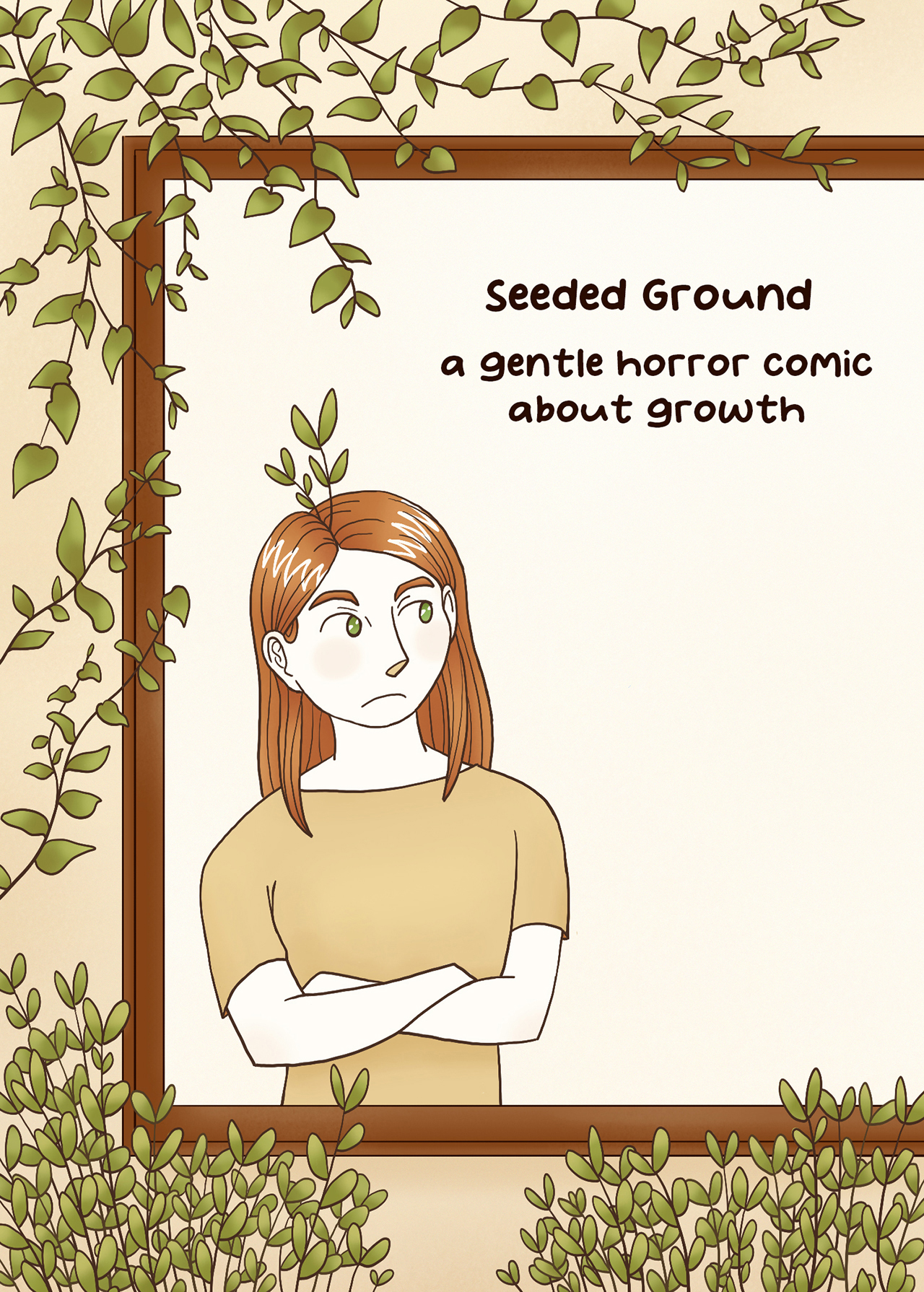
Seeded Ground

Seeded Ground is a twelve-page botanical horror comic about growth. It reads a bit like a supervillain origin story, but I created it as a statement of resistance against the oppressive ideologies of neoliberalism that have lured so many people in my generation into the trap of self-optimization.

You can download a free digital copy of the comic from Itch.io here:
https://digitalterrarium.itch.io/seeded-ground

I was inspired to draw this comic by a tweet written by a respected senior scholar. They argued that assigning at least five pages of writing every week is necessary to maintain “a certain standard of quality” in the undergraduate students who register for their classes.

This tweet inspired me to reflect on an unfortunate aspect of education in the United States. Namely, it’s an unstated but almost universally accepted goal of the formal education system to monopolize students’ time in order to train them to become the sort of adult workers who are willing to devote their lives to their career. An employee at a “good” job is expected to wake up early, commute, spend the entire day at work, and then go home and finish the tasks they didn’t have time to complete at the office. Meanwhile, freelance and part-time workers are expected to be available at any hour of the day, every day of the week, and at short notice. This is messed up, and I hate it.

My own experience as a professional working adult has essentially been the equivalent of that professor’s tweet. Namely, I’ve felt compelled to engage in meaningless work that no one will ever see in order to maintain the pretense of “a certain standard of quality.” Around the time of the pandemic, I got fed up. Was I really supposed to feel guilty about not replying to emails within 24 hours while I was sick with Covid? Fuck that.

These days I’m much more aggressive about enforcing boundaries concerning how much work I’m willing to do, and I can’t even begin to express how much the quality of my life has improved. I have no regrets.

As an epilogue to Seeded Ground, I illustrated a quote from the radical social theorist Herbert Marcuse’s 1964 book One-Dimensional Man: Studies in the Ideology of Advanced Industrial Society:

“If the individual were no longer compelled to prove himself on the market, as a free economic subject, the disappearance of this compulsion would be one of the greatest achievements of civilization.”

And he’s not wrong! I know it’s a twee Millennial stereotype to hate capitalism, but I really do believe that the point of life is not to optimize your performance as an employee. People need room to grow.

And if that growth is impeded? All sorts of bad things can happen. 🌿

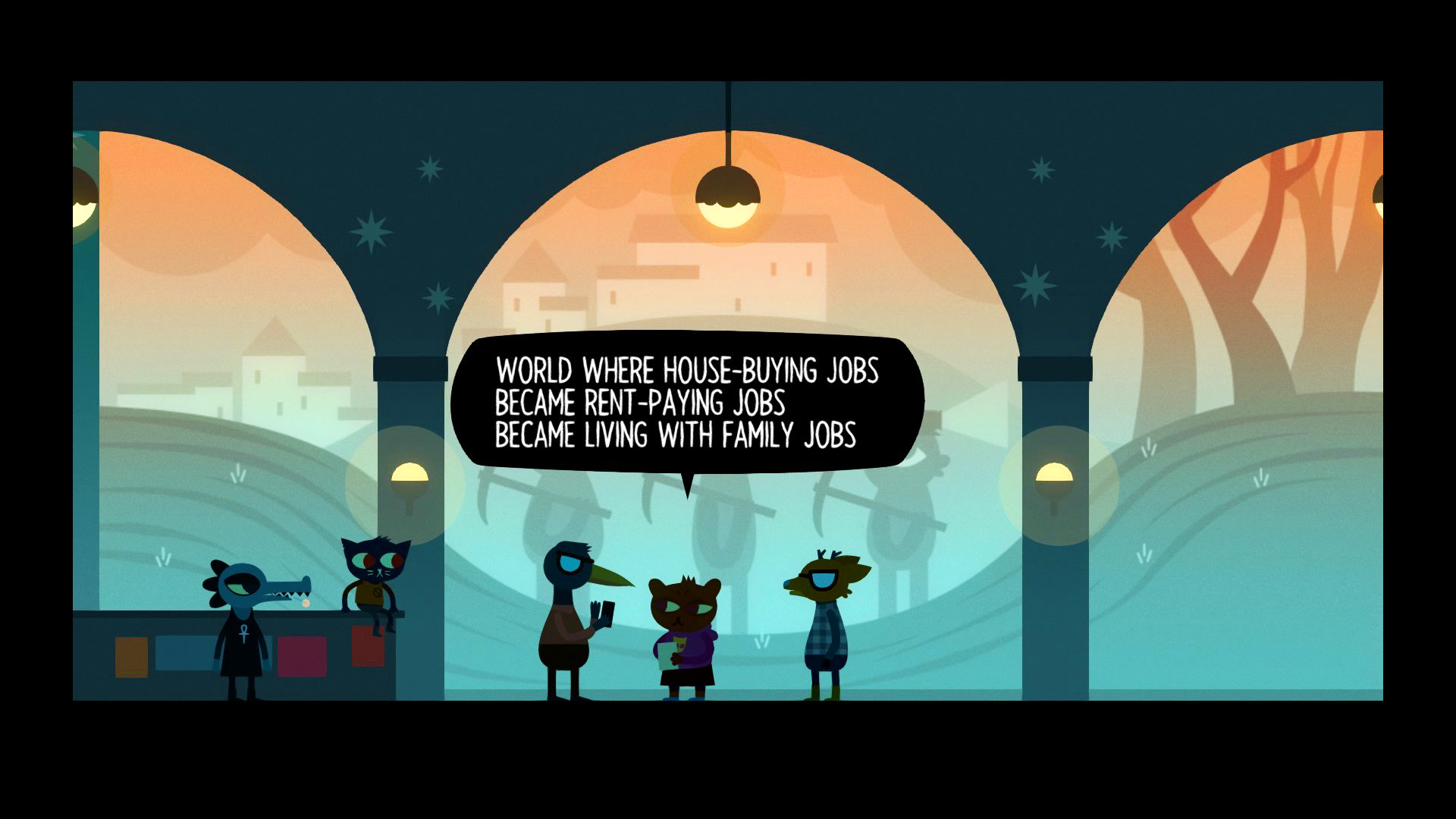
Cosmic Horror and the Ruins of Capitalism in Night in the Woods

I maintained my sanity during the pandemic by spending time outdoors in abandoned places. Some of these places exist in the real world, but most were virtual. One of my favorite haunts has been Possum Springs, a depopulated town in western Pennsylvania that serves the setting of the 2017 story exploration game Night in the Woods.

In Night in the Woods, you play as Mae, an anthropomorphic cat who has dropped out of college and moved back to Possum Springs to live with her parents. With no job and nothing better to do, Mae decides to investigate the disappearance of several local children. It turns out that there is a monster living in the abandoned mine tunnels under Possum Springs, and a cult of town residents has been feeding young people to this creature in return for a promise that it will prevent the town’s economic decline. When Mae and her friends catch the cult in the act of sacrificing one of its own members, its leader tells the group of teenagers that these rituals aren’t easy for them, especially now that they’re getting older. It’s time for a new generation to take over and ensure the prosperity of Possum Springs, however modest this prosperity might be.

Mae and her friends don’t join the death cult, of course. They escape from the monster, and the mine tunnels collapse and trap the remaining cult members underground. At the end of the game, Mae reflects that what she’s taken away from this experience is the conviction that, if there is no benevolent higher power in a hostile universe, then she and her friends will have to help each other while doing the best they can for themselves and their community.

The elements of cosmic horror in Night in the Woods are genuinely creepy, especially during Mae’s interactive nightmare sequences, but the purpose of the cult is to serve as a thematic juxtaposition to the true terror of Possum Springs, a large and impersonal set of interlocking systems that collectively exploit hardworking but vulnerable people – namely, capitalism.

Mae’s parents are afraid of losing their house to the bank because of an usurious mortgage they took out to finance Mae’s college tuition, and entire neighborhoods in Possum Springs are filled with repossessed, unsold, and subsequently abandoned buildings. The pastor of the local church wants to open a shelter for the newly homeless and the railroad drifters who camp out in the forest next to town, but she fails to obtain a permit from the city council due to concerns that lowering the property values in the neighborhood will fatally disrupt an already struggling real estate market.

The horror of an absurd and uncaring universe in Night in the Woods has very little to do with the unfathomable monster lurking in the mine tunnels, although the cult of older people who sacrifice members of younger generations for the vague promise of being able to sustain an imagined standard of living comes uncomfortably close to allegory in the wake of the 2016 American presidential election. Forces beyond our control and comprehension are indeed destroying individual lives and modestly thriving communities, but these forces are nothing as quaint as a stygian tentacle beast that eats children.

According to Scott Benson, the lead writer and artist of Night in the Woods, Possum Springs is located in western Pennsylvania just outside of Pittsburgh. This situates the town in the Rust Belt, an economically depressed region stretching around the Great Lakes from Buffalo to Detroit. The cities in the Rust Belt were centers of American manufacturing until the 1980s, when international free trade agreements incentivized companies in sectors like natural resource extraction and the automotive industry to outsource materials and labor. Formerly bustling mines and factories closed, resulting in a dramatic decline in population that in turn resulted in the bankruptcy of many smaller businesses.

It’s currently possible to accrue a sizeable following on social media by posting urban exploration photos of shuttered factories and other ghostly relics of infrastructure, such as empty schools, hospitals, movie theaters, and shopping malls. There’s a certain poetic charm in high-contrast photos of healthy green weeds stretching up through the cracks of ash-gray concrete and leafy vines twining around rusted iron support pillars. Images of the remains of modern civilization devoid of human presence provide fertile ground for the imagination to run wild.

Night in the Woods denies its players the solitary pleasures of urban exploration, however. As a dialog-driven game, its story can’t be advanced unless the player participates in conversations with various people around Possum Springs. As the you learn more about the town, you begin to understand the problems experienced by its inhabitants, which range from poverty to alcoholism to severe depression. At the same time, you come to appreciate the people who care about each other and want to do right by their community even despite the financial and emotional burdens they carry.

Night in the Woods suggests that the fractures in the community cannot be repaired by any given individual action, like “going to college” or “owning a home.” Rather, the problem lies in the larger economic forces that steamroller over working-class people in small towns. None of the characters Mae interacts with are stupid or unaware of what’s happening, but most of them don’t have the agency to make any real choices about their lives.

Night in the Woods features a number of optional sidequests that tell an ongoing story about the historical tension between the former mine owners and the labor unions in Possum Springs, and it’s clear that the working conditions for miners were deplorable. The mines closed at least a decade before the story begins, but the labor of the workers in Possum Springs is still exploited. Mae’s father, who was laid off from his job at a small factory, now works at a large supermarket by the highway that forced the local grocery store in Possum Springs to be shut down. At the end of the game, Mae’s father considers starting a labor union at his workplace, which pulls money out of the local economy without benefiting the town or its people.

The game’s presentation of unions isn’t entirely positive, however. As Mae’s friend Bea explains, the unions are male-dominated, and homosocial labor solidarity lends itself to an atmosphere in which overt sexual harassment is swept under the rug. Mae’s friend Selmers, who started writing poetry for the rehab program she entered after becoming addicted to pain pills while working at the local pharmacy, performs a reading of an incredible piece about how even unionized jobs are becoming unsustainable in the face of global capitalism.

Night in the Woods is ultimately about accepting uncomfortable realities while moving forward and finding friendship and community in difficult times and circumstances. The game isn’t just a protest against the violence of the global neoliberal capitalism that destroys local economies; it’s a model of resistance on a small and personal scale, as well as an argument for the quiet beauty of allowing outdated structures to fall gently to ruin.

Small town life isn’t for everyone, but neither is building a community from scratch in a big city. If nothing else, it’s good to have choices. The gameplay of Night in the Woods is centered around making choices, and the choice Mae and her friends make is to bury the monster in the mine, sacrificing short-term gains for long-term stability.

Although Night in the Woods is set in the days leading to and following Halloween, its advocacy for regrowth and positive change is a welcome message as society gradually begins to recover from the effects of the pandemic. If nothing else, Possum Springs is a great place to find surreal and spooky chills, and Mae’s homecoming is a crash course on how to make conversation with other people in real-world places that will be hopefully be not so abandoned in the future.

. . . . . . . . . . . . . . .

This essay was originally published on May 18, 2021 in Entropy, a digital magazine about the fringes of art and culture. Entropy closed its website in late 2022, and I am reproducing this publication with the kind permission of the editors.

The Life-Changing Magic of Just Letting Things Break

Solarpunk Is Not About Pretty Aesthetics. It’s About the End of Capitalism.
https://www.vice.com/en/article/wx5aym/solarpunk-is-not-about-pretty-aesthetics-its-about-the-end-of-capitalism

Many solarpunks agree that the “punk” element becomes clear when they go past the movement’s visuals and into the nitty gritty. Solarpunk is radical in that it imagines a society where people and the planet are prioritized over the individual and profit. Of course utopian visions of the future aren’t new and art and technology have long drawn from nature: Just take the example of Belgian architect Luc Schuiten, whose drawings and buildings often employ biomimicry, where the form and function of organic elements influence design. The movement gained traction in progressive circles on early 2010s Tumblr, but as its popularity has bloomed over the past 10 years, early Solarpunks fear capitalist co-option. Flynn calls it “fake Solarpunk urbanism,” luxury condos with a green roof that price out existing communities and might end up doing more environmental damage.

This is a lengthy article with a lot of interesting links, and it’s worth checking out solely for the beautiful embedded video.

I think the emphasis on “radical action” might be somewhat misguided, though. My concern, as always, is the way anti-capitalist movements are embedded within the language of capitalism. Like, we have to be active! And go out and do things! And harness our energy as our best and most productive selves! I think this neoliberal emphasis on individual agency and power strays a bit too far into the territory of ecofacism, which holds that people who don’t have the skills or resources to survive environmental catastrophe deserve to die.

For me, the appeal of solarpunk is that you don’t have to do shit. You don’t have to work. You don’t have to make money. You don’t have to buy things. You don’t have to participate in “community improvement” projects. Instead, leave your job early and turn off your phone. Stay at home and chill out. Sit out on your porch and have a drink with your neighbors. Grass and flowers will grow in the cracks of the concrete without your help. All you have to do is literally nothing.

One of the reasons I enjoy living in Philadelphia is that it’s a very compact but very green city. The great thing is that it’s not green because of city planning or district gardening budgets, but rather the exact opposite. The city just lets plants grow, and nobody who lives here does anything to stop them. The Amish set up farmer’s markets on the weekends, and nobody bothers them. People sell fresh fruits and vegetables out of the backs of U-Haul trucks in parking lots on the weekdays, and nobody cares. Nobody chases away the urban outdoorspeople who plant gardens in the larger public parks. The city is covered in folk art, from Isaiah Zagar’s broken glass murals to the work of street artists whose tags are elaborate illustrations of Studio Ghibli characters. This aesthetic exists because nobody “did” anything to “fix” it, and it makes Philadelphia a comfortable and interesting place to live.

At the same time, a cleaner and more carefully managed solarpunk aesthetic would make much more sense for a place like New York, where “just letting things break” would result in most of Manhattan Island flooding in less than 48 hours. The sea level is rising, and I assume that the flooding is going to happen eventually, but that doesn’t mean you can’t have stylish vertical gardens while the city is still above water. People have to eat, and people have to live somewhere, so your rent might as well pay for community deck gardens and solar panels.

Opossum Country

Opossum Country by Ben Jelter
https://benjelter.itch.io/opossum-country

Opossum Country is a free ten-minute lo-fi horror game about a rural pizza delivery driver who finds himself stranded in an isolated trailer park where something isn’t quite right. If you’re worried that the game is poking fun at the sort of low-income and mentally unbalanced of people who might live in a trailer park, there’s definitely an element of that, but the story goes in a direction that I wasn’t expecting. In the end, the moral of Opossum Country is that you shouldn’t jump to conclusions about a community you don’t understand. I mean, if the game can be said to have a moral. Which it arguably doesn’t. Regardless, the ending is fantastic.

Ben Jelter also made another free ten-minute Game Boy game called The Last Employee, which definitely has a moral: fuck capitalism. This being the case, I’m guessing that Opossum Country was created from a place of deep sympathy for people on the margins of society. This narrative viewpoint is refreshing in its unapologetic portrayal of difference, but Jelter’s sympathy for these characters doesn’t stop the game from being creepy as fuck. The overworld pixel graphics are creative and unsettling, as are the more detailed character portraits.

Opossum Country was made with a program called GB Studio. Not only is it free, but there are also a ton of pay-what-you-want graphics asset packs floating around Itchio, as well as collections of free-to-use chiptunes music that’s compatible with the Game Boy engine. I also found a few pixel art resources for Clip Studio Paint in the form of brushes, templates, and filters. I’m not sure that “just anyone” can make a game as unique and interesting as Opossum Country, but it’s nice to know that there’s nothing stopping you from trying.

Plant Space

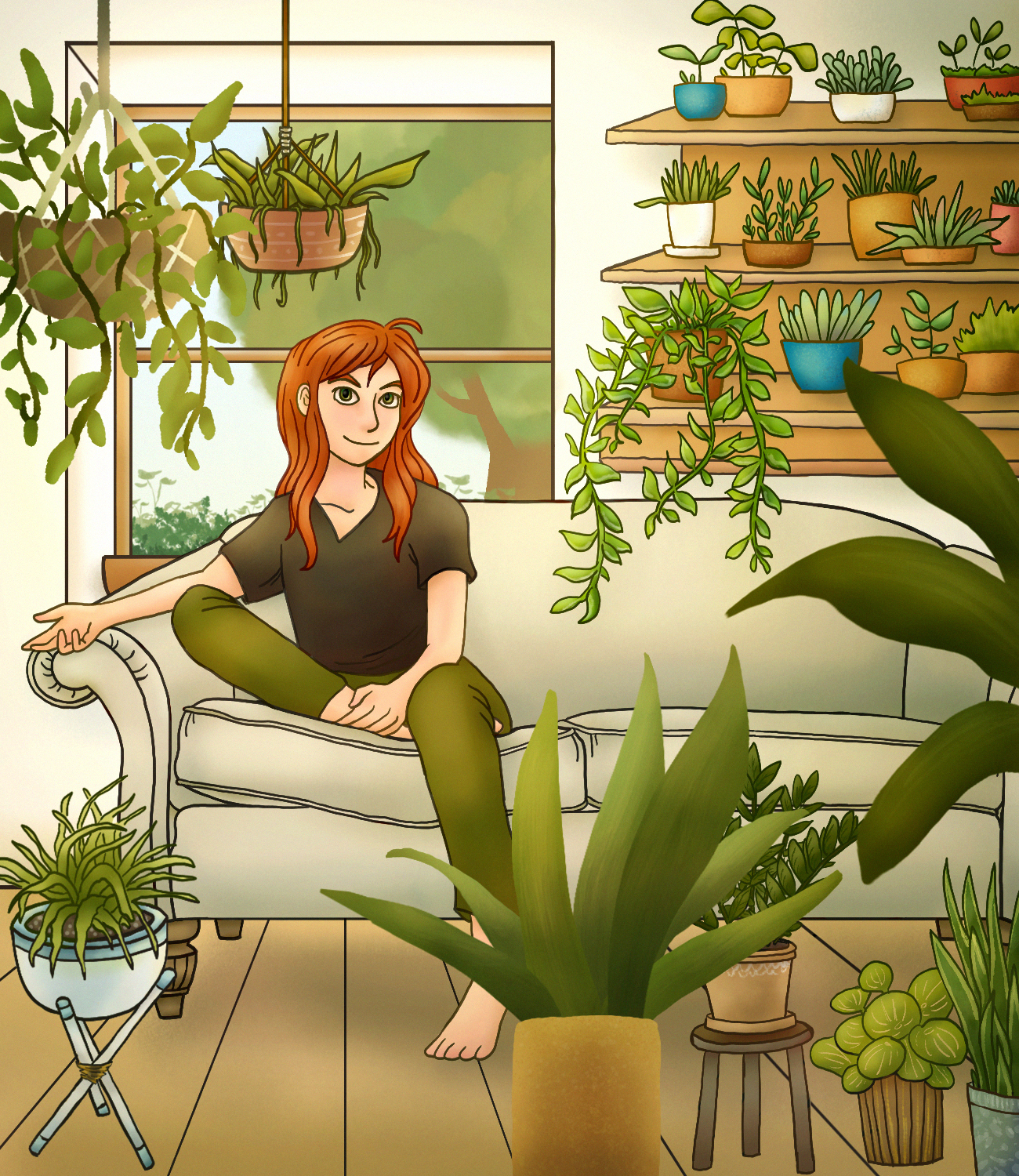
No one in this house is “productive.” 🌿

Inspired by my annual reading of Sarah Ahmed, I drew this as a reminder to myself that there’s room for stillness and silence in the ongoing resistance against systems that seek to exploit our energy and labor. It ended up becoming an unintentional self-portrait. I was thinking, “What sort of person would live in a house like this,” and then I realized, “Oh right, I do.”

A lot of my plants have been all across the United States as I moved from apartment to apartment while chasing jobs in a market that depends on people like me, by which I mean young(ish) people who are willing to cut their connections and uproot their entire lives in order to have a small chance at getting their foot in the door of an unnecessarily competitive industry. Academia especially is built on exploited and largely uncompensated labor, and there’s so much survivor bias that not even the people who have experienced and suffered from this precarity acknowledge how harmful it is to everyone involved.

It’s wild how the vast majority of critiques of capitalism are contained within the logic of capitalism. Capitalism is all about doing things and being productive; and, in exactly the same way, most critiques of capitalism are about doing things and being productive. To give a classic example, Marx says that workers need to utilize the “muscle power” and “vital force” that have been harnessed by capitalism and redirect their energy and labor to overthrow the system. I would argue that not doing things and not being productive is an equally valid means of resisting capitalism. Sarah Ahmed, who has just as fraught of a relationship with academia as I do, has argued the same thing: Don’t allow yourself to become a tool in the hands of people who are intent on breaking you.

After being destroyed by a “dream job” that I almost had to kill myself to stay on top of, I made a firm decision to take it easy and chill out for a bit. Part of this decision is deprogramming my instinct to be “productive,” but a lot of it is simply taking the time to be quiet and listen while creating the space to appreciate the sort of time-consuming writing, scholarship, and art that’s been marginalized and pushed aside by the constant demand for new content. Like my plants, I’m going to sit still and soak in the sun.

………also, I needed an “author photo” for my summer project, a zine about Gothic botanical horror. 💀🌱

Solidarity with the Etsy Strike

The Etsy Strike isn’t just about the platform increasing its fees for sellers, although that’s a wild move for the company to make after bringing in record profits for two years straight. Rather, it’s about how these fees are structured to hurt small businesses.

In essence, Etsy is forcing independent artists to operate according to the same business model and practices as Amazon. The most egregious instance of this is the platform’s insistence that we offer free tracked shipping.

Shipping costs rose steeply during the past two years. The pandemic also resulted in significant delays, and the new regulations regarding shipping packages to and from the UK haven’t helped. To ensure â€ścustomer satisfaction,” Etsy now penalizes sellers who don’t include tracking on every order, even if it’s just a single sticker. In addition, Etsy is aggressive about its policy of burying the listings of sellers who don’t offer free shipping.

What this means is that sellers are expected to absorb the rising costs of shipping. We are encouraged to purchase mailing labels through Etsy, which generally overcharges and also levies additional shipping fees on the seller. To give an example of what this looks like in practice, an artist would be expected to pay about $4 in order to mail a $3 vinyl sticker. This is exponentially worse when it comes to international shipping.

In other words, this protest isn’t about paying a few more dimes to Etsy for storefront rent. Rather, it’s about how Etsy is forcing small businesses to choose between losing money or raising their prices to levels that would substantially decrease sales. Artificially inflated prices also effectively shut out artists and crafters who don’t already have substantial online followings.  

This is only one of many instances of how Etsy’s recent policies and fee structures hurt small businesses and independent artists. The situation is especially upsetting because it doesn’t have to be like this. Although Etsy was never without its flaws, the platform was relatively welcoming to part-time and amateur sellers, and this inclusive environment resulted in record-breaking profits for the company.

Unfortunately, this profit has led Etsy to consider licensing itself as a storefront for large international distributors such as AliExpress and Rakuten, who are already operating on the same scale as Amazon. This is especially unfortunate because Etsy forbids independent sellers from reselling professionally manufactured goods, thus creating a double standard that puts actual artists at a distinct disadvantage.

Etsy is a major platform for independent creators, especially as competition to table at in-person conventions is at an all-time high and platforms like Gumroad and Kickstarter are quickly losing their viability. Even if you doubt the efficacy of a grassroots strike against a giant multinational corporation, I think it’s still important to stand in solidarity with the artists, crafters, and other creators who are taking a stand against the entire online marketplace becoming like Amazon.

You can learn more about the strike here:
https://etsystrike.org/

You can read and join the strike’s Reddit group here:
https://www.reddit.com/r/EtsyStrike/

You can sign a petition to Etsy here:
https://www.coworker.org/petitions/cancel-the-fee-increase-work-with-sellers-not-against-us

ETA: I want to acknowledge that it is in fact possible to send tracked first-class letters through Pitney Bowes, which has partnered with Etsy to offer tracked shipping directly through the seller interface.

That being said, there are two problems with using the Pitney Bowes letter tracking offered by Etsy, both of which have been well documented, even on Etsy’s own forums. The first is that this option is difficult for many sellers to access, and Etsy Support doesn’t help with troubleshooting. The second is that letters mailed via Pitney Bowes aren’t directly trackable via USPS (or via the Pitney Bowes site) and seem to have a higher instance of becoming lost, thus resulting in sellers having to refund orders.

The Reddit group for Etsy is constantly filled with variations on this second issue. One of the more common of these variations is that tracking never updates beyond “pre-transit,” making it seem as though the order was never mailed. Another common variation is that first-class letters aren’t actually tracked, with the “tracking” being more of a delivery estimate. This means that letters and packages are frequently marked as “delivered” even though they haven’t been. Because sellers are penalized for not responding to complaints within 24 hours, the easiest course of action is to apologize, refund the order, and hope that the buyer doesn’t leave feedback saying that there was a problem.

In addition, the Pitney Bowes labels are larger than regular first-class envelopes. More “professional” sellers therefore use stiff cardboard mailers even for first-class shipping, which is an additional expense, as is a label printer. What I wanted to argue is that sellers shouldn’t be penalized for simply using a stamp and an envelope to mail small paper goods, and that we weren’t penalized for this until very recently.

I understand that this may look different from the perspective of a store with thousands of sales and a smooth workflow, but my sympathies lie with artists and other creators who aren’t operating on a large scale and don’t yet have the experience (or personal connections within the community) to be able to understand things that are easy for more established sellers.

There are a lot of nuances to this argument that I simplified in order to provide an accessible summary for why so many smaller storefronts went on strike. The point I want to emphasize is that there’s no need for Etsy to be so hostile to amateurs.

Turnip Boy Commits Tax Evasion

Turnip Boy Commits Tax Evasion is a 16-bit Zelda-style adventure game with cute graphics and meme-heavy writing that takes about two and a half hours to play from start to finish with 100% completion.

Along with a bright and colorful overworld, Turnip Boy Commits Tax Evasion features three formal inside dungeons and two less formal outside dungeons, as well as the usual variety of “go fetch me this thing” sidequests. The game is meant to be accessible to a diversity of players but still presents a range of entertaining challenges. The gameplay isn’t engineered for precision mechanics, which makes the boss fights somewhat more difficult than they perhaps need to be, but you can turn on “god mode” at any time from the menu. Around the middle of the game, Turnip Boy discovers a device that generates portals, and this tool enables are some fun puzzles involving getting bombs and blocks to where they need to be on the map in order to move forward.

Your main goal, as Turnip Boy, is to destroy every single piece of horrible paper you get your (non-existent) hands on. Tax documents? Rip them up. Leases? Rip them up. Receipts? Rip them up. A love letter that the girl you like wants you to deliver to someone who isn’t you, even though she knows you like her? Rip it up right in front of her face. Someone’s uwu anime drawing? Rip that mess up.

It’s very cathartic.

The exploration and puzzles are fun, but what I really enjoyed about Turnip Boy is the dialog, as well as the way your adorable yet feral protagonist’s silence is used for comedic effect. This game uses one of my favorite Earthbound-inspired tropes ever, which is to populate dungeons with people who talk to you, making them feel like towns that happen to be temporarily overrun with monsters. There are also diaries and other documents (that you can rip up!) scattered about in the dungeons that provide lowkey Fallout-style worldbuilding.

So I suppose you could say that Turnip Boy Commits Tax Evasion is a comedy story game that’s set up as a 16-bit Zelda adventure quest. Thankfully, the 16-bit graphics and Zelda-style gameplay elements work really well. The music is super-catchy too.

Is Turnip Boy Commits Tax Evasion worth $15? To me, it definitely was. A team of fifteen people developed this game, and I’m happy to give each of them a dollar. If you’re in the “I want shorter games with worse graphics made by people who are paid more to work less and I’m not kidding” camp, Turnip Boy Commits Tax Evasion is the game for you, especially if you’re in the mood to take an afternoon off and enjoy yourself by exploring a colorful fantasy garden while gleefully smashing capitalism.