Review of Witchcraft on Comics Beat

My most recent review for Comics Beat is about Witchcraft, a graphic novel by Sole Otero, an internationally famous Argentinian comic artist whose style has developed in a cool and unique way during the past decade. Witchcraft is a massive book, but it’s an incredible page turner. The writing is brilliant, and the art is both extremely stylized and exactly what it needs to be to tell the story, a gothic cautionary tale that jumps between the present day and various periods in the history of Buenos Aires. And the story is indeed about witches and magic and power. This book is so goddamn good, and I feel very honored to have been able to write about it. Here’s an excerpt:

Witchcraft is primarily set in Buenos Aires, and the narrative jumps between historical periods when the witches were active and the present day, when the gender politics of their activities are far more complicated. It would be easy to see the witches as feminist saviors as they run women’s clinics and shelter members of the local indigenous population, but their benevolence is called into question by the nature of their magic, which requires the victimization of men and the silent complicity of their fellow women. Instead of a feminist message, what Witchcraft offers is a fast-paced and high-stakes story about cycles of abuse and the human cost of the sacrifices necessary for the marginalized to survive.

You can read the full review on Comics Beat here:
https://www.comicsbeat.com/graphic-novel-review-witchcraft/

Strange Tales and Modern Legends

My zine Strange Tales and Modern Legends collects three illustrated short stories based on demonic Japanese folklore.

When I was an undergrad, I had the honor of taking a class called “Demonic Women in Japanese Fiction” with a professor I truly admire. This course was a foundational experience, and I ended up writing a lengthy senior thesis with the same title. The project served as an introduction to literary theory and feminist thought; but, more than anything, I really enjoyed stories about women behaving badly.

I taught my own “Demonic Women” class at the University of Pennsylvania for the first time in Spring 2024, and it was a resounding success. Everyone in this class was just as fascinated by the stories as I was, which was a minor miracle. In all fairness – demonic women are a lot of fun.

Though I teach and publish (and blog) about Japanese literature, and though I’ve spent a significant amount of time living in and around Tokyo, I generally don’t write original fiction set in Japan. Still, I love demonic folklore so much that I couldn’t help but be inspired by the literature in my “Demonic Women” class. I therefore put together a short zine that collects two previously published stories and one original piece of flash fiction, and I commissioned a coven of talented artists to create illustrations.

In the zine’s opening story, “The Smile of a Mountain Demon,” a 21st century yamauba entraps a YouTube influencer with Buddhist pretensions by using Airbnb and the language of New Age spirituality. The young man is looking for a scenic “spiritual retreat” to use as a source of content, and the yamauba is looking for a tasty snack. I was inspired by the medieval Adachigahara folktales in which a cunning yamauba entraps a less-than-devout Buddhist priest, as well as Minako Ohba’s beautiful and heartbreaking short story “The Smile of a Mountain Witch.”

The zine’s main story, “The Kumo Diary,” is set in the Meiji period, the era of Japan’s industrial revolution. As Japan established itself as a nation that could compete with Western powers, its intelligentsia were motivated to create a unified sense of “Japanese culture.” Scholars were therefore tasked with making The Tale of Genji a respectable classic to be held in esteem by a modern nation. While I was studying the history of The Tale of Genji, I couldn’t help but wonder about all the apocryphal chapters that never made it into the canonical version, and I created a few fragments of a medieval text to be discovered by a reader who dwells in the shadows cast by the light of modernity.

The final story, “Hanahaki,” is about a neglected cat who vows revenge on the small child that has monopolized his beloved human’s attention. The title comes from a trope in underground manga and fancomics of the late 2000s and early 2010s. In these stories, someone suffering from unrequited love painfully coughs up (haki) delicate flower petals (hana) in lieu of the words they can’t say. The cat in this story is unable to communicate in human language, but he still finds a way to make his displeasure clear. If nothing else, the child must go.

Strange Tales and Modern Legends explores themes that have fascinated me for years, specifically the intersections of folklore, feminism, and the unruly joy of problematic characters. I hope readers find these stories as delightfully unsettling as I did when I wrote them.

If you’re interested, you can order a paper copy of the zine from Etsy or download a free digital version from Itch.io.

👹 https://digitalterrarium.itch.io/strange-tales
👹 https://www.etsy.com/listing/4299187840/strange-tales-horror-fiction-zine

The art at the top of this post, which is one of the illustrations featured in the zine, was created by Le Soldat Mort, a dark fantasy artist who shares their work on Bluesky (here) and on Instagram (here).
Dark Souls Fandom Essay on Sidequest

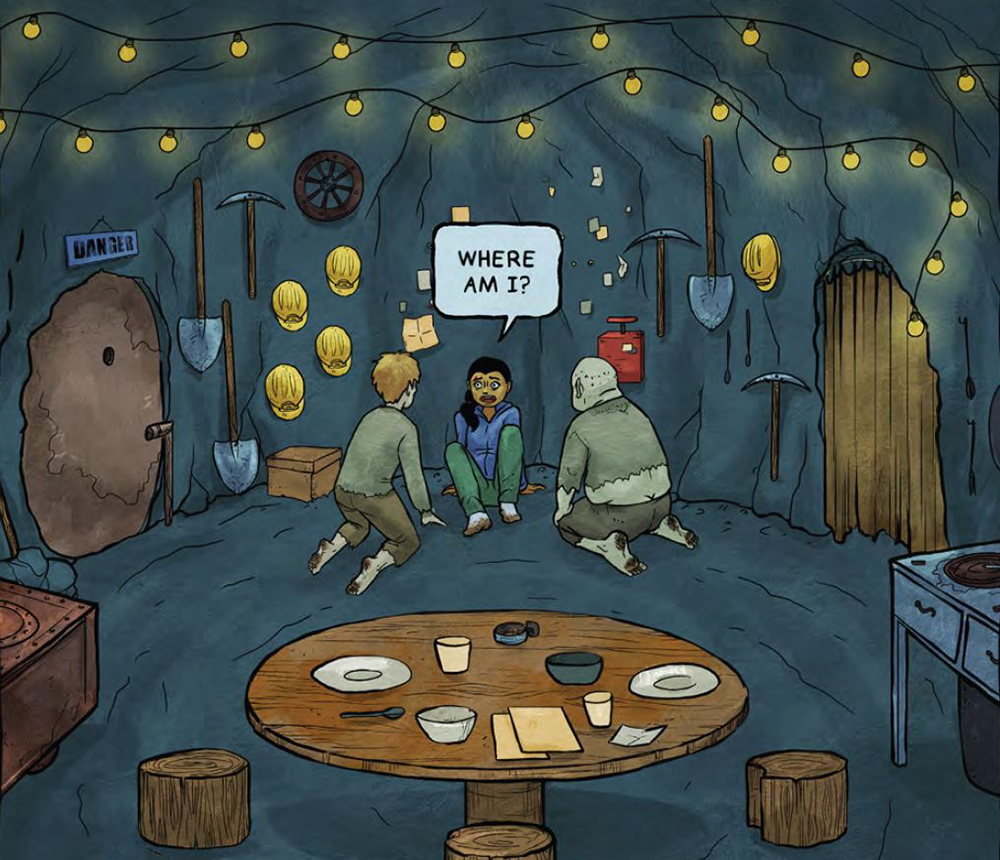
“The Softer Side of Dark Souls Fandom,” my essay about a major shift in internet culture, was published on Sidequest. Everybody loves Bloodborne and Elden Ring now; but, ten years ago, FromSoft fans were a fairly isolated group, not to mention some of the most hateful people I’d ever encountered online. At about 1,400 words, this piece is far shorter than it should be, but I still had a fun time writing about how FromSoft fandom has become much more welcoming and inclusive over the past decade. Here’s an excerpt:

I’ve put untold hundreds of hours into Dark Souls and its sequels. When the game first came out almost fifteen years ago, however, there was nothing I hated more than Dark Souls. I refused to play it. I associated the game with the worst people on the internet, who spewed hate while using Dark Souls memes to shame and attack anyone they felt challenged the hegemony of their male-dominated subculture of video game fandom.

I therefore feel an ironic pleasure in the fact that, these days, Dark Souls and the other FromSoft games have been embraced by women and the queer community, the exact people these angry online gaming communities loved to hate. In a strange twist of fate, the games weaponized to mock diversity have become a sanctuary for many of the people who were once excluded.

You can read the full essay here:
https://sidequest.zone/2025/07/14/dark-souls-fandom/

An earlier version of this essay was published in Act Your Age, Vol. 2: Dark, a fandom memoir anthology zine that you can check out (here).

I decided to publish this piece online when the host of one of my favorite video game podcasts, Bonfireside Chat, came out as transgender. Since she’s not really a public figure, I don’t mention her in the essay itself, but her announcement made me incredibly happy. Regardless of gender and sexuality, I hope everyone can find a place where they feel accepted and supported in their interests… even if their interest is in dark fantasy games about dying in all sorts of grisly and horrifying ways!

The Wisdom of the Waiting Princess

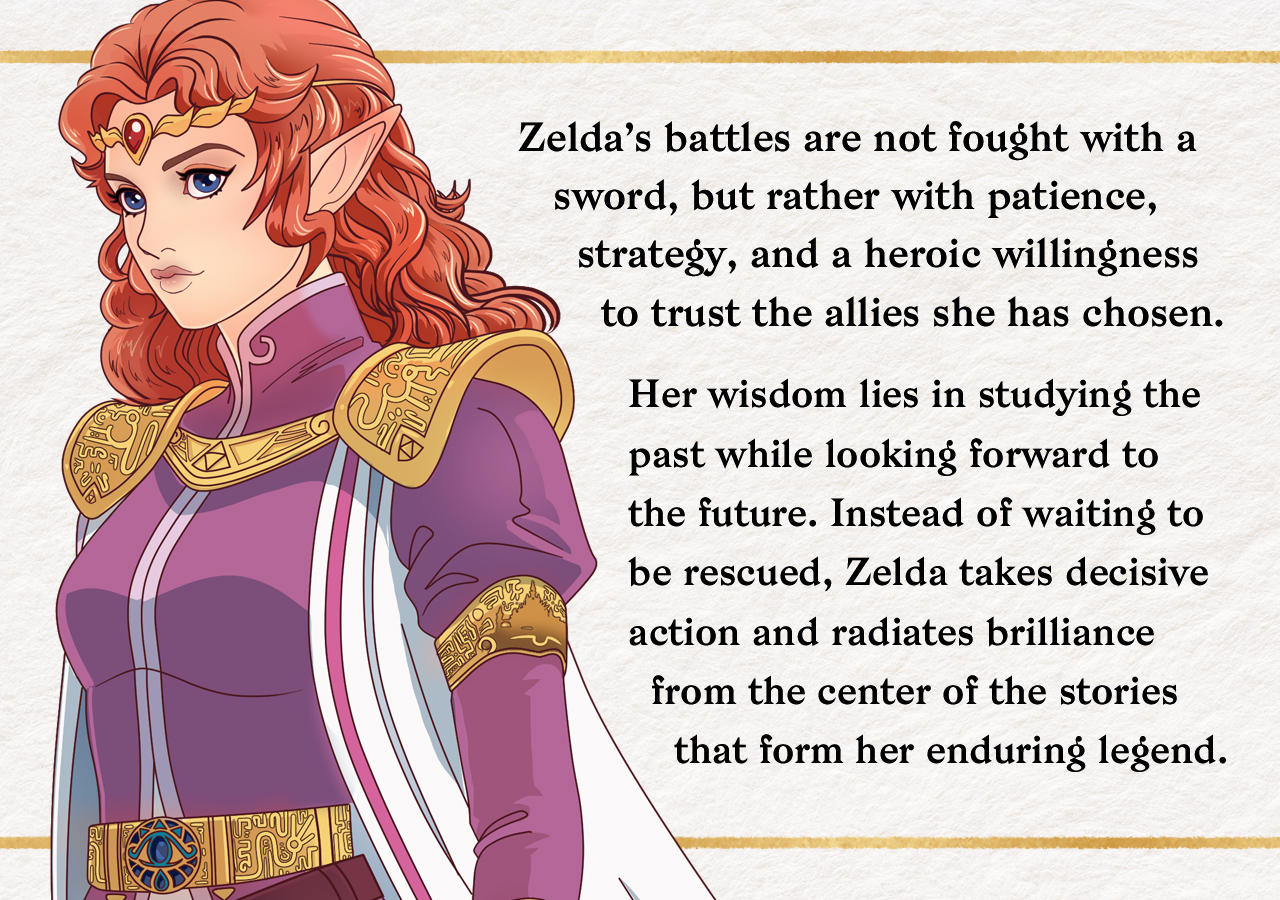
The Wisdom of the Waiting Princess is an empowering feminist reading of how the trope of the “captive princess” applies to the Zelda of the original 1986 game. While this Zelda is an action hero in her own right, her wisdom manifests in her remarkable ability to lay plans for the future.

You can read the essay on AO3 here:
https://archiveofourown.org/works/67410167

I had the honor of contributing this essay to Silent Princess: A Zelda Zine. The zine’s website is on Carrd (here), and you can check out the art and writing featured in the zine on its Tumblr site (here). Leftover sales of the zine merch are currently open (here), and you can still pick up a digital copy of the zine (here). All profits from zine sales will go to support Doctors Without Borders.

This original design for Princess Zelda was created by Hollarity, who put an incredible amount of love and care into portraying the character as a courageous young woman who is fully capable of going on her own adventures. You can find more of Holly’s gorgeous artwork on her website (here).

Essay about Elden Ring and Dark Academia

I’m excited to share an essay I wrote for Bloodletter Magazine, a stylish biannual anthology of queer and feminist horror. The piece is titled “Dark Academia for Dark Times: Elden Ring and the Fall of the Academy,” and I’m writing about how the haunted lore of the game’s cursed university reflects real-world academic anxieties. 

You can read the essay here:
https://bloodlettermag.com/dark-academia-for-dark-times-elden-ring-and-the-fall-of-the-academy/

While I use the character Rennala from Elden Ring as an illuminating point of focus, my piece is really about the uncanny connections between the crisis currently facing universities and the social media aesthetic of “dark academia” embraced by young women. I’m arguing that the association of dark academia with the corruption of female bodies reflects deeper concerns regarding the ties between academic liberalism and the decay of imperial privilege. 

Basically: Is the wokeness of postcolonial queer feminism ruining college? I would like to believe that it is, and I think this is kind of neat, actually.

My piece is graced with a creepy spot illustration by the magical Katy Horan, who goes by @goodyhoran on Instagram, and you can follow Bloodletter at @bloodlettermag, where they post eye-catching film stills from indie horror movies created by emerging female directors. 

Silent Princess Zine Preorders Open

I’m proud to have contributed a nonfiction meta essay to Silent Princess, a fanzine celebrating Princess Zelda.

My essay, “The Wisdom of the Waiting Princess,” offers an empowering feminist reading of how the trope of the “captive princess” applies to the Zelda of the original 1986 game. My goal is to demonstrate that, while this Zelda is an action hero in her own right, her wisdom lies in patience, strategy, and the careful coordination of allies.

Silent Princess contains a sparkling treasure trove of essays, stories, comics, and illustrations, and I can’t wait for everyone to see the amazing work the team has created.

Preorders for the fanzine are open until January 6 on Bigcartel here:
🌟 https://silentprincesszine.bigcartel.com/

The Smile of the Mountain Demon

Liam is a budding content creator who specializes in guided meditation videos. Seeking to grow his following, he jumps at an Airbnb listing for a spiritual retreat in the Adachigahara mountains of rural Japan. At the end of a long journey, the stylish cabin enclosed within a verdant forest is everything Liam could hope for. The beautiful young woman who manages the property offers a warm welcome, but there’s something strange about her smile…

I was extremely honored to contribute to this year’s 13 Days Advent horror anthology. My story, “The Smile of the Mountain Demon,” is about a 21st century yamauba who entraps a YouTube influencer with Buddhist pretensions by using Airbnb and the language of New Age spirituality. The young man is looking for a scenic “spiritual retreat” to use as a source of content, and the yamauba is looking for a tasty snack.

This story is based on the medieval Adachigahara folktales in which a cunning yamauba entraps a less-than-devout Buddhist priest, as well as Minako Ohba’s beautiful and heartbreaking short story “The Smile of a Mountain Witch.”

If you’re interested, I’ve posted my story on AO3 (here), and you can download a free digital copy of the anthology via its page on Itchio here:

🌟 https://13daysadvent.itch.io/13days-demons-divinity

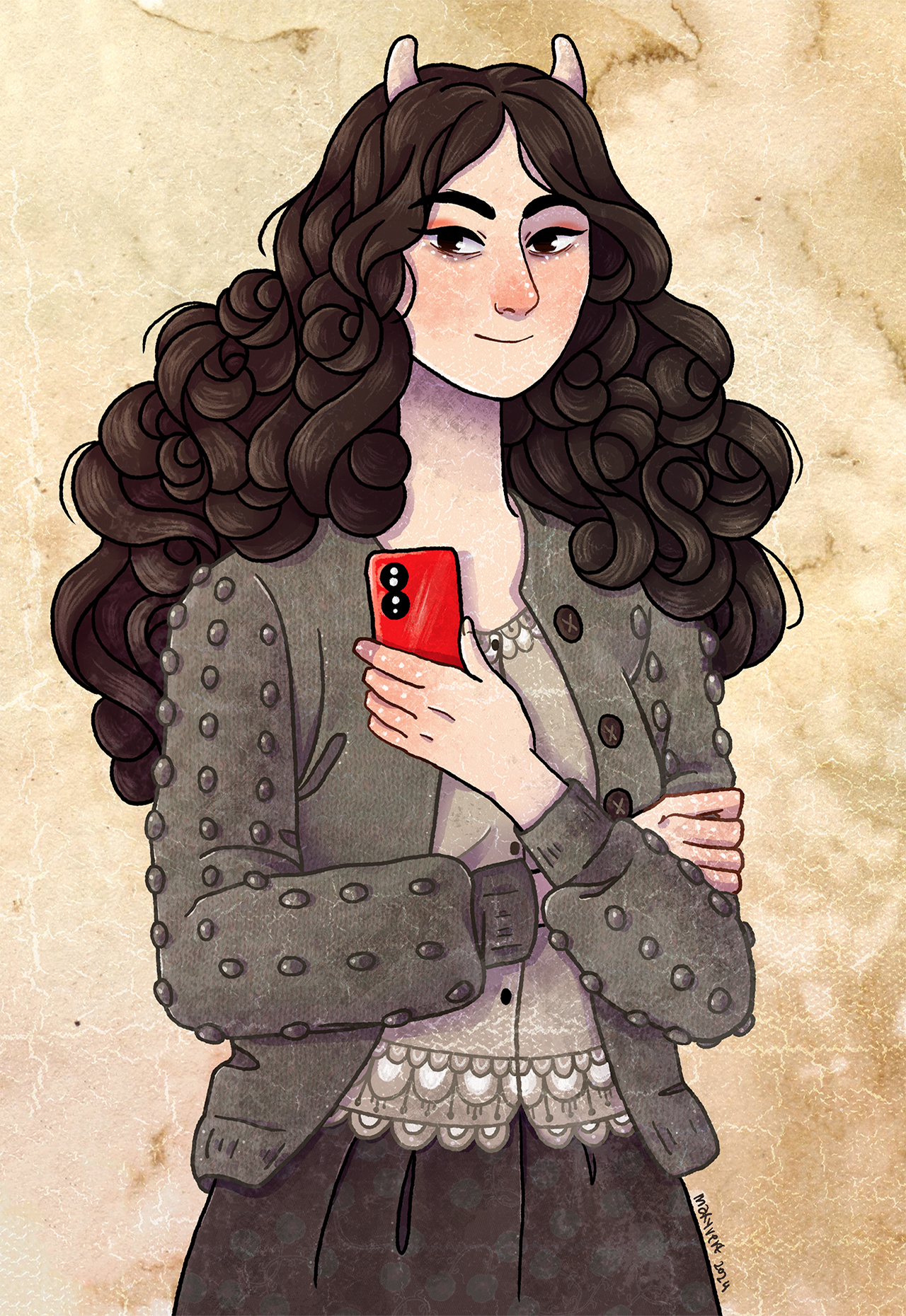
The illustration that accompanies my story was created by the brilliant dark fantasy artist Maxyvert, who posts strange and ethereal paintings on Tumblr (here), on Instagram (here), and on Twitter (here). This artist takes commissions for both digital and physical watercolor portraits (here), and it was an amazing experience to work with them.

The Memory of Stone

I wrote “The Memory of Stone” back in 2020, when the announcement of a sequel to Breath of the Wild encouraged many Legend of Zelda fans to speculate that the game would feature Princess Zelda as a playable character. I returned to this story after finishing my second playthrough of Tears of the Kingdom, which reduces Zelda to a voiceless source of crafting materials. It was a disappointment, to say the least.

One might argue that there are other games with female protagonists, so why insist on playing as Zelda? I would counter this argument with another question: why not play as Zelda? The concept of Zelda as a playable character makes perfect sense within the context of the games’ stories. Link’s journey almost always runs parallel to a journey that Zelda undertakes on her own, after all, and being able to explore Hyrule with a different set of skills (and from a different narrative perspective) would be a lot of fun.

“The Memory of Stone” follows Zelda through each of the temples in Ocarina of Time, and it’s a small attempt to imagine what the eponymous “legend of Zelda” might look like through the eyes of Zelda herself.

You can read the story on AO3 here:
https://archiveofourown.org/works/25230271

The illustration of Sheik included in the story preview graphic was drawn by the revolutionary Nolvini, a fan of shōjo anime who creates magical character illustrations filled with personality and flare. You can check out her work on Twitter (here), on Instagram (here), and on Tumblr (here), and she also has a shop on Etsy (here).

Watching from the Shadows

I contributed a story about Impa and Princess Zelda titled “Watching from the Shadows” to Goddess Reborn, a zine celebrating the female characters of the Legend of Zelda series. You can check out the zine’s Twitter account (here), and you can read my story on AO3 (here). Here’s a short description of the story…

Impa prepares to train Princess Zelda as a Sheikah warrior during the year following the fall of Hyrule Castle. Zelda is tired of hiding and eager to fight, so Impa shares stories from the past to demonstrate that there is wisdom in waiting for the right moment to strike.

This spot illustration was created by the magical and marvelously skilled Frankiesbugs, whose sharp and deadly work can be found on Tumblr, on Twitter, and on Instagram.

Goddess Reborn Zelda Fanzine

I’m excited to share a preview of the story I contributed to Goddess Reborn, a collection of art and fiction that celebrates the female characters of the Legend of Zelda series.

The zine is beautifully inclusive, and the amount of love that has gone into this project has been incredibly uplifting. I can’t wait for everyone to share their full pieces, but you can check out previews on Twitter (here) in the meantime. Preorders are open until May 31, and all proceeds go to international women’s charities.

goddessreborn.etsy.com